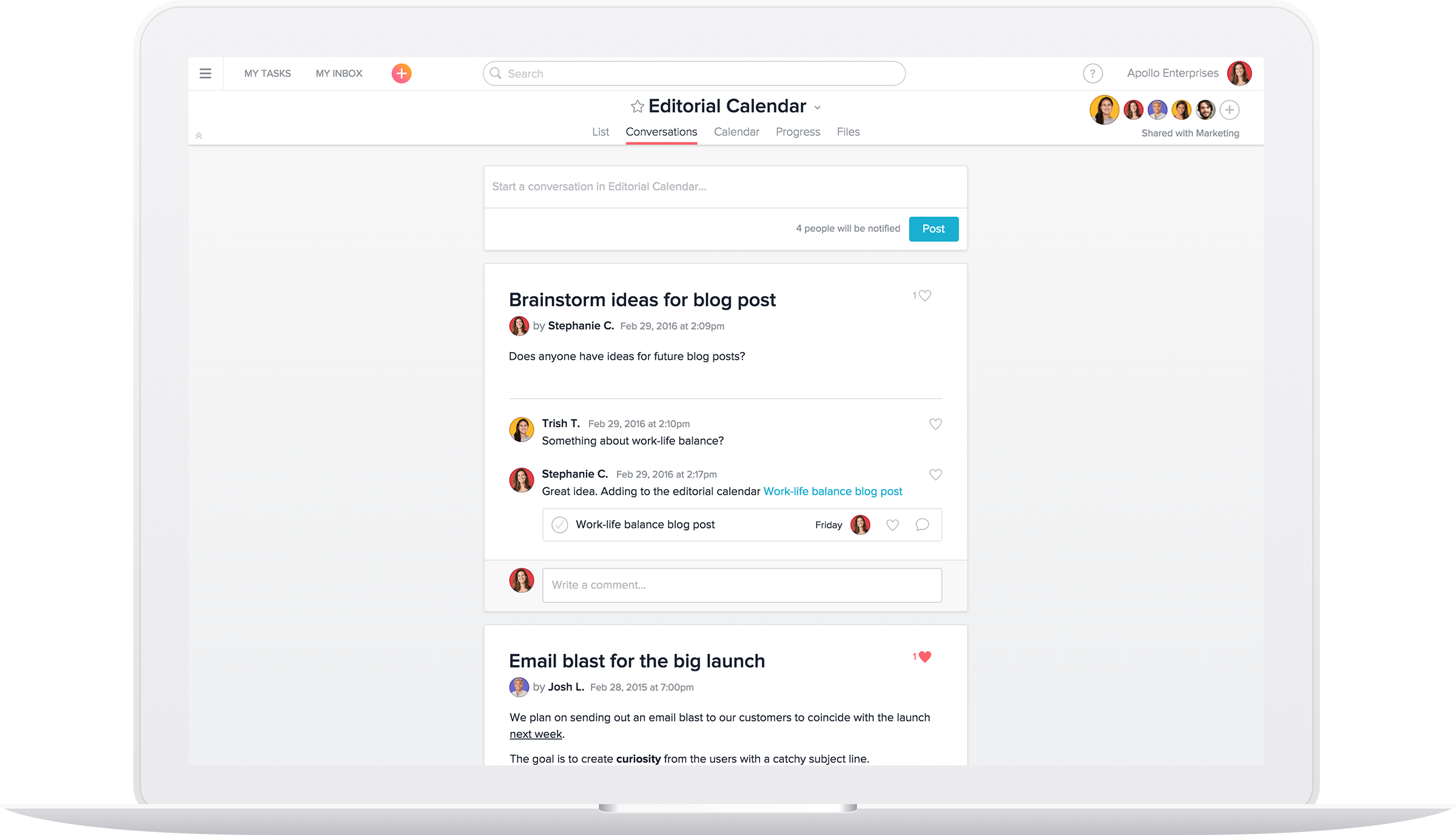
Asana is a web and mobile project management app. With tasks, projects, conversations, and dashboards, Asana lets an entire team know who's doing what by when, enabling workload balancing. Users can also add integrations for GANTT charts, time tracking and more.
$13.49
per month per user
Google Workspace
Score 9.0 out of 10
N/A
Google Workspace enables teams of all sizes to connect, create and collaborate. It includes productivity and collaboration tools for work: Gmail for custom business email, Drive for cloud storage, Docs for word processing, Meet for video and voice conferencing, Chat for team messaging, Slides for presentation building, and shared Calendars.
$6
per month per user
Microsoft Planner
Score 7.5 out of 10
N/A
Microsoft Planner is presented as a solution to organize teamwork with intuitive, collaborative, visual task management. With it, users can create Kanban boards using task cards with files, checklists, and labels. Users can collaborate in Planner and Microsoft Teams and check visual status charts—all in the Microsoft cloud.
Asana had more useful features, is a more mature product and a better interface than Microsoft Planner while Microsoft Project was harder for the average person to learn and hit the ground running due to it complexity making Asana that nice middle ground for most persons to …
Asana does well at the assignment of tasks and task management, but it is not a resource planning tool. Other tools do better at resource planning and some principles of agile/scrum. It is simple and easy to use within the mobile application and on desktop, but it doesn't have …
Asana is the best for task management, it’s easy to use and streamlined for team members to use with minimal intervention. It’s a lot nicer to use compared to similar products like Projectplace although there is some difference in features. It has much better features in terms …
I like Nifty as this has time sheets, however we preferred the clean interface of Asana. Nifty was a bit overwhelming when we tried it. Their app on Android wasn't anywhere near as mature as Asana's app.
Plutio is great and has many features, but we preferred the look of Asana.
Asana is the best of both worlds because it allows multiple views of your tasks and dashboards for project managers to review. Some of the competitors only allow one way of working, which can be a roadblock for users who are less flexible in their workflow. Getting all users to …
There are lots of competitors to various tools in Workspace, like Meet versus Zoom. However, Microsoft is the other big competitor I can think of for Google Workspace as a whole. To me, at least, the strength of Workspace is how easy it is to share and collaborate with others. …
G-suite has been the preferred solution, particularly compared to Microsoft, particularly because of cost, ease of administration and users general familiarity with Google applications since so many of our folks use the same apps and services personally as well as …
I actually never researched anything else - I loved Gmail for business and then started using G Suite when it changed. I love it, so I've never even looked into alternatives. The email is great, the documents you can create are great, and the way you can sync everything …
G Suite is a much more cost efficient way of managing email and documents for a small organization than any other tools we've worked with. A far more robust and diverse option than most and also one that has been financially feasible for us in our cash starved environment as …
While Asana and Trello are mature products, Planner is getting there pretty quickly. Since our organization is on the Microsoft ecosystem, it helps to use SSO for most of the apps that are within the same license. It helps save money and does the work. For proper project …
Compared to the other options, we already had access to Microsoft Planner, preconfigured accounts, and support and ordination from tech internally to use it. We previously used Wrike, I wanted to use Asana, and other people in the organisation either used Microsoft Project, or …
We tried to select software from various tools, and in the end we chose Planner both for economic reasons (it is included in the Microsoft 365 license we have in the company) and for its ease of use (we have no particular or specific needs, such as advanced scheduling or ticket …
Main reason is that it is cost efficient because we're already using Microsoft 365 and it's literally part of the ecosystem. No need to purchase any other software. Microsoft is also a well known company, credible for providing business solutions and has a strong enterprise …
Microsoft Planner isn't as detailed for project planning as some of these. However, it is more user friendly. Anyone can learn how to use it. If you want simple and affordable for a diverse group, it's the way to go.
Our organization chose MS Planner because it is an included tool in the MS Suite, and since we are unfortunately replacing our current and much better project management tool due to a consolidation of the tech stack. However, it doesn't appear that any of the teams using the …
In my experience, Microsoft Planner has much less features and less effective than other project management tools. But, it's free and included as part of Microsoft 365, so senior management may think it's saving them money. However, the poor productivity and the inefficient …
Microsoft Planner was included in our package of Microsoft email. Thus, we [don't] have to pay anything separately. This is was the main reason. However, the functionality we required was similar. [Microsoft] Planner also gives a schedule calendar where we can add tasks as per …
Features
Asana
Google Workspace
Microsoft Planner
Project Management
Comparison of Project Management features of Product A and Product B
Asana
8.3
179 Ratings
7% above category average
Google Workspace
-
Ratings
Microsoft Planner
-
Ratings
Task Management
9.2179 Ratings
00 Ratings
00 Ratings
Resource Management
8.0152 Ratings
00 Ratings
00 Ratings
Gantt Charts
9.061 Ratings
00 Ratings
00 Ratings
Scheduling
8.4162 Ratings
00 Ratings
00 Ratings
Workflow Automation
9.0132 Ratings
00 Ratings
00 Ratings
Team Collaboration
9.4178 Ratings
00 Ratings
00 Ratings
Support for Agile Methodology
8.57 Ratings
00 Ratings
00 Ratings
Support for Waterfall Methodology
8.57 Ratings
00 Ratings
00 Ratings
Document Management
8.3150 Ratings
00 Ratings
00 Ratings
Email integration
8.2142 Ratings
00 Ratings
00 Ratings
Mobile Access
8.7149 Ratings
00 Ratings
00 Ratings
Timesheet Tracking
6.16 Ratings
00 Ratings
00 Ratings
Change request and Case Management
8.44 Ratings
00 Ratings
00 Ratings
Budget and Expense Management
7.077 Ratings
00 Ratings
00 Ratings
Professional Services Automation
Comparison of Professional Services Automation features of Product A and Product B
The usability of Asana is broad since it's available in a variety of platforms that are widely used nowadays. I think that it would be great for people who are constantly on the move and switching devices, since it has allowed me to work from my phone, too. I also think that Asana has proven itself to handle a large quantity of work
Google Workspace does offer several different plans that can match well with the stage of your business. As your business grows, the higher plans can provide the better tooling or expanded features/products to scale with your needs. It would probably become very complicated to swap over to, if you are deeply embedded with another competitor. But, it could be a nice platform to consolidate several disconnected systems under one roof.
There are a few examples where MS Planner would be suitable for employees at a mature organization. In my opinion, if you have Outlook or Teams, you already have built-in calendars and to-do lists. If you need a project management tool, you have two options: either pay for MS Project or use an alternative tool like Monday, Asana, or Jira. Regardless, their free versions are much more sophisticated than Microsoft's (MS Planner). Any team wishing to put together a halfway-decent project management board will need to look elsewhere, as MS Planner is only suitable for a personal to-do list.
Through it, we were able to communicate and cooperate with the rest of the team to complete the work in the required manner and at the appropriate time.
Google Calendar...amazing. I don't need to ask team members when they're busy anymore and play this game of bouncing times back and forth. All I need to do is enter their email address and it shows my calendar and theirs side by side and then select the day and time I find that works best for the both of us.
I actually prefer Google Meet over Zoom. Zoom bogs down my computer and I find their UI overcomplicated for what it actually does. Google Meet is simple and does practically everything Zoom does without needing to pay any extra money.
Sheets integrates with our CRM (Copper) so it's perfect for us. Being able to export information out of our CRM into sheets and then create pivot tables from that data makes our lives a million times better.
Pricing is a little bit higher than other services
The cost of each email inbox costs the same whether you want just email or all of the features. For example, we wanted a support email address that we could setup our support desk with. The cost of that added account is the same as the account I use with all of the features.
They removed their free tier for small organizations like mine and restricted the free tier from adding new domain names. This was likely due to abuse, but everyone lost the privilege of the free service.
Would be nice to see a calendar view instead of a list view
Permissions aren't configurable, anyone can delete any task at any time and there is no recycle bin
Notifications aren't great, you have to be attached as an owner to a task to see comments and be notified of changes, and even then notifications aren't shown for a lot of things
There is no better solution for cloud storage and real time collaboration. The amount of features included in G Suite is unmatched and out of other things we’ve tried over the years, nothing comes close to being as great of a tool.
It is a very useful tool that brings teams in sync with one another. The integration with other Microsoft products makes it an obvious choice because you don't have to purchase a license for a completely different tool that doesn't have cross-functional capabilities with the software you already use on a daily basis.
It is very user-friendly. Takes a new employee an hour to start figuring out how the system works. That's an important factor. You don't want to encounter the issue where employees need a week to understand how the system works. For example, JIRA, I tried using it for a week and I still don't understand the complicated layout. Asana has a simple interface. Once you see it, you get it type of program.
Google Workspace is incredibly intuitive and user friendly. It's easy to adopt through simple features, for example the prompts to enable Gemini on each call for note taking is reliable, and helps to stop you forgetting to use the feature. The main reason for a strong rating is the consistency and reliability, whilst there's definitely areas for improvement, for example additional calendar features (sharing), or deeper functionality in sheets. The level that it provides means that anyone adopting it will be able to take full use of features within a day or two. Gmail, calendar and the documentation suite contain all the basic features for a small / medium business to run at a high level day to day, with minimal downtime or learning curves.
The board-and-bucket layout makes it easy to organize tasks, track progress, and prioritize work at a glance, even for first-time users. I also appreciate how Planner seamlessly integrates with tools like Teams, Outlook, and SharePoint, enabling users to collaborate, schedule tasks, and access their plans without needing to switch platforms. I also like how it’s accessible not only on desktops, but also on mobile devices.
I haven't had to use their support so I can't rate it. The fact that I haven't needed them reflects the ease of use of the product. I would recommend that any new users schedule a complete demo of the product to ensure that they are using it to it's fullest (there's a lot of useful features).
My experiences of getting support have been positive. Calling in is not overly difficult, but it does require getting a PIN. The knowledge of those responding to the calls has been impressive. I have managed to work with them to fix two Google bugs that I had identified. These bugs required a some technical expertise and the support staff were able to understand the issue and forward the concerns to the appropriate persons. The first bug was fixed with 24 hours. The second bug took a little longer, but it was also more complicated to reproduce.
Asana is a top-tier project management software that helps us organize and track projects from start to finish. It allows us to apply tasks/to-dos to multiple projects without duplication, divide complex projects into smaller tasks, and track project progress. It also helps us organize work on Kanban boards or linear lists. It stands out from the crowd in a big way compared to the competition.
There are lots of competitors to various tools in Workspace, like Meet versus Zoom. However, Microsoft is the other big competitor I can think of for Google Workspace as a whole. To me, at least, the strength of Workspace is how easy it is to share and collaborate with others. For items that I only need for myself and can keep on my own computer, I typically rely on Microsoft Word, Excel, etc. For items that I need to share, I turn to Workspace a lot. Being able to collaborate in real-time and not having to send documents back and forth is so amazing, and such a time saver. And I love that Workspace is also a built-in tool with Dropbox now.
Many areas of the company still use Trello to organize their activities and tasks, but gradually Microsoft Planner must replace the activities. Users are often "attached" to familiar technologies, but Office 365 takes advantage of the more organized use of the tools. This year we will not renew the Trello contract.
In my experience, productivity is negatively impacted because assigning subtasks aren't clear on Microsoft Planner
Managers aren't able to track direct reports' tasks across multiple boards -- leading to poor visibility for us
Notifications aren't always sent to inbox, so you rely on people's own project management skills to follow the communication on tasks they're assigned to. In my experience, this leads to missed deadlines impacting customer relationships.