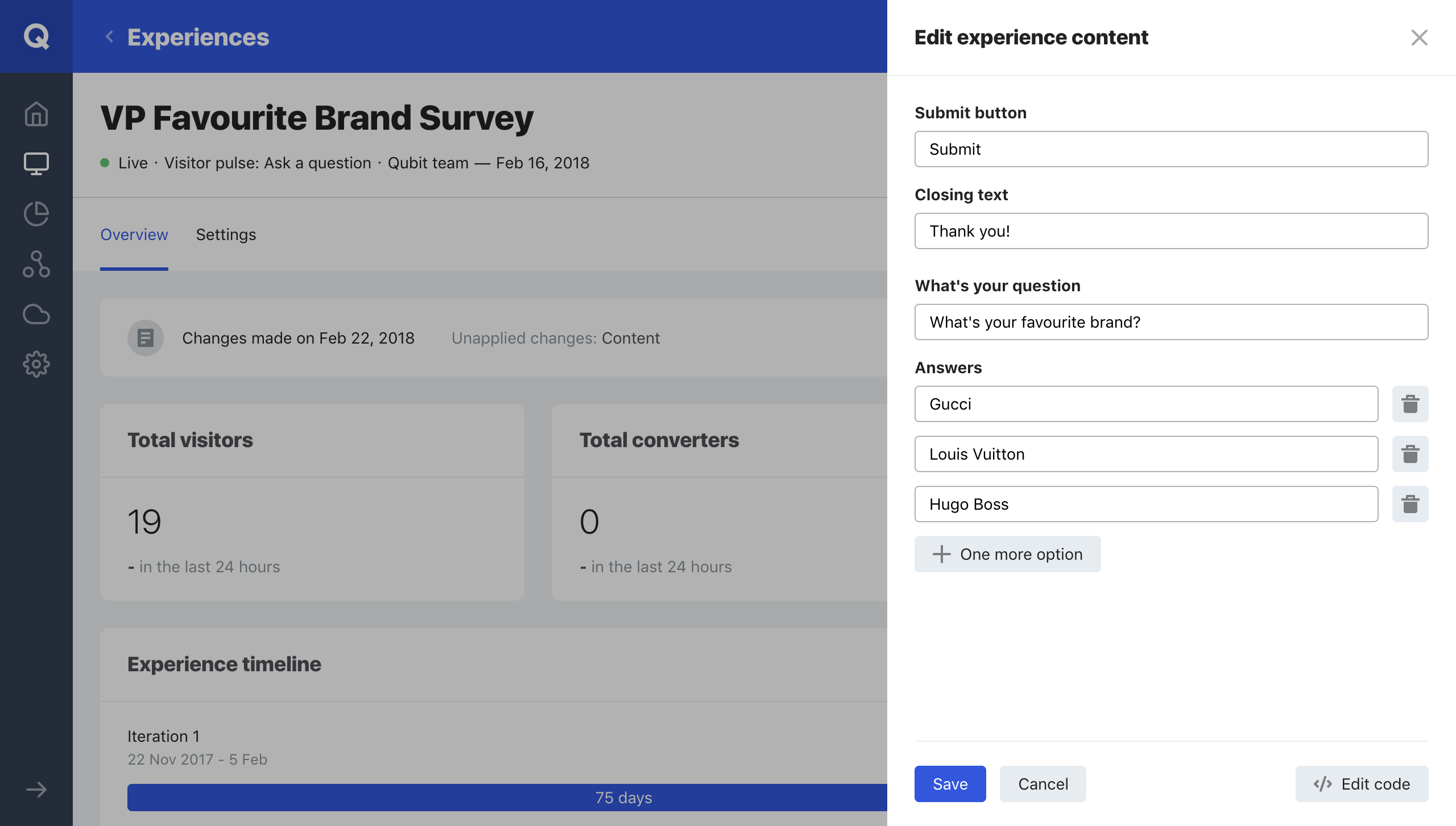
Qubit, now from Coveo (acquired October 2021) uses visitor history data to understand different user segments and serve personalized messages to segments using JavaScript. It is available as either a managed or self-service model. Data is collected using Qubit's own Universal Variable data model, or by integrating the user's existing model via our API. It combines quantitative data with qualitative visitor feedback to give Qubit users the ability to detect areas for optimization.
Using…
N/A
Dynamic Yield
Score8.9 out of 10
N/A
Dynamic Yield is presented as an AI-powered Experience Optimization platform that delivers individualized experiences at every customer touchpoint: web, apps, email, kiosks, IoT, and call centers. The platform’s data management capabilities provide for a unified view of the customer, to allow the rapid and scalable creation of highly targeted digital interactions. Marketers, product managers, and engineers use Dynamic Yield for: Launching new personalization…
N/A
Pricing
Coveo Qubit
Dynamic Yield
Editions & Modules
No answers on this topic
No answers on this topic
Offerings
Pricing Offerings
Coveo Qubit
Dynamic Yield
Free Trial
No
Yes
Free/Freemium Version
No
No
Premium Consulting/Integration Services
No
Yes
Entry-level Setup Fee
No setup fee
No setup fee
Additional Details
—
—
More Pricing Information
Community Pulse
Coveo Qubit
Dynamic Yield
Considered Both Products
Coveo
Verified User
Chose Coveo Qubit
We've chosen Qubit because of the data driven approach, ease of use and the offered support. We like the ability to build some tests externally with the Qubit help.
A de minimis incentive was given to thank the reviewer for their time. The incentive was not used to bias or drive a particular response, nor was the incentive contingent on a positive endorsement. More Info
Senior Data, Analytics & Optimization Manager in Marketing at LVMH (Luxury Goods & Jewelry, 5001-10,000 employees)
Chose Dynamic Yield
DY can be linked to the product feed allowing use cases that are not possible on a simple testing solution. Also, DY is simple to use for the marketing team, there is no need for technical knowledge to set most of the experiences. To conclude, DY can be used as a CDP with a …
A de minimis incentive was given to thank the reviewer for their time. The incentive was not used to bias or drive a particular response, nor was the incentive contingent on a positive endorsement. More Info
We moved from Qubit to Dynamic Yield for a number of reasons. Qubit was very clunky, had limited out-the-box capabilities and thus required a wait for coders to build tests or make small site changes. The features they intended to be quick and easy to use were invariably not, …
A de minimis incentive was given to thank the reviewer for their time. The incentive was not used to bias or drive a particular response, nor was the incentive contingent on a positive endorsement. More Info
A de minimis incentive was given to thank the reviewer for their time. The incentive was not used to bias or drive a particular response, nor was the incentive contingent on a positive endorsement. More Info
A de minimis incentive was given to thank the reviewer for their time. The incentive was not used to bias or drive a particular response, nor was the incentive contingent on a positive endorsement. More Info
Senior Digital Change Manager at Boux Avenue (Retail, 201-500 employees)
Chose Dynamic Yield
We previously employed Qubit as our personalisation partner - Dynamic Yield have out performed in all areas, but especially; ease of use, simplicity of implementation, account and customer support responsiveness, and price. I have also used Maxymiser, Optimizely and Monetate in …
A de minimis incentive was given to thank the reviewer for their time. The incentive was not used to bias or drive a particular response, nor was the incentive contingent on a positive endorsement. More Info
Digital Consultant in Marketing (Retail, 51-200 employees)
Chose Dynamic Yield
This alternative is cheaper and does its job. They appear to be new and hungry for business and therefore we were able to get more attentions from them. The reporting function is easier to understand than the above providers and we don't have to spend time trying to calculate …
A de minimis incentive was given to thank the reviewer for their time. The incentive was not used to bias or drive a particular response, nor was the incentive contingent on a positive endorsement. More Info
Manager in Marketing at FineRugCollection.com (Internet, 11-50 employees)
Chose Dynamic Yield
Dynamic Yield is far more advanced than anything else we have evaluated. We can personalize our site, run tests and send targeted messages from one platform. I am unaware of another tool in the marketplace offering that capability.
A de minimis incentive was given to thank the reviewer for their time. The incentive was not used to bias or drive a particular response, nor was the incentive contingent on a positive endorsement. More Info
Coveo Qubit is a very helpful platform mainly for organizations that need to provide a solid business model before carrying out any implementation or new functionality. In addition, it is a very good tool to generate changes and show different content to different types of clients, with their personalization and segmentation criteria.It is ideal for simultaneous testing and customization, only one of these activities individually is not recommended.
A de minimis incentive was given to thank the reviewer for their time. The incentive was not used to bias or drive a particular response, nor was the incentive contingent on a positive endorsement. More Info
For us, it is well suited for personalization. Since we are hospitality brand, we have different rooms sales inclusion based on different segmentation like Mem or Non-mem, Global or UAE, we have to personalize our landing pages accordingly so that we show the relevant information to relevant audience. The inactivity pop up box and newsletter signup popups work good for us. It does not work well in some scenario like Dynamic Yield offers built-in analytics focused on campaign and test performance, but it’s not a replacement for tools like GA4, Adobe Analytics. It lacks deep funnel tracking or complex reporting capabilities.
A de minimis incentive was given to thank the reviewer for their time. The incentive was not used to bias or drive a particular response, nor was the incentive contingent on a positive endorsement. More Info
Qubit platform uses solid testing algorithms and delivers reliable reporting and analytics of testing campaigns. The dashboard section is easy to use and provides a good high level overview of the core campaign metric performances.
On-boarding and implementation of Qubit technology was painless and well handed throughout the entire process even with more complicated platforms.
Turn-around time for development and testing of campaigns is extremely fast. This enables the business to have a much higher throughput of tests and allows for quick validation of ideas rather than having to wait for months before a test is ready to go live on production site.
A de minimis incentive was given to thank the reviewer for their time. The incentive was not used to bias or drive a particular response, nor was the incentive contingent on a positive endorsement. More Info
Provide fantastic support, both in relation to strategy/best practice and troubleshooting.
An easy to use interface, as a user who is relatively new to Dynamic Yield I find that it is an intuitive platform to use.
The ability to segment and drill down on data allows for really specific insights which, whilst not necessarily being leveraged on a testing basis, can be super valuable from a greater marketing perspective.
A de minimis incentive was given to thank the reviewer for their time. The incentive was not used to bias or drive a particular response, nor was the incentive contingent on a positive endorsement. More Info
While they do work very closely with us, especially our success manager, more involvement on a technical level or a dedicated engineer, would be a great advantage. We develop a lot of experiences in house and, like all companies that dev in house, we have our own way of working. A dedicated engineer that got to know us better as well and understood how we work could only help. Sometimes, a few errors can get through QA due to this.
A de minimis incentive was given to thank the reviewer for their time. The incentive was not used to bias or drive a particular response, nor was the incentive contingent on a positive endorsement. More Info
Brand templates could need complex CSS/custom code.
We'd like to see a little "i" next to specific labels, which elaborates on what is meant. For example, when I hover over "Dynamic allocation," I get something like "An advanced form of A/B testing where the best-performing variations receive higher traffic."
Jargon (for example, for audience targeting) can be overwhelming for new users; therefore, clearer, user-friendly explanations are needed.
A de minimis incentive was given to thank the reviewer for their time. The incentive was not used to bias or drive a particular response, nor was the incentive contingent on a positive endorsement. More Info
Qubit is currently providing resources and support we do not have internally. Our relationship managers are exceptional and I feel well informed and well supported by their team. The tool is nice, but our contacts from the company are the real reason to maintain our relationship. They work hard for clarity and continue to help us push for additional opportunities.
A de minimis incentive was given to thank the reviewer for their time. The incentive was not used to bias or drive a particular response, nor was the incentive contingent on a positive endorsement. More Info
implementation took a long time but also, DY has really proven that they are transforming and adapting their platform to be more user friendly and the right technology choice for their brand or company
A de minimis incentive was given to thank the reviewer for their time. The incentive was not used to bias or drive a particular response, nor was the incentive contingent on a positive endorsement. More Info
Very simple user interface, built on top of advanced functionality, makes the platform easy to use. The team at Qubit are also very open to feedback and introduce new and useful features fairly often. On the reporting side, the inbuilt dashboard reports are good for a top-level view of test results, and Qubit have made a lot of their output data available should you wish to run your own analysis
A de minimis incentive was given to thank the reviewer for their time. The incentive was not used to bias or drive a particular response, nor was the incentive contingent on a positive endorsement. More Info
Setting up strategies, audiences, and experiences is simple and fast. It is incredibly easy to modify the appearance of your site and optimize every aspect with the Dynamic Yield Personalizations. However, while the data visualization on an experience level is easy to modify and analyze, exporting the data in meaningful ways is time consuming.
A de minimis incentive was given to thank the reviewer for their time. The incentive was not used to bias or drive a particular response, nor was the incentive contingent on a positive endorsement. More Info
I would say that the Qubit account managers are always available for any request. We have a lot of different promotions that could always do with last minute optimizing or changes and Qubit can be relied on to get this changes up and running in an impressive amount of time, so that we don't need to patch live or wait for the next IT sprint. Invaluable to our business.
Technology is good for A/B testing and personalisation - allowing any team with a dedicated developer to create test relatively easily and to report/analyse them in a fair amount of details. Some advanced features, especially on the set up of test cells, are dearly missing. Unfortunately, new features are often not free of bugs... Also, support is sub-par, which means new features are realised without proper documentation, example or training (but of our Qubit counterparts and internally).
A de minimis incentive was given to thank the reviewer for their time. The incentive was not used to bias or drive a particular response, nor was the incentive contingent on a positive endorsement. More Info
Qubit are supportive and flexible in providing support. They are happy working out of usual hours, even on weekends and if I have any doubts about the set up of an experience they’re quick to respond and willing to check my work. On particularly big revenue days they monitor our account and they’re quick to identify and problem solve any issues.
A de minimis incentive was given to thank the reviewer for their time. The incentive was not used to bias or drive a particular response, nor was the incentive contingent on a positive endorsement. More Info
Overall, the support is very good. If you are a partner (my case), they assign you a customer success manager, that helps a lot. Also, there is a technical person to provide support to the partners, again a great help.
My only "complain" is that with some complex issues, the support may delay in providing you with a solution. Sometimes that can cause some tension with your client.
A de minimis incentive was given to thank the reviewer for their time. The incentive was not used to bias or drive a particular response, nor was the incentive contingent on a positive endorsement. More Info
The training was great, but would be great to have a script or PDF with some explanations of the qubit JS layer. Without the script you can just try to learn on your own, so the training is not as powerfull as it could be. On the other hand - would be great to have training related to reading statistics or personalisation.
A de minimis incentive was given to thank the reviewer for their time. The incentive was not used to bias or drive a particular response, nor was the incentive contingent on a positive endorsement. More Info
Implementation couldn't be easier. All we needed to do was insert the tag. (easy) and set up the data layer. (dev required) This was pretty smooth in comparison to some of the other tools we use on our site, and was done in less than a day. Note : Data needs to be collected for a set period of time before you can accurately rely on the data that you are receiving. This is normal though with everyone else that we have used
A de minimis incentive was given to thank the reviewer for their time. The incentive was not used to bias or drive a particular response, nor was the incentive contingent on a positive endorsement. More Info
At the time of taking the product, we found no comparable alternatives. Since then, the product has only grown from strength to strength, so it still does not have any comparable competitors that offer both the technical product and business knowledge that Qubit can. Google appear to offering a competing product which may be one to watch in future, and something for Qubit to keep an eye on
A de minimis incentive was given to thank the reviewer for their time. The incentive was not used to bias or drive a particular response, nor was the incentive contingent on a positive endorsement. More Info
Dynamic Yield provides far more capability and ready-to-go templates for small-medium sized businesses, as well as decent API implementation for businesses who want to have a deeper integration. The ease of implementation and faster time-to-market is why we chose Dynamic Yield.
Our requirements change throughout the year like most E Commerce retailers. At Christmas and Peak we're dealing with around ten times the usual traffic on the site. Qubit had no problems with this at all, tests continued to fire, and stats were still reported accurately. I don't think that it is the most server intensive .js anyway, but we have seen no issues at all.
A de minimis incentive was given to thank the reviewer for their time. The incentive was not used to bias or drive a particular response, nor was the incentive contingent on a positive endorsement. More Info
Most tests have had a positive impact on either revenue or conversion rate - quite often in double digits.
Dynamic Yield has also helped us to stop some particular initiatives through direct interaction with the customer base via questionnaires or by a test proving negative quicker than rolling out a permanent feature.
A de minimis incentive was given to thank the reviewer for their time. The incentive was not used to bias or drive a particular response, nor was the incentive contingent on a positive endorsement. More Info