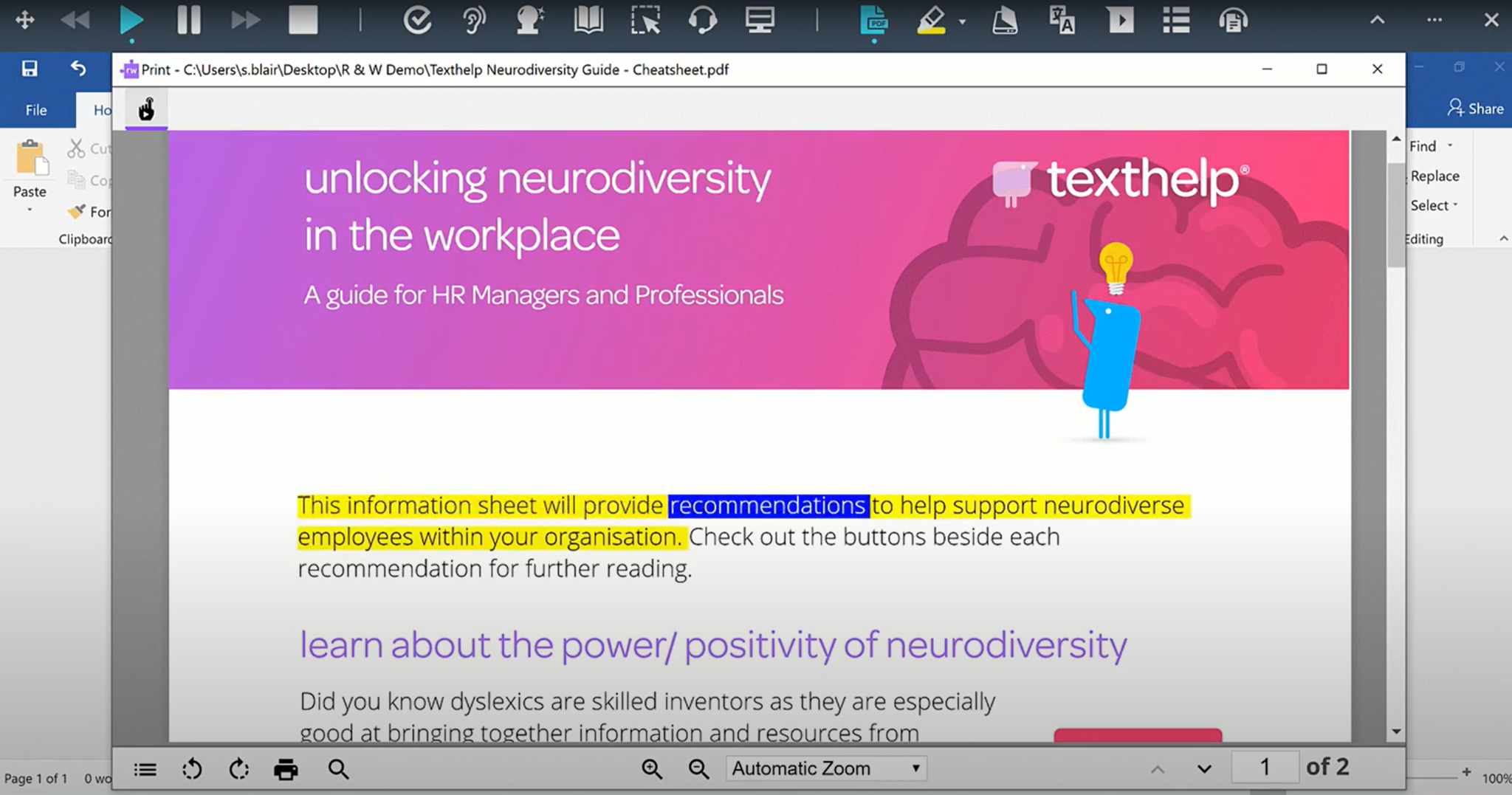
Read&Write is a literacy support tool that helps individuals of all abilities read, write, and express themselves with confidence. For education and the workplace, its assistive features include text-to-speech, word prediction, and research tools for users with diverse learning needs.
N/A
LibreOffice
Score 9.0 out of 10
N/A
LibreOffice is a free and open-source Office Suite from The Document Foundation, presented as the successor to OpenOffice.org. The suite includes Writer (word processing), Calc (spreadsheets), Impress (presentations), Draw (vector graphics and flowcharts), Base (databases), and Math (formula editing).
$0
free and open source under the Mozilla Public License v2.0
Microsoft 365
Score 8.6 out of 10
N/A
Microsoft 365 (formerly Office 365) is a Microsoft Cloud subscription service that includes Microsoft Office products (Word, Excel, PowerPoint, OneNote, Outlook, Publisher, and Access). The software can be installed across multiple devices and ensures that users always have the most up-to-date version of the included Office applications.
While the Microsoft 365 features are convenient, Read&Write has the advantage that it can be used consistently in both Office products and the Chrome web browser, which helps students as they don't have to learn different systems. Crucially, Read&Write can be used in exam …
Early on our district was using Kurweil 3000 but that was restrictive to the computer that it was placed on. We also used co-writer (Don Johnson) for writing supports. By having both features available in one convenient toolbar along with other amazing features that follow the …
We still utilize Microsoft Immersive Reader as our Tier2 / UDL support tool. However, the word prediction is barely functional and there are confusing limitations to when certain tools are available (the picture dictionary is available in Word Online but not in Edge).
Owner IT Managed Services Provider and Lead Consultant
Chose LibreOffice
Except for collaboration, which I seldom need, I find that LibreOffice beats all of the other similar products I have used in features, functionality, and intuitiveness. The user interface on the LibreOffice applications seems cleaner, and the right-click menus are more …
Hated Microsoft and went right back to LibreOffice. The cost, the annoying way it's always nudging you to use their browser and other apps, and the evil genius of Microsoft is something we want no part of.
LibreOffice is an easy choice if you don't have access to a free copy of Microsoft 365. LibreOffice is also much easier to use on Linux. But it does fall short in terms of collaboration with Microsoft users and consistency with advanced features such as custom Styles and …
Google does not offer equivalent desktop applications. Microsoft's nonprofit licensing is too complicated and their support is not really supportive of such a small organization as ours.
I selected LibreOffice due to cost. While we need an office software suite, we don't need the sophistication of MS Office. We used the basics of MS Office. We couldn't justify the expense when we only use a faction of the functionality.
In my view, Microsoft office products are very much user-friendly and well documented. However, these products are very expensive where the LibreOffice is free of cost. Also if you have a Linux platform, the best office product will be the LibreOffice. Although LibreOffice is …
If you are looking for a well-rounded, GNU-licensed product that will encompass word processing, spreadsheets, presentations, and database then LibreOffice is probably all you need.
For online collaboration, links with cloud storage, and more …
As noted previously, LibreOffice blows Google Docs (G Suite) out of the water in terms of singular application quality, and comes close but misses the mark as a drop-in replacement to Microsoft Office. We currently are evaluating the latest release of LibreOffice to see if we …
I have chosen LibreOffice for the possibilities it offers and because it allows me to save money on the licenses of other programs. Being a free program, I do not have to think about renewing licenses every year. It is a software that offers the same characteristics as other …
Mainly CSV and other formats compatibility, when compared to MS alternative, it's faster than cloud-based solutions (Google Docs, Zoho), I don't have to wait for MS Office to look at what I have in the cloud before saving something, its interface is better than MS Office, for …
I have followed and used many various office suites in the open office range of open source offerings. I still occasionally download and try one of the others just to take a look. But, I always end up making LibreOffice my choice to go with.
The most ubiquitous office suite now is of course, Microsoft Office. Microsoft Office offers very good tools, but is very Microsoft/Windows "centric" - understandably they want to tie users to the Microsoft/Windows universe. I'm a big proponent of open source operating systems …
The online docs - people often found [them] confusing and limited in what they do. LO was preferred to those though they lack the real-time collaboration features in the other documents. Users preferred Office 2016 though support was going to go away for it so we investigated …
MS Office is a very good office suite but in the early days of the company spending hundreds of EUR on licenses was not the priority and the added value of MS Office at that time could not compensate the costs. Google documents are used in a limited way for a few …
Microsoft Products: LibreOffice is an affordable programme that is on par with Microsoft products. Unlike Microsoft, which tends to reinvent itself every couple of years and sacrifices functionality for aesthetics, LibreOffice is tried and true, sticking to the functionality …
I've (minimally) looked at LibreOffice however the integration between Outlook and Exchange makes Office the simple choice when it comes to collaboration. There is simply no other product that has the functionality of collaboration.
In our company we have both Office 365 and regular Office 2016. We are transitioning more to 365 for the ease of managing the licensing. We don't have to keep license cards or numbers stored anywhere because 365 uses your microsoft login which you are using anyway. Compared to …
LibreOffice is great for single-users or freelancers, but for organizations Microsoft 365 provide all the components that may be required in a single and unified product.
Microsoft is leaps and bounds ahead of these product suites and is an ecosystem unto itself, except for Google Workspace, which offers more features in its online versions than Office Online.
In my opinion Microsoft 365 is the most complete out of the bunch because of the cloud and desktop apps, the easy expandability it brings in combination with Azure and Entra/Intune. I must say that Google Workspace is a close contender but the desktop apps are less complete in …
Microsoft 365 is in almost all cases the best option for office solutions in a professional environment. If there is a budget for software like this, I would generally recommend Microsoft Office. However, where your requirements for features are basic, you might enjoy free …
Microsoft 365 is the de facto office suite for professionals. It's main competitor is Google's Gsuite. In comparison, M365 offers a more robust offline solution with its iconic suite of office programs with superior integration with the Windows OS. When I first started using …
Compared to its competitors, Microsoft 365 (formerly Office 365) has more functionalities, is more integrated between applications and enables a better data document management. Its predefined templates and database connection set-ups offer better user experience. There is more …
It's all about the network effect. Since everyone else at my school using Microsoft 365, eventually I had to bite the bullet and join the crowd. Using the officially supported file syncing and sharing solution solves a large number of problems right out of the box. Other …
Notepad++ is a great, lightweight editor that doesn't have a same advanced features as Word, but has a very nice feel and can be better for simple text editing. Libre Office has roughly the same features as Microsoft 365, but the usability and intuitiveness is lacking. …
Stability, high security, unique capabilities, speed of execution, cloud storage space, and compatibility and integration with other software has made this Microsoft product one of the best in the competitive market.
Verified User
Engineer
Chose Microsoft 365
MS Office 365 is more powerful than others. They provide us more advanced features. One thing is compatibility when we work with our customers and suppliers. We can exchange data in a very common format. Another thing is MS Office 365 is being updated frequently with more …
Microsoft Office 365 definitely blows the competition out of the water in regards to performance, security, updates, community support, and available features. I think that Microsoft Office 365’s only weakness would be its price point, as some of the competing products are …
The main point was the integration of the tools: backup + email + text editors, all in one tool; Employees had greater difficulty creating presentations on their competitors' tools, as well as more advanced use of data sheets.
Microsoft Office has a monopoly on the formats for documents, slides and spreadsheets. No wonder since Microsoft Office has a long history and has always had the best performance. The great capacity that this product has has been demonstrated and improved over the years, …
Coordinador Maestría Historia Regional de Venezuela
Chose Microsoft 365
Being one of the first has always had the ability to offer a universal format in addition to being the most demanded office package and the best paid, which together with its options make it indispensable.
Microsoft Office 365 simply drives through the cloud platform allowing to set a huge variety of options that can be set from custom to standard software in a single package or just to set an specific range of options enabled to the end users, and given the chance to the company …
Features
Read&Write
LibreOffice
Microsoft 365
Writing and Proofreading
Comparison of Writing and Proofreading features of Product A and Product B
Read&Write is especially well-suited to supporting students with reading accommodations during independent work, content-area instruction, and written-response tasks. In my 5th-grade classroom, one of the most effective scenarios is during science and social studies lessons, where students are expected to read complex informational texts independently. There can also be occasional challenges when websites, PDFs, or testing platforms are not fully compatible with all Read&Write features.
If you're working with numbers, LibreOffice doesn't get in your way and try to make changes as it sees fit, forcing you to repeatedly go back and undo processes you didn't want, didn't ask for, and that have no place in the document you are trying to produce. All I want to do is assemble the data, process it for the task at hand, and then print it for distribution. LibreOffice allows me to do that.
Microsoft 365 would be well suited for medium to large enterprises. This is where there are several hundreds or thousands of people. Since most everyone has used one of the applications the learning curve would be reduced. Another reason would be the ability to implement security measures to prevent access to sensitive data. This could justify the cost of an Enterprise license.
I would like to use the practice reading aloud tool more, but the kids that I work with have a hard time understanding the concept. I think that, while there are a lot of tools available, sometimes they are hard for younger students to understand.
The hover to read function is nice as well, but my students struggle with the fact that if you move the mouse once it starts reading it will start all over in a new area. It's not as smooth as I would like it to be.
Slack is 1000x better than teams. Why put a 250 limit on a chat? Our company hasn't moved fully to channels and it's making us lose transparency. Plus, the teams channels we do have nobody is going to. 90% loss in visibility and engagement.
Teams for web meetings. I think the UI/UX should match Zoom which is the standard for all our customers. They don't like it when we use Teams.
Chats and Channels need to somehow be on one screen automatically without having to choose that view because majority of our company hasn't opened Teams Channels and only stays in chats.
I'm just really impressed with the software and the access it gives to learners who are used to coming up against barriers in education. It's a quick-fix for a learner - something they can access usefully and productively with very little training. I also love that learners can access Read&Write on their devices at home - that really is a game changer.
We use it consistently and have a lot of documents in the OpenDocument format so it will be necessary to use LibreOffice or a compatible product such as Openoffice in the future to be able to open these files. Because the license fee for Libreoffice is zero it is not very costly to keep using it - the costs are mostly for keeping it installed on the office PCs and regularly updated, and solving employee issues with the user support.
I am giving this an 9. Not a perfect score because working on PDFs is better but not yet as easy as I need for it to be. Working with many students who have executive function challenges, I need a smooth simplistic access method. We are not quite there yet for writing on PDFs. Overall the toolbar on Read&Write is super easy to access and I love that the suite includes several tools on the toolbar providing a solution to many accessibility challenges.
For all of the reasons in the foregoing evaluation. Its menus are clean, intuitive and straightforward. Any function I need to use can be accessed via keystrokes, without having to stop, move my hand to the mouse, deal with it, and then get back to the keyboard to proceed. It helps me keep my mind on my work and not worry about dealing with the mouse all the time.
Microsoft 365 is the gold standard for performing project tasks in a professional environment, enabling the quick transfer and exchange of files and ideas for team members who work locally and remotely. Its suite of tools is familiar and has evolved to being cloud based, allowing for files to be updated in real time from near and far.
Libreoffice is a desktop app not requiring any server part so it is always available when the PC is working normally. Installing it on another machine if one PC fails is very quick and easy. This is a non-issue.
For big/imported tables or text documents with images loaded from the internet it is sometimes getting very slow, RAM and CPU intensive, and sometimes even hangs due to some memory leaks or other bugs. This is a long-term problem and is still not resolved perfectly.
The support team at Texthelp is excellent. They're all super helpful and open to feedback and new ideas. Still, more importantly, they are ultimately fully committed to aligning with us and ensuring they help us provide the best education possible. Furthermore, they're open to new features and always communicate this incredibly well.
Support is not officially offered. However, you can find answers to any usage questions or trouble-shooting online easily, typically starting with a Google search. (I believe that all forums / tips for OpenOffice apply equally to LibreOffice, and vice versa.) While Microsoft Office, for example, officially includes support, I find that typically you end up going to a Google search in any case. So, this is not really a downside. However, in all these cases, you end up doing a lot of figuring things out for yourself.
Over the past 8 years of using Microsoft 365, I have noticed that they change vendors often. This always leads to a poor experience in the beginning, then levels out after some time for the company to get things worked out. As a customer, it is really frustrating because I don't have time when something isn't working to have them "look into my issue" and get back with me. They have even closed a ticket I specifically told them to keep open. Your applications are only as good as the support.
It took a solid 2 weeks for R&W to work on our students chromebooks even after reaching out to tech support. The toolbar was greyed out and not accessible to students. Took a long time before tech support helped us solve this problem.
Generally easy to perform, issues are how to ensure regular automatic updates on Mac OS X. Fortunatly we have only a few machines with OS X run by management and we can do these updates manually occasionally. Windows updates are quite easy with the support of third party software such as Ninite or Chocolatey, and Linux updates are super-easy thanks to the package manager (apt-get).
We are still learning how to use Equatio. I am not a mathematician and therefore I am finding understanding it a bit more difficult. Once I understand how to use it I will be able to cascade it down. My hope is that it will be as useful as Read & Write
If you are looking for a well-rounded, GNU-licensed product that will encompass word processing, spreadsheets, presentations, and database then LibreOffice is probably all you need.
For online collaboration, links with cloud storage, and more robust support, Microsoft Office 365 and Google Docs are probably what you or your organization needs.
LibreOffice is at its best for regular document creation and spreadsheet management. It is more cumbersome when it comes to fonts but also when it comes to linkages with cloud-based services. It is there, but you need some more computer knowledge to make it work.
There are other free alternatives, most notably Apache Open Office, which is also a very good alternative if you do not like LibreOffice.
Having said that, I honestly think off-line computers or laptops used off-site can certainly benefit from having LibreOffice installed.
Its very user-friendly, collaborative and efficient that boosts productivity using cloud tools. their security is strong and it provides data protection. There are regular updates that shields us from attackers too. It offers a wealth of learning resources, including tutorials, help articles and video guide to help users make the most of the application and personally upgrade their skills.
With more users using it in the company there are more cases when a simultaneous editing of the same document is needed and this feature is lacking in Libreoffice even though the files concerned are shared and synced by some solution (we use ownCloud). Google Docs or MS Office365 via Sharepoint/Onedrive offer a better function for this.
I am able to quickly create and edit word processing documents and spreadsheets which are for all intents and purposes equivalent to documents I could create and edit in other tools such as Microsoft Office and Google Docs/Sheets.
Lack of an online portal for sharing documents necessitates the use of Google Sheets for automation/integration. Ideal would be an all-in-one solution.
Having open-source software that provides common functionality eliminates the need for expensive licenses.
Lack of dedicated support is negligible. Most issues can be resolved using online search.
We have a lot of nonprofit users, so they have a good ROI.
I like the constant updates without having to purchase the software repeatedly.
I used to purchase each Office (insert year here) often, so the software was up to date and had the newest options and connectors. I think my return on investment would have been much better if Microsoft had updated those versions to keep them current; after all, we did pay for them.
Microsoft 365's offering a monthly fee or a discount for a year helps, and you can look at it as a free backup if you have everything set to back up to One Drive. (Cloud-based document filing you can access anywhere ( with an internet connection)—you Can't beat that!)