Google Analytics is perhaps the best-known web analytics product and, as a free product, it has massive adoption. Although it lacks some enterprise-level features compared to its competitors in the space, the launch of the paid Google Analytics Premium edition seems likely to close the gap.
$0
per month
Looker
Score 8.4 out of 10
N/A
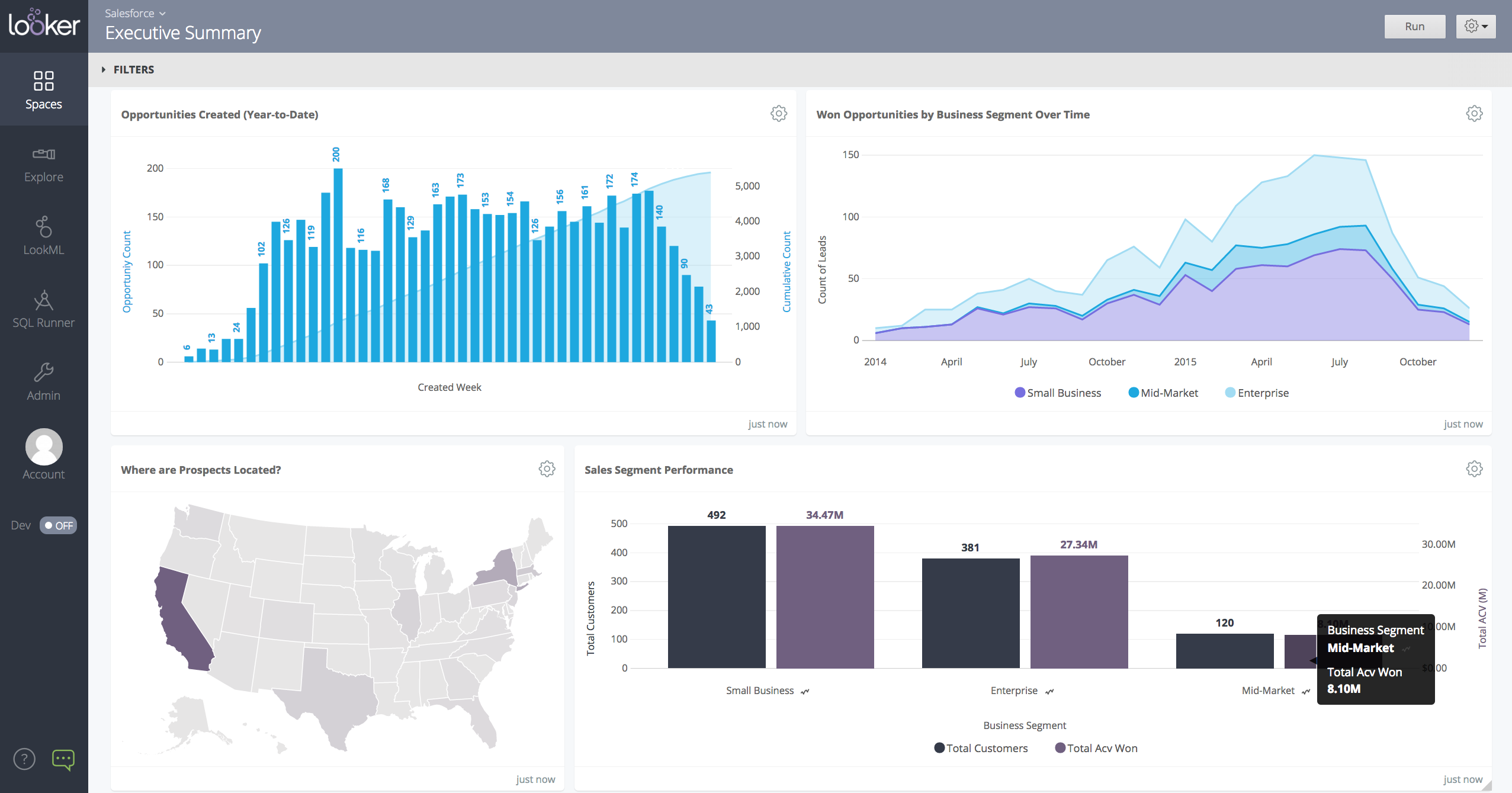
Looker is a BI application with an analytics-oriented application server that sits on top of relational data stores. It includes an end-user interface for exploring data, a reusable development paradigm for data discovery, and an API for supporting data in other systems.
N/A
Amazon Redshift
Score 8.9 out of 10
N/A
Amazon Redshift is a hosted data warehouse solution, from Amazon Web Services.
Wix and other website platforms have a built-in analytic tool, but it is not as sufficient as Google Analytics, so I always use GA as the main source of information about sales. Most of the analytic tools on web platforms can't visualize user flows, which is very important when …
Ease of use: Google Analytics is known for its user-friendly interface and straightforward setup process, making it accessible for beginners. Adobe Analytics has a steeper learning curve and requires more technical expertise. Features: Adobe Analytics offers a more comprehensive …
Looker
Verified User
Manager
Chose Looker
I haven't used a very similar software to Looker. However, for the same means, I have extensively used Google Analytics. While Google Analytics is great for e-commerce, it has some issues for businesses where you need to input conversion from different sources, and that is …
Looker is a lot less overwhelming and lets you take the data that you have in Google Analytics to make it understandable, focused and specific to the audience that is viewing the content. I haven’t used any other tools, but feel because of the ease of accessibility and cost, …
Tableau was significantly more expensive than Looker, more detailed, and required more set-up. Overall, Tabluea is great; we just didn't need something that robust. Plus, our client budgets can't afford a multi-year contract. Perhaps once they scale more, we'll need something …
Tableau provides additional visual functionality and is great for more in-depth visuals or further data exploration, but it is costly and an extremely robust solution for simple data reporting. Looker can't be beat when it comes to integrating with other G-Suite tools. All in …
Looker Studio is not as robust as Tableau or Microsoft BI. So it does not provide quite as much insight or depth and it has more limitations overall then the other major reporting products. However, it is also free and connects perfectly with other Google products. Plus, all of …
Technically, Power BI is much more complete and powerful, but it's like an ocean liner. I didn't need all that equipment. In my case, I needed to move more quickly, like on a speedboat, to build a page with several data sources in a single source of truth that could be easily …
We use both Looker and Tableau. It depends on the specific team. However, there is a clear correlation that we use Tableau more often when there are more data sources, including financial data.
Looker is an off-the-shelf, free tool for Google business users. Other than the internal cost of time to build, we had no costs to set up what we needed to do. Knowledge sharing internally and using templates greatly reduced this cost, making the overall cost very low.
Looker was, hands down, better than any other products we looked at. It was far easier to get started and keep moving because of Looker's internal programming language and data definition language, LookML. We were up and going in just a few days and were creating advanced …
Tableau- Not web based which makes it more difficult to use and share templates etc. Seems more dated. ChartIO - Looker's LookML layer that predefined joins was appealing to us vs a tool like ChartIO which requires more raw SQL comprehension.
I considered Looker along with RJ Metrics and Domo. The other platforms seemed to be offering much more of a service-focused offering, with fees that would likely scale quite high without certainty. Looker is focused on more of a product-driven approach and would be a good fit …
Amazon redshift is useful for our data sets due to its low cost and ease of use for the analysts, however, we were considering using BigQuery instead if we had chosen to pursue the Google Analytics 360 product.
Redshift leapfrogged Hive back when Hive was trying to figure out how to implement indexes, providing a more stable, standardized (postgres), easy to use (any postgres client), easier to administer, and scalable solution for querying server logs and raw usage data.
It's fast processing compared to other products and it's best for structured data analytics & data warehousing purpose. The unique columnar data storage architecture compared to other products makes it the great choice for analytics projects.
Google Analytics is particularly well suited for tracking and analyzing customer behavior on a grocery e-commerce platform. It provides a wealth of information about customer behavior, including what products are most popular, what pages are visited the most, and where customers are coming from. This information can help the platform optimize its website for better customer engagement and conversion rates. However, Google Analytics may not be the best tool for more advanced, granular analysis of customer behavior, such as tracking individual customer journeys or understanding customer motivations. In these cases, it may be more appropriate to use additional tools or solutions that provide deeper insights into customer behavior.
When data drives potential for new orders, Looker earns its place in our tech stack. If, on the other hand, we are hoping for pipeline generation, Looker is useful if you are willing to repeatedly go check customer utilizations .... it is not appropriate if you are hoping to automate data analysis for this purpose.
If the number of connections is expected to be low, but the amounts of data are large or projected to grow it is a good solutions especially if there is previous exposure to PostgreSQL. Speaking of Postgres, Redshift is based on several versions old releases of PostgreSQL so the developers would not be able to take advantage of some of the newer SQL language features. The queries need some fine-tuning still, indexing is not provided, but playing with sorting keys becomes necessary. Lastly, there is no notion of the Primary Key in Redshift so the business must be prepared to explain why duplication occurred (must be vigilant for)
Show visited pages - sessions, pageviews - which programs are viewed the most.
Displays session source/medium views to see where users are coming from.
It shows the video titles, URLs, and event counts so we can monitor the performance of our videos.
It gives a graphic face to the numbers, such as using bar charts, pie graphs, and other charts to show user trends or which channels are driving engagement.
Our clients like to see the top pages visited for a month.
I like the drop-and-drag approach, and building charts is a little easier than it was before.
[Amazon] Redshift has Distribution Keys. If you correctly define them on your tables, it improves Query performance. For instance, we can define Mapping/Meta-data tables with Distribution-All Key, so that it gets replicated across all the nodes, for fast joins and fast query results.
[Amazon] Redshift has Sort Keys. If you correctly define them on your tables along with above Distribution Keys, it further improves your Query performance. It also has Composite Sort Keys and Interleaved Sort Keys, to support various use cases
[Amazon] Redshift is forked out of PostgreSQL DB, and then AWS added "MPP" (Massively Parallel Processing) and "Column Oriented" concepts to it, to make it a powerful data store.
[Amazon] Redshift has "Analyze" operation that could be performed on tables, which will update the stats of the table in leader node. This is sort of a ledger about which data is stored in which node and which partition with in a node. Up to date stats improves Query performance.
We've experienced some problems with hanging queries on Redshift Spectrum/external tables. We've had to roll back to and old version of Redshift while we wait for AWS to provide a patch.
Redshift's dialect is most similar to that of PostgreSQL 8. It lacks many modern features and data types.
Constraints are not enforced. We must rely on other means to verify the integrity of transformed tables.
We will continue to use Google Analytics for several reasons. It is free, which is a huge selling point. It houses all of our ecommerce stores' data, and though it can't account for refunds or fraud orders, gives us and our clients directional, real time information on individual and group store performance.
I give it this rating because it deems as effective, I am able to complete majority of my tasks using this app. It is very helpful when analyzing the data provided and shown in the app and it's just overall a great app for Operational use, despite the small hiccups it has (live data).
Google Analytics provides a wealth of data, down to minute levels. That is it's greatest detriment: find the right information when you need it can be a cumbersome task. You are able to create shortcuts, however, so it can mitigate some of this problem. Google is continually refining Analytics, so I do not doubt there will be improvements
Looker is relatively easy to use, even as it is set up. The customers for the front-end only have issues with the initial setup for looker ml creations. Other "looks" are relatively easy to set up, depending on the ETL and the data which is coming into Looker on a regular basis.
Just very happy with the product, it fits our needs perfectly. Amazon pioneered the cloud and we have had a positive experience using RedShift. Really cool to be able to see your data housed and to be able to query and perform administrative tasks with ease.
We all know Google is at top when it comes to availability. We have never faced any such instances where I can suggest otherwise. All you need is a Google account, a device and internet connection to use this super powerful tool for reporting and visualising your site data, traffic, events, etc. that too in real time.
This has been a catalyst for improving our site's traffic handling capabilities. We were able to identify exit% from our sites through it and we used recommendations to handle and implement the same in our sites. We have been increasing the usage of Google Analytics in our sites and never had any performance related issues if we used Analytics
Somehow resources heavy, both on server and client. I recommned at least 50Mbs data rate and high performance desktop comouter to be abke to run comolex tasks and configure larger amount of data. On the other hand, the client does not need to worry when viewing, the performance is usually ok
The Google reps respond very quickly. However, sometimes they can overly call you to set up an apportionment. I'm very proficient and sometimes when I talk to reps, they give beginner tutorials and insights that are a waste of time. I wish Google would understand my level of expertise and assign me to a rep (long-term) that doesn't have to walk me through the basics.
Never had to work with support for issues. Any questions we had, they would respond promptly and clearly. The one-time setup was easy, by reading documentation. If the feature is not supported, they will add a feature request. In this case, LDAP support was requested over OKTA. They are looking into it.
The support was great and helped us in a timely fashion. We did use a lot of online forums as well, but the official documentation was an ongoing one, and it did take more time for us to look through it. We would have probably chosen a competitor product had it not been for the great support
love the product and training they provide for businesses of all sizes. The following list of links will help you get started with Google Analytics from setup to understanding what data is being presented by Google Analytics.
I think my biggest take away from the Google Analytics implementation was that there needs to be a clear understanding of what you want to achieve and how you want to achieve it before you start. Originally the analytics were added to track visitors, but as we became more savvy with the product, we began adding more and more functionality, and defining guidelines as we went along. While not detrimental to our success, this lack of an overarching goal resulted in some minor setbacks in implementation and the collection of some messy data that is unusable.
I have not used Adobe Analytics as much, but I know they offer something called customer journey analytics, which we are evaluating now. I have used Semrush, and I find them much better than Google Analytics. I feel a fairly nontechnical person could learn Semrush in about a month. They also offer features like competitive analysis (on content, keywords, traffic, etc.), which is very useful. If you have to choose one among Semrush and Google Analytics, I would say go for Semrush.
Looker Studio, you can easily report on data from various sources without programming. Looker Studio is available at no charge for creators and report viewers. Enterprise customers who upgrade to Looker Studio Pro will receive support and expanded administrative features, including team content management. So it's good.
Than Vertica: Redshift is cheaper and AWS integrated (which was a plus because the whole company was on AWS). Than BigQuery: Redshift has a standard SQL interface, though recently I heard good things about BigQuery and would try it out again. Than Hive: Hive is great if you are in the PB+ range, but latencies tend to be much slower than Redshift and it is not suited for ad-hoc applications.
Redshift is relatively cheaper tool but since the pricing is dynamic, there is always a risk of exceeding the cost. Since most of our team is using it as self serve and there is no continuous tracking by a dedicated team, it really needs time & effort on analyst's side to know how much it is going to cost.
Google Analytics is currently handling the reporting and tracking of near about 80 sites in our project. And I am not talking about the sites from different projects. They may have way more accounts than that. Never ever felt a performance issue from Google's end while generating or customising reports or tracking custom events or creating custom dimensions
Looker has a poignant impact on our business's ROI objectives. As an advertising exchange we have specific goals for daily requests and fill, and having premade Looks to monitor this is an integral piece of our operational capability
To facilitate an efficient monthly billing cycle in our organization, Looker is essential to track estimated revenue and impression delivery by publisher. Without the Looks we have set up, we would spend considerably more time and effort segmenting revenue by vertical.
Looker's unique value proposition is making analytical tools more digestible to people without conventional analytical experience. Other competing tools like Tableau require considerably more training and context to successfully use, and the ability to easily plot different visualizations is one of its greatest selling points.
Our company is moving to the AWS infrastructure, and in this context moving the warehouse environments to Redshift sounds logical regardless of the cost.
Development organizations have to operate in the Dev/Ops mode where they build and support their apps at the same time.
Hard to estimate the overall ROI of moving to Redshift from my position. However, running Redshift seems to be inexpensive compared to all the licensing and hardware costs we had on our RDBMS platform before Redshift.