Hive Technology offers their eponymous project management and process management application, providing integrations with many popularly used applications for productivity, cloud storage, and collaboration.
$24
per month per user
Paymo
Score 9.0 out of 10
N/A
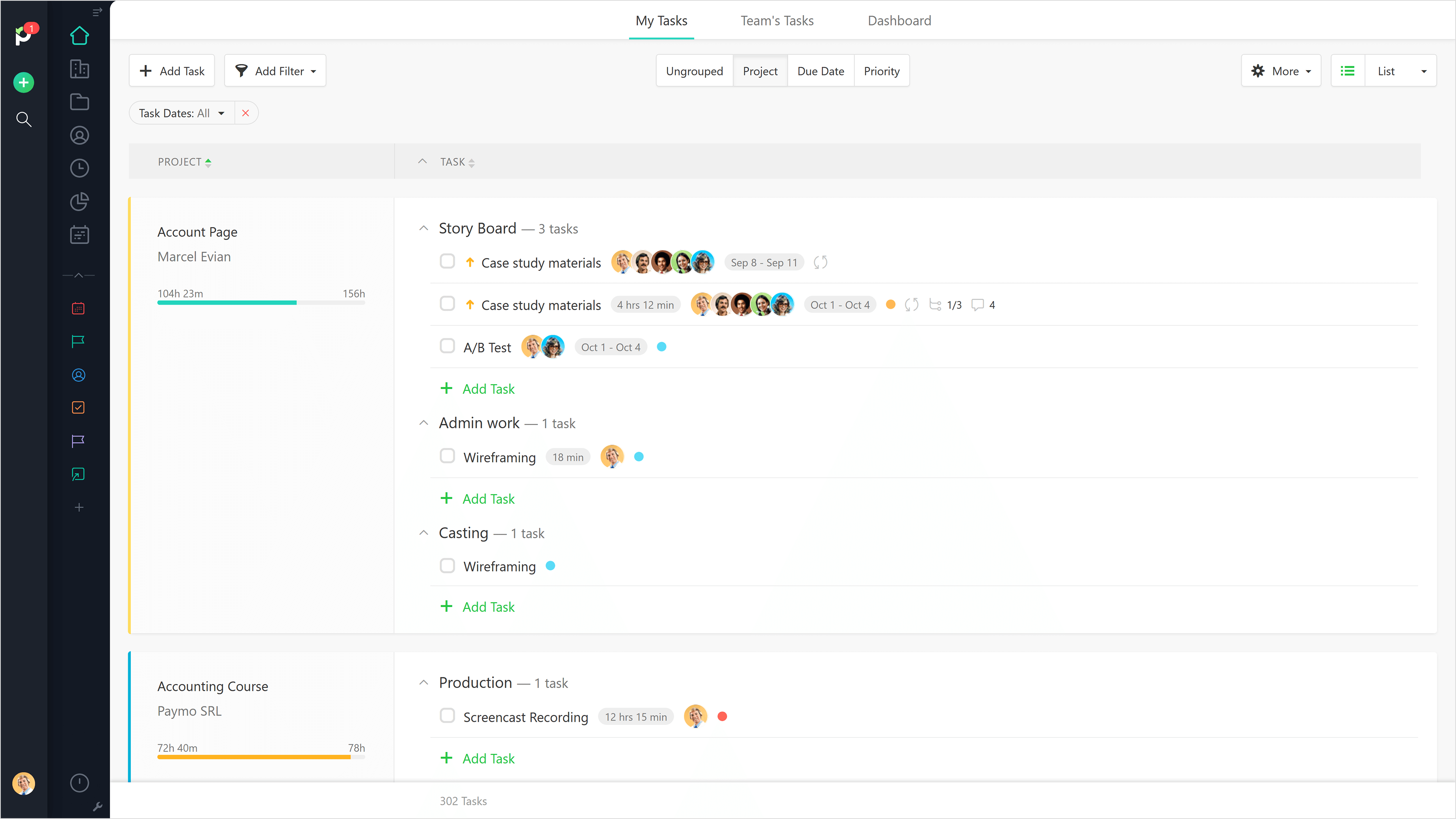
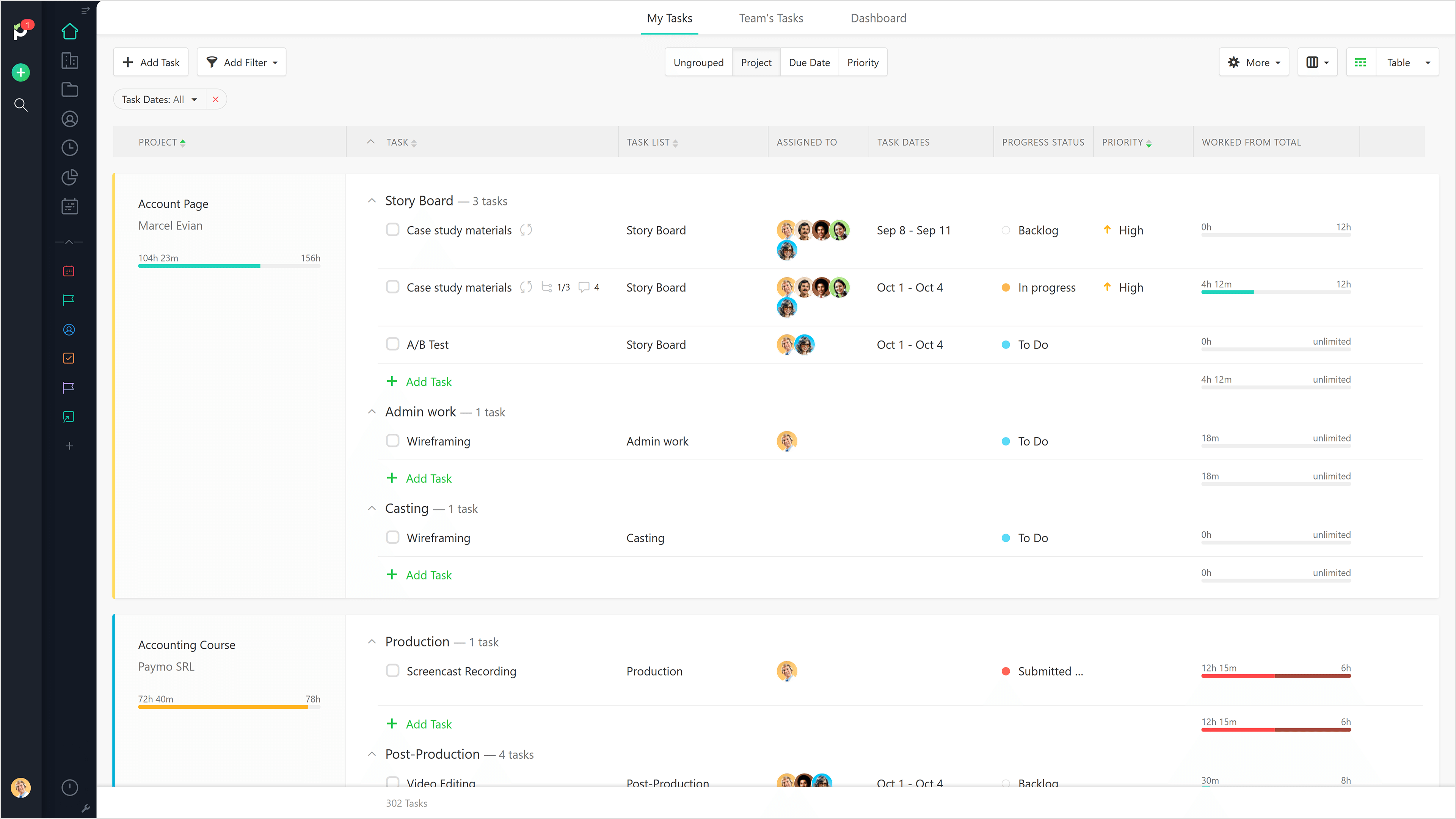
Paymo is a collaborative work management platform that helps track team progress, collaborate in context, and make smarter decisions. It acts as a single source of truth, where project planning, resource scheduling, file proofing, time tracking, and billing feed into each other to co-exist under the same roof.
$0
Up to 10 users
Trello
Score 8.4 out of 10
N/A
Trello from Atlassian is a project management tool based on a Kanban framework. Trello is ideal for task-management in a to-do list format. It supports sharing boards and cards across users or teams. The product offers a free version, and paid versions add greater automation, collaboration, and administrative control.
$6
per month per user
Pricing
Hive
Paymo
Trello
Editions & Modules
Free
$0
Lite
$24
per month per user
Growth
$34
per month per user
Pro
$59
per month per user
Elite
Contact Sales
Free
$0
Up to 10 users
Small Office
$11.95
per user/per month
Business
$18.95
per user/per month
Standard
$6
per month per user
Premium
$12.50
per month per user
Enterprise
$17.50
per month per user
Free
Forever Free
Offerings
Pricing Offerings
Hive
Paymo
Trello
Free Trial
Yes
Yes
No
Free/Freemium Version
Yes
Yes
Yes
Premium Consulting/Integration Services
No
No
No
Entry-level Setup Fee
No setup fee
No setup fee
No setup fee
Additional Details
A discount is offered for annual pricing.
Free version available for freelancers.
A discount is offered for annual billing and for larger numbers of users.
I like Hive better than Trello. Hive is definitely more user-friendly, but Trello had nice shortcuts that I miss in Hive. I would like to organize my board with just one click.
Hive did what these other tools do. It has Kanban boards, Gantt views, timeline views, reporting, task management, and file uploads. While it is not as feature rich at the lowest subscription level as some of these others, its interface is quite a bit less overwhelming than say …
We still use Trello and Slack, but Basecamp and HubSpot are too much for our operation to manage or integrate. Paymo is missing some of the tracking features of HubSpot and isn't as universally used as Basecamp but we've been with them for 8 years and they seem to know what …
Similar in almost all project management aspects... Paymo seems to have a slight edge in invoicing and reporting. They are also adding new features regularly so that (in our opinion) makes the investment worth it. Customer support has also been terrific. Easy onboarding process …
Toggle was confusing. I couldn't figure out how to work a task within a project and would mix up tracking different tasks along with projects. I didn't understand why tagging is needed. Paymo was super easy and intuitive, and I didn't want to bother spending time to learn how …
Hive is a powerful tool for data analysis and management that is well-suited for a wide range of scenarios. Here are some specific examples of scenarios where Hive might be particularly well-suited: Data warehousing: Hive is often used as a data warehousing platform, allowing users to store and analyze large amounts of structured and semi-structured data. It is especially good at handling data that is too large to be stored and analyzed on a single machine, and supports a wide variety of data formats. Batch processing: Hive is designed for batch processing of large datasets, making it well-suited for tasks such as data ETL (extract, transform, load), data cleansing, and data aggregation.Simple queries on large datasets: Hive is optimized for simple queries on large datasets, making it a good choice for tasks such as data exploration and summary statistics. Data transformation: Hive allows users to perform data transformations and manipulations using custom scripts written in Java, Python, or other programming languages. This can be useful for tasks such as data cleansing, data aggregation, and data transformation. On the other hand, here are some specific examples of scenarios where Hive might be less appropriate: Real-time queries: Hive is a batch-oriented system, which means that it is designed to process large amounts of data in a batch mode rather than in real-time. While it is possible to use Hive for real-time queries, it may not be the most efficient choice for this type of workload. Complex queries: Hive is optimized for simple queries on large datasets, but may struggle with more complex queries or queries that require multiple joins or subqueries.Very large datasets: While Hive is designed to scale horizontally and can handle large amounts of data, it may not scale as well as some other tools for very large datasets or complex workloads.
Beautiful interface throughout, easy setup, most natural progressions are fluid and easy to use. Browser functionality allows us to use it cross-platform. Very reasonable pricing model as well. We have had a little trouble using Paymo for the entire creative process to have proofs reviewed and approved. Also, have to use external forms to have work submitted from campus.
For teams or individuals with lots of individual tasks/details to track, Trello is perfect! It basically removes the need for a paper checklist. For those that need an overall project management tool that requires less tasks and more overarching goals, collaboration amongst various teams, and gantt charts I would suggest monday.com
Simplicity, it offers a clean environment without risking the outcome. An example of this are the timesheets that allow a fast way to keep track of progress
Interaction, the different options make it faster and easier to interact and collaborate in the development of a product. An example of this would be Hive Notes for meetings
The different visualisations it offers allow to explore the best ways to affront your projects. I really like the Gantt mappings view to understand who can be contacted at each point
The ability to code exactly what time I worked on a project enables me to bill clients more accurately and within different minimums, which besides more accurately tracking time, this has been extremely helpful as I negotiate contracts for services and offer different deals with potential clients. Some are billed to the minute, some in 15-minute minimums, and some in 20-minute blocks.
The live reports are great, showing time spent in the minimums that I've set, while also including as much detail as I wish to share.
I've now started just writing my notes into the tracker, which are then carried into the live reports - this eases my needing to send logs to clients, as well as helping me to keep projects on track.
It would be really helpful if on the timer tool, they asked you to switch projects when you stop the timer, so it could fill that time in right away for you.
I never use the 'My Tasks' because I don't fully understand how to integrate it to be useful to what our purposes are in Paymo. Some Youtube tutorials might be helpful
I am very likely to renew Trello, because it doesn't cost anything to do so. I am also very likely to use Trello's upgraded features in the future because a lot of my team's data is stored on there and they have already gotten used to the platform. Trello is very easy for new team members to pick up, making the onboarding and usability very streamlined.
It is a complete, a bit overambitious app but with many features that are needed. I didn't need most of the features but managed to make the most of the two I was using. Also, I think it is a well-rounded app and I am considering moving some team collab there.
Trello is incredibly intuitive, both on desktop and mobile right away. It is also full of helpful features that make it even easier to use, and is flexible enough to suit almost any organizational need. Onboarding for the software is thorough, but concise, and the service is frequently updated with even more QOL improvements.
Our CSR is easily accessible and they have support built into the app itself. They also have a pretty robust support site. We also took advantage of the free trial and learned so much by putting Hive through the paces and figuring out the best way to mold it to our needs.
Good! Fast, excellent, speedy responses. They always wanted to know why and how they could improve on something (good on receiving feedback, too). Not that they were much needed, but my limited experience with them is good; they were really keen to understand what the problem was really about and how they could help with it.
I haven't reached out to their support very often and their support is very limited anyway for the free users. They do have tons of great articles and videos in their Help Center and constantly send emails with updates and add-ons to the product. The fact that I've barely ever had to contact their support team means that they've developed a great product.
For our small business, getting a few of us started well on Trello was the key, I think. As long as a couple of us were really comfortable with the interface, we could lead others and help them with any questions. From now on, anyone who works with us just naturally uses Trello for information sharing - it's just part of what we do.
Hive is a bit different than Jira and Monday, which I used mostly. Overall does a great job managing project and helps with team communication. Removes dependency of asking team members for updates by going to conference rooms. With Hive, the team updates the status, and we can easily track it.
We still use Trello and Slack, but Basecamp and HubSpot are too much for our operation to manage or integrate. Paymo is missing some of the tracking features of HubSpot and isn't as universally used as Basecamp but we've been with them for 8 years and they seem to know what matters most to their user base
Trello is more simple and not as "robust" as the other tools, but it's easier to use and manage and understand and ACTUALLY get stuff done with. It's simplicity is part of the beauty of using it. You don't need a million options that nobody uses, you just need to get stuff done.
Gives me more accurate time that I've spent on projects compared to older methods I've used.
Has data that I can pull together, for example my boss wanted to know the percentage of time I'd spent working on projects for one client compared to everything else - I was able to give them an accurate percentage.
Forces you to stay on top of jobs, which can lengthen the time to complete something
Trello keeps me organized, focused, and on track. I could filter the Trello board to only see my issues and understand what I needed to work on and when.
Trello helped our team implement an agile structure. It's a very simple kanban method of viewing all of your team's tasks and statuses. You can completely customize the columns to your team's specific workflow and create tags relevant to your work.
Trello helps reduce unnecessary communications between teams. When I want to request translations, I simply create a card on the localization Trello board -- no need to directly message anyone on the team, and I can watch the status of the card change from "in progress" to "in review" to "translated," all without having to directly ask for updates.