Jira Core is Atlassian's general purpose business and project management tool available to smaller companies or teams and designed to suit a variety of purposes (e.g. marketing planning, product roadmap, etc.). In Jira Core, Workflows define process and enable teams to track tasks. Jira Core Cloud instances also have boards that let users visualize workflows and drag and drop tasks from to-do to done. It is available on the cloud.
$7.53
per month per user
monday.com
Score 8.3 out of 10
Mid-Size Companies (51-1,000 employees)
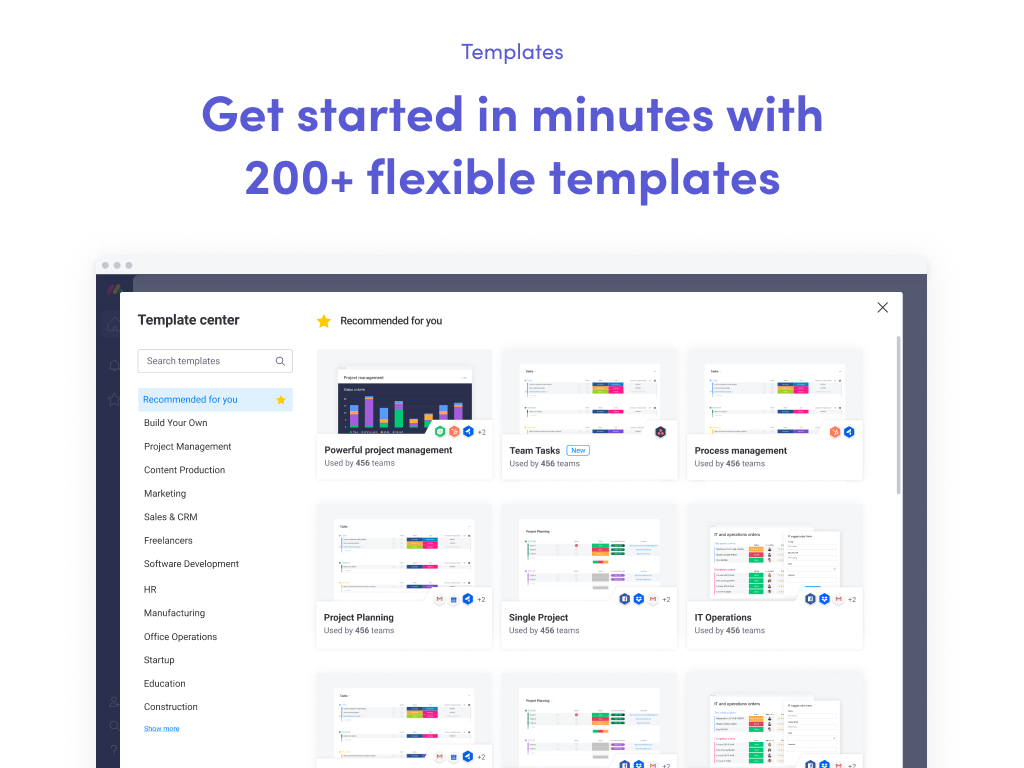
monday.com Work OS is an open platform designed so that anyone can create the tools they need to run all aspects of their work. It includes ready-made templates or the ability to customize any work solution ranging from sales pipelines to marketing campaigns, CRMs, and project tracking.
I found better features than Zoho Projects and Zoho Sprints. Airtable required a lot of effort in configuring so won't recommend that. monday.com was easy but has fewer controls and familiarity among the developers when we work with external agencies.
monday.com was our first attempt at using project management software, but we couldn't get the hang of it and nobody updated tasks. Management got even more confused with it so we switched to Basecamp. Basecamp is very simple and easy for small companies just getting into their …
Whereas all competing products are great and you may do more or less the same type of tasks, Atlassian has the edge when it comes to cross-team collaboration, in particular in scenarios where escalations must also involve developers or the product teams. All in all, all are …
Jira is the gold standard if your company can afford it. I have used other programs at other companies that do not have the same collaboration features and do not do as well. This seems to be the best for aligning and for offline use across the board really, can’t beat it.
I'd put monday.com and Asana on par, then ClickUp and lastly Jira. Jira would be more appropriate for exclusively technology engineering teams. Jotform offers better choices for forms use cases especially ones with complexity. Zoho makes more sense when you have the full suite, …
Jira Work Management suits projects involving multiple teams, such as product development. In our case, the design, development, and QA teams use Jira to track tasks from ideation to deployment. Custom workflows and real-time updates ensure that all teams are on the same page, and the ability to link related tasks helps manage dependencies effectively.
The platform has a good deal of versatility and extensibility, but I do not feel it is well suited for anything too complex. More complexity seems to bog down performance and increase maintenance to keep everything humming. As much as possible, avoid creating too many bespoke workarounds that will end up creating tech debt. The platform seems to work best for more straightforward scenarios and smaller to mid-size companies. Pricing can be reasonable for specific teams, but can feel a little too pricey for company-wide usage. It has served us well for the early stages of our company, but we find ourselves offloading the more complex use cases to other apps specifically developed for those, and reducing to just those teams that are more deeply embedded in the functionality.
I like summary of subitems, especially with subitasks as subitems and add item tracking for each subtask it can show total tracked in parent item. Similar with other columns, like numbers, status, date.
Dashboard features, Many kinds of dashboard view available, we can utilize on the basis of requirements.
monday.com workform is very powerful, easily share form link when submitted it will create line item in board with provided data.
monday.com automation is very helpful in order to automate steps with specific rules and easy setup.
monday.com also provides integrations in order to automate processes if need to integrate multiple app together. or need to transfer data between multiple apps.
I would like to see our company logo show up larger on the form feature.
I prefer the version of the form they have now instead of the new version for 2025. The current form shows the questions in bold font, and the new version does not. This may mean it could take our volunteers longer to get to the pertinent information on the form.
It would be nice if monday.com staff had monthly webinars showing how to use some features. such as, using formulas effectively.
Teams involved in content creation, such as marketing or editorial teams, could use monday.com to manage the entire content lifecycle. Boards might track content ideas, assignments, drafts, reviews, approvals, and publication schedules, helping teams collaborate and keep content production on track.
As we are Atlassian users overall, this entire ecosystem is truly built from a 360 perspective. It becomes the one source of truth, and we can easily see where we are in our projects and where to emphasize focus in the upcoming period. There are some areas for minor improvements, but they are more a matter of preference rather than business necessity
I give monday.com a 10/10 because I almost never encounter any lag or connectivity issues despite all of the many templates, boards, and automations we have. As a matter of fact, I feel like the last issue I encountered was over a year ago... and I'm in monday.com every single work day. Not only is monday trustworthy, it is easy to find what I'm looking for... making the overall usability extremely hard to beat.
Everything performs fairly well. Every now and then there are user errors where an employee will not click "ok" on a note they've created and simply exit out (I do wish that something was in place to prevent this, such as a pop "are you finished?")
monday.com only really care about accounts that have 20 seats or more. While this is great for monday.com, it pushes smaller organisations to evaluate alternatives. We rate monday.com highly in our organisation because key staff have already got good experience with the application and we know we will get to 20+ seats one day. But, till then the billing model and lack of permanent enterprise features is a dread.
To have someone walk you thru the features and capabilities of Monday.com is priceless. Someone also coming along later in the contract to see if you are maximizing the program to suit your company needs is beyond helpful. The staff that have provided this training are fun, creative and very patient.
We signed up for the accounts. Created the accounts. Ran the trial version and tested it live while we were running multiple projects and found that it was fitting our needs perfectly. When the trial ended and we were asked to purchase the full version, we did. We have found other ways to use it and it's a breeze.
The evolution of Jira Service Desk to Jira work management is accompanied by lot of new features like the List View which allows inline editing, easy column management, the Calendar View bases on extensible modal and state categories, the Timeline View supports tasks and subtasks, the Boards which allow the categorization of status and allow the visibility of subtasks on the cards, Forms can be created very easily, Project templates can be used based on the business area.
monday.com is cleaner, offers more customization and is easier to design out with a team project focus in mind. With the ability to automate steps as well, it is super easy to move tasks along, have stages auto-update and to go through my personal to-do list of tasks to get things done.
For it to work across multiple departments and sites, I would like to see improvements made with integrations and automation. For this question, I am acknowledging not only the addition of internal triggers/automation, but also an expansion on external ones.
For our marketing team, Jira Work Management caused us to lose valuable work time due to manual updates that could have been automated.
Due to lack of creative review tools within Jira Work Management, our team had to pursue other tools that do not integrate with Jira Work Management, thus creating additional OpEx.
Much easier to review my prior month and report to clients on work completed; easy to extract the information and work done to Excel to add budget tracking etc - I see this is possible in monday.com and I will investigate how/if this is possible on our current plan.
Very fast and easy set-up of Boards.
Still lots to learn and grasp - many more opportunities to become more efficient using monday.com. I'm only just getting started.
The initial automations are quick and easy to set up, and if set up correctly.
My month-end client status and progress reports are now more accurate, and I can keep track of all the information in one place (inside monday.com).