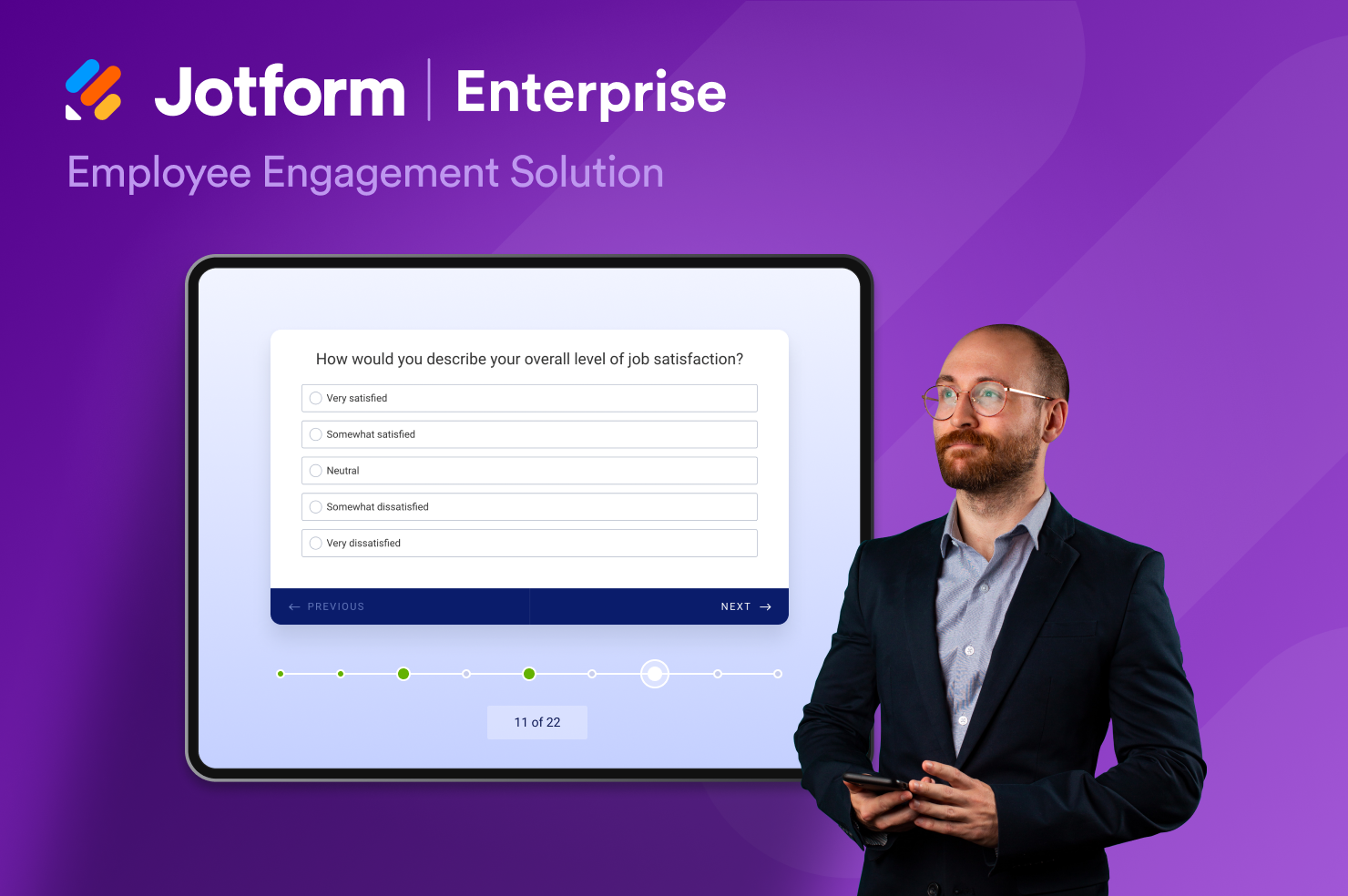
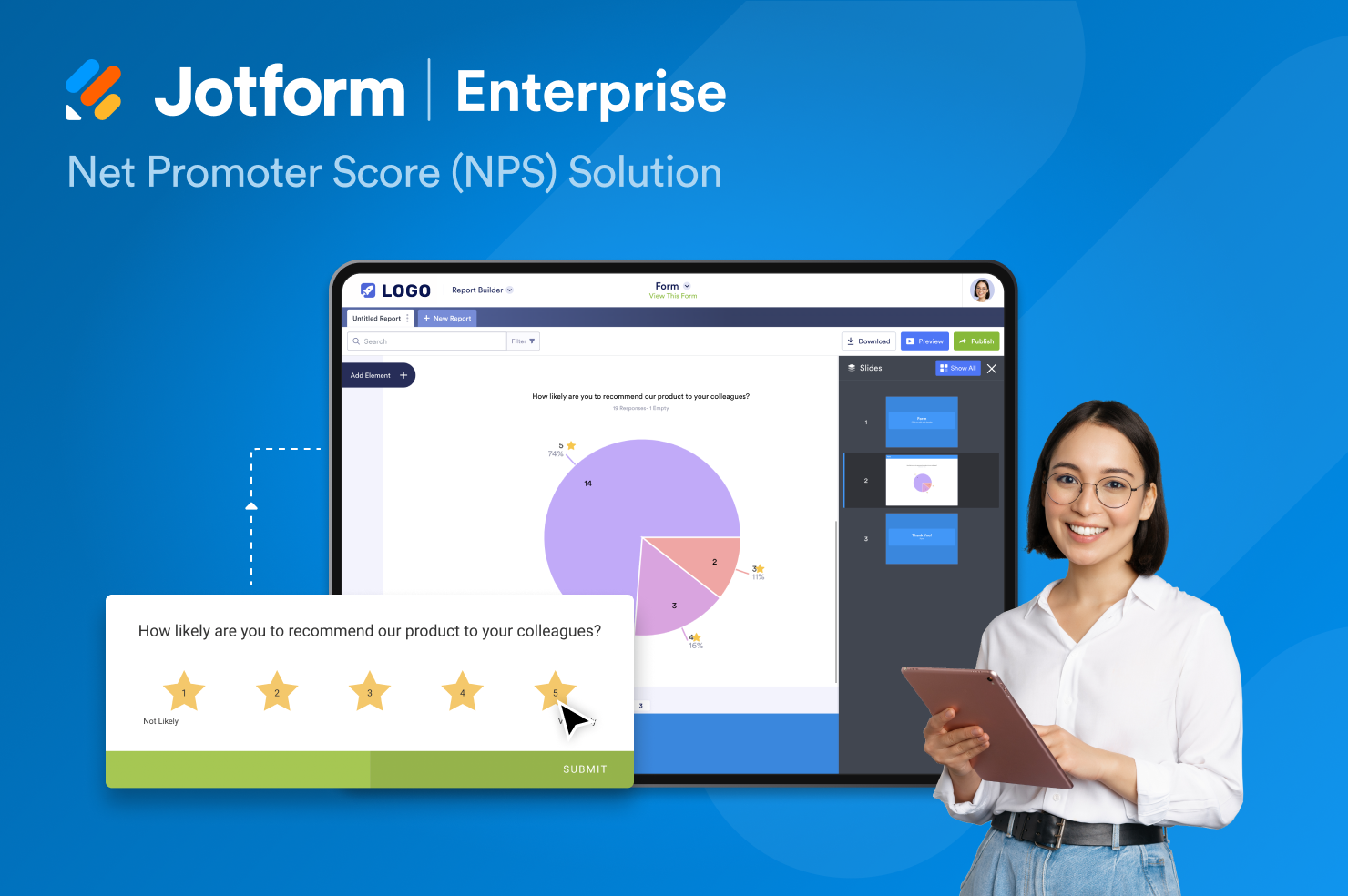
Jotform Enterprise is a digital workspace productivity tool that provides a platform for organizations. The aim of Jotform Enterprise is to give companies an easy-to-navigate tool that makes reaching out to customers, collaborating with coworkers, and collecting e-signatures and data a more seamless process. Jotform Enterprise strives to enable companies to make data-driven decisions without compromising when it comes to quality and security. It doesn’t matter what type of…
$0
Typeform
Score8.1 out of 10
N/A
Typeform is online form and survey software, focused on high-quality visuals and user experience. Users can create surveys, registration forms, tests & quizzes, contests, tutorials, shopping carts, and contact forms, without needing to write code. Typeform offers freemium plan pricing. Their basic plan is free for one user; their Pro plan in $35/month for one user (includes logic jump, respondent notifications, calculator, custom thank you screen, hidden fields, payment fields, and 2GB file…
A de minimis incentive was given to thank the reviewer for their time. The incentive was not used to bias or drive a particular response, nor was the incentive contingent on a positive endorsement. More Info
Software Engineering Manager in Engineering at Lucidworks (Internet, 201-500 employees)
Chose Jotform
Jotform is easy to use, and has an incredible free tier. Its really easy to get started at a small scaler vs Alchemer, and SurveyMonkey. Typeform and Google Forms is not flexible enough for my needs.
A de minimis incentive was given to thank the reviewer for their time. The incentive was not used to bias or drive a particular response, nor was the incentive contingent on a positive endorsement. More Info
Director of ecommerce in Marketing at Yvolve Digital Marketing Agency (Wholesale, 51-200 employees)
Chose Jotform
Typeform is clearly a leader in the survey space. Their product can indeed be used for information gathering (sign up forms) and is quite attractive. We just appreciate the functionality of JotForm for our customer base and specific application.
A de minimis incentive was given to thank the reviewer for their time. The incentive was not used to bias or drive a particular response, nor was the incentive contingent on a positive endorsement. More Info
A de minimis incentive was given to thank the reviewer for their time. The incentive was not used to bias or drive a particular response, nor was the incentive contingent on a positive endorsement. More Info
Verified User
Chose Jotform
Compared to Google and Microsoft, Jotform has a lot more features. I particularly love the e-signature because it makes the form feel more trustworthy for our team.
A de minimis incentive was given to thank the reviewer for their time. The incentive was not used to bias or drive a particular response, nor was the incentive contingent on a positive endorsement. More Info
Lead Generation Specialist in Corporate at Explode Your Audience (Marketing & Advertising, 1-10 employees)
Chose Jotform
We use Jotform instead of Google Forms because you can customize the input fields. We need very specific information from our participants and Jotform allows our participants to fill in the information we need a specific format to fit our list-building events. Also, the …
A de minimis incentive was given to thank the reviewer for their time. The incentive was not used to bias or drive a particular response, nor was the incentive contingent on a positive endorsement. TR verified that a representative sample of customers was invited. More Info
Verified User
Chose Jotform
we see Jotform more user friendly to use and much more easier to understand and communicate with users
A de minimis incentive was given to thank the reviewer for their time. The incentive was not used to bias or drive a particular response, nor was the incentive contingent on a positive endorsement. More Info
Founder in Corporate at Raw Athletics (Sports, 1-10 employees)
Chose Jotform
Jotform worked better with the specific pieces of software we already use and can natively integrate with them, making it quick and easy to share and store data we collect. The pricing plan also worked well with our specific use cases and seems like it would scale efficiently …
A de minimis incentive was given to thank the reviewer for their time. The incentive was not used to bias or drive a particular response, nor was the incentive contingent on a positive endorsement. More Info
Mentor & Coach in Professional Services at Mastery To Success Pty Ltd (Professional Training & Coaching, 1-10 employees)
Chose Typeform
Typeform has similar features to JotForm. Depending on the use and the data I need to collect, I will either use Typeform or JotForm. For example for data collection from customers, I use Typeform, but testimonials and reviews, I use JotForm. If you need to collect information …
A de minimis incentive was given to thank the reviewer for their time. The incentive was not used to bias or drive a particular response, nor was the incentive contingent on a positive endorsement. More Info
We use it for mostly community surveys and I absolutely prefer it over any other survey program out there. It is easy to create, easy to understand and easy to navigate. I love the QR code option it creates for you to share your form/ survey with others. It really is the best out there!
Typeform is definitely a leader in the online survey space and that's for a reason. Between logic mapping and the ease of use for the end user, it's a solid app. The unfortunate thing, however, is the price tag--particularly considering the protection you receive from bots. Typeform only allows a certain number of responses at certain package levels, ie: the lowest level, you get a very limited number of responses but in order to receive more responses before your survey is locked, you must upgrade. This is what ultimately lead us to cancel with them. When you post a survey on Typeform, that survey is automatically posted publicly on their website--making it widely available to bots. Typeform offers no easy form of protection like a standardized captcha that you can add to the survey in order to filter bots out. Instead, there are several "work arounds" that they advise users to do that have very limited degrees of success. A quick online search shows that Typeform knows this is clearly an issue, yet they have yet to build in a bot-prevention feature. Since their plan prices vary by number of responses, it seems that they have no incentive to limit the amount of bots filling out surveys I believe. Ultimately, we canceled because, although the app is powerful, it just seemed like their business practices were unethical in my opinion.
A de minimis incentive was given to thank the reviewer for their time. The incentive was not used to bias or drive a particular response, nor was the incentive contingent on a positive endorsement. More Info
The pricing structure is a little steep, especially for the Pro+ plan. It would be nice if they had an a la carte option because there are some features we are paying for that we will never use.
When creating forms, sometimes the cursor will inexplicably leave the field you are typing in and leave you with incomplete sentences.
Even though we are paying for our use, we still have the Typeform branding on our forms, which I think should be removed once you upgrade from the basic plan.
A de minimis incentive was given to thank the reviewer for their time. The incentive was not used to bias or drive a particular response, nor was the incentive contingent on a positive endorsement. More Info
A de minimis incentive was given to thank the reviewer for their time. The incentive was not used to bias or drive a particular response, nor was the incentive contingent on a positive endorsement. More Info
A de minimis incentive was given to thank the reviewer for their time. The incentive was not used to bias or drive a particular response, nor was the incentive contingent on a positive endorsement. More Info
As a seasoned user who relies on seamless online forms for a multitude of purposes, I can confidently attest that JotForm has not only simplified the form creation process but has also elevated it to new heights.JotForm's interface is a masterpiece of intuitive design. Even if you're a newcomer to the world of online form creation, the platform's user-friendly layout will have you crafting professional-grade forms in no time.
A de minimis incentive was given to thank the reviewer for their time. The incentive was not used to bias or drive a particular response, nor was the incentive contingent on a positive endorsement. More Info
Typeform takes a little bit of getting used to. Compared to Google Forms there are a lot more parts to the software and customizing the form isn't as intuitive. I have also found that embedding it into one smaller section of a webpage seamlessly can be a little tricky. But everything can be figured out eventually and the analytics are very good.
A de minimis incentive was given to thank the reviewer for their time. The incentive was not used to bias or drive a particular response, nor was the incentive contingent on a positive endorsement. More Info
I honestly have not used the support feature with Jotform. From what I can see when I look information up, everything I want to do something that I can't figure out myself it seems to not be a possible solution or edit that Jotform is currently capable of.
A de minimis incentive was given to thank the reviewer for their time. The incentive was not used to bias or drive a particular response, nor was the incentive contingent on a positive endorsement. More Info
I haven't used the support portion of Typeform, as everything was quite easy to use. I have never encountered a situation where I did not know what to do or how to fix something myself. Typeform is very easy to adopt within any organization, no matter if you understand tech or not.
A de minimis incentive was given to thank the reviewer for their time. The incentive was not used to bias or drive a particular response, nor was the incentive contingent on a positive endorsement. More Info
the most valuable things that Jotform give free trial, so the resistant users can get the experiences of the easiness and more handling to the digital things
A de minimis incentive was given to thank the reviewer for their time. The incentive was not used to bias or drive a particular response, nor was the incentive contingent on a positive endorsement. More Info
Typeform is better hands down [in my opinion]. It's not even a comparison as [I feel] JotForm doesn't work properly and [from my experience I think] their support is very problematic. I would suggest using Typeform or using GravityForms as an alternative to JotForm. Whatever you do, [I feel you shouldn't] depend on JotForm for something that is important to your business or research project.
When looking for a feature rich & flexible / customizable solution, Typeform beats out everyone. However, for specific use cases (like NPS), AskNicely is a clear winner in terms of features, but is much too expensive. Typeform is also fun to use, especially compared to Wufoo which seems so out of date
A de minimis incentive was given to thank the reviewer for their time. The incentive was not used to bias or drive a particular response, nor was the incentive contingent on a positive endorsement. More Info
It saved me time. Within minutes I was able to create and share forms to collect demographic data.
While struggling to use another software, I thought of Jotform and it was able to assist me with collating the data I had to confirm results previously obtained.
I could not easily identify what new information was provided in a resubmission by a respondent.
Typeform has helped guide our Customer Success, Product, and Marketing teams in strategizing how to engage with customers better, and it has also given us a quick and easy way to do so! By collecting feedback and being able to share it across internal teams, we can coordinate our efforts to build our customers a better tool.
Typeform has proved to be an elegant solution to one of our earlier vexing problems (previous survey tools that looked annoying, had extremely limited branding options/were not customizable, and didn't integrate well with the rest of our tool set) while not breaking the bank for us - it's a very reasonable price point and does WAY more than the previous tools we were paying just as much for.
A de minimis incentive was given to thank the reviewer for their time. The incentive was not used to bias or drive a particular response, nor was the incentive contingent on a positive endorsement. More Info