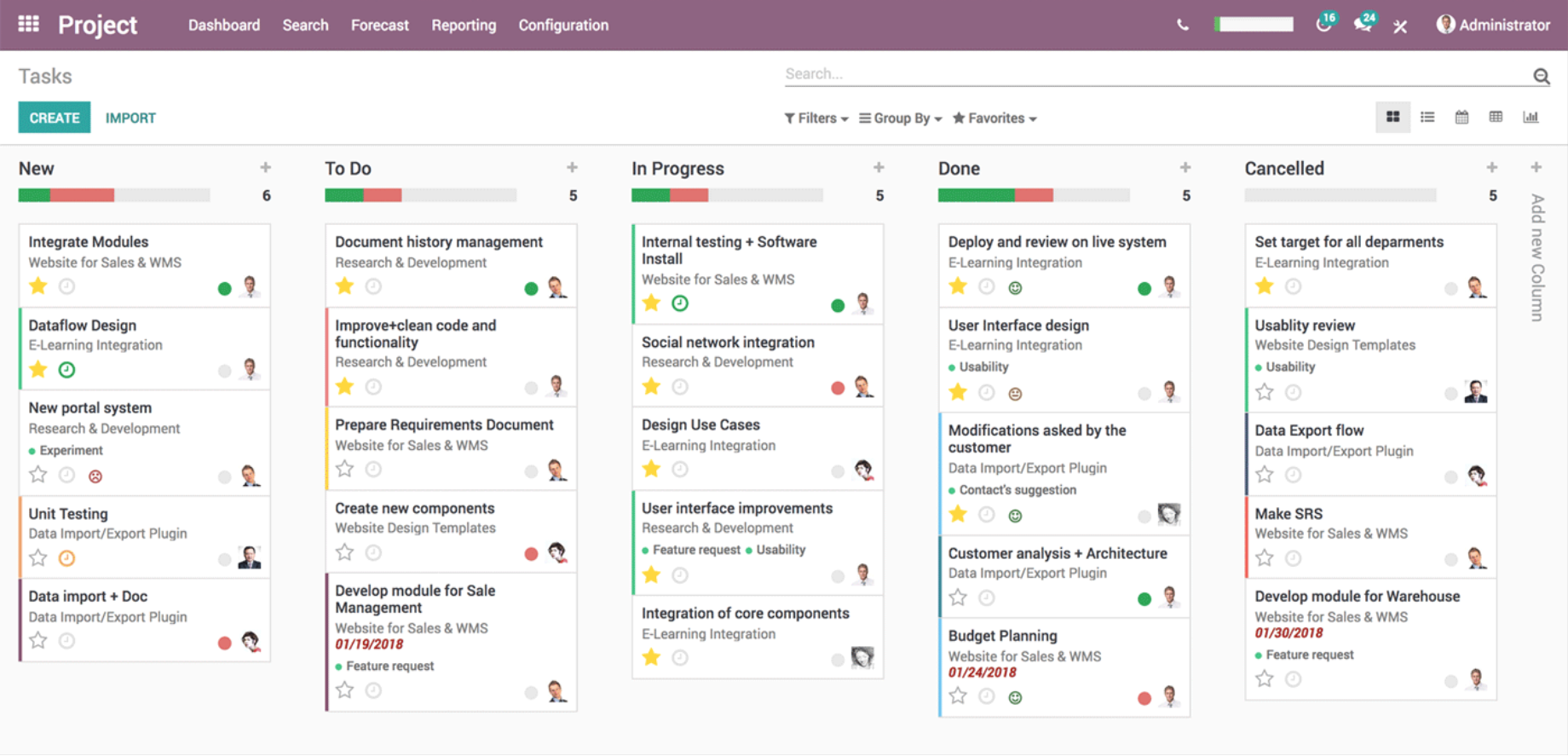
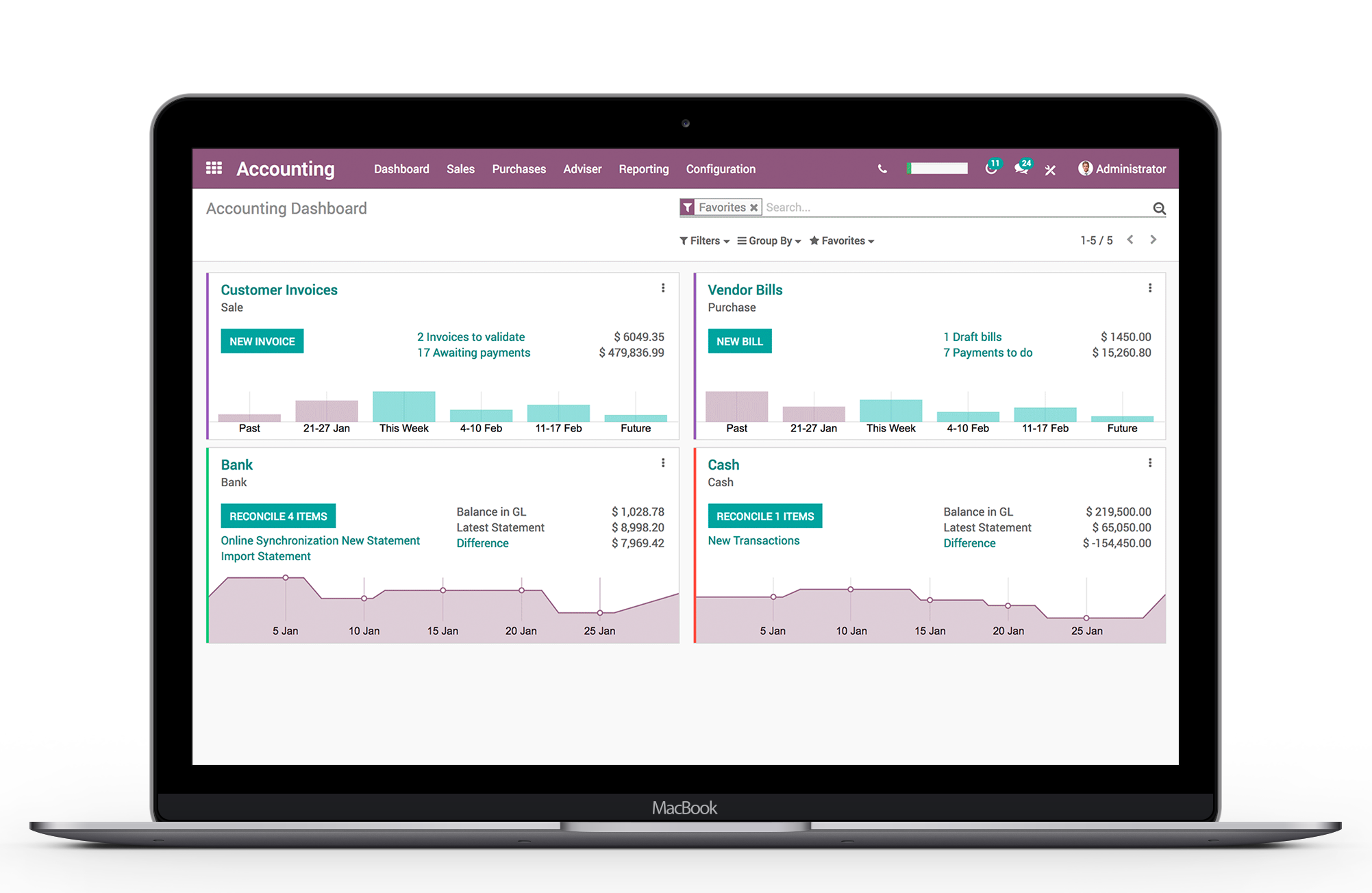
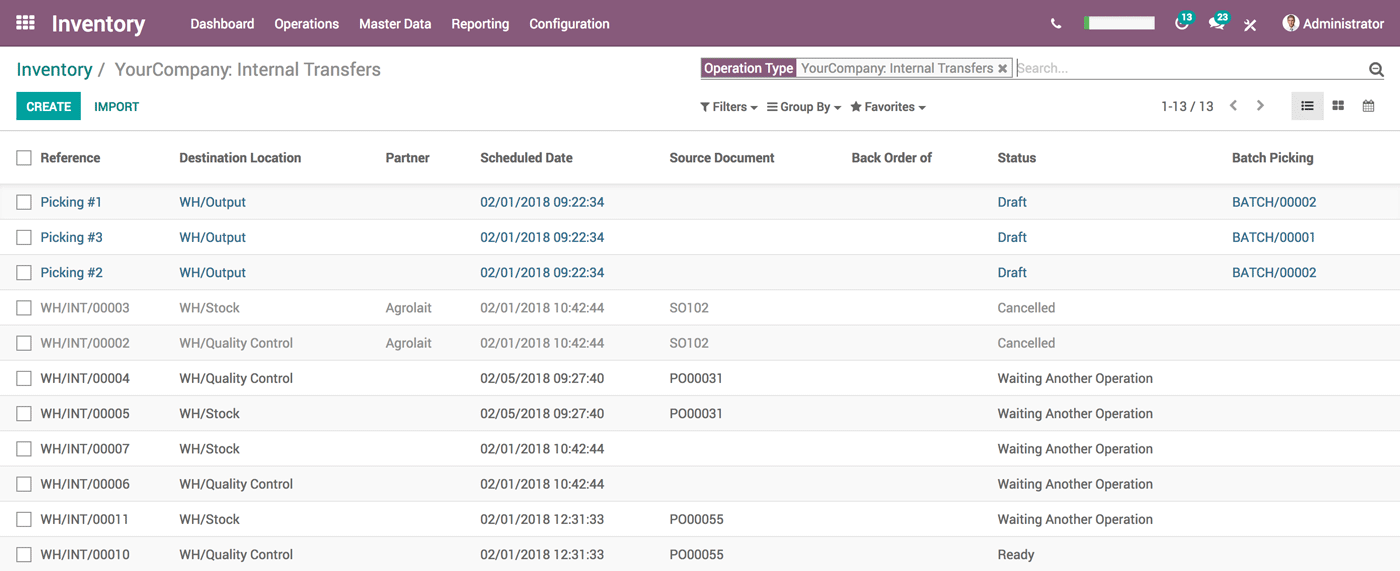
Odoo, from the Belgium-headquartered multinational company of the same name, is a suite of business applications for managing the sales pipeline. It also comprises a PoS and inventory management modules, scaling to a warehouse or retail management solution.
$31.10
per month per user
SAP Cloud ERP
Score 8.6 out of 10
N/A
SAP Cloud ERP (SAP S/4HANA Cloud) is a modular ERP that enables users to run mission-critical operations in real time from anywhere, introduce new business models in any industry, and expand globally. SAP Cloud ERP is a SaaS product and can also be deployed in a hybrid landscape for quicker time to value. SAP Cloud ERP is a foundational component of the
N/A
Workday Adaptive Planning
Score 7.7 out of 10
Mid-Size Companies (51-1,000 employees)
Workday Adaptive Planning streamlines planning workflows, using AI and real-time data integration to improve collaboration and provide predictive forecasts for better strategic analysis.
N/A
Pricing
Odoo
SAP Cloud ERP
Workday Adaptive Planning
Editions & Modules
Standard
$31.10
per month per user
Custom
$46.70
per month per user
No answers on this topic
No answers on this topic
Offerings
Pricing Offerings
Odoo
SAP Cloud ERP
Workday Adaptive Planning
Free Trial
Yes
Yes
Yes
Free/Freemium Version
Yes
No
No
Premium Consulting/Integration Services
Yes
Yes
Yes
Entry-level Setup Fee
-$49,321,250 per app/ per user/ per month
Required
Optional
Additional Details
A discount is offered for new users for the first 12 months of use for the initial users purchased. ($24.90 instead of $31.10 for Standard)
What other products like SAP S/4HANA Cloud have you used or evaluated?Select from the list of products, or give insights on products your peers may not know about in the space below.Describe how SAP S/4HANA Cloud stacks up against them and why you selected SAP S/4HANA Cloud.
SAP S/4HANA Cloud is an easy choice with its interface connectivity and scalability. It is also much better to integrate with SuccessFactors and every other SAP product we use.
In our quest for an ERP solution, we evaluated alternatives such as Oracle ERP Cloud and Microsoft Dynamics 365. However, SAP S/4HANA Cloud's reputation for advanced analytics, scalability, and seamless integration with other SAP solutions made it the natural choice for our …
The only alternative we looked at was BI360, and there really is no comparison. The choice was easy to go with Adaptive. We strongly wanted to move away from working with Excel spreadsheets, which was apparently a selling point of BI360. It was clear to us that the stability of …
It is well suited for inventory tracking, shipping and sales work flows. While some customization is needed to make it functional, if done correctly Odoo can serves as a powerful one stop shop for all of a businesses needs. The ease of customization for email templates, both for sales communications and marketing outreach leaves something to be desired. Perhaps our team hasn't explored this fully enough. I have personally found it intimidating in trying to construct a news letter using the email marketing module
SAP Cloud ERP reduces dependence on multiple systems and improves efficiency in enterprise resource planning. Real-time reporting capabilities and scalability of the product. Use of the software ensures compliance and allows smooth integration with other systems. The software allows customization to accommodate users' individual needs and offers very convenient customer support services. The only major challenge with the software is its limited configuration.
We're a mid-size organization working with a shoestring budget and an IT skeleton crew...not much room to dedicate resources to a platform like this fully. Having it SaaS based is helpful for system management through their Helpdesk system, and a single platform also helps streamline the knowledge needed by our developers when integrating other business aspects to Workday.
The creation of products is extremely simple, I like that it does not complicate you to put a lot of detail, of course if you want to put more detailed information later it allows you to do it without problems
The fact that I can manage my inventory of my warehouse is very convenient, I only generate my stock report of the products we have in stock and taking inventory is easier
The management of opportunities in the CRM is also great, because the guys from the sales department generate their opportunity, place what their client is requiring and we, the logisticians, can automatically generate the quote for what they are requesting, and from there they can only download their quote and send it to their clients.
It helps create dynamic plans for finances, operations and various functional units in an organization all under one platform
It helps in scenario modeling to help analyze various business events and report by any number of business dimensions including channel, customer or product
It can be integrated with any system including ERP, BI or CRM
Customer service is nonexistent. You will need a 3rd party to assist you.
The system has an open app for integrating with other programs. These are developed by third parties and can be hit or miss in functionality.
The system offers great flexibility; however, it is too much and requires coding. For example, changing a Sales order PDF requires coding to modify the document.
Initial implementation is clunky and seems to require a 3rd party just for setup.
Dashboards are not the best for graphs/charts. However, I have heard of companies using the dashboards for forecasting/budgeting. I would like to see Workday Adaptive Planning demonstrate this part of the feature.
Better security or locks to prevent deleting Actuals data - you are literally one click away from doing this.
On the web-based reports, better functionality when needing to reverse the sign in calculations - right now it is only available for revenue vs. expenses.
The cost of SAP as an ERP is quite high and the switching costs associated with ERP systems are even higher. That being said moving from one ERP to another only happens once in a great while for large organizations. Those switching costs include retraining, IT hardware requirements, outside consultants and more
For one we're in way too deep to not move forward with Adaptive. We're integrated with Workday, we do a ton of reporting with Adaptive, and it's working very well for planning and forecasting. No reason to look back or change course.
Once you complete the training with Odoo, you have a great grasp of how the system works, and most every feature is intuitive- There is rarely a task within Odoo that I get frustrated trying to figure out- I can typically look through the system and find what I need to do, and if I ever do need support, the Odoo Support team is excellent
SAP Cloud ERP is a useful solution for automating and streamlining business processes. It offers modern technologies such as built-in AI, machine learning, and real-time data analytics. It offers multi-currency, multi-language support to manage international operations smoothly. It comes with a modern, role-based user interface that enhances your user experience and lets you perform tasks smoothly.
It is overwhelming at first, but once you really get to know it, you realize it is fairly simple and customizable, and then it has a lot more limitations than you first thought. Realizing those limitations and finding workarounds is when you know you've mastered the software.
There haven't been any lately. The only one issue I can think of is when there was an update in Adaptive that altered our reports. Before I realized there was an issue, Adaptive reached out to let me know, so that it could be fixed.
All aspects of Adaptive Insights perform well. One area that I wish was quicker was integration. When importing data from Intacct our accounting ERP platform, it can sometimes take 4 hours for the import to process. The earlier imports are done, the quicker they complete. My estimate for a quick upload is about two hours.
Easy - there is NO SUPPORT (like in ABSOLUTELY NOTHING!!!!!!!). Even for legally mandatory requirements where the system MUST work, they will gladly take a month to get back to you with a NON-answer. We couldn't even get our bank statements correctly into Odoo for 2 months - leading to no reconciliation and the company accounts were a mess (still are!!) as a result - Completely irresponsible. Have not EVEN had an apology from Odoo - they couldn't care less !!
The support system I find great as whenever I run into problems they rectify them quickly as possible they never reacted late the support is just up to the mark for me. They provide many solutions to the problems I faced the [technical] team support is always amazing they [listen] to mean work accordingly.
Whenever we have had any questions, issues, or concerns, the support has been quick and thorough. [This] allow[s] us to be able to fully resolve any issues, or be connected with the right group quickly to attain the result we were after; be it from simple formatting to adding new detailed reporting.
This was extremely helpful so that they could walk you through the model and teach you more about the complexity of various areas. It is most helpful when it is specific to your organization's model. The larger in-person trainings were helpful but they tended to be more generic and entry level. The trainings that are more tailored to your specific needs are the most helpful.
They often times tended to be way too generic or entry level. They would also become sales pitches to upgrade or get new Adaptive Planning products. The questions in the training would be very niche and specific to other organizations. They were rarely helpful to the group at large.
SAP requires a lot of internal and external resources to complete its successful implementation. The cloud version requires a deeper understanding of the different capabilities of the local systems (hardware) and the connection towards your local IT team. We found several problems on our systems that we couldn't foresee before the implementation and roll out.
Trust the expertise of very strong 3rd party implementers. Having deployed Adaptive at a separate company before, I thought I knew it all (hubris, I know). Fortunately, I began to (very quickly) trust the judgment of our Carlson implementation team, and they provided invaluable insights and best-in-class processes that have benefitted me and my team greatly.
We decided to go with Odoo over Netsuite due to a few factors. Price was a big reason why, Netsuite is the most expensive ERP we vetted. I also did not have a great experience with Netsuite at my last job. I was on the roll out team and it did not work as promised for POS, inventory managing or reporting, it crashed constantly in the middle of using it. Just over all very poor. Considering it is owned by Oracle and the most expensive, you would think it would be able to function on some sort of base level. That company ended up terminating their contract with Netsuite early and going with a different company.
We don't have crashing or error issues. I can complete receives, cycle counts etc and all of my information saves. Visually, Odoo is more satisfying also.
The platform utilizes advanced predictive analytics to anticipate operational bottlenecks and put them out of commission before the problems become larger. We can proactively develop effective strategies that help keep service quality in the face of unexpected changes in the market, or external disruptions, by continuously analyzing historical performance data as well as elements of the current market
Workday became our choice because it is fully web-based and easily integrates with other systems. The learning curve for Workday was shorter than that of Dynamics. The reporting tools in Workday are more user-friendly than that of Dynamics. However Workday did not have Check Printing tools which are available in Dynamics. The organization started a project to digitize all financial transactions so it was not a priority feature. When it comes to scaling up the functionalities of Workday it was much easier than Dynamics.
We went from 2 users to 70+ users over a 2 year period of time. The application scaled wonderfully. 65 of those users were non-finance users so they were able to quickly learn the software and prepare budgets quickly and efficiently. That is the power of Adaptive and its ability to scale
It's facilitated a better financial literacy and management by the non-financial managers in the company, giving them a much better ability to see what they're spending, control it, and plan better in the future.
It's hard to quantify the ease of model and version management, but we could never do what we're doing now with our current staff. It would take a small army to replicate anything close to what Adaptive pulls off using Excel, if it's even possible.