Google Analytics is perhaps the best-known web analytics product and, as a free product, it has massive adoption. Although it lacks some enterprise-level features compared to its competitors in the space, the launch of the paid Google Analytics Premium edition seems likely to close the gap.
$0
per month
Tealium Customer Data Hub
Score 8.5 out of 10
Enterprise companies (1,001+ employees)
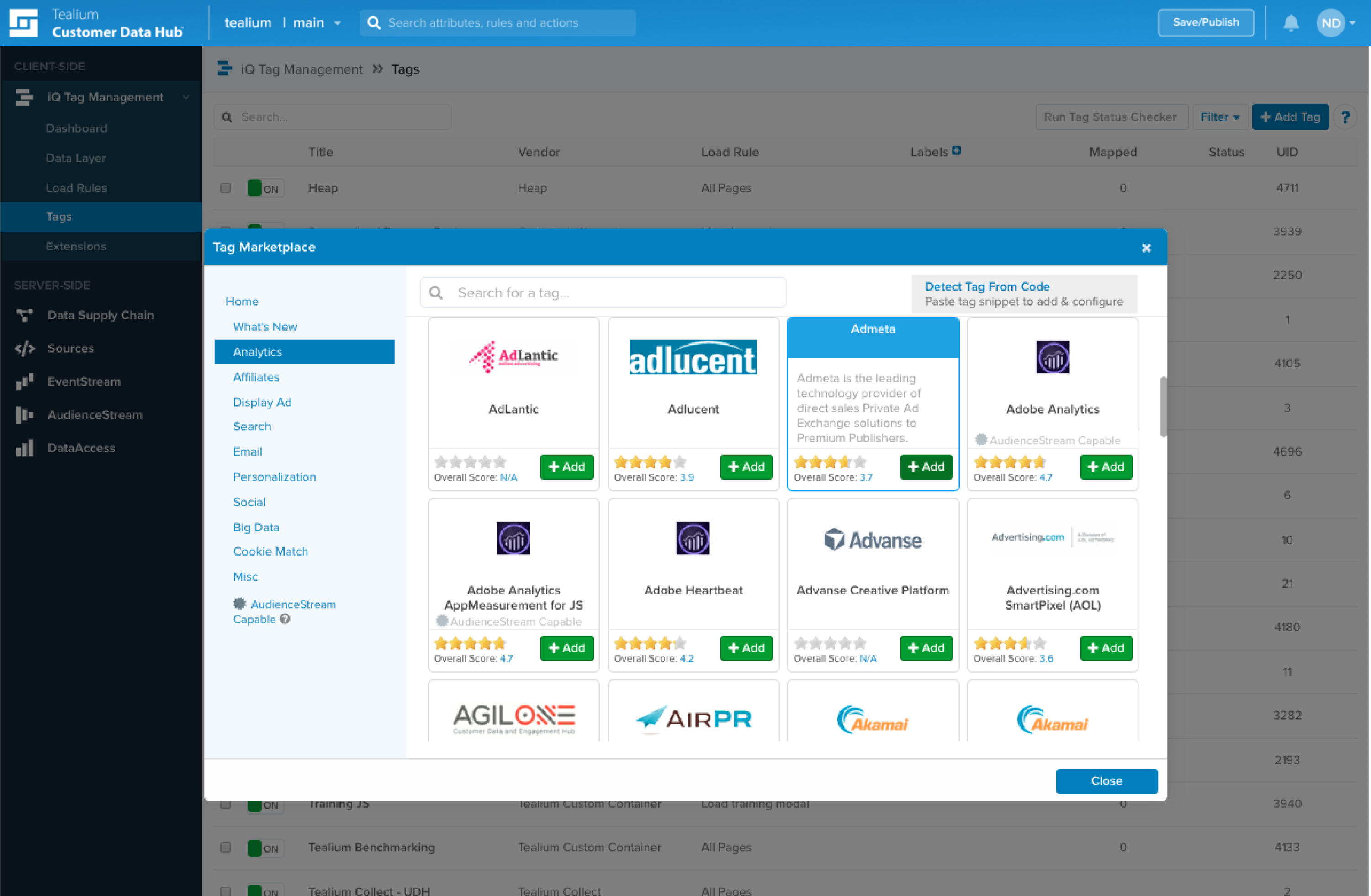
The Tealium Customer Data Hub powers capabilities across the data supply chain. Tealium universally collects customer data from any source including; websites, mobile applications, devices, kiosks, servers, and files. Data collected is then standardized in the data layer, which drives usage of data for customer engagement and analysis.
N/A
Pricing
Google Analytics
Tealium Customer Data Hub
Editions & Modules
Google Analytics 360
150,000
per year
Google Analytics
Free
No answers on this topic
Offerings
Pricing Offerings
Google Analytics
Tealium Customer Data Hub
Free Trial
No
No
Free/Freemium Version
Yes
No
Premium Consulting/Integration Services
No
No
Entry-level Setup Fee
No setup fee
No setup fee
Additional Details
—
—
More Pricing Information
Community Pulse
Google Analytics
Tealium Customer Data Hub
Considered Both Products
Google Analytics
Verified User
Manager
Chose Google Analytics
Google Analytics (free version) is typically my go-to recommendation for most companies. Small to medium size businesses, definitely. Larger organizations with need for a complex account structure / hierarchy and the need for highly customized analytics metrics, dimensions, …
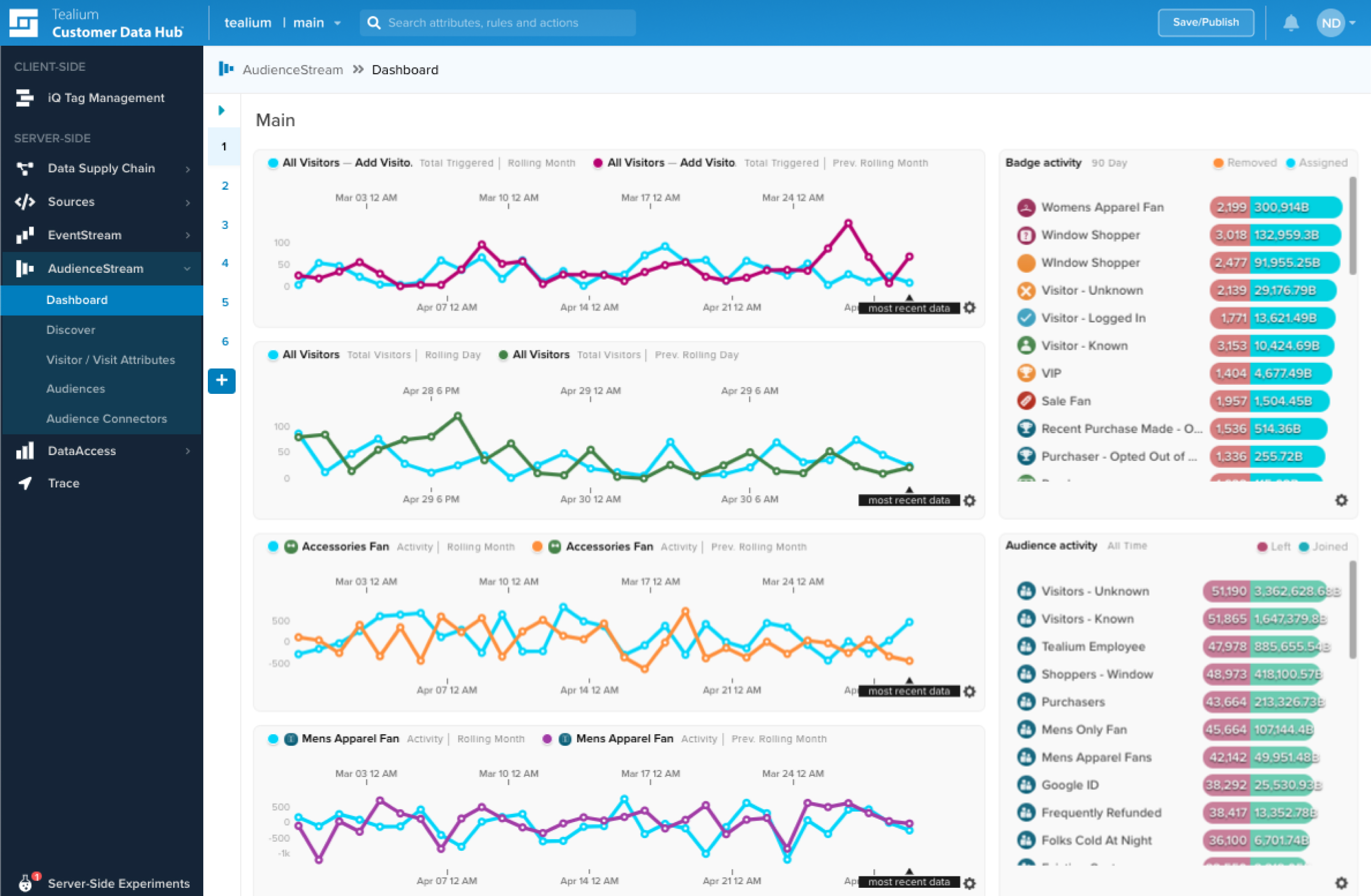
Google Analytics can potentially replace Tealium, especially on the event stream side. Audience stream Tealium is pretty good; not much good competition.
Verified User
Vice-President
Chose Tealium Customer Data Hub
Tealium Customer Data Hub is the clear leader in real-time capabilities, its platform agnostic approach means that it works well with everybody and doesn't require necessary features to be built or still be on the roadmap, or require custom workarounds to function.
Tealium Customer Data Hub focus on security and privacy is second to none, especially when you start to compare these to their competitors. This was one of the main reasons that we recommend it to our clients along with its ability to be easily managed by IT and marketing teams …
There are many ways to move to a 1st party data model, and it might not seem like Tealium Customer Data Hub is even necessary if you're doing your own data warehousing and have BI tools. What Tealium does is allows you to make sense of customer data and easily do something …
In the end, the overall scope of integrations available and the tools on hand were far greater on Tealium and couldn't be matched by any other company. The price is competitive but even though you will pay more, we found that it was worth the added expense. Can't speak to the …
Tealium Customer Data Hub has architected an end-to-end solution where some other solution providers have attempted to integrate various acquired technologies, and in many case not so well. In comparison with Google Tag Manager, being able to utilize support and professional …
Tealium Customer Data Hub is the most effective solution I've used so far in terms of collecting and managing data. We chose this tool because it has a reputation of being the best in the industry. We had also heard that Tealium has a support team second to none - which is …
Verified User
Consultant
Chose Tealium Customer Data Hub
Tealium iQ Tag Management System is strictly Vendor independent. Tealium uses a multi-content delivery network and can therefore be reached from anywhere at any time. Tealium's support is focused, the community is very large, and Tealium has been a pioneer in the field of tag …
As noted earlier, Tealium iQ is a more professional platform with dedicated account support (which you pay for) whereas Google Tag Manager is free and more of a "do-it-yourself" type of product. GTM is great for those first getting into tag management, and want to play around …
Tealium iQ Tag Management is very robust and extensible, however Google Tag Manager is a much better value. My recommendation is to evaluate your business's tagging and tracking needs and identify any deltas with cheaper solutions than Tealium iQ Tag Management can offer. Also, …
We evaluated Google Tag Manager, Ensighten, and Tagman. We found Google's limited tag library to be a non-starter for our needs. Tagman seemed to lack resources to compete with Tealium and Ensighten. We selected Tealium over Ensighten for three reasons:
Google Analytics is particularly well suited for tracking and analyzing customer behavior on a grocery e-commerce platform. It provides a wealth of information about customer behavior, including what products are most popular, what pages are visited the most, and where customers are coming from. This information can help the platform optimize its website for better customer engagement and conversion rates. However, Google Analytics may not be the best tool for more advanced, granular analysis of customer behavior, such as tracking individual customer journeys or understanding customer motivations. In these cases, it may be more appropriate to use additional tools or solutions that provide deeper insights into customer behavior.
Well suited: Any company that has a variety of data interspersed across multiple systems and is trying to get a more unified understanding of their customer profile—that enriched customer view of having all these disparate data sources and wanting to bring them together in a relatively seamless manner, and then having that more nuanced understanding of the entirety of the customer and being able to action off of it. Which again, I feel like is a core marketing use case.
Activation in real time - it's really good and you can literally see the information being activated in all other technologies that my clients use, like TikTok, Facebook, Google, et cetera. At the time that a client arrives on your website, you have instant data to enrich the profiles and activate on this channel. So this is really good and it's something that Tealium give us the control in order to do that.
The other thing is that you have the power to choose what data you want to collect and what data you do not want to collect. Tealium is particularly very good on doing that.
Audiences—don't they technically exist in Tealium? They are just streamed—no count, no backfill, etc.
Working backward to identify issues involves lots of clicking in the UI, going from audience to audience attribute, badge to event attribute, and so on.
You have to wait for a Real-Time event to see the payload. There is no sample or other option.
We will continue to use Google Analytics for several reasons. It is free, which is a huge selling point. It houses all of our ecommerce stores' data, and though it can't account for refunds or fraud orders, gives us and our clients directional, real time information on individual and group store performance.
I already know that my company has no plans to discontinue use of Tealium. We are heavily reliant on it due to a huge number of product teams and developers we would have to work with to place tags across many pages. Tealium is already there on the pages, and our application/product teams are familiar with how to integrate it. It is just the simplest way to ensure that new data requirements are implemented in a timely manner.
Google Analytics provides a wealth of data, down to minute levels. That is it's greatest detriment: find the right information when you need it can be a cumbersome task. You are able to create shortcuts, however, so it can mitigate some of this problem. Google is continually refining Analytics, so I do not doubt there will be improvements
Once you understand how it works and how to implement things, it is a dream and very user friendly. There is the initial learning curve but there are oceans of helpers available to you to help you bridge that initial gap and get going. Take the time to learn it up front and you will never have any problems. And support is great and available to answer questions
We all know Google is at top when it comes to availability. We have never faced any such instances where I can suggest otherwise. All you need is a Google account, a device and internet connection to use this super powerful tool for reporting and visualising your site data, traffic, events, etc. that too in real time.
This has been a catalyst for improving our site's traffic handling capabilities. We were able to identify exit% from our sites through it and we used recommendations to handle and implement the same in our sites. We have been increasing the usage of Google Analytics in our sites and never had any performance related issues if we used Analytics
The Google reps respond very quickly. However, sometimes they can overly call you to set up an apportionment. I'm very proficient and sometimes when I talk to reps, they give beginner tutorials and insights that are a waste of time. I wish Google would understand my level of expertise and assign me to a rep (long-term) that doesn't have to walk me through the basics.
The support team often is so quick to respond and so helpful when it comes to working with the needs of my clients and being able to resolve potential shortcomings or technical issues or surrounding the tool. There have been times more recently that I’ve gotten more generic service rather than the tailored experience that I have come to expect.
love the product and training they provide for businesses of all sizes. The following list of links will help you get started with Google Analytics from setup to understanding what data is being presented by Google Analytics.
I think my biggest take away from the Google Analytics implementation was that there needs to be a clear understanding of what you want to achieve and how you want to achieve it before you start. Originally the analytics were added to track visitors, but as we became more savvy with the product, we began adding more and more functionality, and defining guidelines as we went along. While not detrimental to our success, this lack of an overarching goal resulted in some minor setbacks in implementation and the collection of some messy data that is unusable.
Implementation had some bumps in the road and it was new for all of us, but for the most part, it was easier than many other implementations we've done with other technologies.
I have not used Adobe Analytics as much, but I know they offer something called customer journey analytics, which we are evaluating now. I have used Semrush, and I find them much better than Google Analytics. I feel a fairly nontechnical person could learn Semrush in about a month. They also offer features like competitive analysis (on content, keywords, traffic, etc.), which is very useful. If you have to choose one among Semrush and Google Analytics, I would say go for Semrush.
Tealium Customer Data Hub can do it all in one. Whereas, I think by using multiple Tealium Customer Data Hubs, we can utilize what each tool is really good at. In an ideal world, we'd like to use Tealium Customer Data Hub for everything, but one thing that we struggle with is Audience Segmentation, and we are looking for a one touch solution, without a lot of the work since the data is already there.
Google Analytics is currently handling the reporting and tracking of near about 80 sites in our project. And I am not talking about the sites from different projects. They may have way more accounts than that. Never ever felt a performance issue from Google's end while generating or customising reports or tracking custom events or creating custom dimensions
There has been a near immeasurable return on customer data and improvement of our quality for our physical products due to be in tune with the customer. This has changed our way of doing things for the better to gain a better flow and overall workplace experience.
A negative is that Tealium AudienceStream becomes harder to manuever and use data analytics for when a database has been existing for a fairly large amount of time. It goes from an agile ship to a huge vessel that takes many components to be able to move.