Adobe acquired Omniture in 2009 and re-branded the platform as SiteCatalyst. It is now part of Adobe Marketing Cloud along with other products such as social marketing, test and targeting, and tag management.
SiteCatalyst is one of the leading vendors in the web analytics category and is particularly strong in combining web analytics with other digital marketing capabilities like audience management and data management.
Adobe Analytics also includes predictive marketing capabilities that help…
N/A
Gainsight PX
Score 7.6 out of 10
N/A
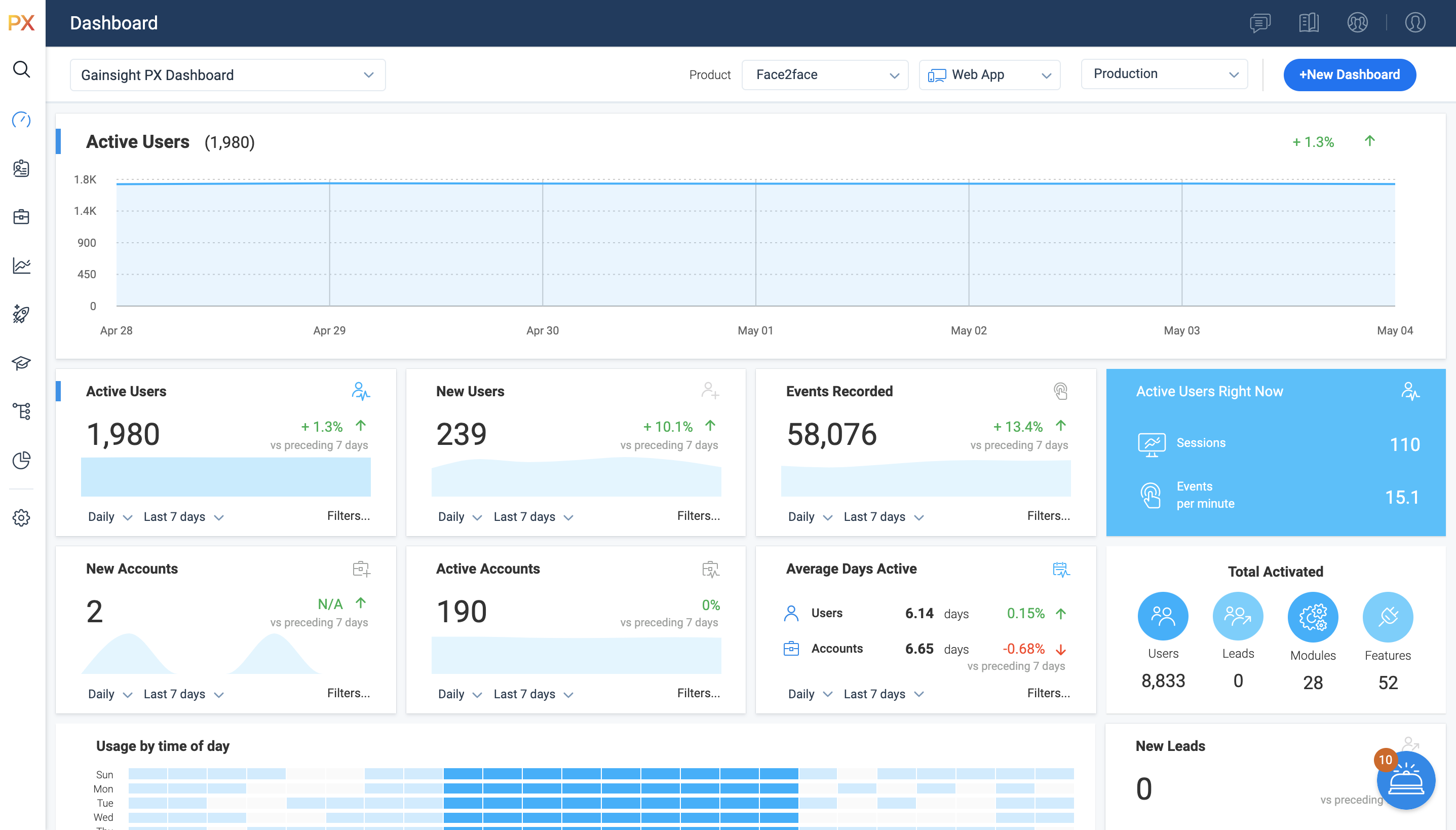
For SaaS products, Gainsight's product experience software enables companies to track every step of their user's journey and fully understand how they're interacting with a product over time.
I've used Google Analytics, which is probably the most direct competitor to Adobe Analytics, as well as Pendo Analytics, which is a little bit more of an adjacent product. It's more focused on product analytics rather than web analytics. I've also used Localytics, which is a …
Adobe in my mind, like I I've had clients that have used it, it feels like more of an enterprise, large size company type of solution. so yeah, it's been one of the, the two, you know, as I've been in advertising for 15 years, like IT and Google Analytics are the two big …
We evaluated and we currently use Mixpanel and we have Google Analytics on a couple of our properties. And honestly, once you get the hang of the Adobe Analytics workspace, the other products really don't stack up against it because the segmentation and the ability to create …
Compared to Google Analytics, Adobe Analytics is more powerful for deep segmentation and global analysis. It’s a bit less intuitive, but we chose it for flexibility, better cross-channel attribution, and the ability to handle complex user journeys at scale, which mattered more …
As I mentioned before, we identify a need to scale up our web performance in different languages and countries. Adobe Analytics allow us to use filters, segments, metrics inside an "all-in-one" report. No new web browser tabs to be loaded every time we need to change a date or …
I cant see direct compition with other products apart from one product which is Adobe Customer Journey Analytics. I'm generally suggesting to use Adobe Analytics with eCommerce platforms like Adobe Commerce as well as Adobe Experience Manager. It works best and easy to …
Google Analytics had issues with Geo locations, and our Markets were tracking less and less users. Also the GA is based on sampled data and it was not flexible enough for us to create different segments and classifications.
We felt Adobe Analytics was a much more robust platform and stacked that gave us much more depth into user behavior across our different channels. We needed a platform that had no sampling involved with a longer time. Period for analysis to ensure we were always able to pull …
Adobe Analytics is a more advanced tool which is used for complex business needs and it does require a lot of setup from the backend. However, when compared to tools like Google Analytics, it is significantly better with customization, personalization and attribution. It is …
Clients usually select Adobe Analytics because it suits them better than the alternatives and they want more customisation than GA4 offers. Also because they might be with Adobe Experience Cloud for a few other things like tag management, A/B testing, audience manager, campaign …
I have used and evaluated a few similar products to Gainsight PX, including Appcues, WalkMe, and Pendo. I found that Gainsight PX was the most comprehensive and user-friendly platform, offering features such as customizable onboarding flows, product usage tracking, and …
We leaned towards Gainsight PX because of the tight integration with Gainsight. Implementations were somewhat similar but the ease of mapping for all features and modules was superior for PX.
It's been a couple years since I've used Pendo and admittedly we were not set up in the best way for Pendo to work like we have PX. Specifically I am referring to how our elements were tagged.
That being said, here is what I recall as main differences:
The feature on Gainsight PX are easy to understand and implement in the solution, the pricing is also very competitive and functionalities like Customer health score, Customer monitoring, playbooks, surveys etc helps us to provide great insight to the team.
Heap has a great value proposition and very nice user experience. But it lacks the clear funnel analysis that Gainsight PX provides. Plus Heap also does not have integration with a lot of CRMs and Customer data platforms. Also, Additionally if you go in the market to find Heap …
I did not select Gainsight and we recently switched some of our products to other software which give us better targeting options but are more difficult to implement.
Mixpanel was much less mature when we ditched it for Gainsight, and the Salesforce integration was very important to us, and Gainsight was the main service that offered it at the time. Mixpanel is probably better today if you look at the big picture, and don't need a specific …
Churnzero is similar in its NPS and walk-through abilities as is user IQ but neither fits in the exact same category. Px is unique to anything I've used for the data extraction it offers. It's not a CS tool like those I mentioned but it is easily the best in terms of tracking …
HelpHero is a very flexible and powerful walkthrough tool. We've used it alongside PX. We still use PX for most customer messages, CES surveys, and in-app badges.
I also evaluated Pendo, WalkMe, and a few other DAPs.
Between the products analyzed, Pendo and Gainsight PX were most complete/mature. At the time, Pendo's UI seemed more intuitive than Gainsight PX. Chameleon and Appcues seemed easiest to use, but were lacking some of the functionality we were looking for. Ultimately chose …
Working with both Gainsight PX and Mixpanel, my experience has been that the integration of Gainsight PX was much easier. Additionally controlling profiles and personas to make sure each group is getting the data they need, and only the data they should see, is easier with …
The main reason is that Gainsight PX offers a perfect combo - analytics and customer engagement. That allows us to make the engagement contextual, based on real-time analytics results.
WalkMe: while the in-app engagements were powerful, there was no email capability, and the analytics were an afterthought (rather than a core part of the solution). WhatFix: the concept was great; the in-app engagements could be made into documentation and videos. However, we …
It is well suited for everything. I do because my advertising platforms will show me where I'm spending money and where I'm getting clicks, but you don't know anything beyond that. I always have to go into Adobe Analytics to see what those clicks are getting me. Are they actually visiting the website and doing anything we want them to do? And advertising, you can't just spend money without the results. So it allows me to close that loop and show the actions, in some cases, revenue, and the ROI for spending money. What's the return in revenue that we're getting? So I use it for everything. I can't look at the data that's in it. Adobe Analytics, when you live in the world of advertising, the contrary, you said, when would I not use it? So there are some instances where I'll go to a different sales-focused reporting platform or Salesforce reporting. Adobe Analytics is currently in our world at ESRI, but we don't have all that Salesforce data in Adobe Analytics. So that means I don't always go there for that sales-related data. I go into other reporting platforms to see that.
It’s a robust tool that allows you to easily map and track key features and actions within your products. It also allows for in app communications to help guide the user through the path you want them to follow. The ability to connect with Gainsight CS also allows you to leverage that data to drive actions for the account team, incorporate it in health scoring, and use it to trigger digital programs. You do need a well thought out strategy for management of the platform, the data and how you will use it.
It summarizes large complex data better than any other analytics solution I've dealt with without the need for sampling, gives the right level of detail, does the right level of breakdowns, aggregation. I consistently not only use Adobe Analytics, but I use other data sets and compare against Adobe Analytics. And as I go into Adobe Analytics and compare, as long as I've done the query right and the other systems, they're very, very close. And if anything, with a lot of Adobe's newer products, they've gotten more accurate over time. So that's basically, you asked me what I liked about it. I like that it's accurate. I like that I don't have to do a lot of explaining. There's enough explaining in the world of web analytics to have to go back and explain why data's problematic. And so like I said, provided that the implementation is correct, it's a very easy conversation. Even if people may not like the answer.
Mapping your product is easier with PX than with Google Analytics (mapping your product makes usage data appear as hits on mapped URLs, buttons, etc)
PX is good at showing simple messaging popups to customers.
PX Badge functionality—a persistent hover- and click-enabled popup launcher, positioned on select pages and attached to select elements—works well as a self-serve resource for users. It can be unobtrusive yet right there when needed.
PX modal content is fully editable HTML with plenty of flexibility.
Audience filters are really powerful. You can target users by many built-in and dev-configurable attributes, like device-type (which helped me work with mobile web users), browser, account, parts of the application visited/used in the last day, and many more.
Support. I mentioned this earlier and we don't know what we don't know. Researching the massive amounts of documentation isn't realistic with bandwidth constraints, and our rep getting frustrated with us when we go through what we are seeing is disappointing.
Education. More please, and designed more towards the "business side". I get with the many many many different implementations (every company is different!), that it's tough, but even a basic of the basics would be nice for situations that everyone is looking at, like the engagement with the merchandising on the home page (or any certain page).
We need it to discover threats long before they become a loophole in the security ecosystem. Also, it is very much compliant with customer standards and expectations. It provides marketing intelligence through in-depth analysis. Overall, a very good product to gain customer attention and thereby improve market
It is necessary to have a minimum knowledge on tracking tools so you can use the tool on full performance. It is not an introduction tool, so please bear that in mind. Once you got the knowledge you just need a small training on how to create your custom reports, where to find the components you need and how to add them to your dashboard. Then you share your report or create a rule for periodic sharing and it's done. Finally, if you have a lot of data stored the tool might be a little slower but that's ok.
It is a good product, but like with every product, there is room for improvement or even just things I, as a user, would prefer, such as the ability to click on a company and have it go to Salesforce instead of Insight. It can also be difficult to find certain reports.
I do not ever recall a time when Adobe Analytics was unavailable to me to use in the 8 or so years I have been an end user of the product. My most-used day-to-day analytics tool Parse.ly however, generally has a multiple hours planned offline maintenance every two to four weeks, and sometimes has issues collecting realtime analytics that last anywhere between 15 minutes to an hour, and happen anywhere between 1 to 5 times a month.
Overall, Adobe's servers seem responsive. Like any large-scale SAS provider, they can have occasional slowdowns where, I presume, a node is not available and other servers get bogged down with the user load. I have noticed this with both large and small data sets and reports.
On that note, Adobe Analytics can take a long time to run reports and pull various data points, depending on the period of time, number of metrics and segments applied. As you create reports, particularly in Workspace, the data are pulled in real-time while you're creating the report. This can often cause issues while trying to drag more metrics into the interface when certain elements of a table are grayed out because data is being pulled in.The more data points and segments involved, the longer it takes to update. When you look at larger windows of time, it takes even longer. If one were to compare to Google Analytics or one of the open source products like Piwik or Motomo, Adobe seems much slower. However, Adobe also supports far more variables than other web analytics products.
Support for Adobe Analytics is ok, it used to be worse years ago. Now, the technology team at Adobe is way more knowledgeable on the product itself as well as the implementation. They also study your custom implementation and have good knowledge of where your company stands. Dedicated support is something worth considering.
I have not had to contact support frequently but when I have I used the chat and my questions were answered immediately. I've also used their knowledge center, help documentation and training videos which are all very thorough. The support we've received from our Customer Success Manager has been helpful as well.
It was a one-day training several years ago that cost the organization several thousand dollars. There were only about 10 people in the training class. Adobe tried to cram so much information into that one-day class that none of our users felt like they really learned anything helpful from the experience. Follow-up training is too expensive
The online training for Adobe SiteCatalyst consists of short product videos. These are ok, but only go so far. For a while Adobe charged a fee for this, but recently made these available for free. There are many great blog posts that help users learn how to apply the product as well.
It is a large effort to implement. Throwing a developer with zero experience with Adobe Analytics with no support is a REALLY BAD IDEA!!! Having experienced developers working as a team is crucial to a strong implementation. I say this because I have experienced both scenarios. I was the only developer on an implementation project and I had no experience with Adobe Analytics. As a result I made many architecturally bad decisions which lead to a rigid fragile implementation that eventually was scraped. It took some hard lessons to learn that Adobe Analytics was not as simple as their sales reps make it sound. Using the Adobe Dynamic Tag Manager made sequential implementations incredibly STRONG. Having a DTM to manage the code was a miracle and a life saver!!! If you plan on doing a big enterprise level implementation, please seriously consider using the Adobe Dynamic Tag Manager!!! it made code maintenance super slick and easy which is super important for a developer!!!
I've used Google Analytics, which is probably the most direct competitor to Adobe Analytics, as well as Pendo Analytics, which is a little bit more of an adjacent product. It's more focused on product analytics rather than web analytics. I've also used Localytics, which is a mobile app analytics platform, which is there. In my experience, Adobe Analytics is far more full-featured and rich compared to Google Analytics and Pendo Analytics. Pendo has some interesting features that it offers that Adobe Analytics doesn't, but at an enterprise level, at least, or at a large organization scale, they're not critical features that are necessary. Adobe Analytics's flexibility in ingesting and exporting data makes it well-suited to environments like ours, where we need to merge web analytics data with other datasets we might have. And so that's been very effective for us. Localytics is strictly a mobile analytics platform, so it has some point level advantages, but the fact that Adobe Analytics is able to marry and kind of merge web analytics data with mobile analytics data into one kind of view of the data is a really nice feature that, in my mind, makes it superior to Localytics in general. And its Localytics reporting capabilities are far limited, I would say, from a reporting standpoint. All of the other competitors I've looked at, they're, the reporting capabilities are just not nearly as sophisticated as Adobe Analytics.
I have used and evaluated a few similar products to Gainsight PX, including Appcues, WalkMe, and Pendo. I found that Gainsight PX was the most comprehensive and user-friendly platform, offering features such as customizable onboarding flows, product usage tracking, and automated customer success workflows.
My organization uses Adobe Analytics across a multitude of brand portfolios. Each brand has multiple websites, mobile apps and some even have connected TV apps/channels on Roku and similar devices. Adobe can handle the multitude of properties that have simple, small(ish) websites and the larger brand properties that include web, mobile and connected TVs/OTT devices.
Each of those larger brands has multiple categories and channels to keep track of. We can see the data by channel/device or aggregate all the data together. This gives our executive teams the full picture and the departmental teams the view they need to see their own performance.
I think we're able to quantitatively analyze and report back on activities on our websites, where in the financial services sector, we really haven't been able to report that in the past. And so, as a company that has clutched onto paper as long as it possibly can, it's refreshing to our leadership to be able to report back and say these are exact things that are being done on our website that can lead to increased sales, increased signups, ease of use for our end users, et cetera.
Customer Sentiment. Customers have been excited when we can show them data around usage and where we can improve.
Deciding to remove features. We have used PX to identify features that have little to no usage which allows us to get rid of unnecessary process and maintenance.
Identifying areas of improvement. We are able to find areas of our product that we need to focus on improving where previously we would have missed or had a tough time justifying spending time and resources.