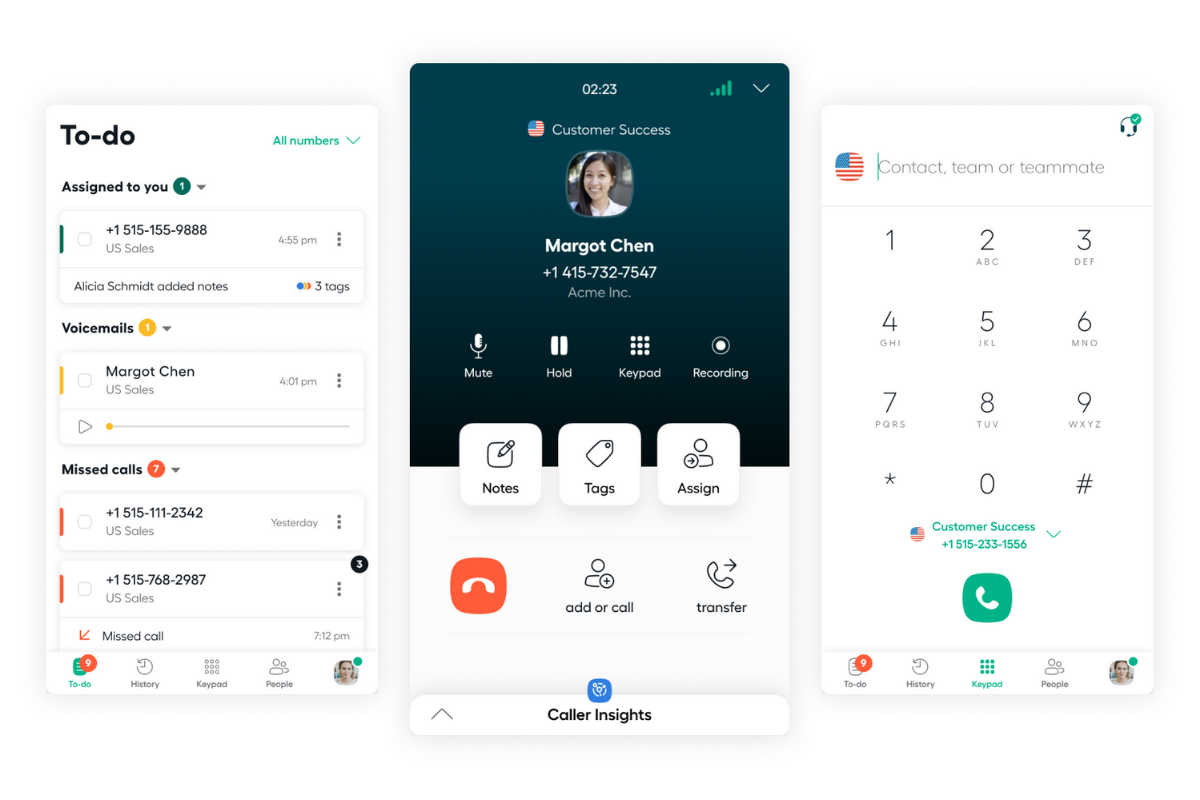
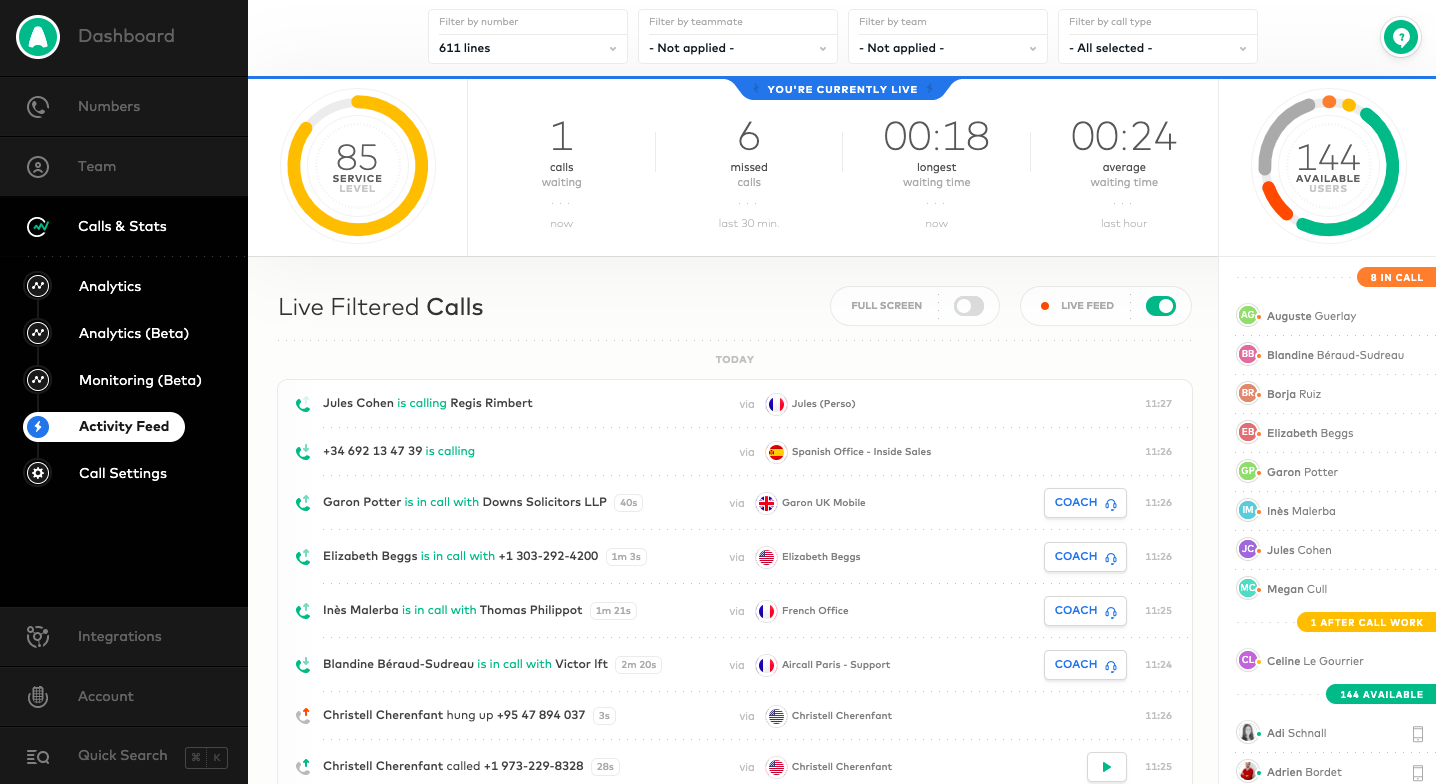
Aircall headquartered in Paris provides a VOIP system for business designed to support contact centers, featuring IVR and automated call routing, conference calls, shared call inbox and call notes, unlimited concurrent calls and call queuing, and many integrations with CRM or marketing systems to support a variety of support or sales purposes.
$40
per month per license
Webex Calling
Score 8.8 out of 10
N/A
Webex Calling is Cisco’s flagship cloud calling solution with over 12 million users worldwide. It delivers an enterprise-grade calling experience that enables customers to replace PBX hardware with a cloud calling solution. Webex Calling's connectivity and collaboration experience includes calling, meetings, messaging, contact center, and integrated devices.
Aircall is a more smooth and easy to use against other tools that are out in the market today. This is the tool I used for two different companies and by just that it proves how effective and good Aircall is. I love the functions and how user friendly it is.
Aircall’s integration to our CRM, salesforce is second to none. Right after a call is made it is uploaded into salesforce right away and is a great way for our reps to reference back on.
dialpad was far more of a struggle to access call recordings for my reps as not only was …
Aircall is a little different from Intercom in that it is specifically for phone and text BUT Intercom just released phone calls and texting options.....
Aircall has a better interface and IVR system then Groove. It also does a much better job integrating with our CRM (Salesforce) and pulling caller IDs from our database vs Groove. I prefer Aircall over Groove and HubSpot, primarily becasue we are a smaller organization and it …
I am not the right person to answer this because I don't make the purchase decisions within our company. I have worked with several companies, and every one of them has their tools. I particularly liked Aircall among all of them because of the different reasons I have already …
We have used Aircall for so long that I cannot remember the name of the company we were using beforehand. I remember that we did make the switch to Aircall because the connection was stronger. We often had call quality issues with the other guys. While this does occur every now …
Aircall is loads better than Grasshopper due to its ease of use and overall platform. Grasshopper is fine, but the price is about the same and Aircall is smoother (and prettier). The only disadvantage if moving from RingCentral to Aircall is the texting feature. Aircall does …
Zendesk could not help us expand our numbers abroad due to too restrictive regulations applied. Aircall however, if provided with appropriate documents, allowed us to keep existing phone numbers and expand them
We used to answer phone calls on our fix line when at the office. The quality was very bad but we had in mind that a VOIP solution would be too expensive. When lockdown began last year, I had to redirect calls on my own mobile phone which was not efficient. Also I couldn't …
Groove was easily integrated with Salesforce CRM and meant that certain administrative tasks were a lot easier and less time consuming to do. The standalone dialer application (Windows) is easier to use than the Groove dialer, and uses far less resources. The addition of …
The only thing that is better than Aircall against Google Meets, is that Google meets has a camera option. However, that is not applicable for speaking to customers, but rather team mates.
It is the first product that we have used. We have not evaluated another option.It is the first product that we have used. We have not evaluated another option.It is the first product that we have used. We have not evaluated another option.It is the first product that we have …
We previously used Grasshopper. It was cumbersome and the web option was not user-friendly. It did incorporate texting but would not integrate with our CRM so we switched to Aircall. Aircall's interface is nicer to use and we are happy with the switch.
They had strong support, but their connectivity was the worst out of all of them and their product was also probably the least customizable for your company.
CUCM was great years back, as it was very granular in its configuration and could collect logs to determine any issues. However, being on-prem made it challenging to maintain and keep the version up to date. Also, Webex calling now has almost all the features CUCM had, and even …
Teams perfectly fit with o365 tools, but for Cisco environments, Teams is not the best tools. Webex Calling has a native compatibility with Cisco's own support infrastructures and devices. Overall, the two tools are complementary rather than competing. Teams is used for …
I use both Webex Calling and Teams on daily basis. One is for internal communication and other with customers. Both the products have similar kinds of features. One major differentiation is video quality. Webex Calling has better video quality. MS Teams has better eco system …
I also use Microsoft Teams for my customers that are Microsoft House, but I prefer Cisco Webex. Microsoft Teams definitely doesn't stack up against Cisco, but it is maturing. There's certain features that some of my customers use that aren't available right now in production. …
Webex Calling easily stacks up against the competition because Webex Calling is all inclusive inside the Webex. Suite, unlike other companies and providers where you have to piece together. A full solution from 4 different products we've used 12 different web pages to manage …
The main thrust of the project was to contain costs and reduce overhead for device (physical phone) management. Since we already had somewhat of an investment in Cisco infrastructure, Webex calling seemed a natural option to evaluate. I was not involved in the product …
We are trying to keep a uniform style of communications and would like to have it across one platform that is easy to use and simple for users in the long run.
The best thing about Webex Calling is its quality and innovation, as they frequently add capabilities and features to the service without requiring additional payments. This isn't the case with Avaya or Microsoft. Furthermore, Cisco Webex Calling can now be integrated with …
Webex Calling is in the top 3 of best cloudcomms solutions, together with teams and Zoom. cisco has the strongpoint of being a joint portfolio offer, where you can acquire the routers/switches/wifi together with the UC making if simpler to have just one provider to work with. …
It does have an advantage due to the name attached behind it, that is Cisco. Due to that it makes it more reliable and trusted solution followed by the integrity they provide us. I fell that it is the best solution available in the market so far. The features and the …
Aircall is great for anyone who has multiple team members calling from the same number or a team that needs to call from many different numbers. The way Aircall allows users to organize people and numbers is extremely customizable and efficient. I think just about any business could benefit from using Aircall and highly recommend it!
Webex Calling is a cloud based enterprise grade calling solution backed by Cisco's strong collaboration expertise. This makes Webex Calling a robust solution as compared to other players in the market. It offers vide variety of calling related features to make the user experience rich and satisfactory. Enterprises which requires strong collaboration for its people working in office or remotely from home will benefit a lot from this cloud calling solution.
The calling features and also that it's web-based and that people and their devices don't have to be connected to the company network for it to function. They can run it right off their home network. So when they're working remote, we don't have to provide a VPN endpoint to connect the product back to the server.
No feature to update more than one phone line at the same time
Admins don't have access to the timeline of a call to see with which agent it rang
Missing agent-specific stats when your phone lines are organized in teams
If calls are setup to ring to a first group and then a second, if the whole first group is already busy, it does not go to the second group but puts the customer on hold
I give this rating as aircall is very easy to use but also lacks a parallel dialing feature which makes it slower to use. aircall has a pretty seamless integration with salesforce which is helpful. For the cost it is definitely very reasonable but it also lacks a live coaching/listening feature which is very valuable as a manager.
The service can be intermittent and the call forwarding feature will not always work perfectly. There will be periods of time where the calling feature will not work at all and people on the other end can hear me but I am unable to hear them. It also requires a fairly strong signal which can be an issue if you work somewhere remote or a building without much service.
I provide this rating based on my overall experience using Aircall. I have used it on my previous company as well and that being said, it is a proof that Aircall is a great tool to use in contact centers and with B2B businesses that has direct communication with clients.
Cisco Webex Calling is an outstanding cloud collaboration that includes enterprise-grade cloud phone system designed for the modern hybrid workplace. Webex Calling integrates calling, messaging, and meetings into a single, intuitive platform, empowering your teams with unparalleled flexibility and productivity. Benefit from advanced features like HD audio and video, voicemail to email, call forwarding, and intelligent call routing, ensuring crystal-clear communication and efficient workflows from any device, anywhere. Webex Calling prioritizes security and reliability, offering redundant data centers and end-to-end encryption to safeguard your conversations. Its scalable architecture effortlessly adapts to your envolving business needs, providing a future-proof communication foundation. Enhance collaboration and streamline operations with a solution that's not just a phone system, but a comprehensive communication hub.
I've not actually had it ever be unavailable when I needed to use it. As mentioned before, a network outage would take it down, but we have redundant systems for our network connections with automatic failover.
I don't really see this impacting any other system performance at all. The client is very light use on resources, even on my iPhone. I don't know what else it connects to behind the scenes other then the campus directory, but I haven't seen or heard of any impacts. It seems fairly self contained except for wherever it interfaces with the general telephone system connectivity outside the campus.
We've enjoyed using Aircall so far and have had no issues with it. The platform is easy to use, looks nice, and makes it easy to keep track of everything.
I have been working for a long time with Cisco as a provider and also Cisco TAC and Cisco Support Engineers. The support starts right beforehand in the documentation of the product you are interested in. From the start you have a good, complete, and detailed and easy to read datasheet and there's always someone available to answer any questions.
I am not the right person to answer this because I don't make the purchase decisions within our company. I have worked with several companies, and every one of them has their tools. I particularly liked Aircall among all of them because of the different reasons I have already mentioned before.
CUCM was great years back, as it was very granular in its configuration and could collect logs to determine any issues. However, being on-prem made it challenging to maintain and keep the version up to date. Also, Webex calling now has almost all the features CUCM had, and even more. The only request I will have is reporting and logs collection to track an issue on a line/user/device.
So far it has been very reliable, with very little down time that was associated with the product itself. We have had network outages due to external factors such as construction cutting a fiber link, but other than that kind of thing not much for failures.
Because of the lack of local partnerships with South African telecoms companies, calls to South Africa is very expensive. This was not originally apparent when opening the Aircall account.
Not having the option to display a local South African number in the CLIP, means that people are not always eager to pick up the phone when they see an overseas number ringing.
The only positive impact has been the collaborative experience and being able to maintain a virtual office
Certainly when it comes to my client base, they certainly understand the benefits of the full end-to-end, Cisco stack. And when I talk about a calling platform in regards to it simply being a call from one end to another or a message from one end to another, Cisco provides so much more because it enables all that AI and I guess analytical data of which the endpoints cover. So when it comes to integrating with a meeting room experience and you're in a meeting room that can cater for up to 20 people, but say for example, only two or three people on average utilize that room, that type of safe spacing information gets transmitted into other business decisions that can benefit the business from an ROI perspective such as rearranging the interior design to create better outcomes for worker experiences. So much more than just a calling platform.