Anaplan is a scenario planning and analysis platform designed to optimize decision-making in complex business environments so that enterprises can outpace their competition and the market. By building connections and collaboration across organizational silos, the Anaplan platform surfaces key insights.
N/A
Google Analytics
Score 8.2 out of 10
N/A
Google Analytics is perhaps the best-known web analytics product and, as a free product, it has massive adoption. Although it lacks some enterprise-level features compared to its competitors in the space, the launch of the paid Google Analytics Premium edition seems likely to close the gap.
$0
per month
GoSquared
Score 9.0 out of 10
N/A
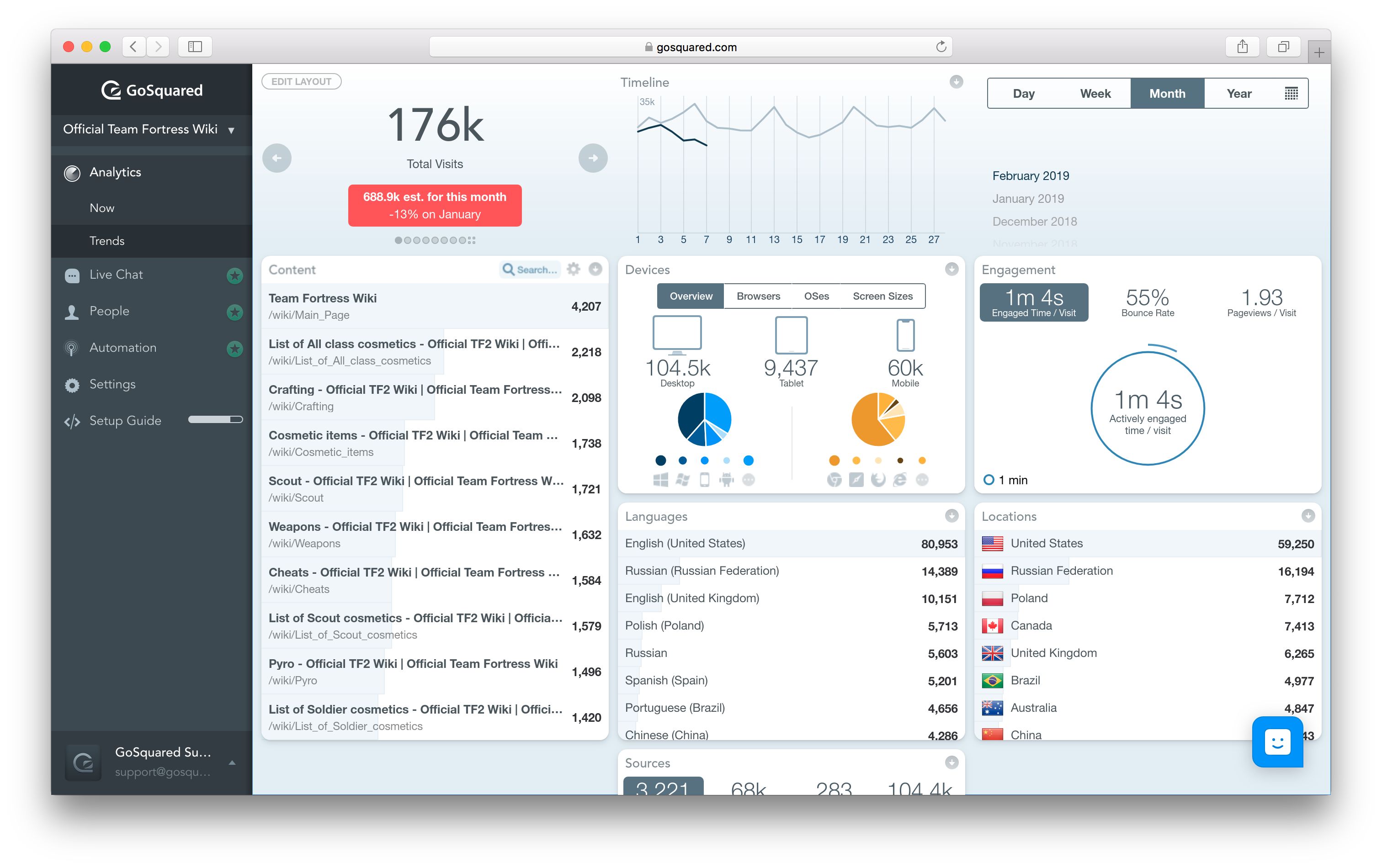
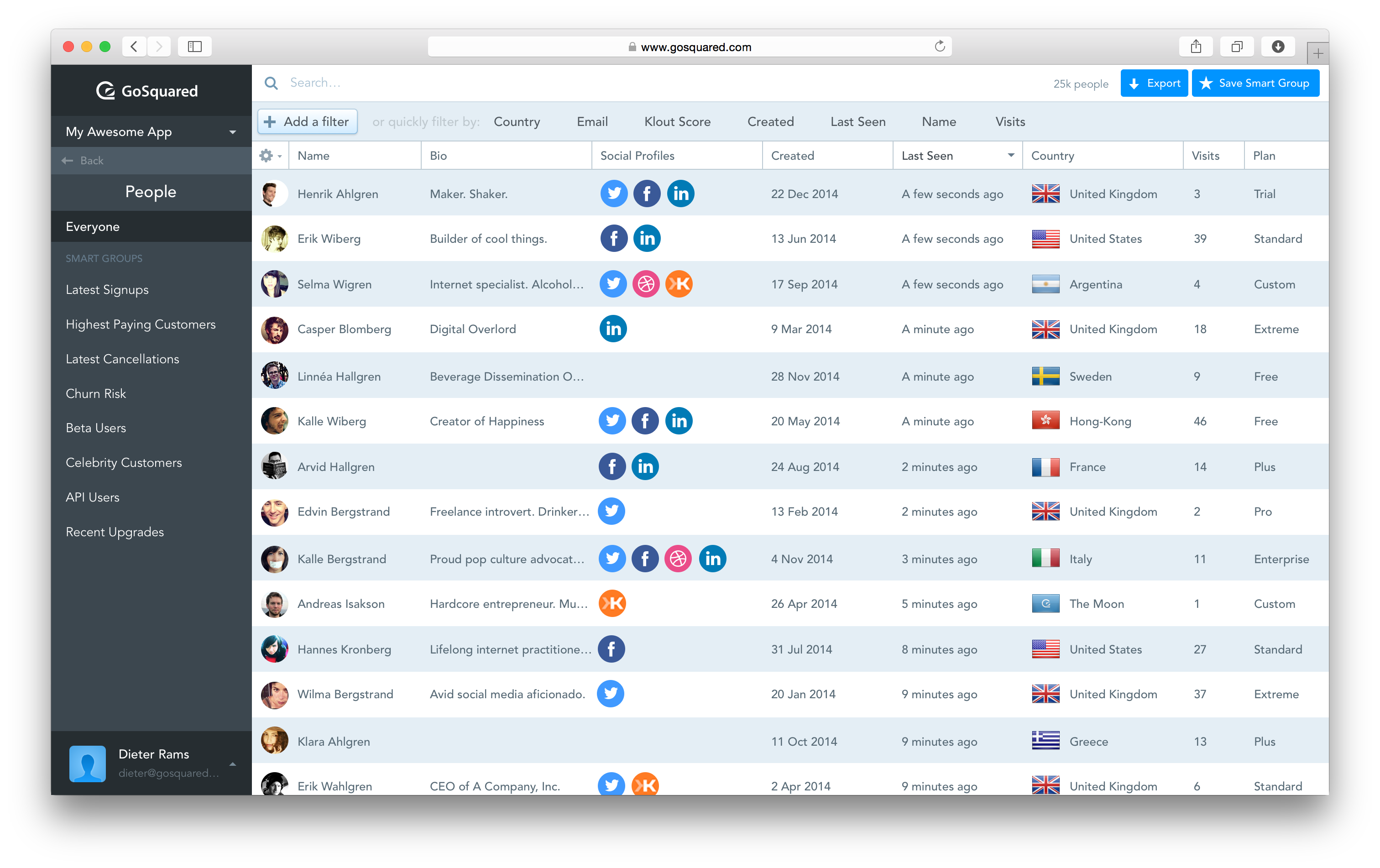
GoSquared provides real-time website analytics to sites of all sizes. The real-time dashboard displays website analytics on an individual visitor basis. The Now App displays concurrent analysis (the visitors who are on your site right now) of your site performance. The Trends App displays historical, trends and comparison analysis on real-time data. You don't have to wait 4 - 24 hours in order to compare todays current performance against last years. The Ecommerce App displays the same freshness…
$0
Per Month [Unlimited Users]
Pricing
Anaplan
Google Analytics
GoSquared
Editions & Modules
No answers on this topic
Google Analytics 360
150,000
per year
Google Analytics
Free
GoSquared Free - Access to the Now and Trends realtime web analytics dashboard.
$0
Per Month [Unlimited Users]
GoSquared Analytics - Everything included in free plus premium analytics features.
$29
Per Month [Unlimited Users]
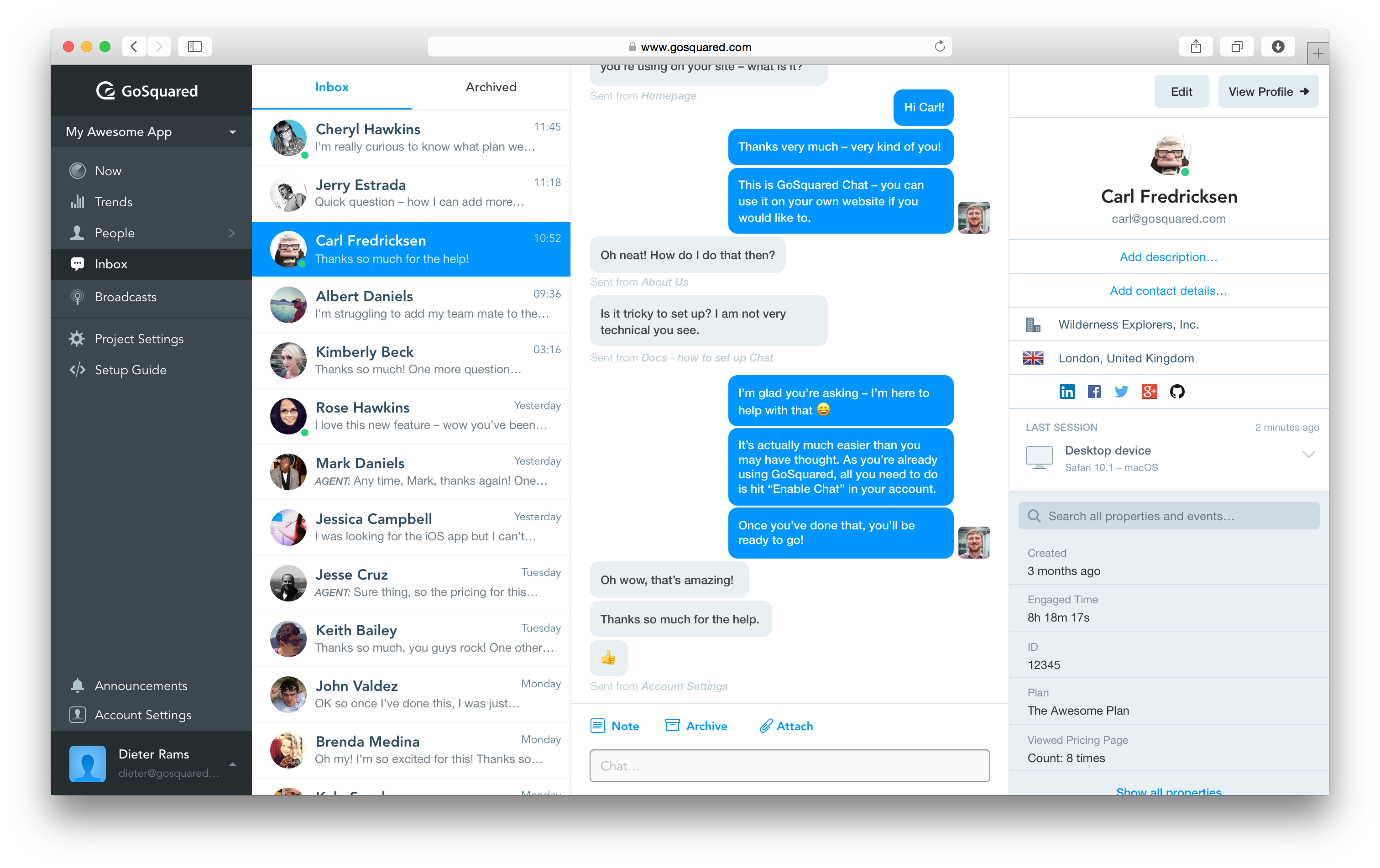
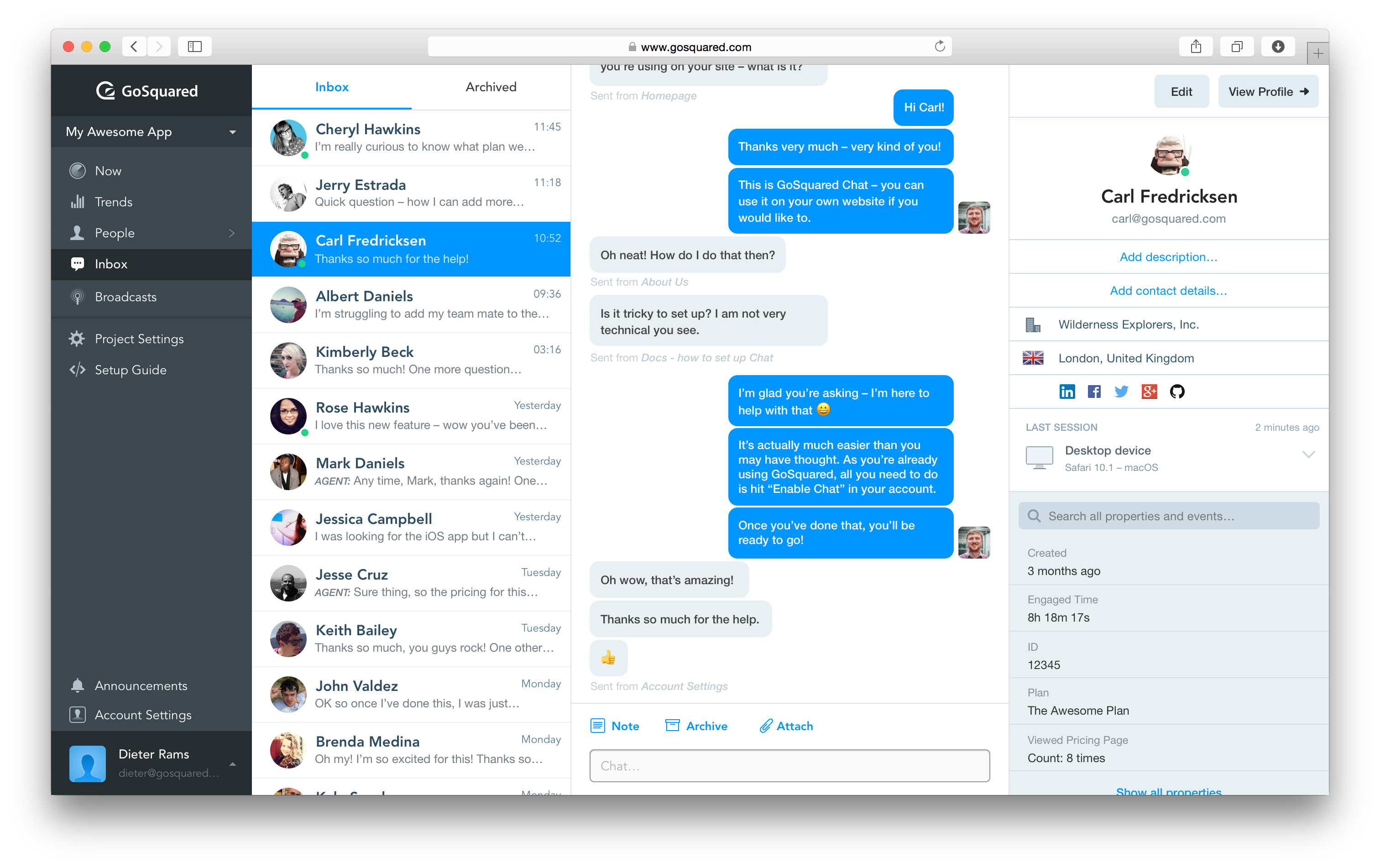
GoSquared Suite - The most popular GoSquared plan, full access to our real time analytics dashboards, intelligent live chat and customer data hub.
$79
Month [Unlimited Users]
Offerings
Pricing Offerings
Anaplan
Google Analytics
GoSquared
Free Trial
No
No
Yes
Free/Freemium Version
No
Yes
Yes
Premium Consulting/Integration Services
Yes
No
Yes
Entry-level Setup Fee
Optional
No setup fee
No setup fee
Additional Details
—
—
GoSquared Free, track up to 1000 pageviews a month. GoSquared Analytics, track up to 100k pageviews a month with pricing starting at £29/month. GoSquared Suite, track up to 100k pageviews a month with pricing starting at £79/month.
Anaplan is more flexible, easier to use, has a better user interface and performs better.
Google Analytics
Verified User
Executive
Chose Google Analytics
Honestly, I don't think any other options really stack up at all but these have a few great features... Matomo - planned integrations with Google Ads, Bing Ads, and Facebook Ads. Woopra - real-time, on-the-fly things like sending a message to a sales Slack channel right when a …
For simplicity & real-time data, GoSquared beats Google Analytics easily. However, for more complex analytics requirements, GoSquared simply doesn't support the vast array of reporting abilities which Google Analytics affords.
Google Analytics is massively bloated and can be difficult to configure, navigate and understand. While GoSquared doesn't provide the feature set that Google Analytics does it focuses on providing the best experience for the features it does offer. If you just want to know who …
GoSquared acts as an end-to-end tool taking care of most of the needs of the organizations unlike most of the competitors. Even while covering a vast scenario, GoSquared handles all the tasks pretty well.
GoSquared is easier and more intuitive to use, also less advanced but it offers enough functionality for most websites. It can be used in conjunction with more advanced tools.
I use GoSquared in tandem with Google Analytics on my site since I don't need an all-in-one marketing software for this site. I love the clean, easy-to-read reports that I receive from GoSquared on a daily/weekly/monthly basis. The graphs are easy to interpret and it pulls the …
For realtime analytics, GoSquare is my go to pick since it does it really well and is very simple to use. The dashboard is also really great to show the team analytics of our website at a glance.
As I said previously, I rather pay for a superb product than use a good free product. I think GoSquared beats Google Analytics on user-friendliness, usability, and UX. The team seems to not stand still and is always innovating, which I value, too.
Features
Anaplan
Google Analytics
GoSquared
BI Standard Reporting
Comparison of BI Standard Reporting features of Product A and Product B
Anaplan
7.3
234 Ratings
4% below category average
Google Analytics
-
Ratings
GoSquared
-
Ratings
Pixel Perfect reports
6.47 Ratings
00 Ratings
00 Ratings
Customizable dashboards
7.8234 Ratings
00 Ratings
00 Ratings
Report Formatting Templates
7.96 Ratings
00 Ratings
00 Ratings
Ad-hoc Reporting
Comparison of Ad-hoc Reporting features of Product A and Product B
Anaplan
9.1
8 Ratings
12% above category average
Google Analytics
-
Ratings
GoSquared
-
Ratings
Drill-down analysis
9.18 Ratings
00 Ratings
00 Ratings
Formatting capabilities
9.18 Ratings
00 Ratings
00 Ratings
Report sharing and collaboration
9.18 Ratings
00 Ratings
00 Ratings
Report Output and Scheduling
Comparison of Report Output and Scheduling features of Product A and Product B
Anaplan
8.4
239 Ratings
2% above category average
Google Analytics
-
Ratings
GoSquared
-
Ratings
Publish to Web
8.67 Ratings
00 Ratings
00 Ratings
Publish to PDF
8.2237 Ratings
00 Ratings
00 Ratings
Report Versioning
8.8208 Ratings
00 Ratings
00 Ratings
Report Delivery Scheduling
7.98 Ratings
00 Ratings
00 Ratings
Data Discovery and Visualization
Comparison of Data Discovery and Visualization features of Product A and Product B
I've implemented a number of projects for Anaplan for Sales Performance Management use cases. It is obviously built for financial planning, but it allows for a lot of flexibility for territory and quota, ICM, sales forecasting, and other important use cases. Territory and Quota is very powerful in the tool as it organize complex assignment structures into hierarchies for easier analysis and reporting.
Google Analytics is particularly well suited for tracking and analyzing customer behavior on a grocery e-commerce platform. It provides a wealth of information about customer behavior, including what products are most popular, what pages are visited the most, and where customers are coming from. This information can help the platform optimize its website for better customer engagement and conversion rates. However, Google Analytics may not be the best tool for more advanced, granular analysis of customer behavior, such as tracking individual customer journeys or understanding customer motivations. In these cases, it may be more appropriate to use additional tools or solutions that provide deeper insights into customer behavior.
1) Maintaining customer relationships - GS just makes it so easy to respond to our users who use our product more from a tactical point of view 2) Onboarding - I think it's more or less an extension of the first point above but GS does make it easy for us to onboard new clients who are sort of beginners.
Anaplan removes the time consuming process of integrating the results of individual spreadsheets.
Anaplan facilitates the standardization of assumptions across all sub-processes
Anaplan provides full transparency of the calculations and source inputs
Anaplan allows us to automate certain planning processes that would have been impossible when relying on the computational capabilities of an individual computer.
Anaplan is a very strong multi-dimensional modeling tool that provides a calculation engine to empower a complex planning process. It is fairly easy to learn for those with experience in similar tools, or excel. It forces structure and auditability that spread sheets do not have, along with extensive security capabilities
We will continue to use Google Analytics for several reasons. It is free, which is a huge selling point. It houses all of our ecommerce stores' data, and though it can't account for refunds or fraud orders, gives us and our clients directional, real time information on individual and group store performance.
Not only does the GoSquared application work well, the GoSquared team is constantly making improvements. When I first started using GoSquared, they only offered daily reporting -- now they offer the weekly and monthly feature per popular request. I like that they are always updating the look and feel of the website and emails they send to maintain a modern look. GoSquared is easy to implement and easy to use!
As a user it is a very simple tool, but at the same time with a very mature and powerful calculation engine. It is very easy to switch from excel or traditional tools with added capabilities of multi dimensionality and real time calculation engine to see quick insights needed to create plans and scenarios
Google Analytics provides a wealth of data, down to minute levels. That is it's greatest detriment: find the right information when you need it can be a cumbersome task. You are able to create shortcuts, however, so it can mitigate some of this problem. Google is continually refining Analytics, so I do not doubt there will be improvements
There are very few outages. Maintenance is scheduled on two or three Saturdays per month, so as not to affect businesses. When there is an outage, users are kept informed of progress to restore the platform and typically this takes no more than an hour. Anaplan customer support is very responsive if we ever have questions about platform issues
We all know Google is at top when it comes to availability. We have never faced any such instances where I can suggest otherwise. All you need is a Google account, a device and internet connection to use this super powerful tool for reporting and visualising your site data, traffic, events, etc. that too in real time.
Everything is calculated in memory in the cloud. It's nearly instantaneous updates when you make changes. The only time things get a little slow is when you have a massive model with very intricate calculations...but "slow" for Anaplan is not what I would call "slow" for something like Hyperion. We used to have Hyperion calcs that ran for 60 mins before you could use data. The equivalent would be 60 seconds in Anaplan.
This has been a catalyst for improving our site's traffic handling capabilities. We were able to identify exit% from our sites through it and we used recommendations to handle and implement the same in our sites. We have been increasing the usage of Google Analytics in our sites and never had any performance related issues if we used Analytics
Support quality has dropped since Thoma Bravo has taken over. I think some serious re-focus needs to happen here -- part of the beauty of being in the Anaplan community was how involved you felt in it before. Before I didn't dread sending a support ticket, now I am starting to.
The Google reps respond very quickly. However, sometimes they can overly call you to set up an apportionment. I'm very proficient and sometimes when I talk to reps, they give beginner tutorials and insights that are a waste of time. I wish Google would understand my level of expertise and assign me to a rep (long-term) that doesn't have to walk me through the basics.
In my opinion, in-person training is always the best if you have the option to do so. This allows real-time interactions with the instructions, whereas the online training I took required me to write-down questions, email them, and wait for responses. This slows down the process, as you can imagine. That said, in-person training is an extra cost and it likely isn't needed for everyone. I would suggest selecting a small number of people to take in-person training and then having them act as mentors to the rest of your team. That way, as the rest of the team takes the online training, they have a resource to help them in real time.
Anaplan training materials are clear, simple, easy to understand and to follow. Visuals are excellent. The vendor is good at updating training materials in a timely manner and encouraging users and administrators to keep coming back to Academy site for refresher courses or new feature courses. I really like their interactive diagrams
love the product and training they provide for businesses of all sizes. The following list of links will help you get started with Google Analytics from setup to understanding what data is being presented by Google Analytics.
One key insight from implementing Anaplan is that success comes from focusing on designing the process, not just building the model. Anaplan is extremely flexible—there are very few planning scenarios it cannot support—but that flexibility means the project needs strong governance, clear ownership of requirements, and a well-defined data model. When those foundations are in place, implementations are fast, iterations are easy, and users can quickly see value. In our projects, both Financial Planning and Integrated Business Planning models were adopted smoothly because we involved business users early, kept the model design intuitive, and leveraged Anaplan’s Excel-like syntax and user-friendly dashboards. The result was more efficient day-to-day work, reduced manual tasks, and increased collaboration across teams. In short: when you combine Anaplan’s flexibility with a structured implementation approach, adoption and value realization happen quickly.
I think my biggest take away from the Google Analytics implementation was that there needs to be a clear understanding of what you want to achieve and how you want to achieve it before you start. Originally the analytics were added to track visitors, but as we became more savvy with the product, we began adding more and more functionality, and defining guidelines as we went along. While not detrimental to our success, this lack of an overarching goal resulted in some minor setbacks in implementation and the collection of some messy data that is unusable.
Anaplan is more powerful than Pigment considering that it is an Enterprise class system and is able to manage bigger data sets. Anaplan allows for advanced scenario modeling and formula capabilities along with custom reporting functionalities. Anaplan has proven its capabilities and stability across various use cases and across bigger enterprises when compared to Pigment which is still in earlier phases of its development
I have not used Adobe Analytics as much, but I know they offer something called customer journey analytics, which we are evaluating now. I have used Semrush, and I find them much better than Google Analytics. I feel a fairly nontechnical person could learn Semrush in about a month. They also offer features like competitive analysis (on content, keywords, traffic, etc.), which is very useful. If you have to choose one among Semrush and Google Analytics, I would say go for Semrush.
Google Analytics is massively bloated and can be difficult to configure, navigate and understand. While GoSquared doesn't provide the feature set that Google Analytics does it focuses on providing the best experience for the features it does offer. If you just want to know who is visiting your website and when then GoSquared is a simple way of tracing this information.
We have managed to leverage Anaplan for financial planning and forecasting across the business. It is now used by almost every department, with more than 50 users (but I know of companies that have hundreds of users) and still the platform is quick and reliable. It is easy to make changes to divisions and departments or add users and apply different user settings - the core part of the model is not affected and end users can continue their work without any disruption
Google Analytics is currently handling the reporting and tracking of near about 80 sites in our project. And I am not talking about the sites from different projects. They may have way more accounts than that. Never ever felt a performance issue from Google's end while generating or customising reports or tracking custom events or creating custom dimensions
Anaplan's implementation led to a significant reduction in planning cycle errors and bugs, streamlining processes and improving overall accuracy in data inputs
Standardizing the planning process and enabling cross-functional collaboration through Anaplan enhanced our ability to adapt swiftly to changing business needs, resulting in improved agility in decision-making
The platform's capabilities, especially in Demand Planning and Supply Chain, positively impacted our ROI by optimizing resource allocation and solving complex business problems efficiently across multiple functions
GoSquared helps us to react quickly to high volumes of traffic, and allows us to identify very quickly how engaging our content is
Using browser specs helps us to ensure our websites are compatible with as many of our customers as possible, rather than relying on generic global stats