Apache Kafka is an open-source stream processing platform developed by the Apache Software Foundation written in Scala and Java. The Kafka event streaming platform is used by thousands of companies for high-performance data pipelines, streaming analytics, data integration, and mission-critical applications.
N/A
Rubrik
Score 8.3 out of 10
Mid-Size Companies (51-1,000 employees)
Rubrik is cloud data management and enterprise backup software provided by Palo Alto-based Rubrik, Inc. It is a software platform that provides backup, instant recovery, archival, search, analytics, compliance, and copy data management in one secure fabric across data centers and clouds.
N/A
HPE Zerto Software
Score 8.9 out of 10
Enterprise companies (1,001+ employees)
HPE Zerto Software aims to enable customers to run an always-on business by simplifying the protection, recovery, and mobility of on-premises and cloud applications.
We looked at Cohesity and it could've been a contender had we not already gotten in bed with Rubrik. They seemed to have the same answers to our old problems as Rubrik with a simple platform. While nice, they were not providing anything extra or even close to make us consider …
I think Rubrik, VEEAM and Zerto are great products, really depends on the use case. Zerto is probably the best real time replication technology available for VMs to a single or multiple DR datacenter. They claim they have backup capabilities but they are not in the ballpark of R…
Zerto was far and away from a much better product than RecoverPoint. EMC was unable to perform near as fast and as good as Zerto and required a lot more setup and infrastructure to run.
Apache Kafka is well-suited for most data-streaming use cases. Amazon Kinesis and Azure EventHubs, unless you have a specific use case where using those cloud PaAS for your data lakes, once set up well, Apache Kafka will take care of everything else in the background. Azure EventHubs, is good for cross-cloud use cases, and Amazon Kinesis - I have no real-world experience. But I believe it is the same.
Rubrik is still a relatively new product when compared to other solutions which tackle total data protection. The feature set is quite broad but still needs some refinements. Most of the User Interface is quite straightforward and easy, but some areas are a bit lacking in a description of what the option is used for, or the option is missing. While making the user experience easy, many tunables aren’t present and require a Support Tunnel to be open for a Support person to make a change in the customer’s environment. Seems the first question Support always asks is if you can open a tunnel for them to remote in. Then you’re not able to monitor exactly what they’re doing.
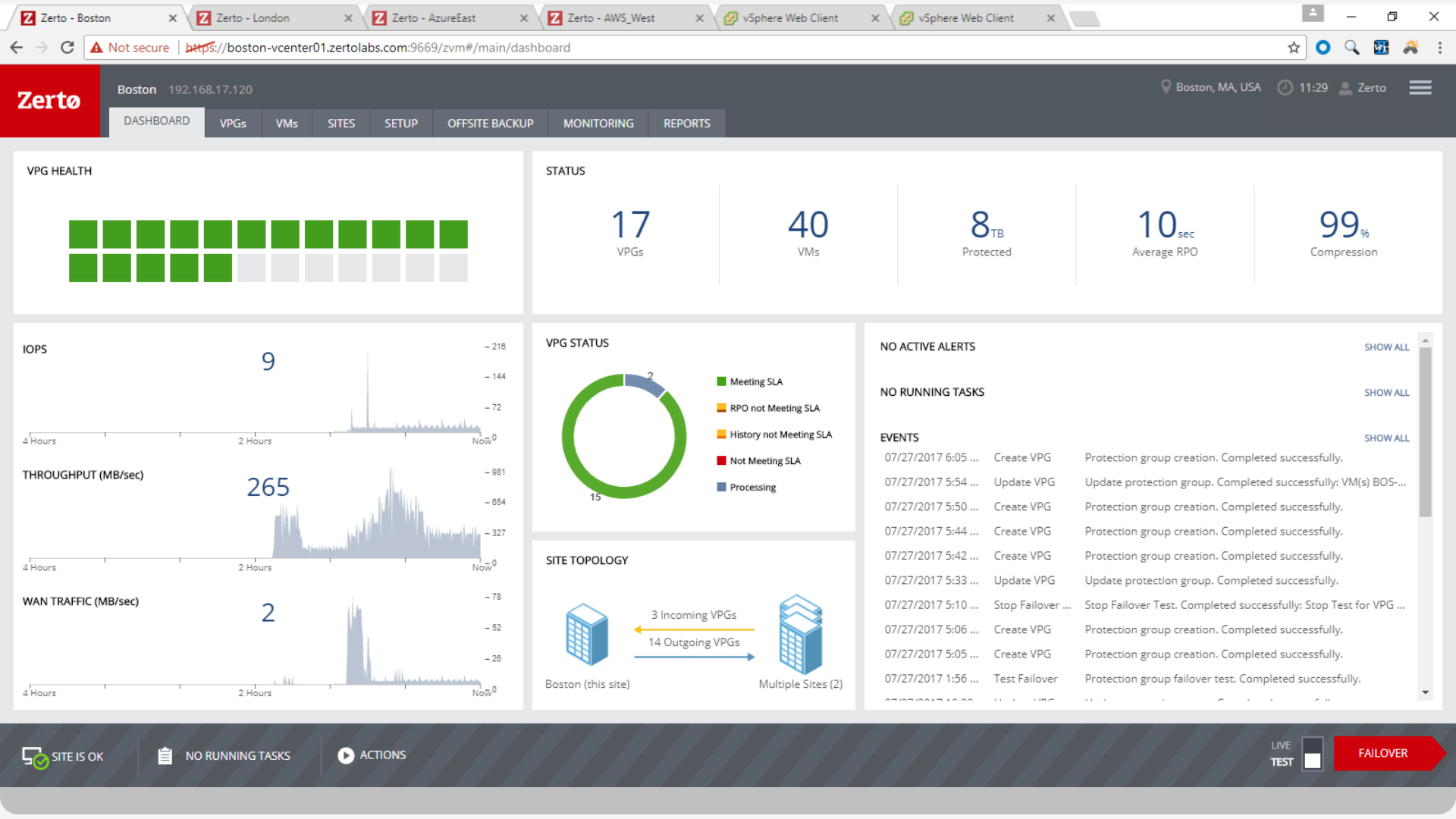
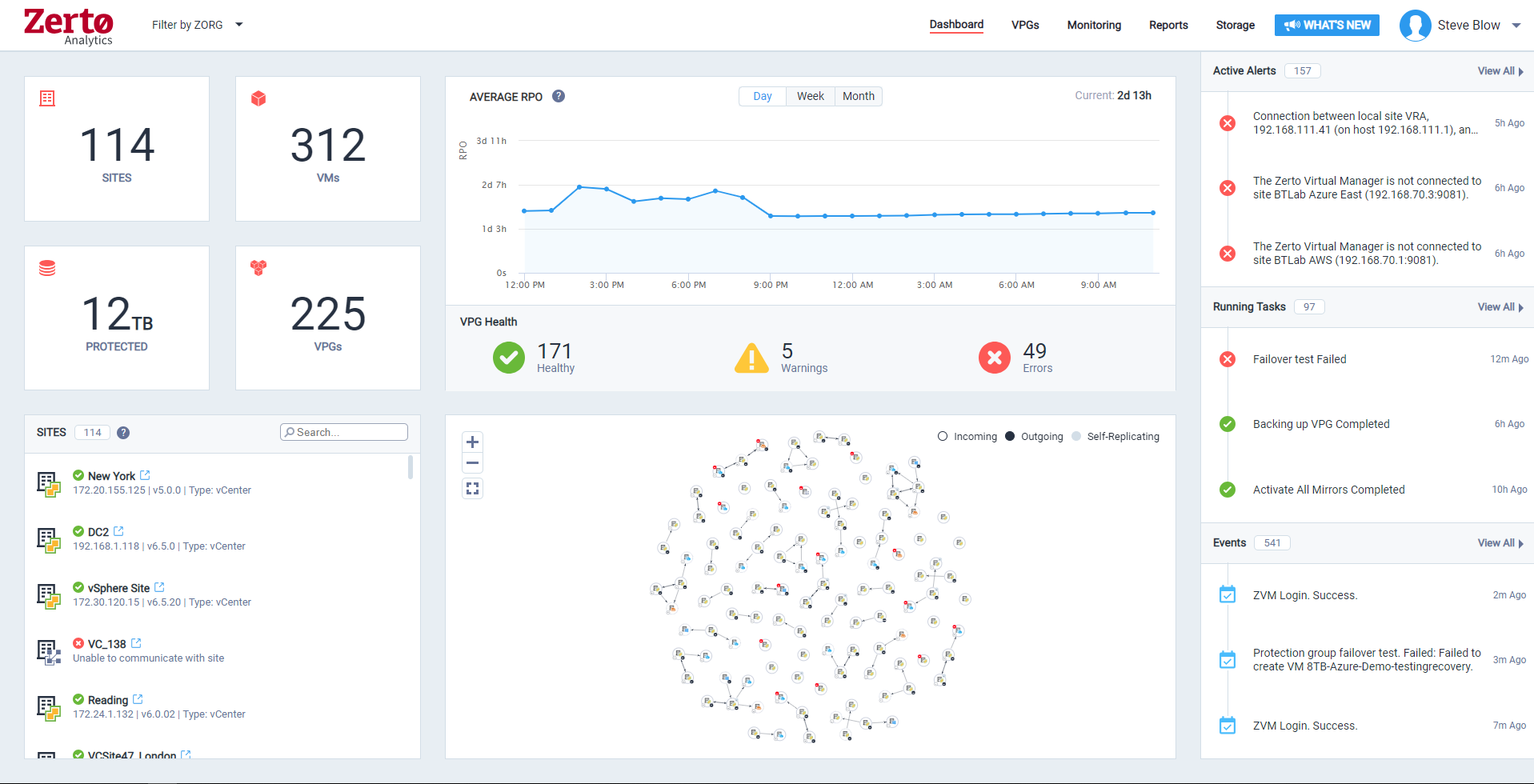
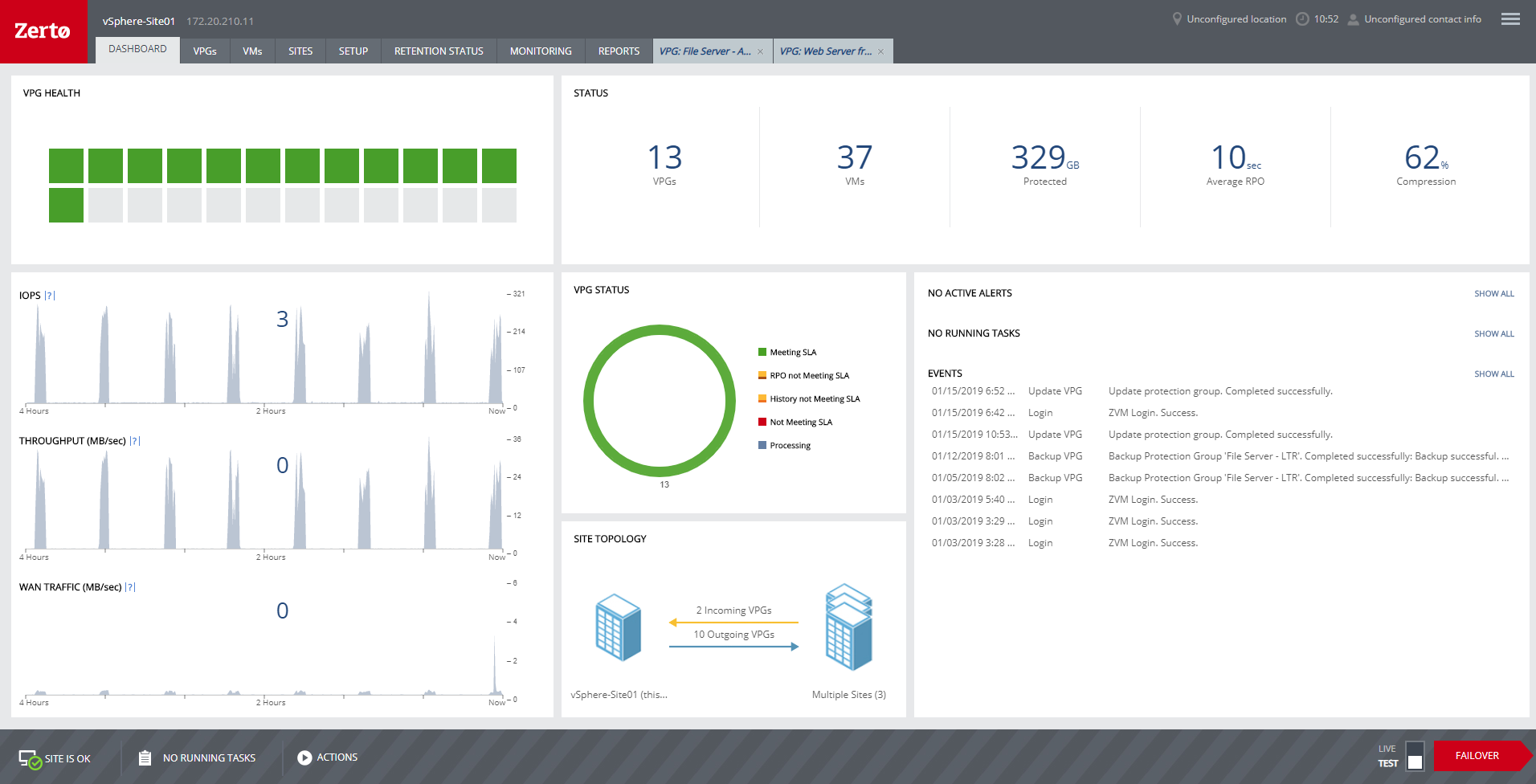
Zerto is well suited for disaster recovery and virtual machine replication between multiple data centers. DR testing for audit or regulations is much easier with Zerto, great reporting, dashboard etc. It is not well suited for physical server replication for disaster recovery or as a primary backup solution.
Really easy to configure. I've used other message brokers such as RabbitMQ and compared to them, Kafka's configurations are very easy to understand and tweak.
Very scalable: easily configured to run on multiple nodes allowing for ease of parallelism (assuming your queues/topics don't have to be consumed in the exact same order the messages were delivered)
Not exactly a feature, but I trust Kafka will be around for at least another decade because active development has continued to be strong and there's a lot of financial backing from Confluent and LinkedIn, and probably many other companies who are using it (which, anecdotally, is many).
Anyone with a large disk (VMDK) knows the issues of VMware snapshots. Most backup software is a "point in time backup" that uses snapshots. While the backup can be run multiple times per day the stress of the snapshot on the host and storage is eliminated by the continuous protection of Zerto log replication.
A client had a the disks on a VM go missing for some reason. We had them "flip the switch" for a real fail over and press the fail over button. The VM on our DR site started to come alive as the VM at the customer site was brought down. When the DR VM was fully up, automatic reverse replication started. The DR machine was available in a few minutes (to take into account different host hardware) for access. One the vm at both sites were in sync, we had the customer again repeat the fail over process and the DR site VM was turned off and the Production site VM was brought back on line. This was a 200 GB VM and the whole process was finished in about 3 hours.
Zerto also allows for "Test" fail overs that can be configured on many different functions, such as host, datastore, network and IP usage. Configuring the IPs is crucial to avoid inadvertent site cross contamination of the same VM.
Zerto can also retrieve files from any VM disk on the DR site without starting a VM. Very handy for retrieving files or directories.
Since Zerto is running continuous log replication, changes on the production VM are nearly instantaneously copied to the DR site. As with any data process, having sufficient bandwidth for "churn" peaks minimizes the delay in updating the DR site.
Sometimes it becomes difficult to monitor our Kafka deployments. We've been able to overcome it largely using AWS MSK, a managed service for Apache Kafka, but a separate monitoring dashboard would have been great.
Simplify the process for local deployment of Kafka and provide a user interface to get visibility into the different topics and the messages being processed.
Learning curve around creation of broker and topics could be simplified
Automated test restores. I would love to setup automated and random test restores on a regular basis where Rubrik's system will restore a random file or directory to a test SharePoint folder, send a full report, and provide a path to the folder for review and confirmation.
The support has been incredible. Any time we have had a question, it has always been answered within 24hrs. Also, the team is always will to hop on a Zoom call to help walk us through the dashboard and troubleshoot any issues we are having. Also, having the peace of mind that our data is protected should anything happen in our system.
We really like the easy setup of this replication solution, as well as the ease of management. Not to mention, our internal IT Economist determined that the Zerto solution would provide the best ROI out of the competing solutions we analyzed. So far, his calculations have been spot on, and we have saved substantially
Apache Kafka is highly recommended to develop loosely coupled, real-time processing applications. Also, Apache Kafka provides property based configuration. Producer, Consumer and broker contain their own separate property file
The support is top notch both tech and sales team, the tools are simple to use and yet still is feature rich. Security is top of the list, the product is sold and reliable, easy to configure and intuitive to use.
Zerto is very easy to implement and support. Uses are broad, only issues are once something doesn't sync it is difficult to get assistance until your reach tier 2 or tier 3 support. Basic file and folder recovery is great. Live and test fail overs are also easy to implement without issue.
Rubrik's brik is designed with redundancy in mind, ensuring that if one node experiences issues, others can continue to provide backup and recovery services.
Support for Apache Kafka (if willing to pay) is available from Confluent that includes the same time that created Kafka at Linkedin so they know this software in and out. Moreover, Apache Kafka is well known and best practices documents and deployment scenarios are easily available for download. For example, from eBay, Linkedin, Uber, and NYTimes.
Rubrik support has been pretty good. There have been a few issues with new releases we have experienced and are still considering if we want to make the jump to version nine. There are a few things we are concerned about which are giving us pause. That being said, support is working hard to answer our questions.
Overall support is very good. We sometimes get pushback when asking Level 1 support to escalate to Level 2. This causes undue frustrations when you need a more knowledgeable support person to get involved. We've had to escalate to account reps a few times for this scenario. Zerto is very responsive and normally handles our requests very quickly.
Easy to follow and very thorough. Trainer was knowledgeable and helpful answering any questions and providing detailed answers where possible. It's also nice to gain another badge :) There is also the Rubrik University online tutorials to refer back to and keep updated with new innovations. I would say the exam was very hard.
From experience the implementation was smooth and easy, like a simple plug and play format but would need coordination from your network team to be able to see the entire IT infrastructure.
I used other messaging/queue solutions that are a lot more basic than Confluent Kafka, as well as another solution that is no longer in the market called Xively, which was bought and "buried" by Google. In comparison, these solutions offer way fewer functionalities and respond to other needs.
Having all our backups under one umbrella made product management easier, with not need to manage myltip contracts.
The additional analysis of the data after the fact gave insights into our user data, without the need for an addition product, or the impact on live data sets.
We started out using Backup Exec which was in service until we virtualized our environment where it didn't perform as well at the time. Then we switched to Veeam which worked well, but then as we started needing to do migrations and off-site DR, we found ourselves relying on Zerto more often.
We are fine with the 1 year or 3 year support options that Rubrik has had. The support for the on-prem hardware has been great too. We've had them for quite a while (4+ years) and no end of support yet.
For my organization, the pricing model was an upfront investment for the Zerto licenses. My organization prefers to pay upfront and not deal with month-to-month or year-to-year pricing models that most companies are moving to. But for some, the investment may be more than they can afford, and would prefer the year-to-year pricing model.
I mean, it was 6 years ago, but we were up and going with all applications synchronizing in short order. The longest tasks was getting the 30 TB of application data synchronized between the datacenters.
Positive: Get a quick and reliable pub/sub model implemented - data across components flows easily.
Positive: it's scalable so we can develop small and scale for real-world scenarios
Negative: it's easy to get into a confusing situation if you are not experienced yet or something strange has happened (rare, but it does). Troubleshooting such situations can take time and effort.
Zerto is like having the best possible insurance ... it just works, and often provides the backups taken overnight that are key in recovering data/work between overnight backups.
Zerto easily enabled the move of primary datacenters by allowing easy failover to a secondary site, and failback to the primary site.