Atera is presented as an Agentic AI platform for IT management, that offers a digital workforce of AI agents that proactively and autonomously support entire IT operations. Atera’s all-in-one IT management platform consolidates RMM, helpdesk, ticketing, and automation, so IT teams and MSPs can manage and protect infrastructure, automate tasks, and boost service quality by reducing downtime and improving SLAs. Atera has shifted focus from automation to AI-powered autonomy in IT. With…
$139
per month per user
NinjaOne
Score 9.1 out of 10
N/A
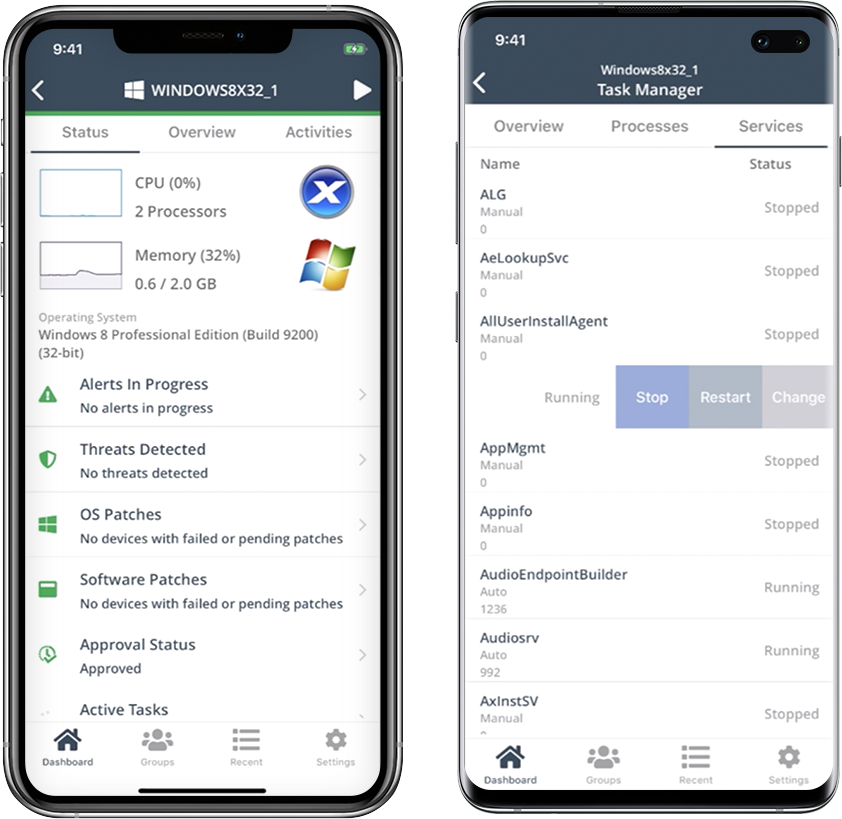
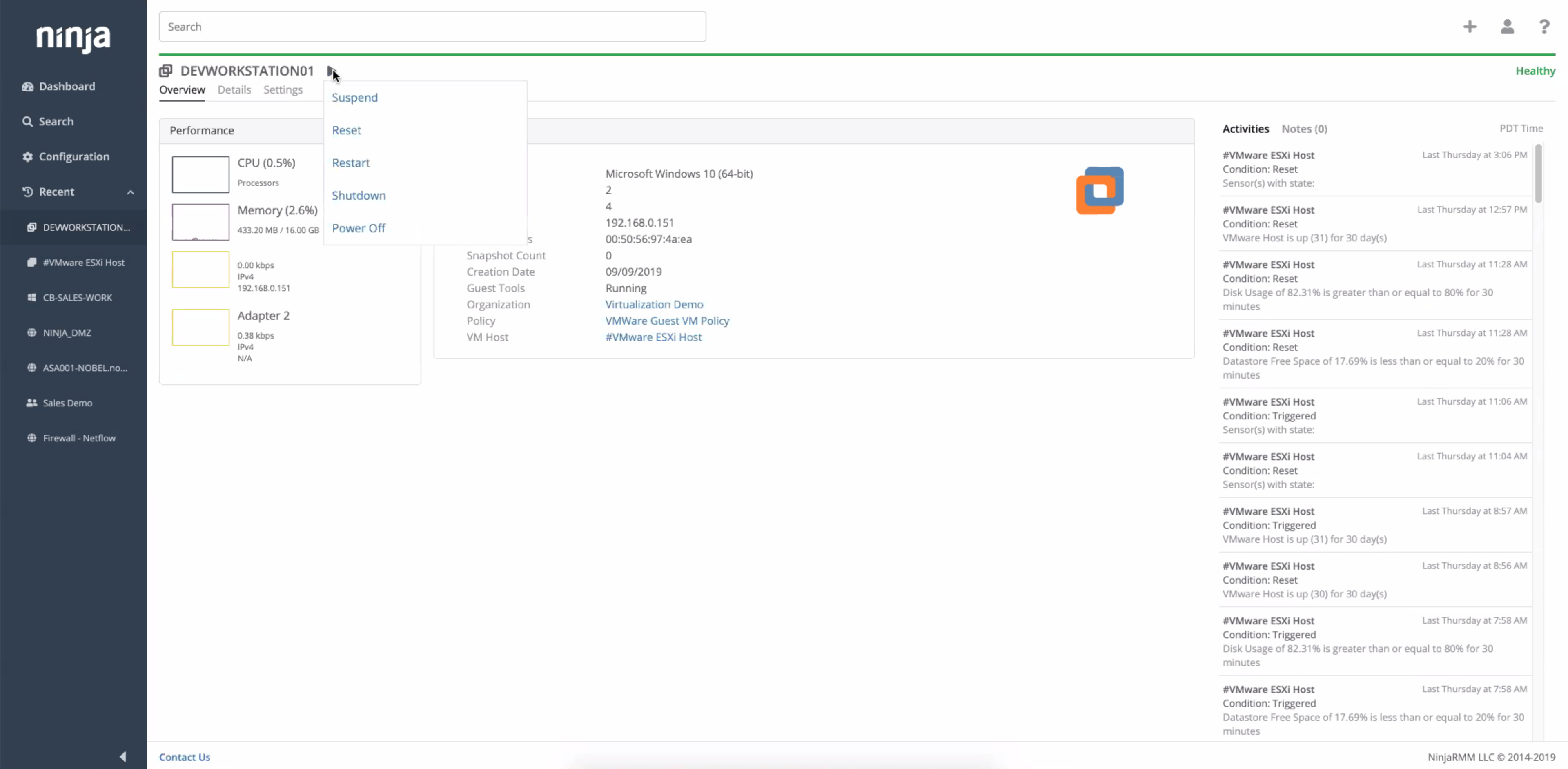
The NinjaOne Unified IT Operations Platform delivers endpoint management, autonomous patching, backup, and remote access. NinjaOne aims to give organizations' employees a great technology experience to work faster, smarter, and easier while IT teams modernize and improve efficiency.
N/A
SolarWinds Service Desk
Score 7.8 out of 10
N/A
SolarWinds Service Desk (formerly Samanage) is a cloud-based, multi-tenant IT service desk and asset management software for IT and enterprise service management. Samanage is on a single, always new instance of software. The service desk includes a self-service portal, service catalog, knowledge base, and SLA management tool. The integrated agent-based asset management solution collects contracts and licensing data from Windows, Mac, Linux, and Unix systems.
N/A
Pricing
Atera
NinjaOne
SolarWinds Service Desk (SSD)
Editions & Modules
MSP - Pro
$129
per month (billed annually) per user
IT Department - Professional
$149
per month (billed annually) per user
MSP - Growth
$179
per month (billed annually) per user
IT Department - Expert
$189
per month (billed annually) per user
MSP - Power
$209
per month (billed annually) per user
IT Department - Master
$219
per month (billed annually) per user
No answers on this topic
No answers on this topic
Offerings
Pricing Offerings
Atera
NinjaOne
SolarWinds Service Desk
Free Trial
Yes
Yes
Yes
Free/Freemium Version
No
No
No
Premium Consulting/Integration Services
Yes
No
No
Entry-level Setup Fee
No setup fee
No setup fee
No setup fee
Additional Details
Unlimited devices.
NinjaOne is a subscription typically billed annually and sold through channel partners. Monthly billing is nonstandard but billed on a case by case basis.
I did like NinjaOne user interface but the price was a lot and the implementation of how it does Windows Updates was not ideal. Pricing would have gotten way up there for the number of endpoints I needed to load up initially. N-able was good with the Apple computer integrations …
We looked at NinjaOne and ConnectWise Automate which are both fantastic tools. Those options definitely have their strengths over Atera, but Atera was the one we chose in the end. The thing that drew us to Atera was the lack of complicated contracts and simple tech based …
NinjaOne is a great platform but is simple overall versus Atera. Atera is so feature rich that it can be overwhelming at times but is worth the learning curve. Take time to go through the onboarding, reading the help articles, and even reaching out to support directly through …
Atera's pay-per-technician pricing just made sense for us. They don't nickel-and-dime either. NinjaOne, by contrast, was over twice as expensive to start out, but they wanted to charge extra just for a ticketing system and many other things.
NinjaOne is a great tool for Remote management and patch management. However, Atera is more polished and gives better functionality for the end user side through things like work from home, and the support portal knowledge base. Also, when using NinjaOne, I don't remember there …
Atera is very similar to Syncro in feature set and pricing, but we liked Atera just a bit better. (We switched from Atera to Syncro and then back to Atera, and have stuck with Atera for several years now.) Kaseya gave us bad vibes from their sales department and we ultimately …
After trying out both Atera and NinjaOne, we found that Atera was generally easier to use, especially for non-tech people. Atera's learning curve has been much less steep than NinjaOne's and the team had a better response to using it. Atera's price point has also been more …
In terms of age Atera is a bit more mature than these younger competitors and it shows with its wider array of features. Pricing might be a bit higher depending on which features you want or deem to be most necessary but in our experience Atera was the cheapest one on the …
I think Atera is the leader here. The aggressive pricing along with feature set is unparalleled in my opinion. They seem to be headed in the right direction and keep pushing the envelope in what the tool can do. The one thing lacking for me is the Apple integration into …
Atera Billing of per technician is a great way to save Atera has 24/7 support that response in a matter of seconds The Copilot that they have added recently is a game changer and will make anyone wants to associate themselves with Atera
In my experience, Atera lured us in with the pricing per technician to try and save us money. They then proceeded to take features away and lock them behind higher-tiers. In addition, in my opinion, their customer support is atrocious. I think if you enjoy long times between …
Atera was the clear winner for us. The interface and tools were very easy to learn and setup. Atera's licensing incorporates good feature sets and value levels.
Some of the other products were difficult to setup and lacked good flow between tools. The value proposition was …
Atera was more cost effective, easy to deploy and had all the features and tools we needed. It's still a little rough around the edges but we can work around those considering its a fraction of the cost compared to others.
This Year I started an IT company and was in need of monitoring and PSA software. In the past I've worked with Datto, Datto RMM and Ncentral so one of these would be a logical choice for me to choose. However their pricing is from a different world. For a starting company, …
Atera competes well with other RMM competitors, lacking primarily in patch management. I was constantly fighting to get my Windows updates out there, and had a couple of troublesome systems where I had to manually install patches from Microsoft Catalog due to WU being brain …
Any RMM that supports licensing around agents / technicians rather than devices is always a win in my mind. Primarily Atera was chosen due to the specific features it provides (we didn't need a lot of bells and whistles) and did what it needed to do, well. Remote access, patch …
Atera has many of the same features as the other products we've tested. The selling point for us was the pricing model for Atera. Most other providers charged a fee per endpoint which could quickly add up. With Atera's pricing model, we have a fixed annual cost which is …
Atera is a lightweight cloud application that handles most every need of small and large IT Firms alike. It closely resembles Ninja, N-Able, and Syncro in performance and scale. The biggest difference is the pricing models as Atera and Syncro charge per user as opposed by …
Costs per technician not # of units monitored, scaleabilty, support, features, remote access tools intuitive endpoint management software to managed service providers (MSPs) and IT professionals with an exceptional user experience and all the support you need to deliver fast …
LabTech is a more comprehensive remote monitoring and management tool but costs considerably more. We switched to Atera from LabTech for a number of reasons. First and foremost, cost. Atera's per user licensing structure is much better suited for startups than LabTech. The …
I'd selected Atera at a point where they were new to the US, and the RMM I was currently using wanted an increase in cost for further growth. I was intrigued by the platform and the cost point was fantastic.
Atera uses a pay by technician model but can't do half as much as Ninja. We still employ one Atera user to monitor some of our old clients that don't pay for monitoring. The UI of Atera is also amazing. Other RMMs could learn from them. We will stick with Ninja for the …
We found NinjaOne far more user friendly and less resource heavy than VSA. Our overall experience was greatly improved from VSA as we experienced many recurring issues with the agents. Additionally, NinjaOne was far more cost effective per endpoint and provided similar, or …
I honestly cannot say enough good words about this system. I would never run an IT department again without NinjaOne, supposing I had to pay for it out of my own pocket. If you are considering any RMM to run your IT operations then I can guarantee you that you will not find …
Verified User
Director
Chose NinjaOne
Prior to NinjaOne, our IT management was a blank slate. We knew we needed something, and we wanted to ensure we were making the best decision for our organization. We attended demos and talked with sales reps, sales engineers, etc. At the end of the day, it was the relationship …
Atera is doing well in the monitoring part as it is informing the real time ping of running devices and if any device goes down, it is informing us on the real time. It is helping us to monitor the last reboot status, current logged in users, time zone, IP addresses and other things so that we can track our end devices status. In the patching part Atera is pathing our all devices with the notification stating user to restart device at their convenient time. It is also patching our third party applications. It is good in installing and uninstalling of the third party application but limited to availability in the Atera inventory. Atera is not good in some parts such as in the patching part of applications, sometime it fails to update all 3rd party applications that were not installed via Atera. It is not good if you have to transfer a file to multiple systems at the same time.
Well suited for support and management of a large fleet of endpoints, particularly across multiple regions and locations. Its well suited for MSPs for this reason. Its also effective for managing patching and updates for server infrastructure, where some other products are unable to manage. Its useful being able to access these features across multiple networks and domains. There is an option to monitor network equipment such as switches, but it didn't provide any information that wasn't already provided in the switches cloud portal.
If you are looking for a way to support a company and bill based on the outcome this software works really well. If it's a quick password change there was no charge, but if it's troubleshooting things you click the box to charge. It works really well for this. Also bringing all your assets into this and associating them to a client works well. I can't think of anything that this software would not be less appropriate for. It works well for what we use it for.
Atera is very helpful in monitoring the servers and end-user devices for high CPU, memory, hard disk uses, and temperature monitoring.
Atera is good at installing third-party applications and also helps to remove it from the end systems.
Atera is perfect for patching as you can select the patches as per your need and reject those that are not required for you or going to disturb any of your internal applications.
Atera is good for managing software inventory as it provides you with the complete software list that is used in your infrastructure.
Remote connections: the NinjaRemote client is spectacular and very easy to use and navigate. It quickly connects to customer systems so my engineers are able to work. As a bonus, they also offer a really good mobile app to connect to client systems.
Antivirus: Bitdefender Endpoint Protection is built directly into the NinjaOne portal. This makes deploying and maintaining AV very easy.
OS Patching: NinjaOne makes it very easy to handle patching across multiple clients and locations. It is very easy to use and doesn't take long to set up.
Support: NinjaOne support is always very prompt and helpful.
Documentation: the NinjaOne Dojo is a one-stop shop for all of your FAQs, guides, and forum needs. You can find almost anything here to help you deploy and maintain NinjaOne.
Automation Library: NinjaOne comes preloaded with a large number of ready-to-go automations. They also provide you with a scripting module to create your own.
Approval flows: You can have multiple layers of approval required for the tickets and service requests you design. This helps us show auditors that access to privileged systems and data was formerly reviewed and approved by the appropriate managers.
Easy to design forms: You don't need to spend hours reading the documentation to figure out how to create forms. It's simple enough that you can just jump right in and start creating them with minimal training.
Lots of options and features are available for you to include in your forms.
Integrates well with SAML-based SSO and has capabilities for MFA.
Easy and useful search function. Need to find that ticket from last year that you worked for a particular user or issue? Just search by keyword or username, and it'll quickly find the ticket.
Atera does not yet have a MDM system, but I have been told that it is in the works!
Sometimes getting around the admin section of the IT side of Atera can be tricky, but the webinars and chat support help.
Many of the demo and onboarding agents are based in Israel, so it can be a challenge to find available times during the day while living in the United States.
There is potential to greatly improve the capacity for cascading attributes. Currently, categories are limited to a top-level category and one subcategory. This leaves a fairly shallow decision tree.
Greater flexibility to modify the layout of incident request forms.
More integration options for cloud file-sharing platforms. Solarwinds Service Desk has tie-ins to Dropbox but not other vendors.
As of right now, we have found nothing that can offer as many features as Atera does along with the affordability. They are doing monthly releases each month and not just making small changes (shared scripting library, chocolatey support, Install packages, Splashtop SOS support, Scheduled tickets to name a few). The uptimes are great and accessibility to the dashboard has yet to be limited. We are a happy customer and bordering on fanboy status now
We already did. After evaluating many platforms, we found the cybersecurity of the company, its development direction, and the performance of the platform to be far superior at its price point.
My renewal is soon coming up, it is fairly likely I will renew again for the 5th year. I may consider evaluating what else is out there, It was requested by my staff to not make a change. They feel that SSD fits our needs, is easy to use and should keep it.
Atera's remote monitoring feature is one of it's best features. The laptops and servers we used it on responded quickly to our administrative task requests and made our work light. We were able to increase the resources, manage patches, windows updates and quite a few other tasks remotely and that too 24×7.
NinjaOne is easy to use, intuitive, and provides great value for our organization specifically with inventory tracking and patch management. There is also a wealth of control from an RMM perspective that we have over our fleet of hardware as well as customer websites. The communications with our account representative is outstanding as well. I'd highly recommend for organizations to engage with NinjaOne, and this is from a user who's used other RMM's and related software offerings at different MSP's. Go NinjaOne!
Solarwinds Service Desk has a very "user friendly" interface. Everything looks nice and neat. And, learning how to use the system is very easy. It provides multiple services that are easy for most people to grasp, and allows for great organization of incidents and assets. Support for Solarwinds Service Desk has a good response and resolution time and are easy to work with.
Because the data is stored on Amazon Web Services (AWS) there are very rarely any outages. There have been some times when the product has been slow to load, but because the interface is web based it could be anything between my computer and AWS that was causing the issue. But also, because the application is web based it can be access from anywhere which makes it very convenient
When the system is working, the pages load very quickly. We run reports all the time in the system. The reporting can be extremely complex or very simple. Either way, we have not had any issues with the reports. We do not currently integrate Solarwinds Service Desk with any other software.
Atera support provides answers to my questions lightning fast. They have never left me feeling like I'm out there on my own. I can ask questions by email, or by chat, or by opening a ticket with them and they are always on it quickly. They also have a forum where other Atera users can help you if you need it, and you can also add feature requests via the forum.
Ninja support has always been top notch. They have always been responsive and efficient both in troubleshooting issues or talking to me at a high-level about on-going improvements or needed changes. Both sales and Technical support has been good and I've been very pleased with the Customer service we have received from Ninja
SolarWinds support department will respond to you quickly from the time of purchase to after-purchase instructions & supporting, and the company is great in customers support. In buying a software, our organization always has a priority for the seller and support and accountability is very important to us, and the manufacturer or seller must be responsible and supportive.
Easy to learn and all of the functions and features were easy to learn. Once I started learning all of the features and functions, it made my everyday tasks much easier and more productive. The user interface is very easy to use. If I did have any questions, the Ninja Dojo was a big help.
It was nice and self paced learning. The sections were easy to understand and the functionality was very worthwhile. The online training was very easy to learn and intuitive. I did not feel the need to ask for any clarification or assistance with any of the sections. I am still learning a lot of the functions but fined it very easy to use.
When we first purchased Samanage (now Solarwinds) they provided us with an informational training session to show us all of the basics on how the service works and showed us everything we were interested in using. There are still some areas of Solarwinds that we do not yet utilize but I know if we choose to use them in the future we would be able to schedule another session with our representative to have them show us what we need to know.
The implementation process for our organization was fairly simple. We set up an email address to receive the emails from the system (for incident creation), and we allowed the system to spoof our IT email to respond to requests. Solarwinds helped us with the rest of the implementation, and it took less than a week to get the system fully operational.
Because Atera is a much more effective and efficient solution to manage all our IT operations, it automates each of our business processes. It offers us the best support to respond to any problem that may arise. I think Atera is much more cost-effective and reliable; its value is justified with each function and satisfies all our business needs and requirements.
NinjaOne has the most rounded set of features however I believe all of the programs have there own plus and minus points. We use a mixture of programs however NinjaOne is the most heavily used.
We chose SolarWinds Service Desk for its user friendly platform compared to what we had. Its was easier for requestors to submit tickets, provide feedback, merge tickets, build a suitable approval process. Our organization had a hard time going back and forth with the end user on providing a status on their request or issue, where most users just didn't follow through or lost interest in their issue. We would have to send multiple emails to get any type of feedback and that's something we did not want to keep on doing.
We have over 500 computers and tablets across our organization and this has helped us greatly in keeping track of where computers are and who is currently using it. I can see this product being useful to groups both larger and smaller than us and I really appreciate this product.
The intuitive user interface has enabled both users and support technicians to familiarize themselves quickly with the functionality, and the learning curve is less.
Some features need to be accessed through documentation; they're not available directly on the dashboard.
Sometimes, internet access plays a significant role, whereas low connectivity is a hindrance.
We are more easily able to quantify user satisfaction with support.
We are able to develop SLAs that quantify and define the obligation of our support teams.
The actual cost of Solarwinds Service Desk per agent user is high in our estimation. The more you implement this platform across your organization, the more tightly tethered you are to this solution.