Dynatrace is an APM scaled for enterprises with cloud, on-premise, and hybrid application and SaaS monitoring. Dynatrace uses AI-supported algorithms to provide continual APM self-learning and predictive alerts for proactive issue resolution.
$0
per synthetic request
SolarWinds Pingdom
Score 9.5 out of 10
N/A
SolarWinds Pingdom is a website uptime monitoring and alert tool, with additional reporting and Real User Monitoring capabilities. Pingdom is part of SolarWinds’s DevOps package, enabling full-stack monitoring as a service.
$14.95
per month
Retrace
Score 8.0 out of 10
N/A
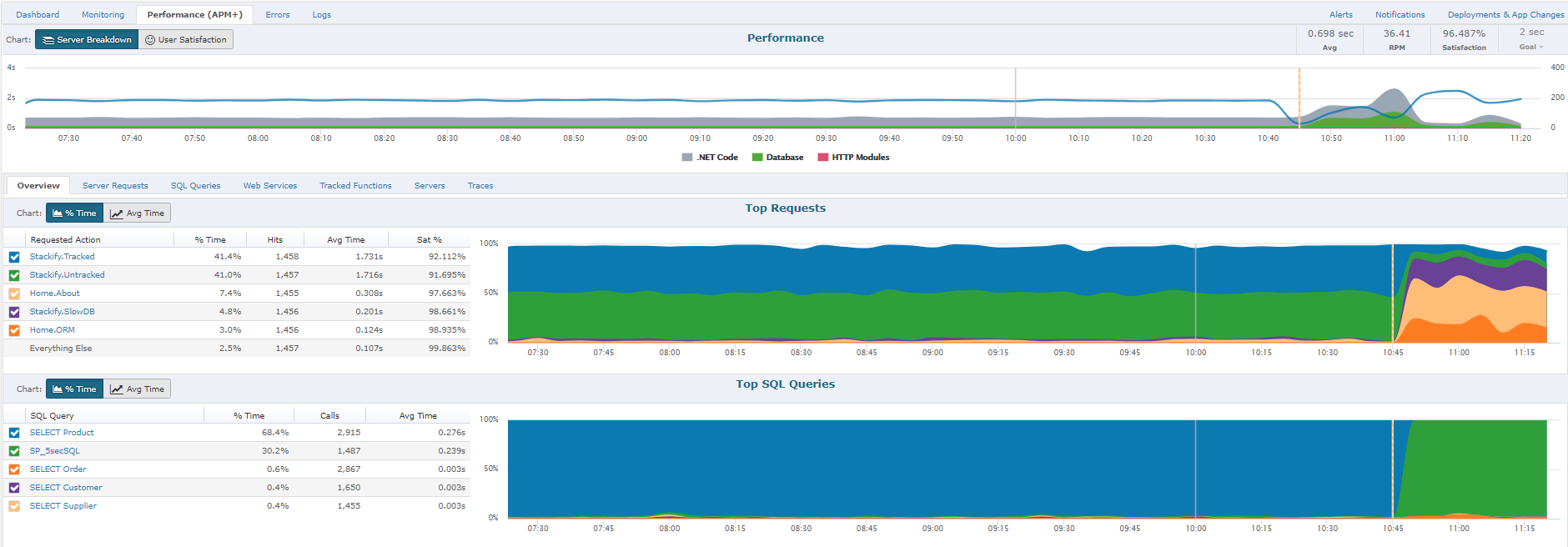
Retrace (formerly APM+) is a lightweight Application Performance Management solution. Retrace gives developers continuous, real-time analysis through a combination of code-level visibility with in-line log and error data. Retrace helps identify top performance offenders by analyzing top page requests, top SQL queries, and top external web services.
$99
up to 3 servers, 500,000 traces, and 1,000,000 logs
Pricing
Dynatrace
SolarWinds Pingdom
Retrace
Editions & Modules
Synthetic Monitoring
$0.001
per synthetic request
Kubernetes Platform Monitoring
$0.002
per hour for any size pod
Real User Monitoring
$0.00225
per session
Application Security
$0.018
per hour for 8 GIB host
Infrastructure Monitoring
$0.04
per hour for any size host
Full-Stack Monitoring
$0.08
per hour for 8 GIB host
Synthetic Monitoring
$10
per month
Real User Monitoring
$10
per month
Enterprise
Custom Pricing
Essentials
$99
up to 3 servers, 500,000 traces, and 1,000,000 logs
Standard
249+
2,000,000+ traces and 5,000,000+ logs
Enterprise
Custom
Customer number of traces and logs
Offerings
Pricing Offerings
Dynatrace
SolarWinds Pingdom
Retrace
Free Trial
No
Yes
Yes
Free/Freemium Version
No
No
No
Premium Consulting/Integration Services
No
No
No
Entry-level Setup Fee
No setup fee
No setup fee
No setup fee
Additional Details
—
—
Pricing is based on trace and log usage.
More Pricing Information
Community Pulse
Dynatrace
SolarWinds Pingdom
Retrace
Considered Multiple Products
Dynatrace
Verified User
Manager
Chose Dynatrace
Dynatrace is much more expensive than pingdom, but it does a better job of doing synthetic monitors and the credential store is much better. When it comes to availability it does a better job of creating of synthetic monitors and it can create a credential store which is a big …
New Relic is SAAS only so it was instantly nixed. Our IT Sec wants on premise.
CA APM was terrible. Like really bad. They came in for a demo too and it is no where near on par. As complicated as Dynatrace can be. CA is worse by a hundred fold.
We no longer use any other products. We used to use the three products listed. However, Dynatrace has replaced all of them. When we moved to Dynatrace, we were using New Relic. I was unsatisfied with the product at that time. Its dashboarding capabilities were insufficient and …
Dynatrace has more auto-discovery capabilities than New Relic. Overall we have been able to monitor more of the stack with Dynatrace than we were with New Relic.
At least during our investigation thus far, all of these companies have a more responsive support organization and are more actively maintaininbg and supporting their products. They are also all significantly more expensive.
SVP, Digital Development, Operations & Strategy and Data Protection Officer (DPO)
Chose SolarWinds Pingdom
Simpler, easier to set up and use, all SaaS based. By having a great GUI that is easy to configure, this makes SolarWinds Pingdom very accessible to business and technical users. The alerts, reports, and APIs that expose the real-time results are also easy to use.
Dynatrace is well suited to a number of tasks. It is important to determine who the end users are and gather good information to tailor their experience accordingly. For instance, business/marketing should not have access to some of the more technical data, and business metrics can be a distraction for IT operations personnel.
I believe the scenarios we used it for were quite well covered, from the executive perspective. The downtime alarms worked very well and were easy to setup, uptime monitoring tools were clear and easy to use, even for non-technical people (C-level) and the SLA management tools allowed us to spend less time, and have less friction, with our clients
If I need to change a logo design on the invoice, the new logo is slightly larger or smaller so the type below the logo is in a different area than before. In this case, you would need to load the new version of the document into APM Plus and redo the mapping of the field areas to properly grab the information needed to process the document. Without doing this, the document could fail or go to the wrong archive based on the fields.
We loved Dynatrace's ability to show the data flow - from the front end points through the back end points straight to the database and various API's. It was advanced in its data visualization. This is useful for debugging - showing when/where the errors are. It can even enable non-technical individuals in the corporation to help debug
Dynatrace has some great highly customizable integration options as well as monitoring. You can configure your layout & integration options to create custom monitoring alerts for your applications performance. Further you can increase the extensibility of using a REST API on your architecture.
Some advanced dev-ops systems are utilizing Kubernetes/docker aswell as Node.JS - Dynatrace was able to log and help understand all of our dev-ops needs. It gave us native alerts based off of deviations from the baseline that we set during initial configuration. These metrics are priceless.
Dynatrace does not monitor easily on a C-based application.
The way DPGR is addressed by Dynatrace is not very complete, and not clear. One thing is to mask the IP and request attributes but is not enough, the replay session feature is great but raises serious questions about user tracking.
The PagerDuty integration could be a lot better. When you use the PagerDuty integration, it doesn't send any information about which check failed! It just sends a message like "Timeout (> 30s)" -- this isn't very helpful when we have hundreds of checks. We've worked around this by using both the PagerDuty and Slack integrations and having them both post to the same Slack channel. But this means that when an engineer is paged from PagerDuty, they have to go to Slack (or Pingdom) to find the details about the page; it's not available on the page itself.
To set up the fields that APM Plus monitors, you need to map each field area on each document.
APM Plus could use a way to link the documents back into the finance or business software so you can find the document under the PO, Sales Order, Invoice, etc.
APM Plus setup is only for the professionals. There are many areas that need tweaking on setup, having a better default setup would lessen the learning curve to set it up for use.
We have already renewed our purchase with the company. They make it easy for us to get a temporary license for our contingency site that is only used for testing twice a year. We are expanding our license with for this tool. We find it very useful and will renew it again.
Recently added features have made Pingdom less intuitive for our requirements. While Pingdom has a broad offering and remains a good value, it is becoming more than we need. Our customer base is becoming more and more global and Pingdom still lacks Asia-Pacific monitoring, which we will need within a year.
Dynatrace is great to use once you understand how to use it correctly and get used to the layout of it. While I do not actively use it every day, whenever I do use it, I do have to get refamiliarized with it. However, once you have your dashboards setup correctly with the data that you want to see when you first login to Dynatrace, it's amazing.
Pingdom is easy to use, very intuitive and has a very short learning curve. From the onset, we've been able to jump in and leverage the tool to accomplish our goals for page speed performance and discover the insights we need to make improvements. Its a well-designed tool and makes for a good user experience.
Given that Dynatrace has become an informal industry standard, the plethora of information available on forums is massive. Most problems or roadblocks you come across are most likely (almost certainly, in fact) already solved and solutions available on these forums. The tech support at Dynatrace is also quite good, with prompt and knowledgeable people at their end.
Support responded the same day to my query, as I was setting the product up but couldn't find the setting I needed. This was successfully resolved in a short time frame, so I was pleased with how quickly we were able to get this resolved. I haven't needed to contact support since.
Synthetic Monitoring automatically does what other products do only through the use of other tools or through the development of user applications that still have a high cost of maintenance. The other products are not immediately usable and require many customizations. Through the use of configuration automatisms, you can be immediately operational and, in our case, we detected several imperfections in the applications.
PRTG Network Monitor was a far more complicated tool to use and set up albeit it does both Internal and External monitoring. The setup wasn't intuitive and there are too many configuration options to complete to form an alert
Amazon CloudWatch is specific to AWS resources and cannot be easily use outside of the AWS Ecosystem
It is a very impressive tool which doesn't overwhelm you with unnecessary data. They have combination of tools that haven't seen by any other company which makes it a very powerful tool
Honestly, we have 4 other products that overlap this functionality whose organizations provide far superior support. At this point it is an unnecessary expense.
In my opinion, their lack of support responsiveness and commitment has impacted our IT agility.
APM Plus has freed up users from having to manually attach documents to each place they are sending it. APM Plus will do it automatically.
APM Plus provides a searchable archive to re-visit sent documents with customers and vendors. Having to reprint a document you risk the potential that something has changed since it was last printed.
APM Plus does need IT staff for adjustments and to review sending problems. Not for an average user.