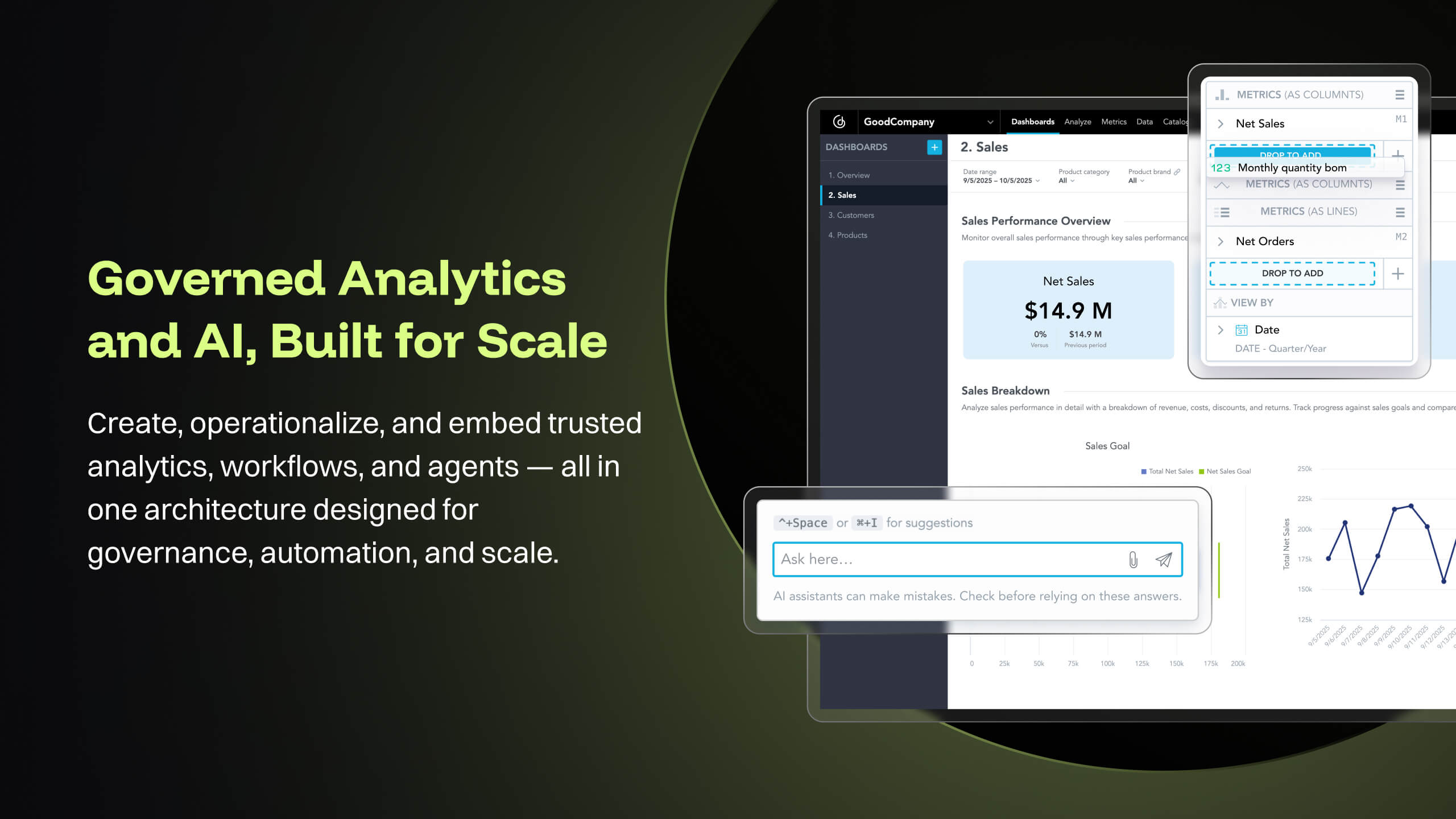
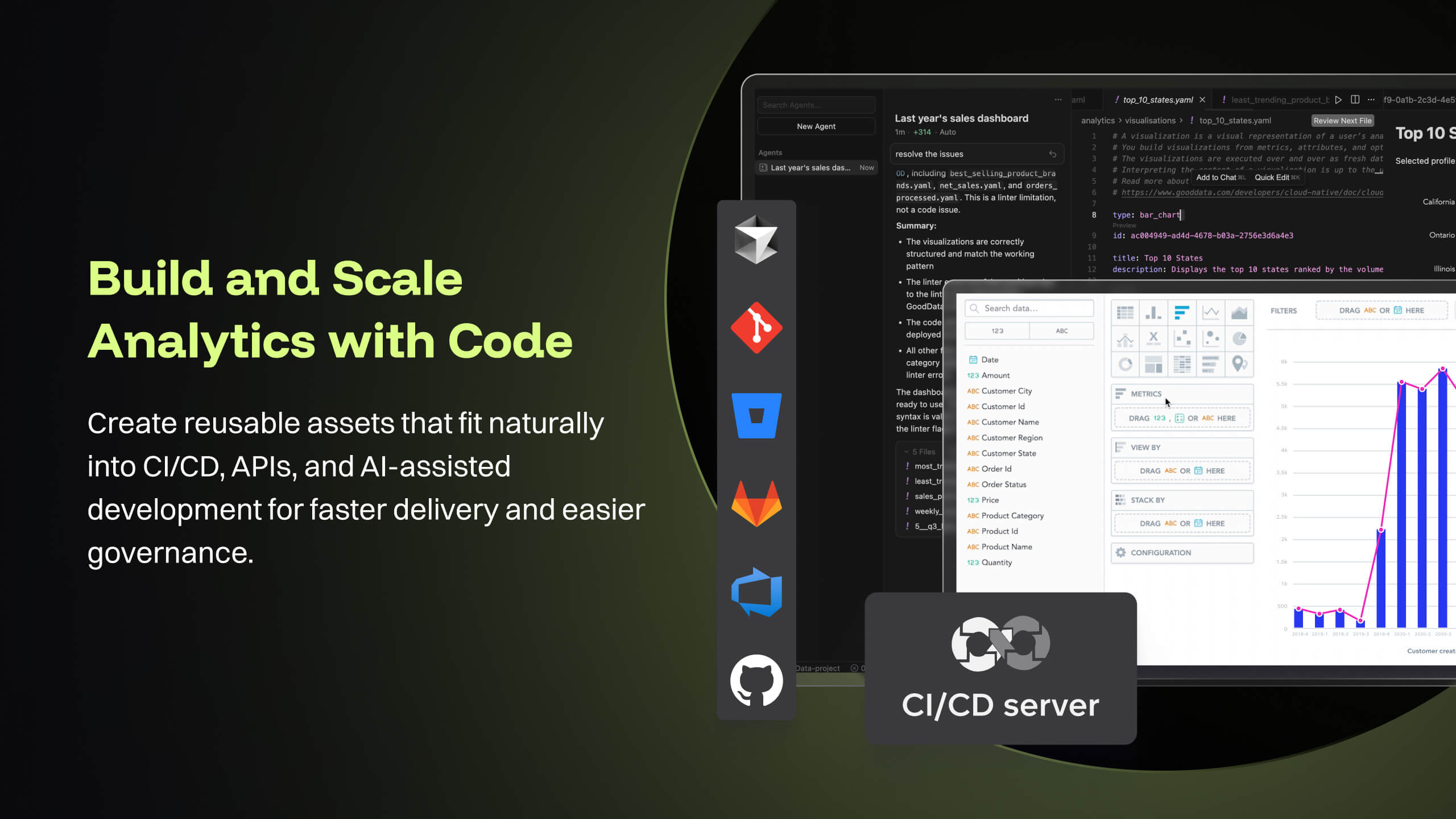
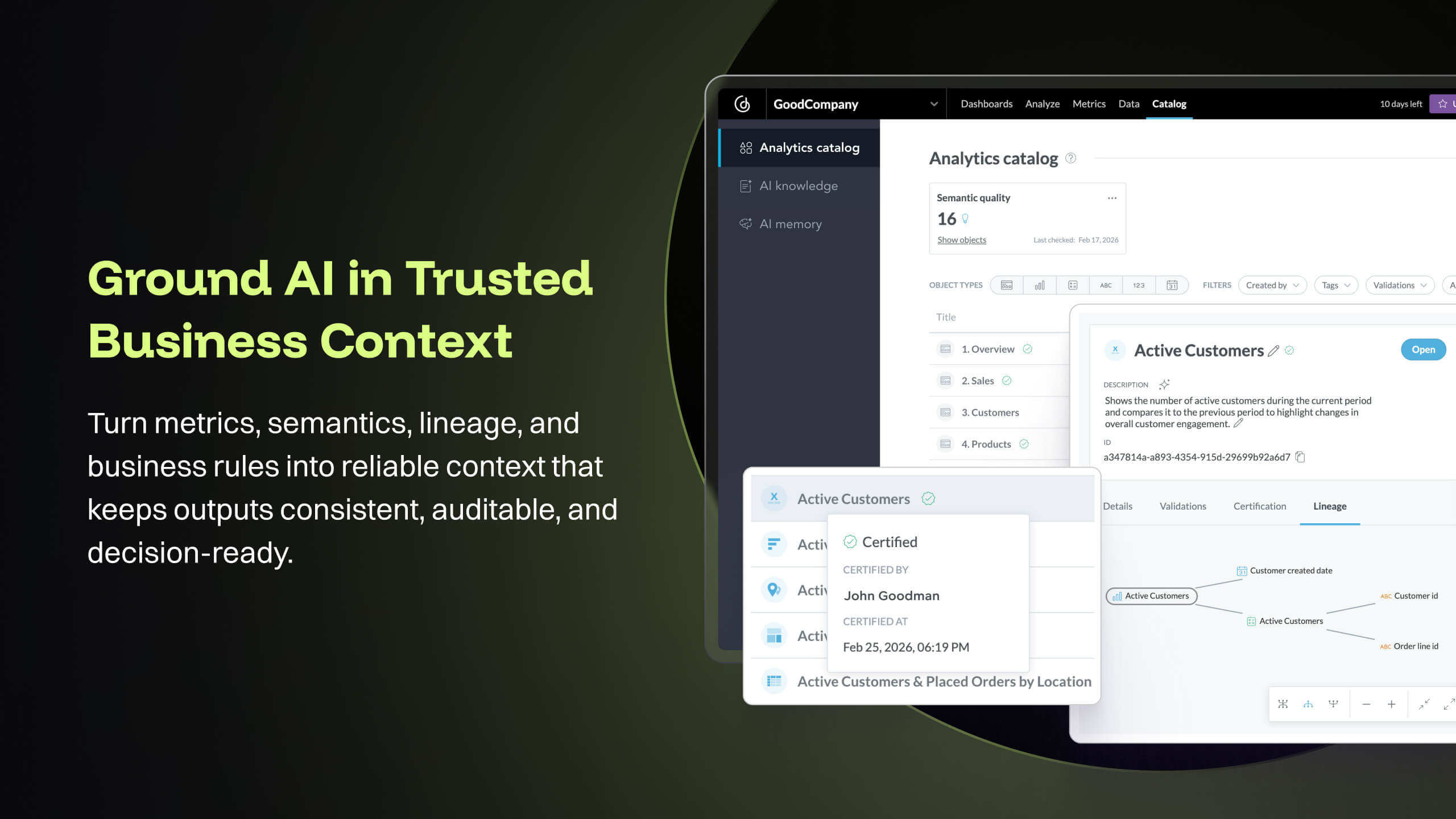
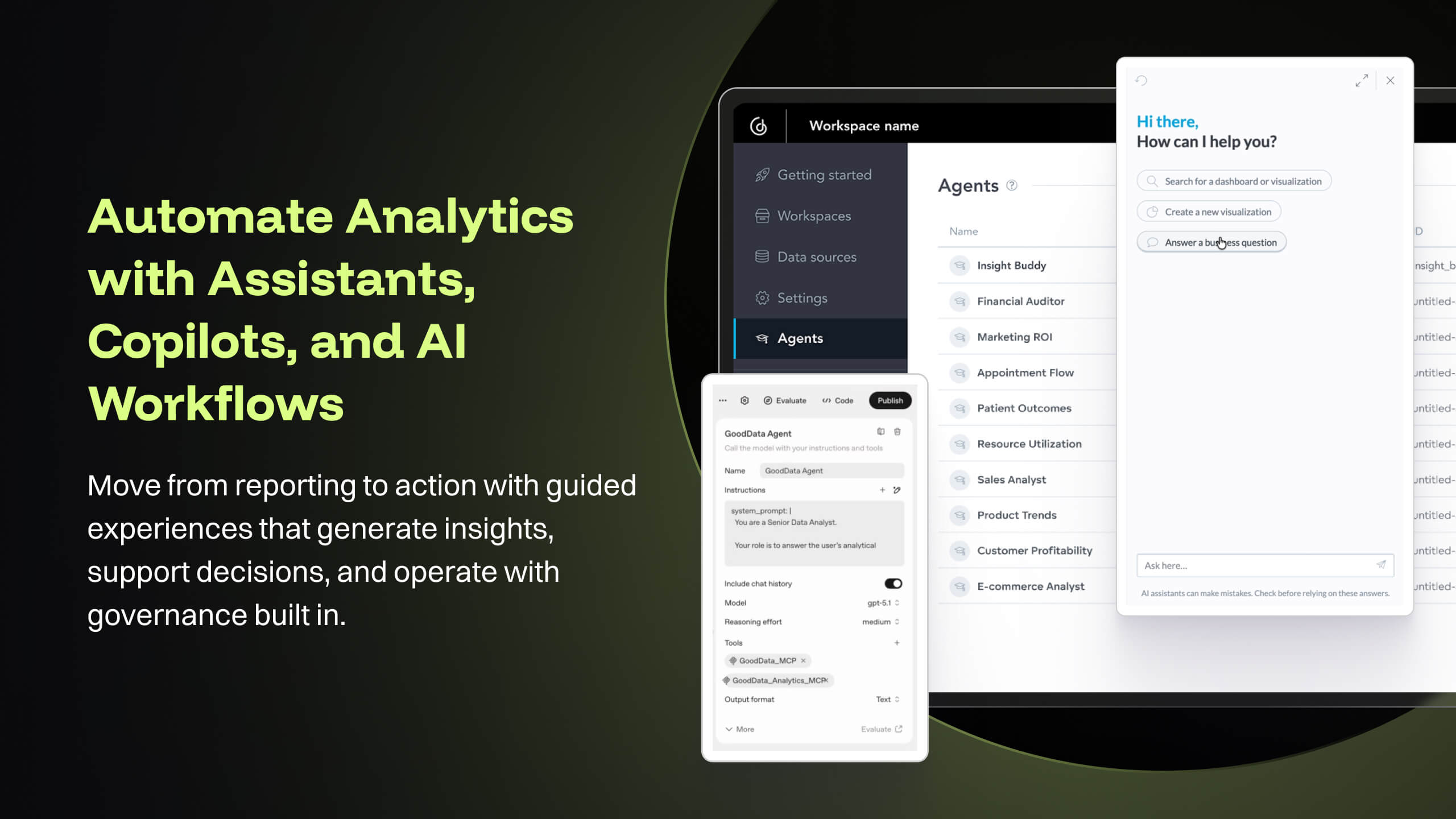
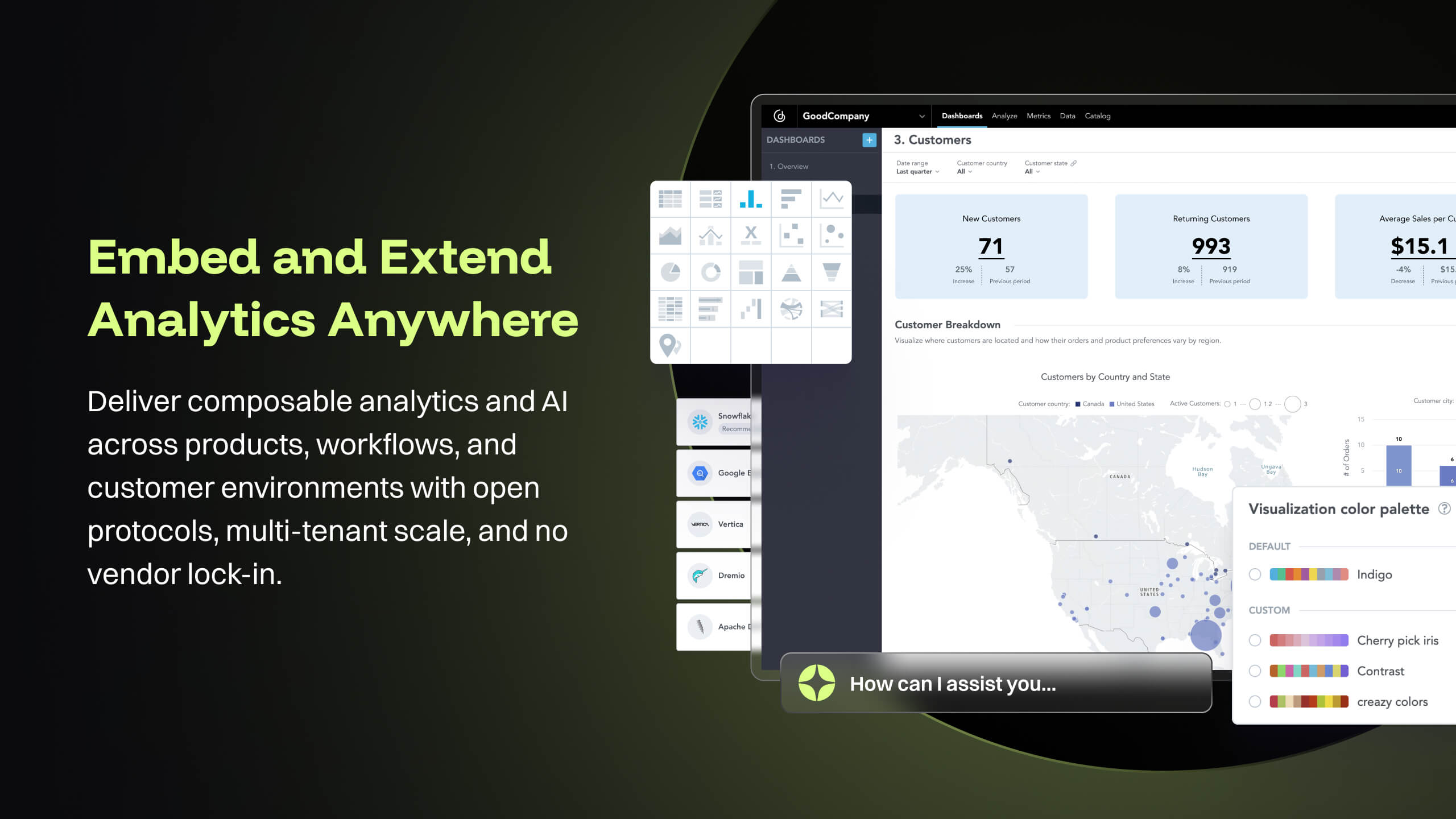
GoodData is an analytics platform used by organizations to deliver real-time, governed insights, embedded into products, customized for users, and integrated into any data environment.
N/A
IBM Cognos Analytics
Score 7.5 out of 10
N/A
IBM Cognos is a full-featured business intelligence suite by IBM, designed for larger deployments. It comprises Query Studio, Reporting Studio, Analysis Studio and Event Studio, and Cognos Administration along with tools for Microsoft Office integration, full-text search, and dashboards.
$11.25
per month per user
Looker
Score 8.3 out of 10
N/A
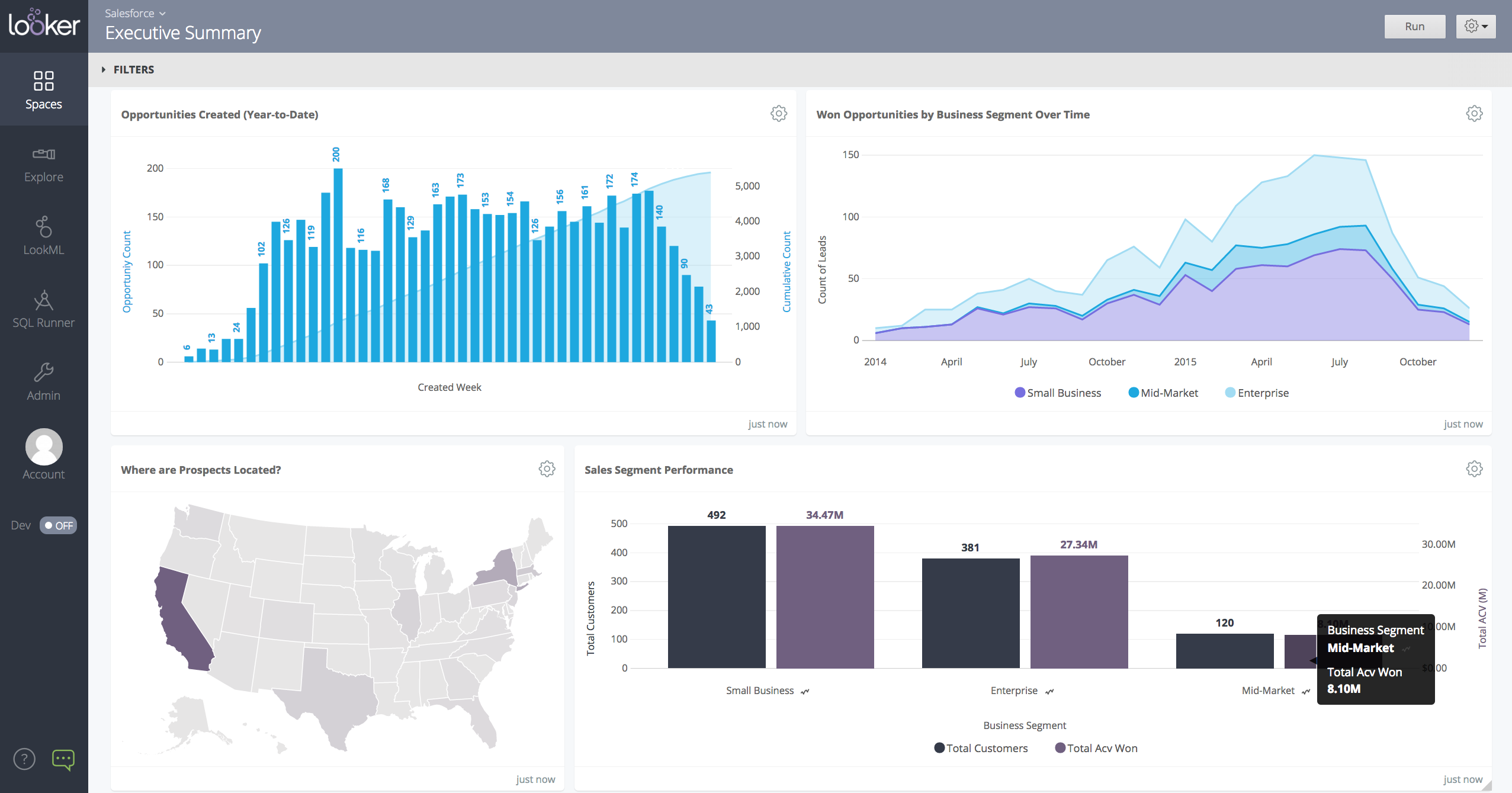
Looker is a BI application with an analytics-oriented application server that sits on top of relational data stores. It includes an end-user interface for exploring data, a reusable development paradigm for data discovery, and an API for supporting data in other systems.
GoodData stacked better over Looker in its ability to manage distribute and provide custom control to end users. overall cost with GoodData would be lower as it would wound not depend on the data platform for compute resources.
Looker and GoodData are both powerful BI platforms, but they have distinct strengths. Looker offers seamless integration with Google Sheets, enabling easy data import and analysis. On the other hand, GoodData excels in data modeling, providing a user-friendly interface for …
I was involved in the decision making but not final decision maker. Ease of implementation for GoodData vs Cognos (used for 15 years in multiple companies). I think Tableau's visualizations are better, but there is much that just can't be done in Tableau that GoodData handles …
GoodData seems less user friendly and doesn't provide that many visualization options so we are slowly moving to other solution in part of the company. There are still teams that plan to continue with GoodData and use React code in orther to supply missing functions.
Embedding flexibility was the main reason we chose GoodData. Interactivity, customization options, and programmatic ability were all very important to us and GoodData's embedding via React SDK offers exactly that. Implementation time was 50% shorter with GoodData than with …
GoodData is easier to understand and designed to detail critical data within a dashboard system. Visualization is essential, and the filters are quite varied. Metrics are also easy to use, so users only need to think a little more carefully about setting up the SQL required for …
GoodData is much more customisable in our case so we choose this. Also when it comes to pricing part GoodData is the best economically as well and in terms of features and functionalities. As compared to others similar products I believe that GoodData is much more reliable with …
GoodData has been proven best for us as it has given the most accurate analytical insights on our data. I've used other tools too but no one has been this good in terms of reporting, handling data, decision making. Using GoodData for almost every organisational decision and …
All of the tools have their plusses and minuses. The one thing that stands out with Qlik is that it allows for two-way API integrations with Salesforce. This means that analytics reporting results can interact with the Salesforce application.
The primary reasons GoodData was selected was data modeling capability, ability to standardize complex metrics, quality of viaualization and multi-tenancy
I have used all softwares in my past 10 years of experience. GoodData stands out with its seamless data integration, advanced predictive analytics, and collaborative features. Unlike Tableau and Power BI, GoodData offers scalable solutions with a user-friendly interface for …
Choosing between GoodData and other platforms was clear for me as the superiority of GoodData over others due to our needs. GoodData stands out for its awesome dashboards, robust predictive analytics, reports, and analysis. Data integration helps us for business intelligence …
GoodData is best among every other platform I used because it's a cloud based platform and way to easy to use. Its robust predictive analytics and unified data view set it way apart. While Power BI and Tableau excel in visualization, GoodData's focus on comprehensive business …
In GoodData we really liked the fact that sales and engineering were on our side from the beginning, the calls were very easy to book and were efficient with clear agenda and participants. We also got invited on Slack were we had support from the team and also we liked the …
For analysts, Tableau is far better because of better graph visualization. Tableau does not need to deal with the amount of uploaded data. Our company uses Gooddata because of its unbeatable price.
I actually investigated around 20 options and in most part the embedding + multi tenant mode that became a key concern. They either do not have the support or the price scaling is terrible or the startup cost is prohibitive. On the average startup cost is around 50k per year and …
IBM Cognos Analytics was more matured enterprise modeling-based tool. Our power Bi struggled against large ERP data sets, which IBM didn't after few initial days.
IBM had much better scalability and security when comes to user reports distribution. The schedule feature worked …
Compared to other tools like Power BI, Tableau, and Google studio, IBM Cognos Analytics is better for the companies who looks strong control on detailed reports. Power BI and Tableau are easy to use and good for quick presentation, but Cognos has more options for security, such …
We find Looker much easier to develop and manage. The LookML central data repository is far more robust and easy to use. The fact that Looker manages the server for you, means you never have any downtime. The other products have you managing all sorts of servers, which is a lot …
GoodData is well suited for classic business intelligence and data analytics solution involving visually driven content using charts and graphs. It's rich collection and drillable interactions make it perfect for embedded analytics where application workflow is tied to analytics. However, GoodData may not be ideal or appropriate for such solutions that require lot of textual content to be displayed with the help of tabular visuals, particularly in regulated industries where the key is in the details. This is all tied to the platform limits that force the default layout to pre-filter
Well suited: Financial reporting - It can handle complex, pixel perfect, muti-page reports with scheduled delivery to stakeholders (like sales report by region on quarterly periodicity) Operational dashboard across departments - It can combine multiple data sources (ERP, CRM, excels etc) with filters, and embedded AI insights Less appropriate: Live dashboards - As stated earlier as well, IBM Cognos Analytics doesn't suit well for live dashboards or event driven data. For ex: live web traffic data or IOT device data, etc Data science - Although IBM Cognos Analytics is great tool for data exploration but it should not be used as a substitute for Python or R, which has edge over advanced modelling and stats based workflows like predictive modelling or clustering
When data drives potential for new orders, Looker earns its place in our tech stack. If, on the other hand, we are hoping for pipeline generation, Looker is useful if you are willing to repeatedly go check customer utilizations .... it is not appropriate if you are hoping to automate data analysis for this purpose.
GoodData provides advanced analytics for predictive modeling. This assists in identifying potential issues before they arise, and making proactive decisions.
GoodData prioritizes data security and compliance, providing features that help IT firms like ours adhere to regulatory requirements.
GoodData gives high customization dashboards, allows us professionals to create tailored view of KPI.
Show visited pages - sessions, pageviews - which programs are viewed the most.
Displays session source/medium views to see where users are coming from.
It shows the video titles, URLs, and event counts so we can monitor the performance of our videos.
It gives a graphic face to the numbers, such as using bar charts, pie graphs, and other charts to show user trends or which channels are driving engagement.
Our clients like to see the top pages visited for a month.
I like the drop-and-drag approach, and building charts is a little easier than it was before.
Good Data is already have certain customizable options. However, having more flexibility in customizing reports and dashboards & control over the visual aspects would enhance the overall user experience.
To make Good Data even more powerful tool, improving the speed and responsiveness of the tool, especially during data-intensive tasks, would be a significantly helpful.
For new users, the interface can be made more user friendly which would promote easy navigation through features of tool.
IBM Cognos Analytics enables customer data segmentation, which is essential for marketing, improving and streamlining purchasing behavior and preferences. This helps companies create more targeted and effective marketing campaigns.
Our clients Through data analysis, we can identify and observe trends in the behavior of other clients, allowing us to anticipate needs and adjust strategies to avoid consequences.
Because gooddata really helps us in processing data to make reports or dashboards. So we are very satisfied when we use it. What we like is the flexible use of charts. We change at will the use of charts to display in reports or dashboards. Thank you Gooddata for helping companies like us who need flexibility in usage
For an existing solution, renewing licenses does provide a good return on investment. Additionally, while rolling out scorecards and dashboards with little adhoc capabilities, to end users, cognos is very easily scalable. It also allows to create a solution that has a mix of OLAP and relational data-sources, which is a limitation with other tools. Synchronizing with existing security setup is easy too.
I give it this rating because it deems as effective, I am able to complete majority of my tasks using this app. It is very helpful when analyzing the data provided and shown in the app and it's just overall a great app for Operational use, despite the small hiccups it has (live data).
From a customer perspective it is incredibly usable. We have more users building their own reports that would normally need custom work from our support team. The back end can be daunting when trying to configure things like new data elements or push changes to a report to all existing customers.
We have a strong user base (3500 users) that are highly utilizing this tool. Basic users are able to consume content within the applied security model. We have a set of advanced users that really push the limits of Cognos with Report and Query Studio. These users have created a lot of personal content and stored it in 'My Reports'. Users enjoy this flexibility.
Looker is relatively easy to use, even as it is set up. The customers for the front-end only have issues with the initial setup for looker ml creations. Other "looks" are relatively easy to set up, depending on the ETL and the data which is coming into Looker on a regular basis.
Reports can typically be viewed through any browser that can access the server, so the availability is ultimately up to what the company utilizing it is comfortable with allowing, though report development tends to be more picky about browsers and settings as mentioned above. It also has an optional iPad app and general mobile browsing support, but dashboards lack the mobile compatibility. What keeps it from getting a higher score is the desktop tools that are vital to the development process. The compatibility with only Windows when the server has a wide range of compatibility can be a real sore point for a company that outfits its employees exclusively with Mac or Linux machines. Of course, if they are planning on outsourcing the development anyways, it's a rather moot point
Overall no major complaints but it doesn't handle DMR (Dimensionally Modeled for Relational) very well. DMR modelling is a capability that IBM Cognos Framework Manager provides allowing you to specify dimensional information for relational metadata and allows for OLAP-style queries. However, the capability is not very efficient and, for example, if I'm using only 2 columns on a 20-column model, the software is not smart enough to exclude 18 columns and the query side gets progressively larger and larger until it's effectively unusable.
Somehow resources heavy, both on server and client. I recommned at least 50Mbs data rate and high performance desktop comouter to be abke to run comolex tasks and configure larger amount of data. On the other hand, the client does not need to worry when viewing, the performance is usually ok
Support team has been highly responsive and helpful from our first initial deployment to present day. They engage and work with us. know when to escalate for more challenging problems. They also follow up. Overall have had a very good experience with support
Why is their web application not working as fast as you think it should? They never know, and it is always a a bunch of shots in the dark to find out. Trying to download software from them is like trying to find a book at the library before computers were invented.
Never had to work with support for issues. Any questions we had, they would respond promptly and clearly. The one-time setup was easy, by reading documentation. If the feature is not supported, they will add a feature request. In this case, LDAP support was requested over OKTA. They are looking into it.
Onsite training provided by IBM Cognos was effective and as expected. They did not perform training with our data which was a bit difficult for our end-users.
The online courses they offer are thorough and presented in such a way that someone who isn't already familiar with the general design methodologies used in this field will be capable of making a good design. The training environments are provided as a fully self contained virtual machine with everything needed already to create the environments. We've had some persisting issues with the environments becoming unavailable, but support has been responsive when these issues arise and straightening them out for us
Implementations are hard and we had limited technical resources. We relied too heavily on GD care team. When we found technical gaps, they weren't simple to overcome
Make sure that any custom tables that you have, are built into your metadata packages. You can still access them via SQL queries in Cognos, but it is much easier to have them as a part of the available metadata packages.
GoodData comparing to other platform is very easy to use, customer support and on-boarding support. Set of features, speed of integration in our platform. Also great benefit for us was very competetive pricing.
Power BI is stronger for quick ad-hoc analysis and dashboards, but IBM Cognos Analytics is better when consistency, precision, and mass distribution matter. Tableau is best for interactive analysis, while IBM Cognos Analytics is better for standardized, repeatable enterprise reporting. Sigma shines for customizable dashboards and drill-down analysis while IBM Cognos Analytics holds an edge in data discovery and visualization.
Looker Studio, you can easily report on data from various sources without programming. Looker Studio is available at no charge for creators and report viewers. Enterprise customers who upgrade to Looker Studio Pro will receive support and expanded administrative features, including team content management. So it's good.
The Cognos architecture is well suited for scalability. However, the architecture must be designed with scalability in mind from day one of the implementation. We recently upgraded from 10.1 to 10.2.1 and took the opportunity to revamp our architecture. It is now poised for future growth and scalability.
Looker has a poignant impact on our business's ROI objectives. As an advertising exchange we have specific goals for daily requests and fill, and having premade Looks to monitor this is an integral piece of our operational capability
To facilitate an efficient monthly billing cycle in our organization, Looker is essential to track estimated revenue and impression delivery by publisher. Without the Looks we have set up, we would spend considerably more time and effort segmenting revenue by vertical.
Looker's unique value proposition is making analytical tools more digestible to people without conventional analytical experience. Other competing tools like Tableau require considerably more training and context to successfully use, and the ability to easily plot different visualizations is one of its greatest selling points.