Google's BigQuery is part of the Google Cloud Platform, a database-as-a-service (DBaaS) supporting the querying and rapid analysis of enterprise data.
$6.25
per TiB (after the 1st 1 TiB per month, which is free)
Looker
Score 8.3 out of 10
N/A
Looker is a BI application with an analytics-oriented application server that sits on top of relational data stores. It includes an end-user interface for exploring data, a reusable development paradigm for data discovery, and an API for supporting data in other systems.
N/A
Looker Studio
Score 8.1 out of 10
N/A
Looker Studio is a data visualization platform that transforms data into meaningful presentations and dashboards with customized reporting tools.
I personally find it by far simpler than Amazon Redshift due it's onboarding seamlessness. For a quick start and simplify tye access to read the data big query provide better user experience and a smoother user interface. More importantly, the fact that Big Query can be easily …
It's easier to connect data between BigQuery and Looker Studio instead of connecting the data between BigQuery and Tableau in terms of data explore or dashboard creating. Therefore we are considering migrating dashboards from Tableau to Looker Studio for the whole company. On …
Google BigQuery seemlessly integrates with all the Google services. In Looker Studio you directly have a connector for Google BigQuery which can help to create dashboards in few clicks. For automating some stored procedures we have used Cloud Functions which are triggered by a …
Google BigQuery of course collects a much much larger array of raw data and can handle (practically) an unlimited amount of data. For a large enterprise like ours that relies on large-scale analytics, this is absolutely imperative. Google BigQuery can also combine GA4 data with …
PowerBI can connect to GA4 for example but the data processing is more complicated and it takes longer to create dashboards. Azure is great once the data import has been configured but it's not an easy task for small businesses as it is with BigQuery.
Main reason is how it integrates directly with the google ecosystem which really facilitates the automatization proceses for the whole company. This ensures that sales and all the other departments have the correct information on a daily bases with a ease of use with day to day …
I have used most of the data analytics platforms. Based on my work, I have found that the user interface of Google BigQuery is simple to navigate. I like the front view - ease of joining tables, and integration with other platforms.
In my opinion, Google BigQuery is custom made to be the best data lake system that is easy to use, scalas to fit any business size, has inbuilt security, as well as tools for data integrity. Although a few other tools have some of the same functionality, Google BigQuery is the …
Google BigQuery's main advantage over its direct competitors (Amazon Redshift and Azure Synapse) is that it is widely supported by non-Google software, while the others rely heavily on their own cloud ecosystems.
I have used other data manipulation tools like SQL Server and Google BigQuery feels more intuitive, Google provides so much documentation and tutorials that getting to know the software is not only easy but even satisfactory, so I'd say Google BigQuery is very superior to that …
Cost is the important factor for us compared with all of the other tools Google BigQuery stands top among all of them which charges very minimal charges for storage against all the apps that we have liked the most additionally, we can do query on our data, and can build …
BigQuery has a simpler and more intuitive user experience (as is the case with most of its products) compared to AWS, which has a more technical and complex profile, so it was the first tool we used. It's still my go-to option for handling SQL queries, though it doesn't detract …
Senior Manager, Digital Advertising & E-Commerce Team
Chose Looker
Google Looker Studio is an online tool for converting data into customizable, informative reports and dashboards. It is a free tool that turns performance data into informative, easy-to-read, easy-to-share, and fully customizable dashboards & reports. Google Looker Studio turns …
Looker works and exists in the Google ecosystem. If you are a Google Cloud Platform user, Looker is a no brainer. There is also Looker Studio, the small (free) brother with less features which is basically a report only viewer/creator. The reason we choose Looker is because can …
The biggest advantage that Looker Studio has is that it's really easy to use and to distribute to other use. You can have a really complex report set up in a couple of minutes with an extract data source that enables Looker to update really fast.
Looker is less complex to use and links directly to google suite which we use across the business and personally think is a better user experience than microsoft.
The learning curve for Tableau Cloud was too steep for our team. After watching a couple of YouTube videos, anyone can begin connecting data sources and creating reports with Looker. Looker is also free with Google Workspace, making the decision between Looker and Tableau a …
The dev/production environment distinction is constructive. Before, in Data Studio, all changes had to be made, which was very inefficient and risky as far as version control goes. Having a more centralized and organized space for all our data visualization is more helpful than …
Tableau is also a great BI tool, but it felt a lot less flexible to me in terms of customization of data. As a visual platform, Tabluea is incredible; it can produce unbelievably rich visualizations and dashboards. It's also easier to get set up on Tableau too, but ultimately …
Looker provides really excellent customer service in comparison to other similar products. The sharing aspect of Looker is also a big plus, which allows multiple users to access the data at the same time. We have also found it to stand out among competitors with its dashboard …
Unfortunately, I was not in charge of the decision to select Looker as it was before my time. I can see why the decision was made as I do see the potential. We have felt the need to supplement Looker with another free tool and, if our integrations weren't so deep and our …
The free version of Looker Studio is still better than the leading enterprise-embedded BI tools, despite its weaknesses. The leading embedded BI platforms have terrible visualizations that can be spotted a mile away. They are also primarily locked to a grid, making it very hard …
Looker Studio is great for free, simple Google-centric dashboards, while Power BI offers strong Microsoft integration, AI, and deep data prep (Power Query/DAX) for corporate users. Tableau excels in advanced visual exploration for complex data, though often much pricier. Fullst…
We are heavily within the Google ecosystem and therefore didn't really consider alternatives to Google Data Studio since it met our somewhat limited needs at the time of implementation. For outside presentations, we would probably lean towards something that allows us to more …
Google Data Studio is widely available and accessible, can be shared easily, and it only takes 20-30 min to build a rudimentary dashboard. It has very little setup and does not rely on internal data architecture and development. For later development purposes, Tableau, Power …
This is starting to feel redundant but we just Google Data Studio to supplement the areas that are lacking in our other BI tools. Because it's free it's an easy decision to make. It does not allow us the deep diving that we get with others but is often simpler to use, more …
Event-based data can be captured seamlessly from our data layers (and exported to Google BigQuery). When events like page-views, clicks, add-to-cart are tracked, Google BigQuery can help efficiently with running queries to observe patterns in user behaviour. That intermediate step of trying to "untangle" event data is resolved by Google BigQuery. A scenario where it could possibly be less appropriate is when analysing "granular" details (like small changes to a database happening very frequently).
When data drives potential for new orders, Looker earns its place in our tech stack. If, on the other hand, we are hoping for pipeline generation, Looker is useful if you are willing to repeatedly go check customer utilizations .... it is not appropriate if you are hoping to automate data analysis for this purpose.
Visualizing cross-channel campaign performance can blend data from a few different sources to compare performance metrics like spend, clicks, and conversions side-by-side in a single view, which helps in quick budget reallocation decisions. When dealing with massive volumes of data (millions of rows) or highly complex queries, Looker Studio dashboards can become slow, laggy, or even crash. Performance issues are a frequent complaint when working with large datasets, making it unsuitable for enterprise-level companies
GSheet data can be linked to a BigQuery table and the data in that sheet is ingested in realtime into BigQuery. It's a live 'sync' which means it supports insertions, deletions, and alterations. The only limitation here is the schema'; this remains static once the table is created.
Seamless integration with other GCP products.
A simple pipeline might look like this:-
GForms -> GSheets -> BigQuery -> Looker
It all links up really well and with ease.
One instance holds many projects.
Separating data into datamarts or datameshes is really easy in BigQuery, since one BigQuery instance can hold multiple projects; which are isolated collections of datasets.
Show visited pages - sessions, pageviews - which programs are viewed the most.
Displays session source/medium views to see where users are coming from.
It shows the video titles, URLs, and event counts so we can monitor the performance of our videos.
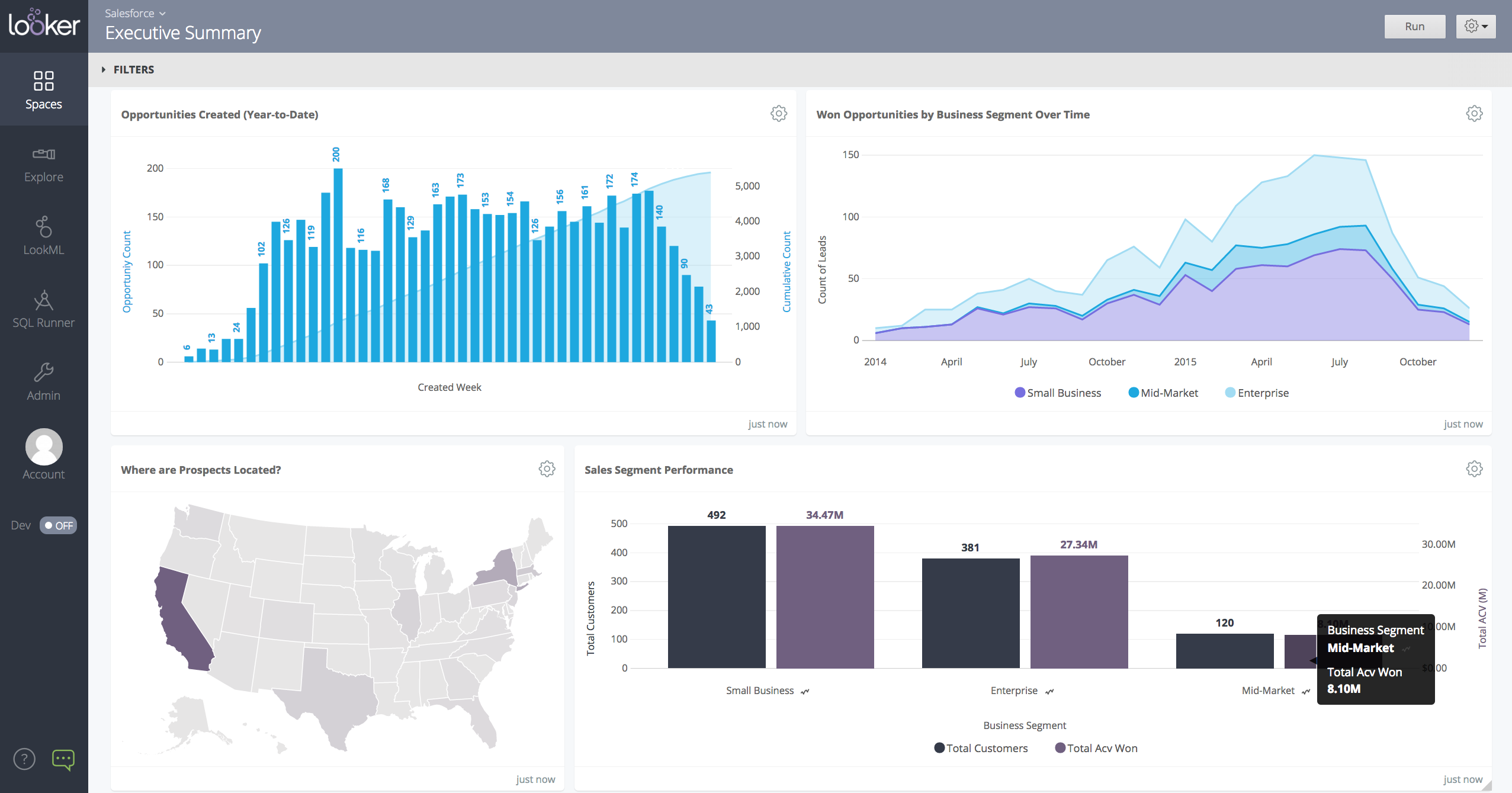
It gives a graphic face to the numbers, such as using bar charts, pie graphs, and other charts to show user trends or which channels are driving engagement.
Our clients like to see the top pages visited for a month.
I like the drop-and-drag approach, and building charts is a little easier than it was before.
Breath of data - the number of ways to interrogate the data is endless, and the options to view metrics alongside each other make for comprehensive datasets.
Data visualisation and customisation - the options for presenting data and separating out across pages allow for clean visuals and segmented information.
Easy shareability/usability - a quick and simple tool to introduce colleagues to, and easy to grant access for them to be able to view the data, without having to understand the setup itself.
Please expand the availability of documentation, tutorials, and community forums to provide developers with comprehensive support and guidance on using Google BigQuery effectively for their projects.
If possible, simplify the pricing model and provide clearer cost breakdowns to help users understand and plan for expenses when using Google BigQuery. Also, some cost reduction is welcome.
It still misses the process of importing data into Google BigQuery. Probably, by improving compatibility with different data formats and sources and reducing the complexity of data ingestion workflows, it can be made to work.
It needs better handling of complex logic. We often need workarounds to perform complex custom calculations, and it can be really unpleasant at times.
Felt it got slow with a larger data set, and in one minor report, we had to set up time filters so that calculations during spikes could be traced more quickly.
Compare to competition they need to improve with notification things.
We have to use this product as its a 3rd party supplier choice to utilise this product for their data side backend so will not be likely we will move away from this product in the future unless the 3rd party supplier decides to change data vendors.
I give it this rating because it deems as effective, I am able to complete majority of my tasks using this app. It is very helpful when analyzing the data provided and shown in the app and it's just overall a great app for Operational use, despite the small hiccups it has (live data).
It is the simplest and least expensive way for us to automate our reporting at this time. I like the ability to customize literally everything about each report, and the ability to send out reports automatically in emails. The only issue we have been having recently is a technical glitch in the automatic email report. Sadly, there is almost no support for this tool from Google, but is also free, so that is important to take into consideration
I think overall it is easy to use. I haven't done anything from the development side but an more of an end user of reporting tables built in Google BigQuery. I connect data visualization tools like Tableau or Power BI to the BigQuery reporting tables to analyze trends and create complex dashboards.
Looker is relatively easy to use, even as it is set up. The customers for the front-end only have issues with the initial setup for looker ml creations. Other "looks" are relatively easy to set up, depending on the ETL and the data which is coming into Looker on a regular basis.
Looker Studio is easy to use, and it offers a sufficient variety of predefined visualizations to choose from. It's easy for us, and anyone can set up basic reporting without extensive data visualization skills. The interface layout is easy to understand, and it doesn't take long to get used to.
I have never had any significant issues with Google Big Query. It always seems to be up and running properly when I need it. I cannot recall any times where I received any kind of application errors or unplanned outages. If there were any they were resolved quickly by my IT team so I didn't notice them.
I think Google Big Query's performance is in the acceptable range. Sometimes larger datasets are somewhat sluggish to load but for most of our applications it performs at a reasonable speed. We do have some reports that include a lot of complex calculations and others that run on granular store level data that so sometimes take a bit longer to load which can be frustrating.
Somehow resources heavy, both on server and client. I recommned at least 50Mbs data rate and high performance desktop comouter to be abke to run comolex tasks and configure larger amount of data. On the other hand, the client does not need to worry when viewing, the performance is usually ok
BigQuery can be difficult to support because it is so solid as a product. Many of the issues you will see are related to your own data sets, however you may see issues importing data and managing jobs. If this occurs, it can be a challenge to get to speak to the correct person who can help you.
Never had to work with support for issues. Any questions we had, they would respond promptly and clearly. The one-time setup was easy, by reading documentation. If the feature is not supported, they will add a feature request. In this case, LDAP support was requested over OKTA. They are looking into it.
I give it a lower support rating because it seems like our Dev team hasn't gotten the support they need to set up our database to connect. Seems like we hit a roadblock and the project got put on pause for dev. That sucks for me because it is harder to get the dev team to focus on it if they don't get the help they need to set it up.
PowerBI can connect to GA4 for example but the data processing is more complicated and it takes longer to create dashboards. Azure is great once the data import has been configured but it's not an easy task for small businesses as it is with BigQuery.
Looker Studio, you can easily report on data from various sources without programming. Looker Studio is available at no charge for creators and report viewers. Enterprise customers who upgrade to Looker Studio Pro will receive support and expanded administrative features, including team content management. So it's good.
Looker Studio is far easier to implement, stand up, and learn. The interface is simpler and user-friendly for various levels of data visualization/analysis knowledge and experience. The biggest benefit of Looker Studio, however, is its ease of connection to GA data and speed. Furthermore, since it is an online program/tool, it requires less CPU/battery/storage on the user's device.
We have continued to expand out use of Google Big Query over the years. I'd say its flexibility and scalability is actually quite good. It also integrates well with other tools like Tableau and Power BI. It has served the needs of multiple data sources across multiple departments within my company.
Google Support has kindly provide individual support and consultants to assist with the integration work. In the circumstance where the consultants are not present to support with the work, Google Support Helpline will always be available to answer to the queries without having to wait for more than 3 days.
Previously, running complex queries on our on-premise data warehouse could take hours. Google BigQuery processes the same queries in minutes. We estimate it saves our team at least 25% of their time.
We can target our marketing campaigns very easily and understand our customer behaviour. It lets us personalize marketing campaigns and product recommendations and experience at least a 20% improvement in overall campaign performance.
Now, we only pay for the resources we use. Saved $1 million annually on data infrastructure and data storage costs compared to our previous solution.
Looker has a poignant impact on our business's ROI objectives. As an advertising exchange we have specific goals for daily requests and fill, and having premade Looks to monitor this is an integral piece of our operational capability
To facilitate an efficient monthly billing cycle in our organization, Looker is essential to track estimated revenue and impression delivery by publisher. Without the Looks we have set up, we would spend considerably more time and effort segmenting revenue by vertical.
Looker's unique value proposition is making analytical tools more digestible to people without conventional analytical experience. Other competing tools like Tableau require considerably more training and context to successfully use, and the ability to easily plot different visualizations is one of its greatest selling points.