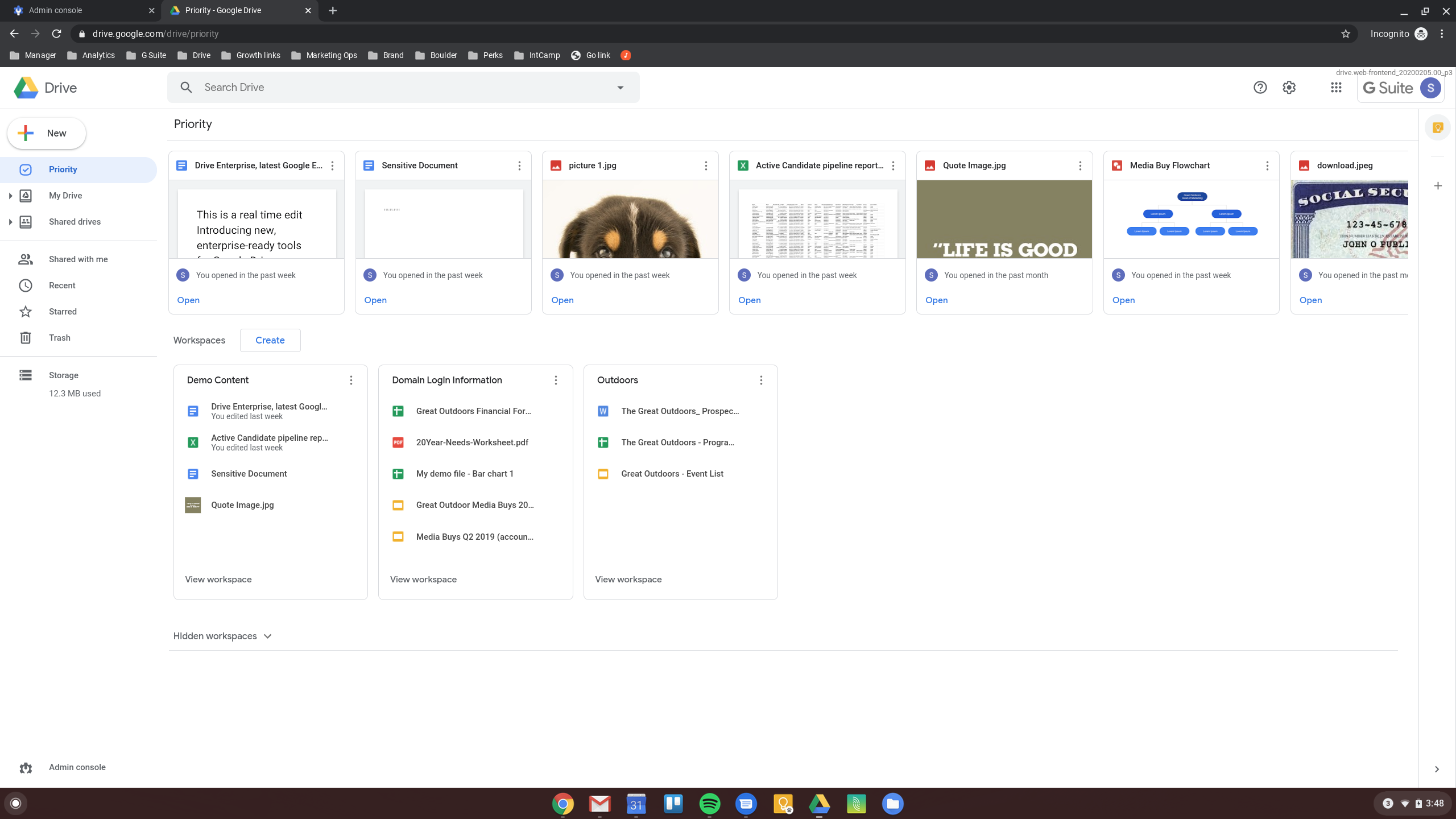
Google Drive is a cloud file storage, synchronization, and collaboration platform and service, that features Google Docs, Sheets, and Slides for document editing and presentation.
$6
per month
SharePoint
Score 7.7 out of 10
N/A
Microsoft's SharePoint is an Intranet solution that enables users to share and manage content, knowledge, and applications to empower teamwork, quickly find information, and collaborate across the organization.
$5
Per User Per Month
OpenAir PSA
Score 5.5 out of 10
N/A
NetSuite OpenAir is a cloud-based Professional Service Automation (PSA) product which includes capabilities around project management, resource management, project accounting, etc.
N/A
Pricing
Google Drive
Microsoft SharePoint
OpenAir PSA
Editions & Modules
Basic
$6.00
per month
Business
$12.00
per month
Enterprise
Contact Vendor for Quote
per month
Plan 1
$5.00
Per User Per Month
Plan 2
$10.00
Per User Per Month
Office 365 E3
$20.00
Per User Per Month
No answers on this topic
Offerings
Pricing Offerings
Google Drive
SharePoint
OpenAir PSA
Free Trial
Yes
Yes
No
Free/Freemium Version
Yes
No
No
Premium Consulting/Integration Services
No
No
No
Entry-level Setup Fee
No setup fee
No setup fee
No setup fee
Additional Details
Discounts are available for students, educators, and non profit organizations.
Compared to Microsoft SharePoint, the interface and learning curve for Google Drive are better mainly because the solution is much simpler and focuses on doing the basics well.
They can all do the basics equally well, storing and sharing documents. Google Drive is the best from an ease of use perspective. SharePoint is a little better in terms of user management. Dropbox has the best name recognition, but not all the features you will need. If you …
Google Drive and Box are extremely similar in functionality, the primary differences being aesthetic (Google is more user friendly, Box's UI design is a little less intuitive) and with regards to security (Box offers an enhanced level of protection commensurate with it's …
Verified User
Consultant
Chose Google Drive
Google Drive is better because it has its own suite of product features so it's simple and easy to use. It also allows multiple people to edit at once, whereas for other products (i.e. SharePoint) you have to "check" the document out for a single person's use.
i have been using google drive from 2012 and found the ease of use of it better than others. Even though I use Dropbox and OneDrive for work on some aspects mostly I prefer google drive for my work and personal.
Prior to adopting MS SharePoint, our team used Google Drive. I think MS SharePoint has made big gains in recent years and now offers essentially the same functionality and services as Google Drive does with added functionality. While Google Drive allows individuals and …
MS SharePoint offers far more beyond just document sharing like Google Drive or Dropbox. It allows our company to collaboate and complete tasks in a timely manner. It is a more robust solution and offers better security, customization, and scalability than other solutions.
SharePoint has more features than Google Drive, but is not free. It has the ability to present full web pages, which Google Drive does not have. It also has integration into Microsoft 365, Microsoft Office, and Microsoft Outlook which are strong product lines for business. Googl…
MS SharePoint's seamless integration with OneDrive makes it the hands-down winner over Google Drive. Although Google Drive is a fantastic tool, not being fully integrated with the MS Office Suite makes it less appealing for a large corporate storage solution.
I think that Google Drive is much faster and more efficient than working in SharePoint. I understand that the benefit of using SharePoint is the integration of other MS tools such as Excel, Powerpoint, Outlook, etc. However, these tools all work more efficiently offline rather …
For my time\money, Google Drive is an infinitely better investment than SharePoint, including in a business setting. Although it may not integrate with existing infrastructure (e.g. Active Directory) as well as SharePoint, Google Drive is much more efficient and effective for …
I have only used Google Drive for personal reasons, not at work. SharePoint has a larger corporation safer feel to it as it uses the comfort of MS Office products for users.
We still have Confluence and Google Drive, but we wanted a product that could provide document security and a single point of access that easily integrated into our active directory. Since we use this for our intranet site, we found the features easier to stand up and the UI …
MS SharePoint lags behind its competitors in most areas. While it does offer more functionality, such as custom sites, MS SharePoint's bogged-down sharing system really hurts it. While sharing documents with coworkers, outside contractors, and guests is hassle-free with Google …
I like Microsoft SharePoint over Google Drive for its organization. I believe that Microsoft SharePoint keeps things much more organized than Google Drive. Also, typically when you purchase Microsoft SharePoint, you get the rest of the Microsoft Suite. However, Google Drive has …
Since Microsoft SharePoint comes with the MS business office package, it is fully integrated with other office products and really works together with other MS Office products like Word, PowerPoint, Excel, Access, Publisher, etc.. in real-time, so it's really easy to maintain …
SharePoint was selected primarily because of its inherent integration with MS Office. The other tools were easier to use and easier to set up, but not selected because they were a third-party integration with Office.
I think that MS SharePoint is a more robust and well integrated tool than other products. Because it lives in the Microsoft universe it likely integrates to the other software products you already have very easily. Most users will not have trouble adopting it as the UI is …
OneDrive focuses mainly on being a repository in the cloud, but where the administrator of this information is usually the person who owns the site or the account where the information is stored. Unlike Sharepoint that allows generating groups of administrators, users and …
We chose SPO because of the integration with O365 and Office Apps. Single sign on and it being included in our O365 plan and license made implementation easy. Plus, Microsoft Teams now integrates with SPO team sites which made more sense for us to continue down this path …
I think SharePoint has been around the longest, at least it's the first cloud-based collaboration tool I used many years ago. It has a very Microsoft feel which has its perks and drawbacks. Reminds me of when I used Microsoft mobile OS and how it felt like Windows on a phone. …
Being integrated into Office 365 and included with your subscription, there are no added costs associated with setting up SharePoint. Also being able to sync one drive and being able to open files SharePoint files via file explorer is a great added benefit.
MS SharePoint is a better option for our team as we use Office 365 across our organization. It allows us some integration, and was a more familiar interface for many of the users on our team. It met our security needs and standards for our parent company as well.
MS SharePoint had great Microsoft product integration compared to other services, and was a more complete enterprise package. We didn't evaluate many other services, as SharePoint's integration into other basic office programs was more valuable than saving a little bit or …
There are a lot of other pieces of software out there that can do things that are similar to the things that SharePoint can do. Some are better and some are worse. We chose to start with what we already could access at no cost and work our way up from there.
It is possible to share files and folders with up to 200 email addresses, as well as with persons outside the company.Use the drop-down arrow to select who may see, comment on, or change the file or folder before sending out an invitation.I am very much impressed with this feature
SharePoint Document Management excels as a central repository for storing, organising, and retrieving documents. It supports version control, metadata tagging, secure access, and integration with tools like Power Automate. At our organisation, it's used for managing contracts, policies, and supplier documents. SharePoint Workflow Automation integrates with Power Automate to streamline approvals, gather feedback, and automate recurring tasks. This reduces reliance on email chains and manual trackers.
This product is well suited for an organization that is focused on client services, project delivery, time tracking, expense reporting, and revenue recognition. From a pure project management perspective, this product is not as feature rich as say Microsoft Project Server. For organizations that are looking for detailed complex project plan and resource management (along with resource leveling, etc.), this is probably not the best suited product
Any user with access can store a file using different platforms like Android, IOS, Windows, or Ubuntu (Desktop version)
You can share files with any number of different users with different access rights or you can even keep it public by providing the access link and assign different rights for public access
You can open Excel/Word files using google software Sheets/Docs in the browser environment without having to install software like Microsoft Office etc on your Windows OS
Netsuite OpenAir PSA is highly configurable and has a large ecosystem of assets to work with.
Tasks are easily designed to automate processes in your business workflow.
OpenAir is designed in such a way that it can communicate and receive information from external systems without having to re-engineer your systems to make them work if you are following standard business practice.
Having a little bit more control and clarity over what is shared and how it is shared would be a useful improvement.
Could be more robust and flexible as far as assigning restrictions.
Google Sheets could be enhanced because Excel really is not there yet as a product with equal capabilities as there are still quite a few limitations to the functionality.
Windows Explorer users have some difficulty having to constantly UPLOAD / DOWNLOAD files. Specifically on the DOWNLOAD when they are used to Drag & Drop in & out of LOCAL folders via Window's explorer.
Microsoft SharePoint supports multiple "library" types. When implementing our "image" library the search function is done via "tags" and boolean logic. This is challenging to most end users. I'd like our users to be able to search our Microsoft SharePoint image library without having to enter KEYWORD or other BOOLEAN logic.
Microsoft SharePoint can also be an internal website for each department or company wide communication tool but I believe these features are geared for much larger organizations. Since we are a SMB we really aren't using these features. So maybe something more useful to SMBs would be nice.
Compared to QuickArrow, setting up reports to reflect the data accurately seemed to require a bit more consultant time and collaboration. Getting the numbers correct is essential, so budget extra time for this iniative. We also learned that certain calculations can not be displayed in the executive dashboards. Ask these questions upfront to ensure your dashboards are complete for your needs (again, working backwards in the preparation stages).
Compared to QuickArrow, NetSuite OpenAir PSA falls short in the resource management capabilities. UI, flexibility, and scheduling options all could be improved. This is on their roadmap, timeline yet to be defined. Scheduling is vitally important to our company and this is THE area where we feel is the applications weakest. However, the application does provide everything critical to scheduling and provided the elements we needed in order to be successful. We altered our scheduling process accordingly.
During our System Administration 3 day online training, when a question was asked about detailed functionality, sometimes the trainer would share..."Yes, OpenAir has a configuration for that. Just inquire with your consultant and they can flip that flag in your instance." The responsibility for obtaining these special application configurations was placed on the System Admin [in training] to ask and to take notes. If your company needs the application to work a certain way, speak up and ask your OA consultant. There seems to be MANY flags that can be flipped in the background to allow for the system to meet your needs. My complaint is that these are not published, rather made available if one inquires.
OpenAir is able to generate invoices directly and we strongly encourage using this feature to keep everything housed under one application. However, this did not work for our organization and we leveraged a financial integration. A bit of a pioneer integrating with Softrax -- the integration works well, however is quite fragile. We do receive appropriate support when needed, but would prefer the integration to be a bit more stable. We recommend integrating with their stated supported financial systems, as staying the course will likely net a more stable integration.
It's perfect for me. It keeps things saved and is easy to remove items if needed. Also, I very much enjoy the formatting options. Along with the integrations it has for SSO. Overall, this is the most user friendly system I have ever come across.
It's integral to our business. It's already included with most of the Office 365 licensing we buy, so the cost is effectively zero. It stores our files, it is the foundation for custom applications, and Microsoft only continues to enhance its functionality and its connections to other Microsoft tools. SharePoint just keeps getting better and better.
It all depends. We are still looking at moving our consultants to Oracle PAC, in order to get our financial systems in line (we use Oracle Financials currently). We are feeling a lot of pain with integration and segmented systems.
Ultimately,it depends on how much pain is felt there. OpenAir has given us a path to follow on from QuickArrow. I foresee either moving onto Oracle PAC by end of calendar, or staying on OpenAir.
OpenAir to Oracle integration is not easy. From a reporting and process perspective, there’s been pain from being in different systems
It's easy enough to use for computer users of all ages and skill levels. I am an advanced user, and I think the hardest part might be showing someone how to download and set up the app on their device if they weren't too familiar with computers, but overall it is very easy to understand.
No usability issues reported. Individual teams also have allocated areas which replace legacy shared drives on local LANs. Access to Sharepoint resources is fully integrated with corporate Active Directory with additional two-factor authentication required for administrative users. Users have access to Microsoft Services Hub which allows you to create, manage, and track support requests while staying current on Microsoft technologies with access to select self-paced learning paths
In this day and age I should not have to read a manual to understand a product. It should be intuitive to administrate and perform basic tasks. It feels like a ton of intelligence was poured into making OpenAir feature rich but no where near as much attention was given to the user experience.
The documents load fairly quickly and also update in real time, especially given the fact that multiple people can be using it at once. The "Offline" feature works great to allow the user to make edits and access the document without access to the internet, and then sync changes later once they're back.
It takes a few days for customer support to get back to you. Although, I have not had to use support too often. Once you get an email back, they are very thorough and work hard to fix the problem quickly. It is a really great resource and a great way to get the help you need if you're stuck. A phone call also works quickly but you have to call during specific times.
As an admin, I've had more contact with OA support than most. I've found their response to tickets typically timely and helpful, however many of the responses to tickets are "we will file an enhancement request" and then I never hear about it again. So not terrible, but not a very fulfilling experience.
The effective google workspace using training that my organization received and was conducted by me (as a team lead of the ICT team) was mind-blowing and as a result, our staff is performing well in terms of using the application for their daily jobs than before. Now, in my institution, all teachers and all the administrative personnel are very much interested in cloud storage facilities, in previous my institution was afraid of losing all important documents in the cloud storage. But, after having received the training they are now realized that if anyone has only one google account then he or she can use 15GB of cloud storage freely and they are now happy because now it is not necessary for anyone to carry the traditional pen drive.
The face to face training I received was on SharePoint Administration. It was rushed as there was a lot of information to cover and the application of the labs weren't that great either. I like to be able to relate what I am learning to what I am currently doing.
Very knowledgeable and able to articulate how other customers configured the solution to meet their needs as well as the best practices they recommended.
I like to learn at my own pace and online training allows for that. Additionally, you can skip through pieces of content that you already know or are already comfortable with. Microsoft actually offers great videos on their website for basic fundamental SharePoint Training. I have used these training videos in some of my own training sessions with end users.
We did a 3 day online remote course back in April. NetSuite prefers training to occur before migration. We went over the functionality of tool and three months later we migrated. Personally, I didn’t find it that beneficial. Certain parts of it were beneficial as they applied to me – talked a lot about invoicing capabilities that didn’t apply to me. They also have knowledge base / e-learning assets, but I haven’t referred to them
It's an extremely easy software to implement, once you sign up for a google account you automatically have access to google drive with a set amount of storage space. The business or Google Suite accounts have more storage space than a regular free account, but setting up and accessing google drive is very easy in both cases
It went fine. Everything came over the way we wanted. In addition to migrating the current projects we wanted to migrate historical data – did that seamlessly. The finished product looked pretty good – just needed to tweak – and they helped us with that
In short, Google Drive is better for independent users who store a normal amount of stuff. OneDrive makes more sense for businesses and teams that are doing heavy-duty storage or large-scale syncing. Realistically, though, most users will fall somewhere in between the two, where either platform would meet their needs.
The reasons for selecting MS SharePoint are: SharePoint provides ease of use and web design assistance and support SharePoint helps you schedule your content for publishing. enables users to share documents with external parties and offers a better internal structure of the content and better indexing and searching capabilities.
OpenAir accurately reflects changes in real-time as well as lends itself to see where a draw is at, when payment is expected and what percentage of the contract has been billed or approved to date. This helps with project billing and tracking as well as cash flow. Quickbooks lacks the ability to show progress draws, approved changes, and pending changes on a given project where OpenAir excels.