Adobe Workfront, acquired by Adobe in late 2020, is a web-based project-management tool. It is designed for both IT and marketing teams, but can be implemented for any kind of project. Workfront offers all the features standard to project management platforms, as well as resource allocation, automation, and agile workflow.
N/A
Asana
Score 8.5 out of 10
N/A
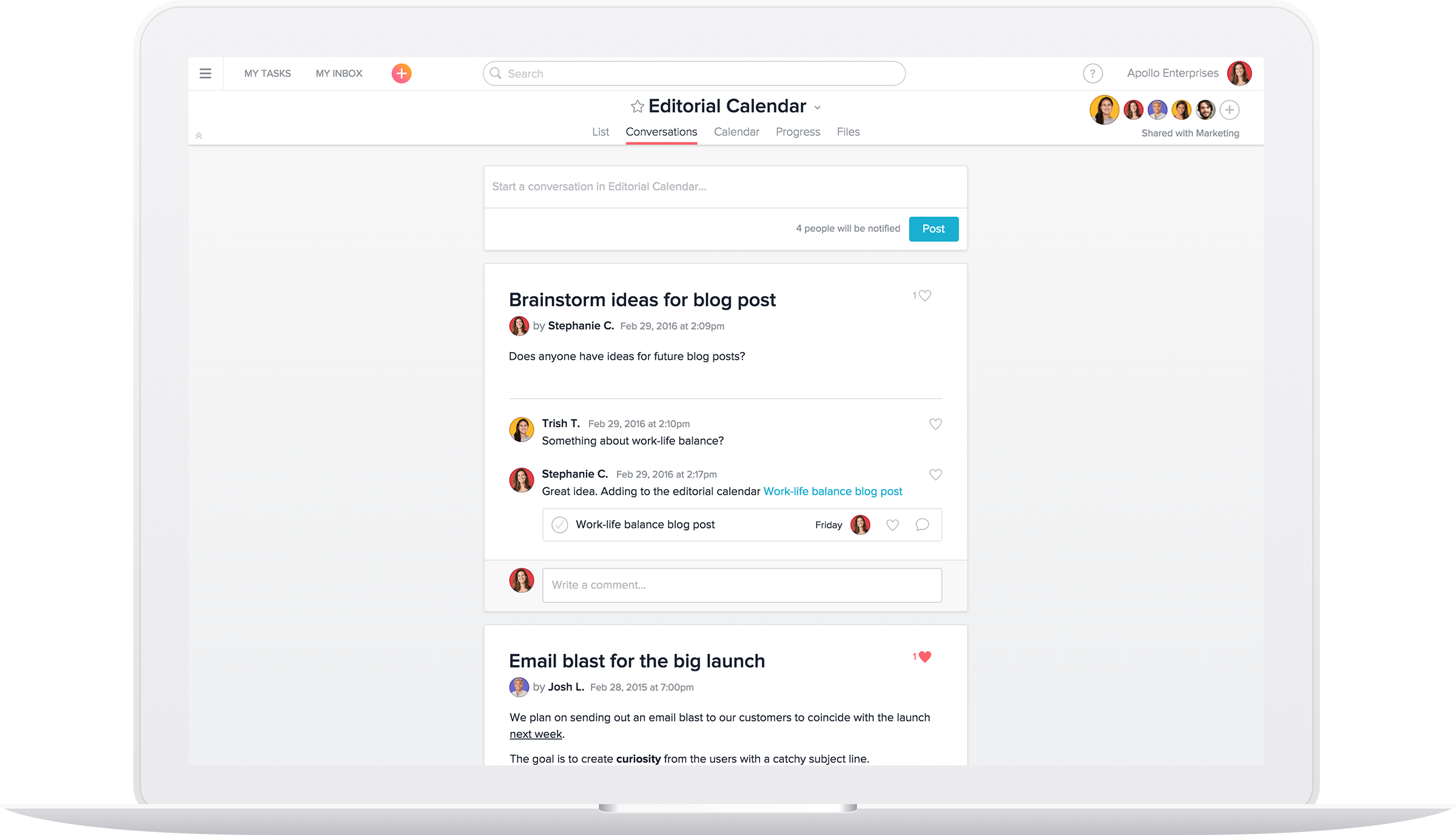
Asana is a web and mobile project management app. With tasks, projects, conversations, and dashboards, Asana lets an entire team know who's doing what by when, enabling workload balancing. Users can also add integrations for GANTT charts, time tracking and more.
$13.49
per month per user
Microsoft Planner
Score 7.5 out of 10
N/A
Microsoft Planner is presented as a solution to organize teamwork with intuitive, collaborative, visual task management. With it, users can create Kanban boards using task cards with files, checklists, and labels. Users can collaborate in Planner and Microsoft Teams and check visual status charts—all in the Microsoft cloud.
WorkFront feels like a chore to use as compared to friendly/easy Asana. Workfront is much more complex and the interface is busy and off-putting for many (but has much more functionality). It has a much more robust predecessor functionality which is one of the main reason we …
We also use Wrike and Asana. Workfront is way better for in-depth reporting compared to Asana, but lacks the intuitive task management that Asana offers. Asana is just easier to use. Workfront is night and day better than Wrike in almost every aspect. Better reporting, …
I would find that feature-to-feature comparisons and extensive features put Workfront at the same class level as Workamajig. It may come down to preferences and UX of the platform that would make for the ultimate decision on which to go with for project management needs. Asana …
Workfront is more robust and versatile than Asana and Smartsheets, which is why we did not go with those tools. It is pretty comparable to Wrike in many ways. We use Workfront over Wrike because we are set up in Workfront already.
My organization used Adobe Workfront due to familiarity with other Adobe products. But it was more manual than the system is replaced (DaVinci Workflow) so it was a struggle for my team at first. Using Asana currently, but we don’t have the full version with proofing so can’t …
Workamajig is great specifically for marketing project management. Jira is great specifically for software development project management. However, if you want all of the company on the same PM software, you need something less purpose-built. Asana is good for both, but lacks …
I like the look and feel for Adobe Workfront better. It's cleaner and easier to read my work order. Asana looks a bit TOO complicated to navigate and often time it's harder to find things.
But I do like Asana's tabs better than Adobe Workfront. I like Adobe Workfront's pin …
I like both Jira and Asana. They both help streamline campaign processes and provide visibility into the work being completed by multiple departments. However, with Workfront, it syncs with other Adobe products, giving it an edge over other products.
It gave better structure for marketing/creative operations where intake, approvals and governance actually matter. Compared to Asana/Monday/Trello, it felt heavier but it handled standardised workflows, audit trails and stakeholder drived demand reliably.
We needed a single …
Adobe Workfront is great for project managers, but I personally don't enjoy using it to much. I work more in the design space and find Adobe Workfront to be a bit clunky and overly complicated at times.
I love that Workfront is easy to configure and change as your organization grows. It's easy to stay up to speed with and make changes based on system changes and your organization changing. I also am in love with the reporting and custom data features. Custom forms and the …
Compared to other software which the organization had implemented before, Workfront has proved to be the best because of its detailed project reporting capabilities. Also, its ability to facilitate virtual proofing has been of great benefit to our project planning team. …
Our team chose to implement Workfront for its detailed project reporting capabilities. Furthermore, Workfront's ability to perform complex virtual proofing is a huge benefit to our work team. Overall, my team's experience has been extremely positive as we continue to implement …
Since our team has over 5 separate divisions (each with different specialties), service dozens of clients and work with more than 40 different vendors - Workfront had the depth of features for project managers that we needed for this type of complexity.
Workfront beats them all hands down. Asana was too simplistic for our needs, Wrike was very clunky and didn't handle the finances very well. Clarizen didn't have document approvals and collaboration that we needed. Workfront was a great mix of ease of use, complexity, and …
For agile, I prefer the Atlassian suite, but for waterfall projects, Workfront was the right choice. In choosing Workfront (then AtTask), I made a weighted grid of features and benefits of a number of project management tools, including WorkZone, Asana, Celoxis, MS Project, …
Asana: Lacked a level of management above projects and tasks. Timesheets, expense tracking, and reporting capabilities are not native. All require 3rd party applications, often at an additional cost. Unable to create custom data. Lacks a scheduling feature. Basecamp: Lacked a …
Asana had more useful features, is a more mature product and a better interface than Microsoft Planner while Microsoft Project was harder for the average person to learn and hit the ground running due to it complexity making Asana that nice middle ground for most persons to …
The other agency we were working with selected Asana as it's a tool with easy access. Other more broad project management tools require contracts and setup time, this is easy to create an account and login to. We used it for one project and it helped give a full picture of the …
Asana does well at the assignment of tasks and task management, but it is not a resource planning tool. Other tools do better at resource planning and some principles of agile/scrum. It is simple and easy to use within the mobile application and on desktop, but it doesn't have …
Asana is the best for task management, it’s easy to use and streamlined for team members to use with minimal intervention. It’s a lot nicer to use compared to similar products like Projectplace although there is some difference in features. It has much better features in terms …
Asana is the best of both worlds because it allows multiple views of your tasks and dashboards for project managers to review. Some of the competitors only allow one way of working, which can be a roadblock for users who are less flexible in their workflow. Getting all users to …
Asana is very simple and straight forward, other more expensive products offer more features but require you to do project management their way. Asana provides a nice interface for task management.
Microsoft Planner
Verified User
Director
Chose Microsoft Planner
I've used Asana and prefer it to Microsoft Planner. Asana has more functionalities than Planner and I think it is more user-friendly.
While Asana and Trello are mature products, Planner is getting there pretty quickly. Since our organization is on the Microsoft ecosystem, it helps to use SSO for most of the apps that are within the same license. It helps save money and does the work. For proper project …
Compared to the other options, we already had access to Microsoft Planner, preconfigured accounts, and support and ordination from tech internally to use it. We previously used Wrike, I wanted to use Asana, and other people in the organisation either used Microsoft Project, or …
We tried to select software from various tools, and in the end we chose Planner both for economic reasons (it is included in the Microsoft 365 license we have in the company) and for its ease of use (we have no particular or specific needs, such as advanced scheduling or ticket …
Main reason is that it is cost efficient because we're already using Microsoft 365 and it's literally part of the ecosystem. No need to purchase any other software. Microsoft is also a well known company, credible for providing business solutions and has a strong enterprise …
Microsoft Planner isn't as detailed for project planning as some of these. However, it is more user friendly. Anyone can learn how to use it. If you want simple and affordable for a diverse group, it's the way to go.
Our organization chose MS Planner because it is an included tool in the MS Suite, and since we are unfortunately replacing our current and much better project management tool due to a consolidation of the tech stack. However, it doesn't appear that any of the teams using the …
In my experience, Microsoft Planner has much less features and less effective than other project management tools. But, it's free and included as part of Microsoft 365, so senior management may think it's saving them money. However, the poor productivity and the inefficient …
The Planner has a more straightforward and intuitive interface, making it ideal for teams that want to get started quickly without a steep learning curve. Additionally, Planner is more budget-friendly, making it a better option for smaller teams like mine. Additionally, …
Microsoft Planner was included in our package of Microsoft email. Thus, we [don't] have to pay anything separately. This is was the main reason. However, the functionality we required was similar. [Microsoft] Planner also gives a schedule calendar where we can add tasks as per …
Features
Adobe Workfront
Asana
Microsoft Planner
Project Management
Comparison of Project Management features of Product A and Product B
Adobe Workfront
7.3
377 Ratings
6% below category average
Asana
8.3
179 Ratings
7% above category average
Microsoft Planner
-
Ratings
Task Management
8.6376 Ratings
9.2179 Ratings
00 Ratings
Resource Management
7.4339 Ratings
8.0152 Ratings
00 Ratings
Gantt Charts
6.3296 Ratings
9.061 Ratings
00 Ratings
Scheduling
8.0334 Ratings
8.4162 Ratings
00 Ratings
Workflow Automation
7.6338 Ratings
9.0132 Ratings
00 Ratings
Team Collaboration
8.0361 Ratings
9.4178 Ratings
00 Ratings
Support for Agile Methodology
6.5240 Ratings
8.57 Ratings
00 Ratings
Support for Waterfall Methodology
7.3251 Ratings
8.57 Ratings
00 Ratings
Document Management
7.5340 Ratings
8.2150 Ratings
00 Ratings
Email integration
7.4284 Ratings
8.2142 Ratings
00 Ratings
Mobile Access
5.6281 Ratings
8.7149 Ratings
00 Ratings
Timesheet Tracking
7.9265 Ratings
6.16 Ratings
00 Ratings
Change request and Case Management
7.4265 Ratings
8.44 Ratings
00 Ratings
Budget and Expense Management
6.8228 Ratings
7.077 Ratings
00 Ratings
Professional Services Automation
Comparison of Professional Services Automation features of Product A and Product B
It works super well for creative brief intake and brand reviews. It took us more time than I'm willing to admit to get it all set up, but for our limited use case, it's working very well now. I'm not sure where it wouldn't be a good fit, honestly. As a newer user, it's still something I'm getting to know and learn.
The usability of Asana is broad since it's available in a variety of platforms that are widely used nowadays. I think that it would be great for people who are constantly on the move and switching devices, since it has allowed me to work from my phone, too. I also think that Asana has proven itself to handle a large quantity of work
There are a few examples where MS Planner would be suitable for employees at a mature organization. In my opinion, if you have Outlook or Teams, you already have built-in calendars and to-do lists. If you need a project management tool, you have two options: either pay for MS Project or use an alternative tool like Monday, Asana, or Jira. Regardless, their free versions are much more sophisticated than Microsoft's (MS Planner). Any team wishing to put together a halfway-decent project management board will need to look elsewhere, as MS Planner is only suitable for a personal to-do list.
Through it, we were able to communicate and cooperate with the rest of the team to complete the work in the required manner and at the appropriate time.
Allow nonusers to add requests, our organization has no need to add all 10,000+ team members to Adobe Workfront, but would like them to be able to send requests to our team
Would be nice to see a calendar view instead of a list view
Permissions aren't configurable, anyone can delete any task at any time and there is no recycle bin
Notifications aren't great, you have to be attached as an owner to a task to see comments and be notified of changes, and even then notifications aren't shown for a lot of things
Workfront is sometimes a bit clunky to use, but overall it works well for our teams when it comes to project management and collaboration across multiple, involved teams. It also has flexibility that allows us to adapt it to diverse use cases, some of which aren't necessarily always the first things that one would think of using workfront for.
It is a very useful tool that brings teams in sync with one another. The integration with other Microsoft products makes it an obvious choice because you don't have to purchase a license for a completely different tool that doesn't have cross-functional capabilities with the software you already use on a daily basis.
Workfront is overly complex, but it is functional as a tool to keep track of projects. It is a shame that sometimes it takes a lot of clicks to find anything. Workfront is slowly modernizing its interface but at the same time, hides certain information away thus making the experience feels worse.
It is very user-friendly. Takes a new employee an hour to start figuring out how the system works. That's an important factor. You don't want to encounter the issue where employees need a week to understand how the system works. For example, JIRA, I tried using it for a week and I still don't understand the complicated layout. Asana has a simple interface. Once you see it, you get it type of program.
The board-and-bucket layout makes it easy to organize tasks, track progress, and prioritize work at a glance, even for first-time users. I also appreciate how Planner seamlessly integrates with tools like Teams, Outlook, and SharePoint, enabling users to collaborate, schedule tasks, and access their plans without needing to switch platforms. I also like how it’s accessible not only on desktops, but also on mobile devices.
Maintenance is required, but usually after work hours, Some days the proofing tool function is not operational, but this is a new function of the tool that WF is working out. the kinks on. Chrome is the best browser to use the system in and we find Firefox and Explorer lose some view functionality - Gantt Chart, Resource Grid
I think overall, Adobe Workfront performs well. There have been some times when it doesn't load or run as quickly as our team would like. This is frustrating when it is such a crucial tool that our team utilizes on a daily basis. It can show our workflow when it lags.
I know that this particular company has it's own Adobe Workfront employee that builds out things they need from the software, and meets with them regularly to troubleshoot. I'm not part of this process, but it's refreshing to see Adobe provide this level of customer service to people, and they're expedient.
I haven't had to use their support so I can't rate it. The fact that I haven't needed them reflects the ease of use of the product. I would recommend that any new users schedule a complete demo of the product to ensure that they are using it to it's fullest (there's a lot of useful features).
The training is very easy to use and you can simply choose the topics included in the course(s) that are most important to your training needs. After each training course, you are tested on what you have learned. If you need a refresher course, they provide Course Catalogs as well as instructor-led courses & workshops.
Most people learn as you go, a lot of this stuff requires trial and error throughout so my suggestion is to provide as much information in the upfront and keep it as simple as possible. You can add other tools and features as you go but everyone should have the basics down so no bad habits can start to develop. Be persistent with everyone, and don't be afraid to correct and talk through steps again so everyone is on the same page
Adobe Workfront blows the other systems out of the water. It just delivers more - out of the gate, and at every quarterly update. Innovation is top of mind, and meeting customers' needs is key. We have been extremely satisfied with Workfront and look forward to all the new features on the horizon, especially AI.
Asana is a top-tier project management software that helps us organize and track projects from start to finish. It allows us to apply tasks/to-dos to multiple projects without duplication, divide complex projects into smaller tasks, and track project progress. It also helps us organize work on Kanban boards or linear lists. It stands out from the crowd in a big way compared to the competition.
Many areas of the company still use Trello to organize their activities and tasks, but gradually Microsoft Planner must replace the activities. Users are often "attached" to familiar technologies, but Office 365 takes advantage of the more organized use of the tools. This year we will not renew the Trello contract.
As I stated earlier, I didn't have to pay for Workfront myself- I'm a user under a large organization. I know it's not cheap to implement, I don't know how the price scales for a small-business, but I do like the product enough that I'm going to look into it in the future for my own company.
Our organization has thousands of users that use Workfront and it seems to hold up very well. I have not encountered any issues using it and I think it makes it very easy for multiple people to be involved in a project and keep things organized and clear for everyone involved.
Resource Management - Year over year, we were able to validate time and money saved by the implementation of Workfront by more than 2%, saving in non-working dollars and 9% savings in working media dollars.
Organization Restructuring and Automation- We also restructured our teams and implemented automation based on our analysis of how and what we spend our time on and the ROI for our respective business units.
In my experience, productivity is negatively impacted because assigning subtasks aren't clear on Microsoft Planner
Managers aren't able to track direct reports' tasks across multiple boards -- leading to poor visibility for us
Notifications aren't always sent to inbox, so you rely on people's own project management skills to follow the communication on tasks they're assigned to. In my experience, this leads to missed deadlines impacting customer relationships.