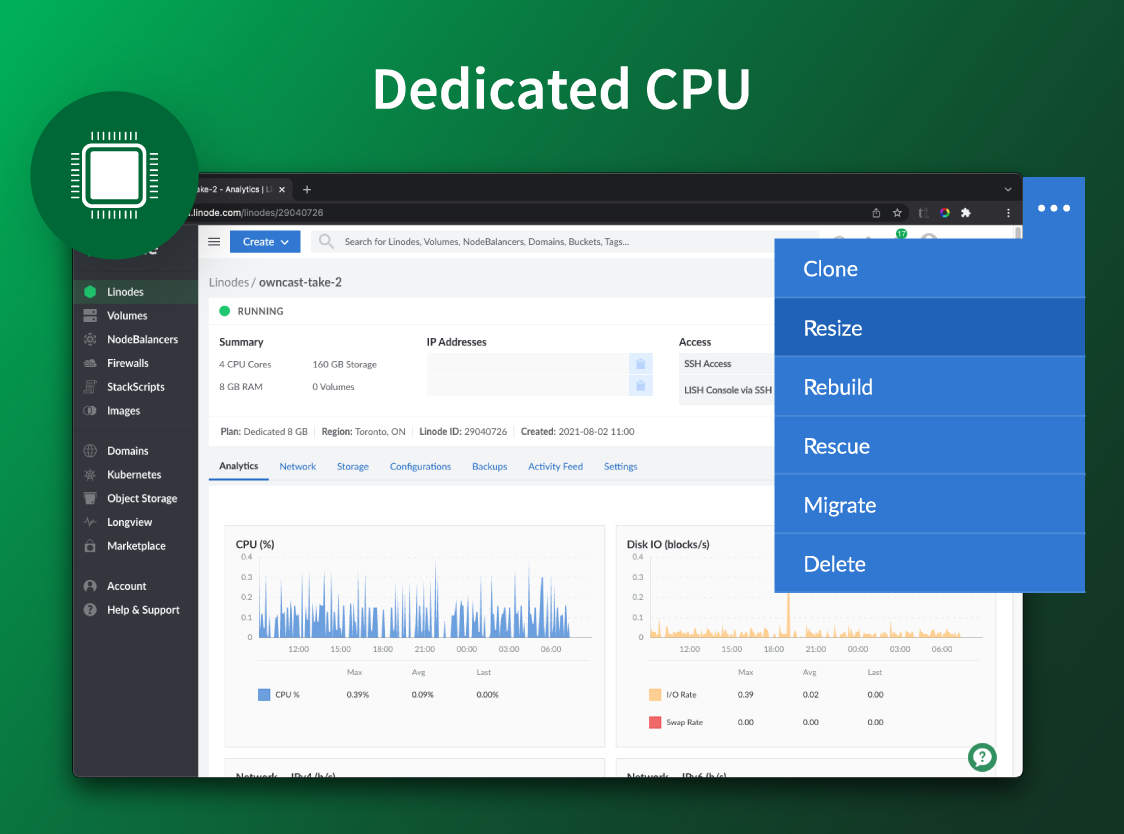
Akamai Cloud Computing (formerly Linode) include scalable and accessible Linux cloud solutions and services. These products and services support developers and enterprises as they build, deploy, secure, and scale applications.
$5
per month
Google Drive
Score 8.6 out of 10
N/A
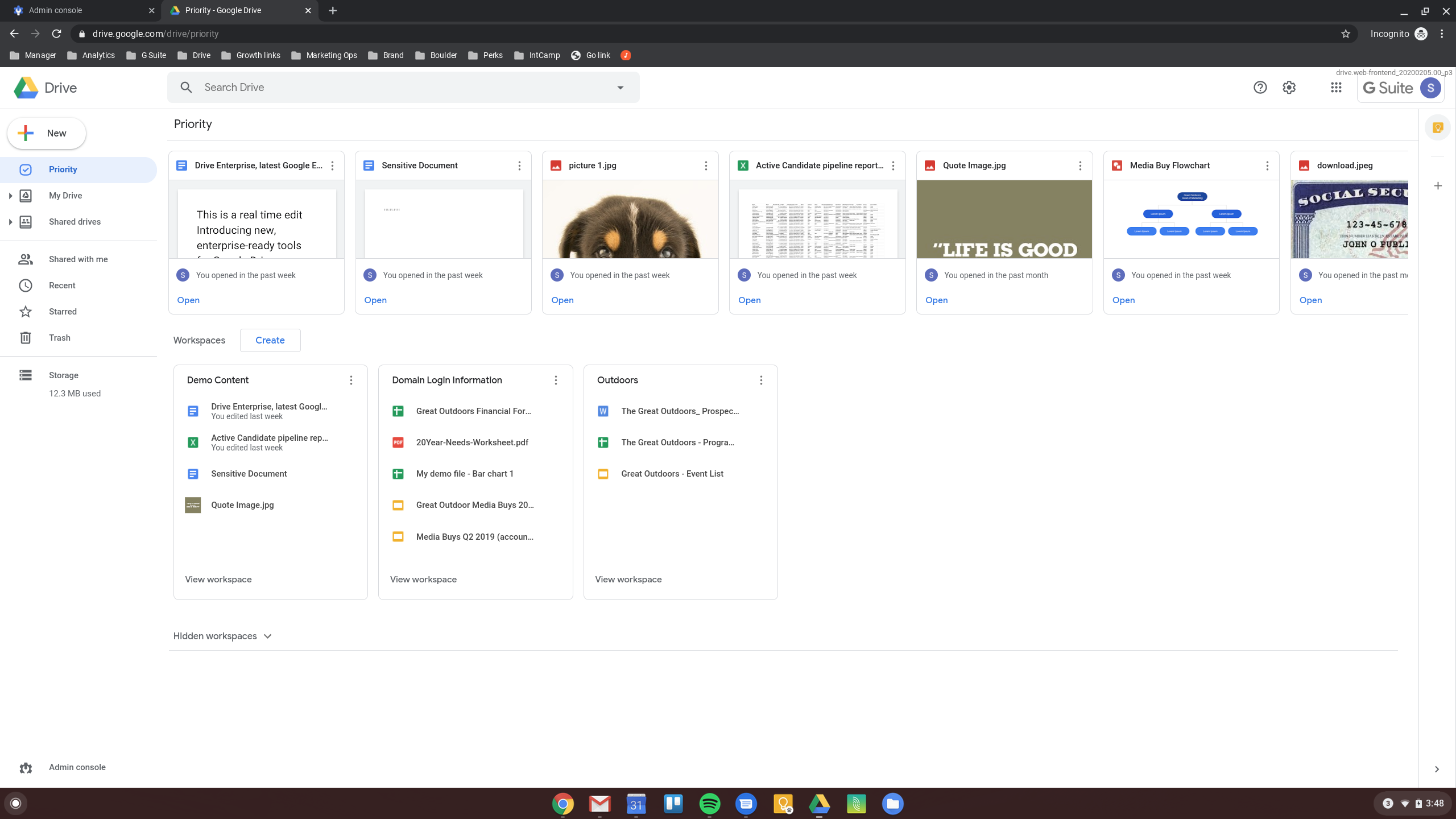
Google Drive is a cloud file storage, synchronization, and collaboration platform and service, that features Google Docs, Sheets, and Slides for document editing and presentation.
$6
per month
ownCloud
Score 9.2 out of 10
N/A
ownCloud is a self-hosted open source file syncing and sharing option, from the Boston-based company of the same name.
$5
per month
Pricing
Akamai Cloud Computing
Google Drive
ownCloud
Editions & Modules
No answers on this topic
Basic
$6.00
per month
Business
$12.00
per month
Enterprise
Contact Vendor for Quote
per month
Standard
$5
per month
Enterprise
$12
per month
For Teams
$13
per month
For Single Users
$15
per month
Community
Free
Offerings
Pricing Offerings
Akamai Cloud Computing
Google Drive
ownCloud
Free Trial
Yes
Yes
No
Free/Freemium Version
No
Yes
No
Premium Consulting/Integration Services
Yes
No
No
Entry-level Setup Fee
Optional
No setup fee
No setup fee
Additional Details
CPU, transfer, storage, and RAM are bundled into one price. Storage capacity can be increased with additional Block Storage or S3-compatible Object Storage. Instant Backups can be added with complete independence to the stack. Linode NodeBalancers ensure applications are available.
Discounts are available for students, educators, and non profit organizations.
—
More Pricing Information
Community Pulse
Akamai Cloud Computing
Google Drive
ownCloud
Considered Multiple Products
Akamai Cloud Computing
Verified User
Manager
Chose Akamai Cloud Computing
I have used Amazon Web Services (AWS) before this and both are reliable. AWS is just as easy to use, but the costs are harder to understand, because they are not fixed, they are dependent on usage. If you have a low usage but an abnormal process the costs can spiral without …
Before I came to Linode, I was a shared hosting customer. I tried several providers over several years. All of them sucked...there were no good options only the "least bad" option. The "least bad" option quickly joined the rest of the "just plain bad" pack very quickly. The …
I have used ownCloud and Dropbox for file storage and they do a decent job of allowing me to backup, share and access my files. iCloud is still new and while it's getting better, there is no Enterprise edition and they only start you out with 5 GBs of space, for all of your …
ownCloud is better than Google Drive and Microsoft's OneDrive. I have not used Google Drive in some time now, so it may have improved. OneDrive has become better over time too, but my go-to is still ownCloud. Firstly, I prefer to have my data under my control. No other service …
Other tools with similar functionality have been much better for me to use. However, my company uses ownCloud as its software of choice, so I use it to remain consistent with them.
The paid cloud services are expensive if you need a lot of data. You're giving your personal and business information to a data-hungry organization. Local NAS solutions are too slow. We run ownCloud on an older business PC and the performance is outstanding, even for remote …
I have a very similar experience between Google Drive and Dropbox. Both offer real-time sharing and collaboration. Google Drive limits external access and requires the recipient of shared files to have a Google account. In the case of both Dropbox and GoogleDrive, they limit …
ownCloud is one of the only self-hosted solutions worth it. It is open source and free, meaning that anyone with a Linux VM or an old laptop can host its own feature-rich cloud server. Many all-in-one firewalls will mix OwnCloud and CrashPlan, joining document management and …
I have used several products based on public (DropBox, Google Drive, Microsoft Drive, etc) and private cloud (Citrix). Most of them work on public cloud space so they could present problems with compliance. Also, it is usually difficult to protect the information contained in …
Akamai Connected Cloud Linode would be a good service to host a content delivery network (CDN) because of its edge network but I'd prefer not to use Akamai Connected Cloud Linode for tasks that need GPU power such as Machine Learning or Artificial Intelligence (AI) because Akamai Connected Cloud Linode lacks deep GPU compute compared to AWS or Google Cloud or Microsoft Azure
It is possible to share files and folders with up to 200 email addresses, as well as with persons outside the company.Use the drop-down arrow to select who may see, comment on, or change the file or folder before sending out an invitation.I am very much impressed with this feature
I'd easily recommend ownCloud to small businesses or teams within organizations. I've not used ownCloud in large deployments, so I'd hesitate before suggesting it in a situation where more than 10 users need support. That said, ownCloud is easy to set up and multiple instances could be used to service a large user base.
Any user with access can store a file using different platforms like Android, IOS, Windows, or Ubuntu (Desktop version)
You can share files with any number of different users with different access rights or you can even keep it public by providing the access link and assign different rights for public access
You can open Excel/Word files using google software Sheets/Docs in the browser environment without having to install software like Microsoft Office etc on your Windows OS
Attention and dedication to making the product a world class product with continual product updates.
Ease of use from an administration standpoint, and a very Clear UI.
The price -- you can't beat free!
Mobile applications are great.
Integration with public S3 cloud providers like AWS S3 and Wasabi S3.
2FA authentication is supported and works great!
Marketplace Add-Ons: I love this! For example, I can install an add-on that natively opens raw images. I am a photographer as well, and being able to quickly view the CR2 Raw Files direct from the camera is fantastic! This was made possible by a marketplace add-in.
Embedded Media Players: Photos, Music, and Video files can be viewed and played right in the browser window.
Sync application to keep local files on a computer updated with the files on the server.
Access control and permissions -- shareable links!
Having a little bit more control and clarity over what is shared and how it is shared would be a useful improvement.
Could be more robust and flexible as far as assigning restrictions.
Google Sheets could be enhanced because Excel really is not there yet as a product with equal capabilities as there are still quite a few limitations to the functionality.
Inability to easily collaboratively edit the same document by several people. Some advances have been made with Collabora (Libreoffice online) but it is still very sub-par compared to Office365 and desktop/online Office editing Sharepoint or OneDrive documents.
Apps for Calendar and Contacts are not part of the basic core, and although now quite supported they cannot still be easily deployed in common email clients such as Outlook or Thunderbird, separate CalDAV and CardDAV plugins need to be installed. Embedding an email solution and plugins for major email clients so they can work just by entering username and password would be good.
Risk of moving important folders/files to another location just by random drag-and-drop on Windows. Sometimes this breaks public links that cannot be restored anymore. Reverting such mistake by any of the users is impossible automatically.
When some user deletes some data in a shared folder it is put into recycle bin of the owner of the folder. The user who deleted cannot himself/herself revert such action as he/she does not see the recycle bin (trash) of the owner. Also, there is no log in the recycle bin who deleted that file or folder.
I've been with them a long time. They provide me with the capabilities I need coupled with knowledgeable support that's not pay-for-extra. However, if I move to a non-Linux OS, the level of support by necessity will drop off. I can still ask questions about the infrastructure but I my ability to ask about OS features will decrease.
It's perfect for me. It keeps things saved and is easy to remove items if needed. Also, I very much enjoy the formatting options. Along with the integrations it has for SSO. Overall, this is the most user friendly system I have ever come across.
Simple and clear, no BS interface. From a design perspective it's no Apple or Stripe, but it does what it needs without making me want to stick a fork in my eyes, like when being forced to use Azure, AWS or GCP.
It's easy enough to use for computer users of all ages and skill levels. I am an advanced user, and I think the hardest part might be showing someone how to download and set up the app on their device if they weren't too familiar with computers, but overall it is very easy to understand.
OwnCloud is easy for me to use, and I believe it would be for others too. The barrier for most people will be the set up. For a technology professional like myself, ownCloud's setup is pretty straightforward, but it's not the sort of thing most casual users will be able to handle. Also, it's on the user to maintain the service. These can be taken care of by paying someone to do it for you.
There is very little planned downtime. Whenever planned downtime is necessary I'm always given lots of advanced notice and an explanation that I can pass along to my users that they'll understand. I really appreciate that Linode appreciates my commitment to reliable service to my users. It shows that they believe they've been successful when I'm successful.
Servers are well dimensioned and price performant. Of course one always wants more, so if they were to upgrade their hardware for the same price I'd consider moving more workloads. Networking - never had an issue. Hardware speeds - disks are fast and can grow to great size.
The documents load fairly quickly and also update in real time, especially given the fact that multiple people can be using it at once. The "Offline" feature works great to allow the user to make edits and access the document without access to the internet, and then sync changes later once they're back.
Compared with other cloud services, ownCloud has been the most efficient. It doesn't create a noticeable drain on resources and very quickly syncs across all my devices. I'm usually able to save a file on my laptop and by the time I walk over and sit down at my desktop machine, it's already there. I don't need to wait as often as I have with services like OneDrive.
Support was excellent and fast. The documentation is extensive and helpful. I learned many things from their online documentation. I did not contact them by phone, but email took a day or less. Complex problems would probably need a service contract. I liked the friendly and polite tone of the support.
It takes a few days for customer support to get back to you. Although, I have not had to use support too often. Once you get an email back, they are very thorough and work hard to fix the problem quickly. It is a really great resource and a great way to get the help you need if you're stuck. A phone call also works quickly but you have to call during specific times.
Regarding the community edition, there is a reasonably good support on the IRC, forums and in the issue section on Github. Perhaps a much more individual approach would be available if the premium support was chosen and the instance of the server was provided by the Owncloud company that also offers some premium extensions, not available generally. However, we did not need this level of support yet.
The effective google workspace using training that my organization received and was conducted by me (as a team lead of the ICT team) was mind-blowing and as a result, our staff is performing well in terms of using the application for their daily jobs than before. Now, in my institution, all teachers and all the administrative personnel are very much interested in cloud storage facilities, in previous my institution was afraid of losing all important documents in the cloud storage. But, after having received the training they are now realized that if anyone has only one google account then he or she can use 15GB of cloud storage freely and they are now happy because now it is not necessary for anyone to carry the traditional pen drive.
We got kick started with an initial walkthrough along with some free credits. The initial walkthrough helped us to understand Linode's ecosystem and start our hands on with Linode. We tried out some apps from Marketplace initially with the free credits, which not only helped us understand Linode better, but also those apps. We had implemented many such apps to our customers with Linode
We're a small organization. The implementation of our Linode solution was trivial. Once I justified a cloud server to my bosses over a co-location -- the co-lo wasn't as fast as our linode server in load tests -- it was a matter of moving one Linux implementation to another. Trivial.
It's an extremely easy software to implement, once you sign up for a google account you automatically have access to google drive with a set amount of storage space. The business or Google Suite accounts have more storage space than a regular free account, but setting up and accessing google drive is very easy in both cases
We switched to Linode from Namecheap due to poor uptime, and never had any issues with stability ever again after switching. We also cut our costs in half by switching. We compared Linode to DigitalOcean and Vultr, with the primary factor that caused us to go with Linode initially being their documentation. After using Linode for 3 years, their amazing support is another reason why we wouldn't consider anyone else at this point.
In short, Google Drive is better for independent users who store a normal amount of stuff. OneDrive makes more sense for businesses and teams that are doing heavy-duty storage or large-scale syncing. Realistically, though, most users will fall somewhere in between the two, where either platform would meet their needs.
The paid cloud services are expensive if you need a lot of data. You're giving your personal and business information to a data-hungry organization. Local NAS solutions are too slow. We run ownCloud on an older business PC and the performance is outstanding, even for remote access, due to local syncing.
Although I use only a fraction of their product offerings, the total set makes scalability an easy goal to shoot for. As I said, I have a few customers that use the services my Linode provides...and I like it that way. However, should I need to scale up, I can...without incurring any more cost than I need to.