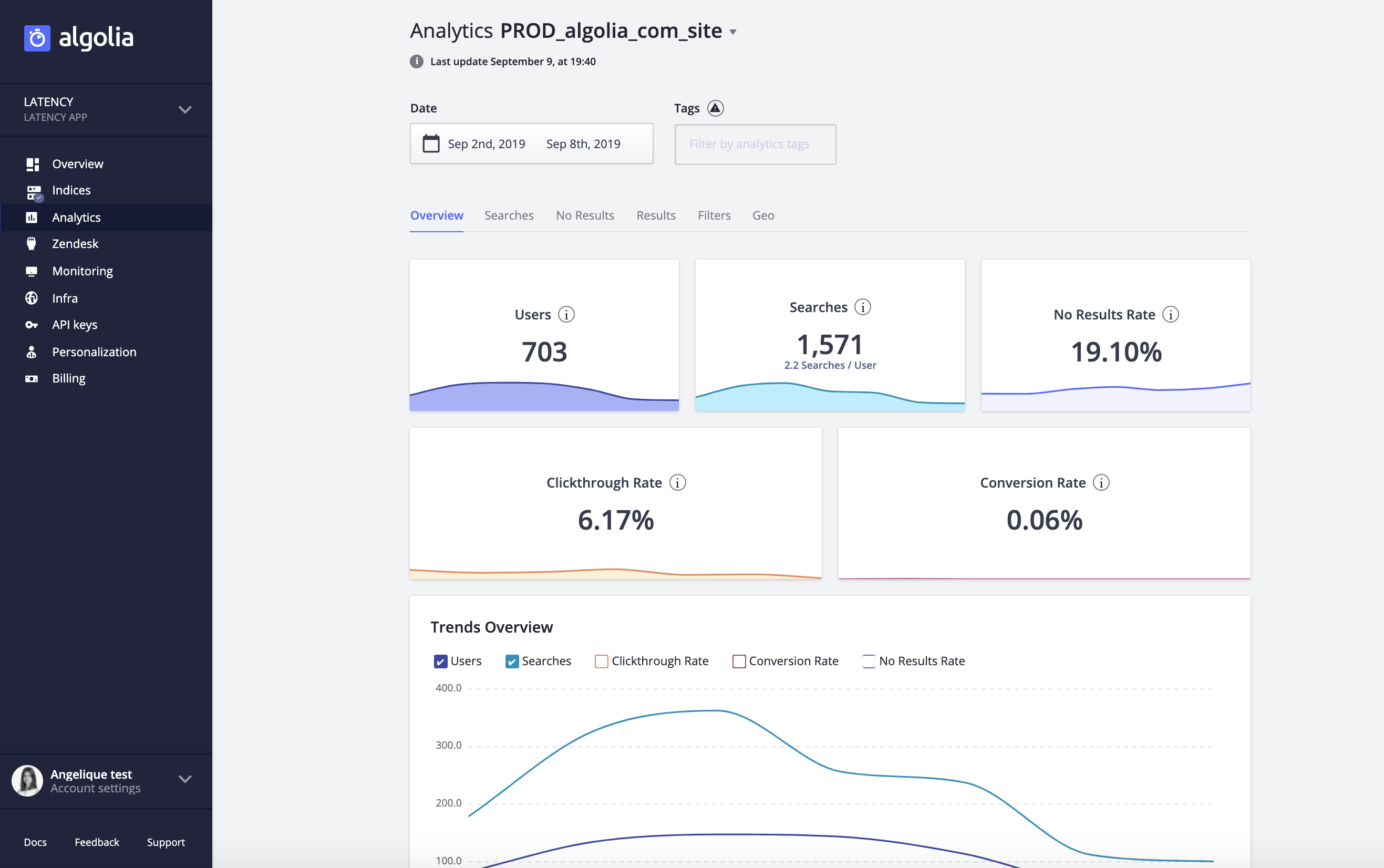
Algolia offers AI-powered solutions to improve online search and discovery experiences, with tools for business teams and APIs for developers that help to improve user engagement and conversions across websites, apps, and e-commerce platforms.
$0
for 10k search requests + 100k records per month
Bloomreach
Score 9.0 out of 10
Mid-Size Companies (51-1,000 employees)
Bloomreach personalizes the customer experience for brands around the world. Loomi AI, its agentic platform, understands customers in context — then tailors their experience in real time. Connected to applications at every touchpoint, Loomi AI brings personalization to life across email, web,…
N/A
Elasticsearch
Score 8.5 out of 10
N/A
Elasticsearch is an enterprise search tool from Elastic in Mountain View, California.
$16
per month
Pricing
Algolia
Bloomreach
Elasticsearch
Editions & Modules
Build
Free
Up to 10,000 search requests + 1 Million records
Grow Plus
Free to start, then pay-as-you-go
10,000 search requests/month and 100,000 records included; $1.75 per additional 1K search requests and $0.40 per additional 1K records
Grow
Free to start, then pay-as-you-go
10,000 search requests/month and 100,000 records included; $0.50 per additional 1K search requests and $0.40 per additional 1K records
Elevate
custom
per year
Elevate
Custom
Custom Custom search requests and records; volume-based discounts available
No answers on this topic
Standard
$16.00
per month
Gold
$19.00
per month
Platinum
$22.00
per month
Enterprise
Contact Sales
Offerings
Pricing Offerings
Algolia
Bloomreach
Elasticsearch
Free Trial
Yes
No
No
Free/Freemium Version
Yes
No
No
Premium Consulting/Integration Services
Yes
Yes
No
Entry-level Setup Fee
Optional
Optional
No setup fee
Additional Details
Pay as you go, scale instantly, or upgrade anytime for advanced features and capabilities.
Bloomreach pricing is quote-based. Bloomreach pricing is customized to the number of customers served, product catalog size, and the number of events executed – such as how many emails or SMS messages are sent.
By far Elasticsearch is the prime competitor that comes into the picture when thinking about Algolia. Where Algolia surpasses Elasticsearch by miles is in performance. Algolia is search on steroids. However, Elasticsearch supersedes Algolia in terms of flexibility and cost. Elas…
Elasticsearch is its direct competitor, but I would say that it is more focused on performance and less focused on aesthetics and recommendations. If you are thinking of getting Algolia, I would recommend that you also compare it at least to Elasticsearch. Either one is a good …
Algolia prioritizes simplicity and quick setup, excelling in user-friendly search experiences. Elasticsearch offers versatility and complexity, suitable for intricate scenarios, while Amazon CloudSearch provides essential features and seamless integration within the AWS …
Algolia works out of the box, you don't need to setup a lot to see how it works for you. Its also pretty flexible and customizable if you need to. With Elasticsearch you have to think about deployment strategies, where to host it, how to send data for it and build custom …
Mostly for instant search capability, then because SFCC option can be easier to use, but front end capabilities where not nice at the time we implemented it. Elasticsearch is more similar with database and index management, but was more expensive at the time + Algolia cartridge …
Algolia is a specialized tool with the largest customer base, the longest history, and the highest level of R&D investments. They provide exceptional assistance and services and are open to collaborating on feature improvement. The tool itself is very powerful, efficient, and …
There are many open source search products available. Prior to Algolia, we used an in-house search system adopted from an open-source system. While this was nice in that we could modify it in any way we wanted, it also required dedicated engineering and setting up many …
Offloading search logic to Algolia saved dev time and allowed our engineers to focus on higher-impact features instead of maintaining complex queries or custom search infra.
While AWS's offering is a typically cheaper solution, it requires a lot of work to gain any of the core features of Algolia. The cost of dev time and long-term maintenance would be more than the costs incurred with Algolia, which is why it made the most sense financially. On …
There were few alternatives when we started by using Algolia and it was the better rated in terms of price & performance. Now there are more alternatives, but we keep algolia as is isolated from the rest of our stack so that we can have better performance & control.
Algolia provides the best user experience, ease of integration and implementation, extremely high performance on large catalogs. The features offered are powerful and complete, with machine learning systems to improve result personalization. The service management can be done …
Algolia got us up and running faster and more easily than if we'd managed elastic search and it's configuration by ourselves. Upfront and ongoing costs and complications/ custom implementations were removed from the equation by choosing Algolia out of the gate.
Amazon is great for huge companies that have a team to support this feature in particular but if you are a small to medium business, Algolia is more manageable.
At the time we did a TD on a number of different solutions, and Algolia was selected for its features and functionality. Why we couldn’t account for at the time was the lack of customer service and tech support, or problems that would regularly and repeatedly occur within their …
Algolia works well in tandem with Magento and provides a large number of tools and features that provide greater control and adaptability as compared to other solutions we reviewed. Algolia has demonstrated its commitment to continual innovation, providing access to next-gen …
Algolia does not require your own setup so we could get going fast. Algolia is known for being fast and highly available. It requires less domain knowledge. It is a lot more expensive though. Another plus is that is it very easy to sync data to it. You can backfill millions of …
Algolia at first seemed and proved to be the fastest compared to the other search engines. It is very easy to implement. Also, it had a 24x7 support which proved to be very useful. It is also useful for all types of clients weather it be organizations or individuals. It can …
Algolia was by far and away the easiest of the three to implement. PostgreSQL has many search modules that can be used on top of your usual database, however, none are particularly efficient and can quickly become overwhelmed at scale. Equally, they do not handle business …
Bloomreach is robust product that benefits from steady investment and some good experience. It lacks some of the latest automations and has a cost structure that is hard to manage and monitor. It is not user friendly but does accomplish most of the tasks we want to complete …
DUe to AI based algo. Elastic search is just a search based platform and it doesnt provide the feature bloomreach experience provides with content management which is completely cloud based. Also bloomreach merchadizing tools and SEO solutions keep them apart from the other …
Algolia is both well-suited to replace Shopify's out-of-the-box search and to very large sites with millions of products in their catalog. Algolia provides a specialized solution that benefits from very large R&D budgets and ongoing investment. Algolia offers a more retail- and open-design solution than competitors such as Amazon or Google search, which offer fewer options and fewer features.
One scenario Bloomreach is particularly suited for is omnichannel abandonment campaigns. We have scenarios that look whether a customer has been into one of our stores, and then if they are subscribed, we can send them more information about the products they have viewed. That wouldn't be possible without Bloomreach. Another scenario that Bloomreach is well suited for is price drop - we can alert users that an item they've viewed has dropped in price, and this has been a really successful campaign for us.
Elasticsearch is a really scalable solution that can fit a lot of needs, but the bigger and/or those needs become, the more understanding & infrastructure you will need for your instance to be running correctly. Elasticsearch is not problem-free - you can get yourself in a lot of trouble if you are not following good practices and/or if are not managing the cluster correctly. Licensing is a big decision point here as Elasticsearch is a middleware component - be sure to read the licensing agreement of the version you want to try before you commit to it. Same goes for long-term support - be sure to keep yourself in the know for this aspect you may end up stuck with an unpatched version for years.
Users get instant feedback as they type, even with complex filters like brand, model, price range, and financing eligibility. This speed significantly improves engagement and reduces bounce.
A user searching for “Camry 2020” or even “Camary 20” still sees relevant Toyota Camry listings from 2020. This reduces friction, especially on mobile where spelling errors are common.
Algolia handles multi-faceted filters efficiently. For example, a user can filter by location, transmission type, color, or inspection status without any lag.
We fine-tune the ranking of search results based on what matters to our business—like prioritizing cars with higher margins or better availability in key cities.
We can experiment with different ranking formulas or UI variations to improve KPIs like lead conversion or time-to-first-interaction.
The product recommendations engine allows for us to create a personalised experience for every customer across the 3m emails we send each month. This ensure that our customers remain connected to our brand.
The customer data platform attached to Bloomreach Composable Personalization Cloud provides an all-in-one solution for our business intelligence needs. Allowing up-to-date purchasing, behaviour, and engagement reporting from our email to website activity.
The ability to integrate with Meta and other paid ad formats allows for us to create a connected omnichannel experience for users, ensuring we are providing the right message, to the right person, at the right time, in the right place.
As I mentioned before, Elasticsearch's flexible data model is unparalleled. You can nest fields as deeply as you want, have as many fields as you want, but whatever you want in those fields (as long as it stays the same type), and all of it will be searchable and you don't need to even declare a schema beforehand!
Elastic, the company behind Elasticsearch, is super strong financially and they have a great team of devs and product managers working on Elasticsearch. When I first started using ES 3 years ago, I was 90% impressed and knew it would be a good fit. 3 years later, I am 200% impressed and blown away by how far it has come and gotten even better. If there are features that are missing or you don't think it's fast enough right now, I bet it'll be suitable next year because the team behind it is so dang fast!
Elasticsearch is really, really stable. It takes a lot to bring down a cluster. It's self-balancing algorithms, leader-election system, self-healing properties are state of the art. We've never seen network failures or hard-drive corruption or CPU bugs bring down an ES cluster.
Better integration of features (ex. synonyms feature is great but isn't respected by their re-ranking product)
Tooling to reduce spam search queries being triaged by system/logged to analytics panels
More automated summaries of analytics (ie. recommend synonyms to add, trends noticed in search volume in specific areas of site, easier ways to leverage API vs using website UI)
Algolia is a great tool, we didn't have to build a custom search platform (using Elasticsearch for example) for a while. It has great flexibility and the set of libraries and SDKs make using it really easy. However, there are two major blockers for our future: - Their pricing it's still a bit hard to predict (when you are used to other kind of metrics for usage) so I really recommend to take a look at it first. - Integrating it within a CI/CD pipeline is difficult to replicate staging/development environments based on Production.
We are extremely satisfied with Bloomreach. It is a central and indispensable pillar of our personalization and data-driven marketing strategy. The platform provides us with unparalleled scalability across 27 countries and guarantees high availability and stable performance, even when working with an enormous volume of data.The fact that the platform is intuitive and allows a wide range of our teams (from CRM to UX) to work effectively with personalization significantly reduces our dependence on IT support and accelerates campaign deployment.Given the robustness of the architecture and the positive results we are generating across channels, renewing the contract is a logical step to ensure our future organic growth.
Algolia is very intuitive to use, especially the Merchandising Studio. The application provides a virtually seamless view of how product will appear on the frontend and making adjustments is fluid and reflects immediately online. Some slow-down occurs when you have a lot of rules enabled or are pinning / boosting a lot of product. But overall it functions very solidly.
In my time working with Bloomreach Commerce Experience Cloud, I always liked to work with it. It is crucial that you get support from experts from the beginning to show you how to work with the vast amount of options and activities to choose from. The learning curve is also well-rounded because of its user-friendly interface and highly skilled customer support.
To get started with Elasticsearch, you don't have to get very involved in configuring what really is an incredibly complex system under the hood. You simply install the package, run the service, and you're immediately able to begin using it. You don't need to learn any sort of query language to add data to Elasticsearch or perform some basic searching. If you're used to any sort of RESTful API, getting started with Elasticsearch is a breeze. If you've never interacted with a RESTful API directly, the journey may be a little more bumpy. Overall, though, it's incredibly simple to use for what it's doing under the covers.
The platform is generally reliable - major outages are rare and most day-to-day campaign operations run without interruption. Where it dips: occasional slowdowns in the analytics dashboard during peak loads, and sometimes scenario executions get delayed without clear explanation. The real-time event processing is mostly solids. Overall uptime is strong - it is not something that keeps me up at night, but it is not flawless either.
Performance is always a major concern when integrating services with our client's websites. Our tests and real-world experience show that Algolia is highly performant. We have more extremely satisfied with the speed of both the search service APIs and the backend administrative and analytic interface.
Performance in Bloomreach Content is quite good but you need to be ready. Your implementation should follow all the good practices (avoid crazy patterns) and the environment setup should be the right one. With all that, Bloomreach's performance is quite solid. Our usage makes use of complex queries and most of them are really quick. Only when you need something really complex and you aggregate queries that should be separated you would get slower results (but then again, that is not a good practice for any platform).
It’s non existent. No tech support and no customer service… my application was blocked and is currently inactive causing huge business disruption, and I’m still waiting days later for a response to an issue which could be resolved very very quickly if only they would respond. Very poor from a company of that size
The project team consistently delivers excellent collaboration and is always available whenever assistance is needed. Their responsiveness and commitment make working together smooth and efficient. Bloomreach support, which is included for free in the platform, can also be quite useful, especially for quick clarifications. However, the quality and speed of their responses can sometimes vary, depending on the issue.
We've only used it as an opensource tooling. We did not purchase any additional support to roll out the elasticsearch software. When rolling out the application on our platform we've used the documentation which was available online. During our test phases we did not experience any bugs or issues so we did not rely on support at all.
Algolia gives way more control for a non-developer than AWS Elasticsearch Service. Previously we'd have to have our developers make adjustments to site search relevancy, typos, prioritizing certain attributes over others, etc. but now the marketing and website team can do that themselves in the Algolia dashboard
Bloomreach is far superior than SFMC as that platform requires too much technical knowledge. Ometria is very good and I would say is quite similar to Bloomreach although I would say Ometria is a smaller company. Dotdigital is also very powerful but not more so than Bloomreach. This being said, Dotdigital and HubSpot does have telephone support which is amazing and something I would like to see from Bloomreach in future or at least shorter wait times for customer support live chat.
As far as we are concerned, Elasticsearch is the gold standard and we have barely evaluated any alternatives. You could consider it an alternative to a relational or NoSQL database, so in cases where those suffice, you don't need Elasticsearch. But if you want powerful text-based search capabilities across large data sets, Elasticsearch is the way to go.
Algolia has been a consistent product that works flawless with very few errors or downtime. With the plan options it’s very easy for us to scale especially with this usage pricing. We have 100% gotten our ROI on this product.
there is an option of multiple projects per organisation, customers and assets can be copied across. Multiple sites can be managed in one project, different activities organized under initiatives. Splitting work into sensible units is therefore well possible. The billing is based on number of tracked and number of stored events, no package-based deals. It should therefore be well scalable from a small e-store to a large corporation.
Users who had abandoned our product (attributing slow search speeds as the reason) returned to us thanks to Algolia
We used Algolia as our product's backbone to relaunch it, making it the center of all search on our platform which paid off massively.
Considering we relaunched our product, with Aloglia functioning as its engine, we got a lot of press coverage for our highly improved search speeds.
One negative would be how important it is to read the fine print when it comes to the technical documentation. As pricing is done on the basis of records and indexes, it is not made apparent that there is a size limit for your records or how quickly these numbers can increase for any particular use case. Be very wary of these as they can quite easily exceed your allotted budget for the product.
We have had great luck with implementing Elasticsearch for our search and analytics use cases.
While the operational burden is not minimal, operating a cluster of servers, using a custom query language, writing Elasticsearch-specific bulk insert code, the performance and the relative operational ease of Elasticsearch are unparalleled.
We've easily saved hundreds of thousands of dollars implementing Elasticsearch vs. RDBMS vs. other no-SQL solutions for our specific set of problems.