Apollo is a sales platform that helps revenue teams find and engage leads, automate outreach, manage deals, and enrich data.
$59
per month per user
Chorus by ZoomInfo
Score 8.4 out of 10
N/A
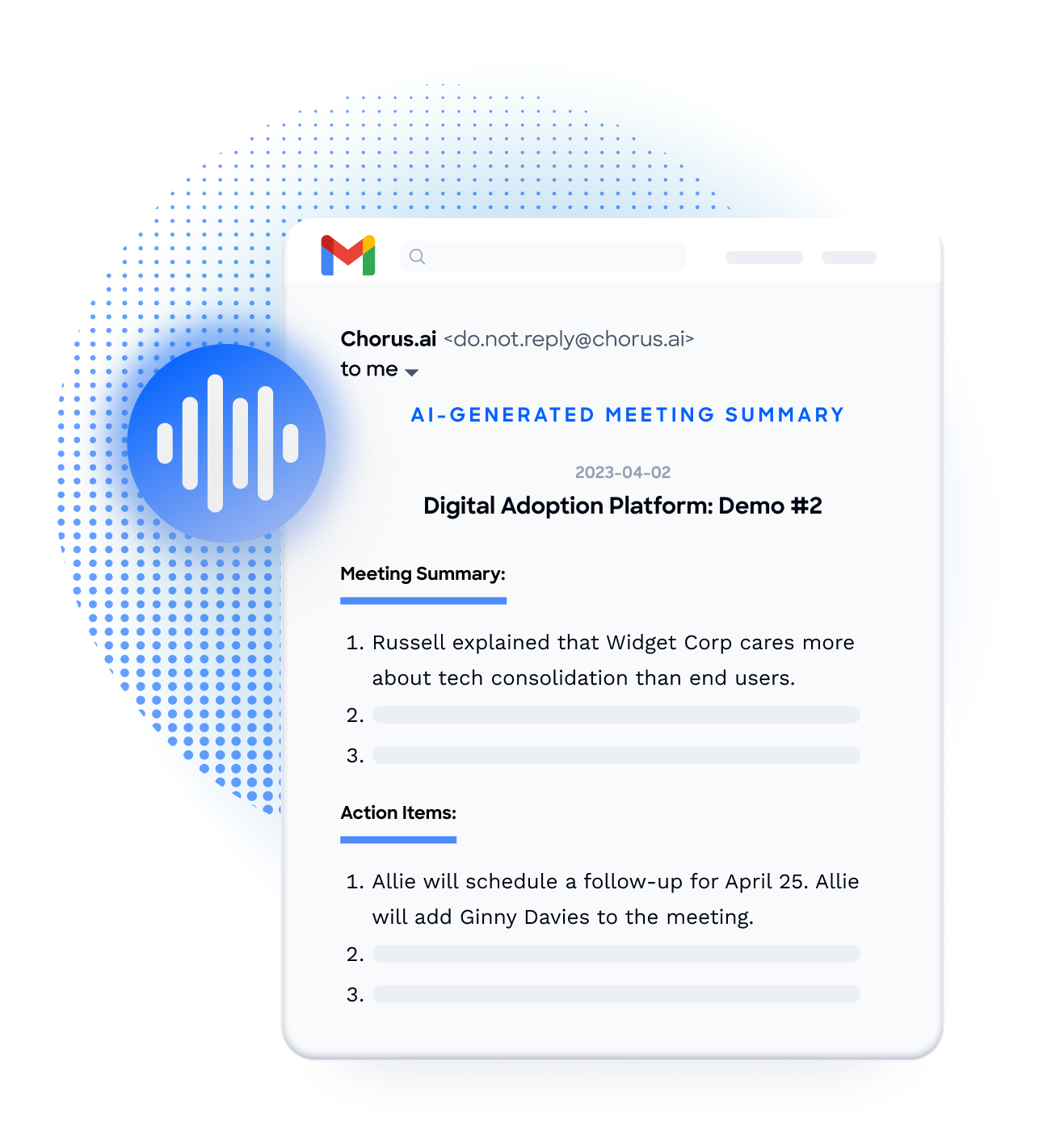
Chorus by ZoomInfo is an AI-powered Conversation Intelligence platform that captures & analyzes all customer engagements across phone calls, video meetings, and email, to help teams hit their number.
N/A
KickFire
Score 9.0 out of 10
N/A
KickFire’sB2B solutions provide account-level information such as industry, revenue, employee count, and more based on an IP address. KickFire’s proprietary TWIN Caching® technology and robust firmographic database deliver business intelligence for first-party intent, content personalization, account-based marketing, predictive/intent, data enrichment, and much more. KickFire offers IP address intelligence and B2B firmographic data through its LIVE Leads platform, API, and integrations…
N/A
Pricing
Apollo.io
Chorus by ZoomInfo
KickFire
Editions & Modules
Basic
$59
per month per user
Professional
$99
per month per user
Organization
$1,188
per year per user
No answers on this topic
No answers on this topic
Offerings
Pricing Offerings
Apollo.io
Chorus by ZoomInfo
KickFire
Free Trial
Yes
No
Yes
Free/Freemium Version
Yes
No
No
Premium Consulting/Integration Services
Yes
No
No
Entry-level Setup Fee
Optional
No setup fee
No setup fee
Additional Details
20% discount for annual billing on the Basic and Professional plans.
The pricing was better with Apollo.io and the feature set checked all the boxes for us. Gong didn't do everything we needed and then Chorus by ZoomInfo was about 10x the price, so it checked all the boxes for us and was also the best value compared to what we were using before …
I found Apollo.io gave us the biggest bang for our buck. Also, I've used it before and knew it was going to work, so there wasn't really a whole lot of competition in my mind.
Apollo.io played big role for us in saving $$$ by bringing data mining, AI Email Writing and acting as CRM altogether...for small to medium organization they can surely rely on Apollo.io...and it is doing things mostly right with some room for improvement for sure. Sales and Marketing team saves time in getting their emails drafted based on prompts, list of contacts they can fetch in minutes of time, earlier we used to have seperate tool just to mine data, then we used to upload the CSV file to email marketing tool, then we used to draft email...for all these process we were using three different tools - Apollo.io brought everything under one umbrella.
One scenario where Chorus by ZoomInfo is well suited is when our team is trying to identify patterns (common objections, frequent competitor mentions, concerns that clients raise). ZoomInfo offers trend analysis, market intelligence, and topic tracking that reveals patterns across conversations. This has allowed us to adapt and update our processes to address these patterns
For small businesses that don't have big budgets for marketing automation, VisiStat is an ideal first step. For companies that have sophisticated systems in place, VisiStat will augment your analytics and provide a deeper dive into your website activity. Since the implementation involves adding javascript to your site, the user should be familiar with how to do this
Firstly, finding the details of the potential customers that is there name, designation email and phone number since these are the most important cases most of the times I can get this data in Apollo.io
I can pull the bulk data of the targeted organization, or I can pull the emails based on the location and job titles
Apart from the email capture, the thing which helpful is that the email sequence can find emails and send emails in Apollo.io itself and also the report and the dashboard are so clean
Friendly UI and UX Apollo.io was the first tool which I used. Since then I'm still using Apollo.io for easy understanding
De-anonymizes website activity at the account (company) level.
Identifies net new target accounts.
Displays click path, time on page, time per session, and engagement level of each de-anonymized website visit.
Gives great daily insight on watchlists you've set up.
Delivers every possible de-anonymized visit with little filtering for accuracy.
More on the watchlists. I really love that you can receive immediate alerts on website visits from accounts you've listed on your watchlists. This way, you never miss the window of opportunity to reach out to your key targets while they are currently on your site.
Salesforce integration is good. KickFire pushes most recent website visits, pages visited, website click path, activity percent change, and more to the given account in Salesforce. You can then create reports and run them regularly to see which accounts are surging in website activity. This is also great for account prospecting, and for planning your sales outreach plan of attack. You can see which bits of your website content are most interesting to the company, and which products they are most interested in.
There are certain features about prospecting that require updates. For example, if people switch organisations, it should be automatically requesting the new email or new contact data for a particular contact in order to be updated in the system
The lead databases that are created if their new addition should automatically be updated in the list that I created with Apollo.io
Sometimes there were issues with the 3-minute delay for Chorus joining a live meeting.
Occasionally, deliverables were assigned to the wrong person in the summary if their voices were similar or if they were on the same audio.
Occasionally, the Chorus had problems picking up on what someone was saying. This was likely due to user error but caused gaps in the conversation recording and transcript.
It's hard for me to give anything more than a 5 at this point. The primary reason is that we have only used it for a few months and I'm still getting a feel for the level of value it provides both to me and the team. In 4 or 5 months I'll have a better understanding of its value long term
Apollo.io does provide campaign setup help and made my SDRs team's life easier, with the use of lead enrichment, lead distribution, I can manage my team from a single dashboard. It also comes with CRM that helps me navigate the progress on leads and what my SDRs progress.
This was sold internally as something that would help us be more efficient. I had high hopes that the speech-to-text feature would be useful for getting call notes/next steps, etc documented. But due to the limitations of the software, these things would take longer using Chorus than if I just write things down manually - disappointing.
The team wants to solve probelms, but we are finding that they don't know how to solve the more technical issues quickly. I suspect that they don't have a mature process for escalations, and they don't have a usable knowledge base article repository. They seems to push emails around to let us know that people are working on the issues to find solutions, but this takes weeks and oftentimes still leaves us without a resolution.
I personally have not had too many major issues with Chorus, but the times that I have reached out to their customer support team I have always received great responses in a very timely manner. Their support team is trained in a very polite way and cares about resolving your issue. They are knowledgeable and helpful and the customer service line does not take long to connect to a real individual.
They are very good at solving cases that I bring to them. I'd like to see more proactive support to make sure we are getting the full value out of the solution.
The tutorials are very good and they explain how to get started using the system. The online webinars are very good for advancing your knowledge of the product.
Like I noted in the other category, it has been smooth for the most part. But we really do enjoy the hard work of our CSM and everything he has been able to provide us in terms of support.
All of these platforms are good and offer valuable tools, but where Apollo.io is different is how this one platform does the job of several different ones. It is nice not having to use multiple platforms to get things done and makes integration and analytics issues occur less often. It is user friendly and constantly working to improve.
We looked at Gong but went with Chorus by ZoomInfo because it felt more practical for our team. Gong has great analytics, but Chorus by ZoomInfo fit better into our existing tech stack and budget. The deal notifications, scorecards, and integrations with Zoom and Salesforce made it the smarter pick. Overall, Chorus by ZoomInfo gives us the insights we need without feeling like overkill or another heavy lift.
I covered this pretty extensively in the cons. The key differentiator here is that KickFire serves up almost all the data (or so it seems) to the end client. The client then has to do their own work on interpreting it. This is good because it means we don't miss out on any website activities, but it's bad because we get a lot of false positives. 6sense uses the confidence score approach I mentioned in the Cons section, which means the match rates of the data we get are much higher. Our experience with Clearbit comes from other tools that are built on it (Bombora, Drift, etc.), and it has not been great. We've seen many more inaccuracies with Clearbit.