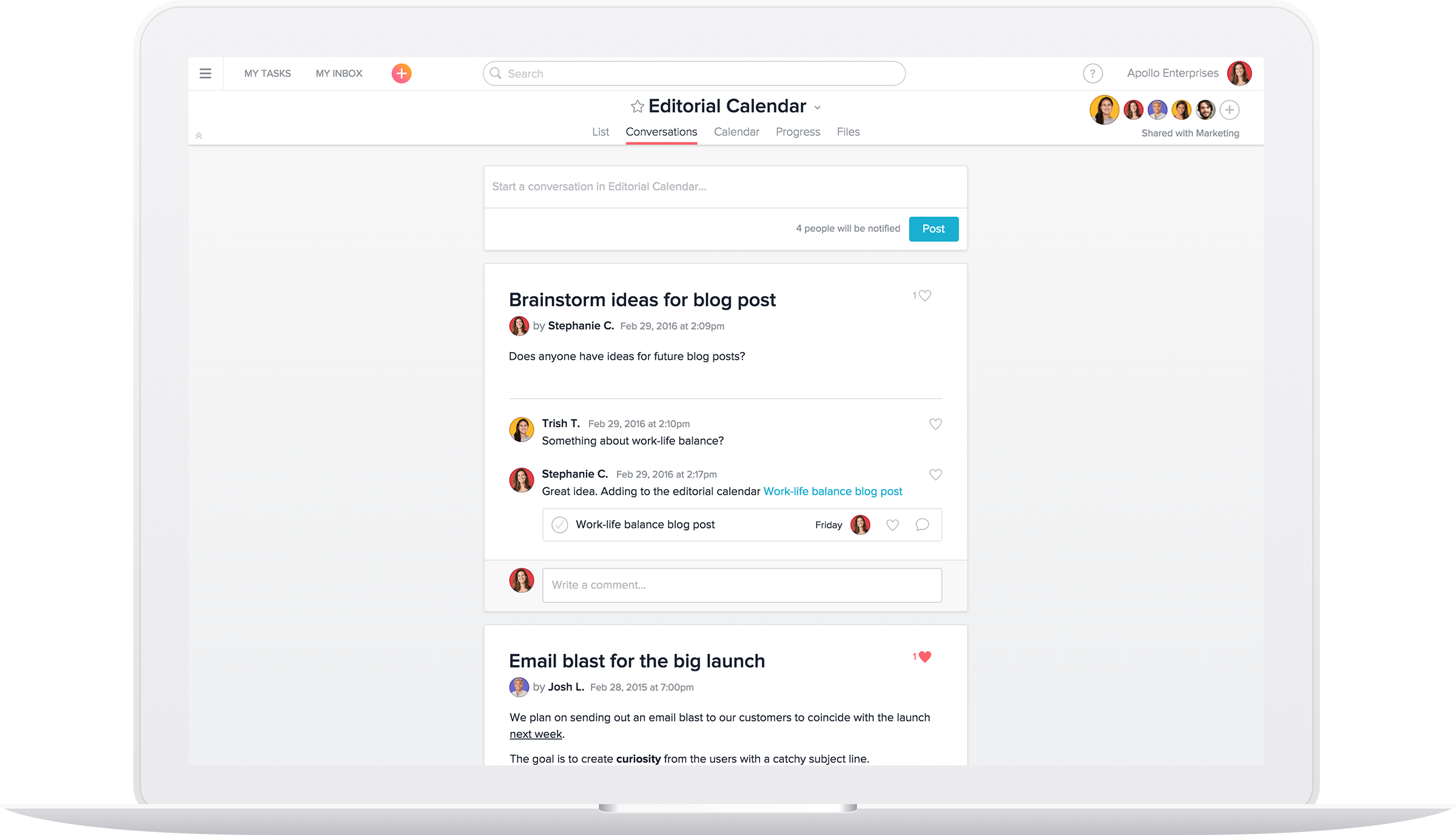
Asana is a web and mobile project management app. With tasks, projects, conversations, and dashboards, Asana lets an entire team know who's doing what by when, enabling workload balancing. Users can also add integrations for GANTT charts, time tracking and more.
$13.49
per month per user
Microsoft Power Automate
Score 8.3 out of 10
N/A
Microsoft Power Automate is an advanced automation platform offering a range of features, including AI-powered automation, robotic process automation (RPA), business process automation (BPA), digital process automation (DPA), and process/task mining. The platform aims to empower organizations to securely automate their operations at scale by leveraging low-code and AI technologies.
$15
per month per user
Smartsheet
Score 8.4 out of 10
N/A
Smartsheet is an online project management and collaboration tool. It includes automated alerts, instantaneous updating and sharing across team members, resource management, nested tasks organized in a hierarchy, a Gantt chart view, exportable and automated reports, and integration with email.
$12
per month per user (up to 10 users)
Pricing
Asana
Microsoft Power Automate
Smartsheet
Editions & Modules
Starter
$13.49
per month per user
Advanced
$30.49
per month per user
Enterprise
Contact Sales
Personal
Free
Power Automate Premium
$15
per month per user
Power Automate Process
$150
per month per bot
Hosted RPA add-on
$215
per month per bot
Process Mining add-on
$5,000
per month per tenant
Pro
$12
per month per user (up to 10 users)
Business
$24
per month per user (3 user minimum)
Enterprise
Contact Sales
Advanced Work Management
Contact Sales
Offerings
Pricing Offerings
Asana
Microsoft Power Automate
Smartsheet
Free Trial
Yes
Yes
Yes
Free/Freemium Version
Yes
Yes
No
Premium Consulting/Integration Services
Yes
No
No
Entry-level Setup Fee
Optional
No setup fee
No setup fee
Additional Details
A discount is offered for annual billing.
—
A discount is offered for annual billing.
More Pricing Information
Community Pulse
Asana
Microsoft Power Automate
Smartsheet
Considered Multiple Products
Asana
Verified User
Administrator
Chose Asana
We switched to Smartsheet for one year and we liked it mostly because of the Gannt Chart feature. However, leadership changed and the funding to continue to use it dried up. However, with all the upgrades to Asana over the past two years Smartsheet doesn't have as many …
I have been using Smartsheet for a similar project management usage with a customer of ours. Asana is way better than Smartsheet with a much better user interface and experience.
I like how extensive the capabilities are for Asana. With other softwares it seems there are many things lacking. I feel like Asana is also a very user friendly platform and aesthetically pleasing which is important in a modern office. We have many young people entering our …
Verified User
Analyst
Chose Asana
We tried it as one my developers swore up and down how good it was at the startup... well it crashed in our office, since we didn't end up working the way they did. We are more of a dev ops company than a social media or open source
In comparison to other Project Management software tools that I have used, Asana is the most user friendly platform without compromising any advanced capabilities.
Asana is lightweight and relatively inexpensive. For our marketing and advertising team, it works great. For teams with stricter needs (development teams, product teams, and other scrum teams), looking at other options might be worthwhile.
Both software are very similar to each other, even in the economic factor, the reason we choose Asana over the others is because of its usability, the software is very easy to use which helps to get the most out of it, in addition to the integrations that provide Asana with …
Asana shines as a project management tool. It far exceeds other comparable programs as it has and is constantly adding new features for its free and premium users. The program is consistently adapting to market needs, keeping it viable as a project tool that can be utilized by …
We loved the fun design hacks (e.g., flying celebratory unicorns when you complete a task, Tab+B puts tabby cats on your screen temporarily; themed backgrounds). We're marketers–can you blame us?! But in all seriousness, we chose Asana over other similar products because of the …
Power Automate beats UiPath basically from a costing perspective. I prefer Power Automate over UiPath because of its different costing segments that make it way cheaper than UiPath.
Smartsheet provides a number of functions when it comes to dealing with and showcasing tabular …
Power Automate can do many things that most platforms can't do as a 'citizen-developer' with no access to coding tools and deployment. It allows you to develop and deploy low/no-cost automation flows quickly. The blocks in Powert Automate do the API work for you, where you only …
.Asana is more task-oriented when I first tried it. I needed something that offered higher-level reporting and aggregation. Smartsheet's automation is also tighter. Podio is great for project-based intake workflows. It has very flexible and customizable fields allowing the …
Asana has a nicer interface but it expensive for what you get. Airtable works well. I would prefer Airtable over Smartsheet except it does not have the capability to fill out the DocuSign's we need. Otherwise, I would solely use Airtable for this. Google Sheets is great and …
Smarsheet was cheaper. JIRA is really expensive compared to Smartsheet. Smartsheet is also not just a checklist. Asana to me is just a checklist, which sometimes is not useful at all in project management. I call it an Excel++. You can use it the same as Excel and also make …
Smartsheets has more PM features than Asana, whereas Asana seems to be better for a roadmap or higher level planning. MS Project is similar to Smartsheets, however less user friendly in my opinion
Smartsheet offers the best blend of features from its direct and indirect competitors. It is intuitive and collaborative, like Asana. It provides entry-level features from DevOps in regards to Agile, it offers traceability and integrations better than both Teams and Liquid …
The dynamic nature of SmartSheet can do the same things as the other tools I've used (Trello, Asana, Basecamp, etc.), but you are not locked into a single methodology or format. You have the flexibility to create the type of project tracking tool that works best for your …
I believe Smartsheet is much easier to use than Asana. There is a better way to collaborate with colleagues and track your progress on projects. There is a better structure on how to set up your system. It has better filters to see what you have accomplished vs what is open and …
Asana and monday.com are typical project management tools where resources can be tracked based on the tasks, etc. Smartsheet does exactly the same but additionally allows people outside of PM to automate their data collaboration with other employees. The solutions that …
Smartsheet is user friendly with easy to use templates as compared to Microsoft Project. Other thing is collaboration which cannot be achieved in Microsoft Project. Smartsheet has different types of pricing for different types of users but Microsoft Project only offers …
Jira is better on user interface and task tracking. However the dashboard isn't as versatile as on Smartsheet. That being said, it takes maintenance to keep the Smartsheet dashboard updated regularly (not automated).
Verified User
Manager
Chose Smartsheet
Price and ease of collaboration was the deciding factor and since we made this decision quite awhile ago, Microsoft Project's collaboration features were not there yet, making Smartsheet the clear winner. Many of our Project Manager were comfortable working with Microsoft …
We used Smartsheet primarily because a customer was already using the tool. We typically use Microsoft Project since most of our customers and team are familiar with the tool.
I liked Smartsheet for the ease of use and simplicity. Having a view in Gantt chart is great and very helpful. Being able to invite multiple people and have everyone collaborate was useful. It made my life as a manager of projects much much easier and saved me a lot of time …
Smartsheet is very robust, and allows much more customization. It is not as user friendly, and takes more time to understand and get used to. Smartsheet integrates with just about all of these other tools. One of the best things about Smartsheet is that it can integrate with …
We chose Smartsheet over the other software because of its solid interface. An easy-to-use and very complete tool was necessary. In addition to the interface, the processes are quite simple so the training time of the software was shorter if we compare it with the other …
Smartsheet is the easiest to use solution for setting up simple- to moderate-complexity sheets for purposes like tracking a project (i.e., I have not used it for complex financial analyses before). I have used similar tools in work and personal life and Smartsheet has been the …
smartsheet performed badly in User Interface against the competition which unfortunately made the use of this software obsolete in our organisation. We finally use a series of other tools to do the same without going through the time consuming process of using smartsheet. We …
I was attempting to do all I've described with Google Sheets & SharePoint. Google Sheets didn't have all the functionality we needed. SharePoint was too difficult to set up and doesn't work well with Mac users. None of the solutions I listed could match Smartsheet's versatility …
Features
Asana
Microsoft Power Automate
Smartsheet
Project Management
Comparison of Project Management features of Product A and Product B
Asana
8.3
179 Ratings
7% above category average
Microsoft Power Automate
-
Ratings
Smartsheet
9.1
129 Ratings
16% above category average
Task Management
9.2179 Ratings
00 Ratings
9.8126 Ratings
Resource Management
8.0152 Ratings
00 Ratings
9.9108 Ratings
Gantt Charts
9.061 Ratings
00 Ratings
9.0109 Ratings
Scheduling
8.4162 Ratings
00 Ratings
9.8111 Ratings
Workflow Automation
8.9132 Ratings
00 Ratings
9.1100 Ratings
Team Collaboration
9.3178 Ratings
00 Ratings
10.0122 Ratings
Support for Agile Methodology
8.57 Ratings
00 Ratings
8.781 Ratings
Support for Waterfall Methodology
8.57 Ratings
00 Ratings
9.079 Ratings
Document Management
8.2150 Ratings
00 Ratings
9.2101 Ratings
Email integration
8.2142 Ratings
00 Ratings
9.1100 Ratings
Mobile Access
8.7149 Ratings
00 Ratings
8.096 Ratings
Timesheet Tracking
6.16 Ratings
00 Ratings
9.762 Ratings
Change request and Case Management
8.44 Ratings
00 Ratings
8.169 Ratings
Budget and Expense Management
7.077 Ratings
00 Ratings
8.175 Ratings
Professional Services Automation
Comparison of Professional Services Automation features of Product A and Product B
The usability of Asana is broad since it's available in a variety of platforms that are widely used nowadays. I think that it would be great for people who are constantly on the move and switching devices, since it has allowed me to work from my phone, too. I also think that Asana has proven itself to handle a large quantity of work
Very useful RPA tools for automating processes with minimal coding and drag-and-drop functionality, with a wide variety of triggers, including scheduled time-based triggers and activity-based triggers, such as modifying a file/list in SharePoint to run a Power Automate flow. Very easy-to-use UI with native integration with every Microsoft product, and a very low automation failure rate for deployed workflows.
Smartsheet shines for collaboration. When you have multiple people involved with planning events Smartsheet makes it easy to share and collaborate. For instance, multiple people can be in Smartsheet working at the same time. Also setting permissions for exactly those who need to know is quite easy with Smartsheet. For data analytics and general spreadsheet purposes Excel is better but for project management and event planning Smartsheet is superior
Through it, we were able to communicate and cooperate with the rest of the team to complete the work in the required manner and at the appropriate time.
Its hard to overstate the value of familiarity. Being able to use a tool that has some familiarity takes away the time needed to train and orient employees on a new tool and allows an organization to hit the ground running.
Smartsheet covers most of the basics of a project management tool, the usual tasks, milestones and project viewing options.
For data viewing, you get multiple data viewing options including a calendar view (good for marketing teams and those who work around scheduling), Kanban, Gaant etc
Smartsheet set up is similar to Excel, yet when you upload an Excel file, things like conditional formatting are lost. Smartsheet has its own conditional formatting, and you have to reinstate the rules. It would be great if those would apply automatically once a file is uploaded
Some Smartsheet management and access rules can take some tweaking to work properly. This may be a case of offering more info to admins so they can apply these better and with more efficiency
The tool is very useful when used with its various native connectors, taking great advantage of the integration between the components and systems of the Office365 universe. However, its cost is still high, and automation using more advanced components containing AI resources becomes unfeasible for some companies. Due to the financial crisis that many companies are currently experiencing, investment in automation systems or tools is taking a back seat.
It definitely meets our needs as far as organizing and archiving our tasks and files. As we train more staff to view it, I see opportunities for more improvement, which I am sure this program can handle. I look forward to seeing continued improvement from Smartsheet on their capabilities and functionality.
It is very user-friendly. Takes a new employee an hour to start figuring out how the system works. That's an important factor. You don't want to encounter the issue where employees need a week to understand how the system works. For example, JIRA, I tried using it for a week and I still don't understand the complicated layout. Asana has a simple interface. Once you see it, you get it type of program.
Power Automate features a clean and intuitive user interface that allows users to create, manage, and monitor workflows easily. The UI is designed to be accessible to both technical and non-technical users, with drag-and-drop functionality for building workflows. Power Automate supports integration with a wide range of Microsoft and third-party applications. This flexibility in integration allows users to automate workflows across various systems, enhancing overall productivity and efficiency.
Smartsheet is very easy to learn. However, while I have been able to pick it easily, Microsoft Excel and Project super users that I have trained on Smartsheet get bogged down in the differences and can find it frustrating. Explaining the differences ahead of time and why Smartsheet is being chosen instead of a different software seems to counteract those reactions
I haven't had to use their support so I can't rate it. The fact that I haven't needed them reflects the ease of use of the product. I would recommend that any new users schedule a complete demo of the product to ensure that they are using it to it's fullest (there's a lot of useful features).
both Community support and Microsoft official support typically respond to (and resolve) reported issues in a VERY expedient manner, usually going above and beyond for education and bugfixing. I have been thoroughly impressed with the level of support I had been provided in the past.
I give this rating because it fills a niche in the market. MS Project scares many away from proper task management but there are limited tools our there, especially cloud-based that are mobile-friendly. Smartsheet fills this market gap, especially for small to medium-sized businesses. IT is not fair to compare it to MS Project, but fairer to see what gaps it fills.
after reviewing the main features of Power Automate, the Microsoft trainer focused on some of our real life use cases implementation, from simple to more advanced.
although it was productive, it is more difficult to stay focused and in a 7 hours a day online training (including screen share issues and the fact that the trainer just can't precisely show the exact location of your mistake)
Overall, our experience implementing Microsoft Power Automate has been positive, with a relatively low barrier to entry and a fast time-to-value—especially because it integrates natively with Microsoft 365, which we were already using extensively. With Respect to migration, I had a very good experience where existing workflows were reviewed and simplified. Unnecessary steps were removed. Business rules were reimplemented using Power Automate logic. We migrated Approval workflows, email-based notifications, SharePoint-centric processes, and simple integrations.
It's absolutely paramount to take a few minutes to actually play with the software. It's nearly impossible to do anything wrong or make a mistake which cannot be fixed easily. Under the help menu is Live Training option. After you familiarize yourself with the commands, watch the live training for some in depth understanding of how to make the software fit your needs perfectly.
Asana is a top-tier project management software that helps us organize and track projects from start to finish. It allows us to apply tasks/to-dos to multiple projects without duplication, divide complex projects into smaller tasks, and track project progress. It also helps us organize work on Kanban boards or linear lists. It stands out from the crowd in a big way compared to the competition.
Microsoft Power Automate is worlds ahead of Zapier in so many ways. The looping, DOM access, and flow controls are much better. I feel that accessing different data within previous connectors used in a flow is much easier in Microsoft Power Automate as well. The custom connector creation process is a lot more pleasant in Microsoft Power Automate. The DateTime data type is handles MUCH better in Microsoft Power Automate, which is reason enough to use it.
Jira and Redmine are much more robust and technologically advanced project management solutions. I enjoy using either when managing a very large project. However, I prefer to use Smartsheet for my smaller to medium sized projects. As for Google Drive - I would say that Google sheets and Smartsheet are almost identical in my opinion when it comes to functionality. Personally I prefer to manage smaller projects via Google Drive, but it is a personal preference!
Microsoft's professional services provide hands-on support throughout the implementation lifecycle of Power Automate.This includes initial setup, configuration, integration with existing systems, testing, and deployment. They ensure that workflows are correctly designed, optimized for performance, and aligned with security best practices.
You can automate a lot of process very easy like automatic mails for status updates and such. This will save a lot of time and is more accurate, faster and up-to-date than a user can be.
Task approval is centralized and automatic reminders save us a lot of time.
The ROI is good if you have a lot of use cases and things to automate