Asigra is an enterprise-level, agentless, cloud-based recovery software to provide data backup and recovery of servers, virtual machines, endpoint devices, database, and SaaS/IaaS-based applications. Asigra charges customers by the amount of data they recover rather than the amount they back up.
N/A
Forcepoint DLP
Score 8.4 out of 10
N/A
Forcepoint Data Loss Prevention (DLP) protects sensitive data everywhere it resides and moves, across endpoints, cloud apps, web, email, and on-premises environments. It delivers unified policy management and centralized control from a single console.
N/A
Veeam Data Cloud for Microsoft 365
Score 8.7 out of 10
Mid-Size Companies (51-1,000 employees)
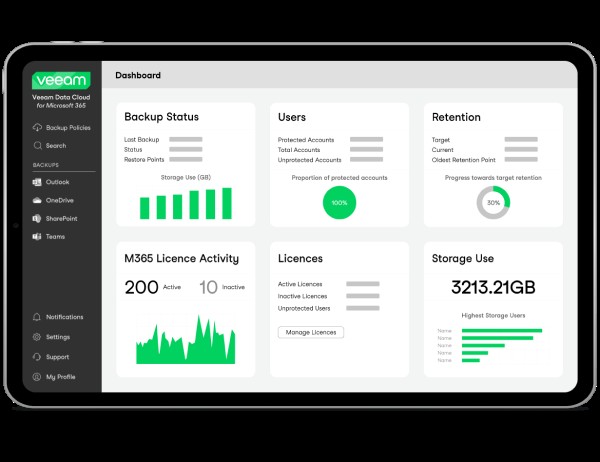
Veeam Data Cloud for Microsoft 365 is a BaaS (Backup as a Service) solution used to back up and restore Microsoft 365 data, including Microsoft Exchange, Microsoft SharePoint, Microsoft OneDrive for Business and Microsoft Teams data.
-Where companies need to secure their attachment, which goes outside, means from their company to outside -Where companies need to ensure their client's personal information -Where companies need DLP. They need to look for Forcepoint only, as they have the upper hand over the rest of their competitors.
Analyzing campaign performance is a great area where the Veeam Data Cloud for Microsoft 365 is well-suited, and it’s working well. In the past, when we analyzed campaign performance, we had to use outside vendors, which was a time-consuming, laborious, and costly process.
Provides capability of local backups while maintaining remote copies on cloud to ensure faster recoveries of recent data and remote protection of all data.
Helps reduce cost of long term retention by leveraging the BLM functionality.
It does not need specialized hardware for it to work. Customers and Service Providers can choose their own infrastructure and do not need to rely on any OS or storage based replication even for deploying replication of backups.
Supports wide range of environments including virtual environments with remarkable features like remote VDR with incremental restores.
It has predominantly protected us from unauthorized parties and has provided us with better visibility and control over our data.
This software has also successfully prevented us from both malicious and accidental tasks, which are quite flexible actions when it comes to the violation of data loss prevention policies.
This product has been successful in improving compliance and even mitigating compliance violations, which further facilitated IT security.
I think there is room for improvement, as the user interface is slightly rough and difficult to adopt in the beginning. The software also hangs up at a few instances, which leads to some wasting of time and annoyance, but other than that, this software is good. The technical staff should work on the complexities for a better user experience.
We would like to see Asigra come out with a Replication Model for quick Recovery of systems upon Disaster. We can have quicker recovery, DR, with Virtual Machines but we would like to have Physical Machine recovery in less than 2 hours. Replication can accomplish this...
We would like to see Geolocation and remote wipe for endpoint devices
We would like to see the solution provide easy "roll back" after a disaster.
Forcepoint technical support--specially for users who go with essential support--is challenging to get support on time. You need the ticket to be raised long beforehand to get support from TAC. However, in the case of enterprise support, its is not like this technical person will come on a priority basis.
However it comes with higher prices, especially for SMB, it is allowed to pay that amount for support only.
I would like the option to remove users from the backup and set them to an alternate storage location/ archive location. Currently, my backups are at 7 TB, and I would like to segment out data with lower data retention requirements.
Compliance is a tricky thing. Jumping backup software means having to deal with previous copies somehow. Asigra is built for the long haul.
Asigra is continuing to increase their feature stack. They have made huge steps in the VM backup in the last 3 years and continue to implement features there.
As far as cloud backup software goes, there are many that can do it, but none that do it as well as Asigra.
We have been fairly happy with the product and how it has worked. We have looked at other vendors for url filter and such and have not found one that meets our needs or does what we have been doing with Websense. The product has been fairly stable and we have only had a few issues in the past. We have all seen that it was one of the highest leaders from the Gartner Group Magic Quadrant for Web Gateways.
Veeam Backup for Microsoft 365 just works so well and is so easy to use. I researched multiple options for Office 365 backup and none seemed to be as easy to setup and use as Veeam Backup for Microsoft 365 and the pricing was very comfortable to us. I can't imagine any reason why we would change away from Veeam Backup for Microsoft 365.
It is a bit rough around the edges and the GUI feels like a wrap around of a CLI but it is simple to use. The problem comes in when there is an error code you are usually chasing down the error code in the specific vendor's forums rather than Asigra's
For us, Forcepoint Data Loss Prevention was difficult to administer, did not work well when it did work, was incredibly expensive for the feature set you get, and was difficult to uninstall when we moved on from the software. Once it was fully set up, it worked occasionally for us.
The interface is simple, but powerful. It's easy to setup, easy to use. It's able to restore individual files and emails with ease. Would like to see the wording on some features cleared up, as it's caused us some confusing learning the tool.
Over 6 consecutive years our Asigra Backend had 99.99% uptime and provided 7x24 data restore availability. Software is robust in operations, provides N+1 node architecture to protect against failure of half of the nodes (majority of the nodes still up) and software based replication to protect against data loss across two geographically independent datacenter locations. Why not 10 points? Some major upgrades still require short downtime within a planned maintenance windows.
We have a lot of data, and pulling backups out of the store sometimes takes a bit of time - but this is within acceptable tolerances. I don't expect restores to be instantaneous, and I can't quantify if the speed is software or data repository.
They respond quickly on your request. They ask for details at the time of logging the support request itself ensuring the first response is not for collecting the basic details only. They refund you the support request if they find it as a functionality issue. They follow up on you to ensure you are satisfied and happy with the response and resolution that they have provided.
Support from Forcepoint has been lacking. When calling in with a high priority issue we rarely are able to work with a technician immediately. The queue waits are very long and when you get through there are no support engineers available and we need to wait for a call back for hours it seems.
The setup support we received was extremely helpful. They allowed us to learn as they created the policies and managed the handoff between setup and guided setup very well. This resulted in active, usable policies and us having the knowledge to adapt these as our needs change in the future.
Anything training past level 1 and level 2 is a waste of time. They do not offer training, just an exam and require you to read 2500 pages of their documentation as their training. They are selling you something which you already have. Training exams are far fetched and cover topics hidden within the documentation. A lot of their documentation does not match across itself. They don't even follow the standard versions Major.Minor.ServicePack.Hotfix. They use the MAJOR.MAJOR.MAJOR.Hotfix method, which doesn't match their documentation. They require you to take training in order to keep your engaged hybrid partnership. If you ask me personally, their training is a scam to make more money.
Quick to install, easy to create jobs, schedules and retention policies. No large cycles of setting up backup volumes or trash volumes. Retention job itself configures the BLM functionality so you don't need an expertise to handle the BLM module separately.
I would say that it has the same functionality as the three mentioned above in their respective fields (might have a bit less than some of them) but Asigra offers all of this and more so if you are looking for a single backup solution across the entire firm then Asigra is the much better choice
User friendly solution that makes it easy to deploy and manage. Forcepoint Data Loss Prevention very effective to protecting our valuable data on endpoints and where data lives like in the Cloud, server and on-premises disk drives and its valuable to just set policies once and start utilizing Forcepoint Data Loss Prevention solution.
First and foremost, Veeam's reputation stood out. They have been a leader in the backup vendors for a few years. That reputation along with recommendations from colleagues sold us on Veeam Data Cloud for Microsoft 365. The other vendors that we did demo's with were lacluster in setup and performance. Veeam Data Cloud for Microsoft 365 immediately won us over.
The exchange of financial documents with customers creates extreme risk as data loss could result in financial and reputation damage to the customer. The cost of deploying Forcepoint is fractions of pennies compared to the potential financial impact of data loss.
There is some administrative overhead associated as false positives are inevitable, requiring a manual review and a potential loss of productivity.
The only real impact is from a compliance standpoint. Our company is expected at a regulatory level to be protecting our data and even though the tenant has little traffic there could still be some regulated data in there. We have to be able to tell an auditor that it's being backed up by an enterprise grade solution, and that's what VDC was intended for.