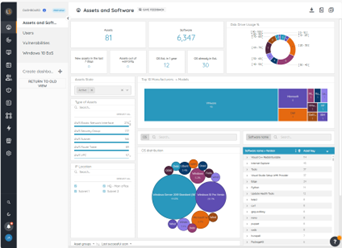
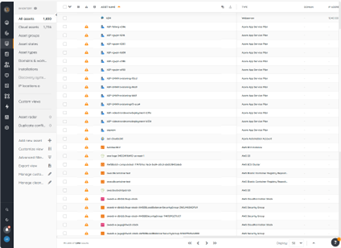
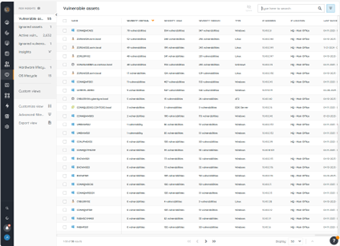
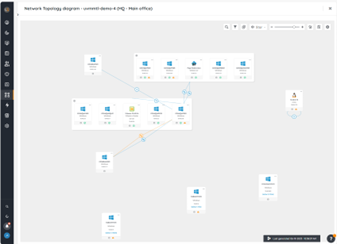
Automox is an endpoint management platform built for the era of autonomous operations. It provides a cloud-native foundation that unifies automation, speed, visibility, and trust.
$1
per month per endpoint
Ivanti Endpoint Manager
Score 7.6 out of 10
N/A
Ivanti Endpoint Manager increases user and IT productivity by helping IT administrators gather detailed device data, automate software and OS deployments, and quickly fix user issues.
N/A
Lansweeper
Score 8.7 out of 10
N/A
Lansweeper helps organizations see, understand, and make confident decisions about their technology estate across IT, OT, IoT, and Cloud. Lansweeper automatically discovers and inventories every asset: hardware, software, and user—then connects that data to insights about usage, lifecycle, and risk. This is to create what the vendor describes as Technology Asset Intelligence (TAI): a trusted foundation of knowledge that turns raw inventory data into clear, actionable…
$2,868
per year (includes 2000 assets)
Pricing
Automox
Ivanti Endpoint Manager
Lansweeper
Editions & Modules
No answers on this topic
No answers on this topic
Starter
$239
per month (billed annually) Includes 2,000 assets
Pro
$439
per month (billed annually) Includes 2,000 assets
Enterprise
Contact Sales
Starts at 10,000 Assets
Offerings
Pricing Offerings
Automox
Ivanti Endpoint Manager
Lansweeper
Free Trial
Yes
No
Yes
Free/Freemium Version
No
No
No
Premium Consulting/Integration Services
No
No
Yes
Entry-level Setup Fee
No setup fee
No setup fee
No setup fee
Additional Details
Automox can patch macOS, Windows, and Linux endpoints with PatchOS, an offering at $1 per endpoint/ month with an annual commitment.
The Automate Essentials or Automate Enterprise packages are for scaling IT automation, endpoint configuration, and software updates.
Modules are available with Automox Assist, a one-on-one remote endpoint control and assistance for helpdesk technicians.
Automox was a much simpler to use and more robust patching solution. It handles both Microsoft and third party patches without issue and allows for simple but powerful scripted deployments and planning.
Automox lets us control so much more and makes it incredibly easy to target very specific devices for very specific actions. it is also incredibly reliable and I know it will patch as expected with very minimal monitoring. Automox has been the most stable of all the tools I …
Automox was easier to install and deply, it is more lightweight, and it allows up the ability to remote in to a user even when they are not connected to the LAN or VPN. It also automates the patching and software deployments in a better manner. The UI for me was also easier to …
LanGuard is fine but the UI is clunky and it's not a cloud-based product. Automox is a nice tool for endpoints, however, not great for server patching IMO because it doesn't seem to patch in "real-time" as LanGuard does. I can monitor LanGuard's patching in real-time, I can see …
The main competitor that are not isted on your TrustRadius is PDQInventory and PDQDeploy, and those two come as a package and they blow Lansweeper out of the water for both software deployment and hardware inventory. That being said, comparing it to the others I see listed: …
I was able to update browsera like edge and chrome which have updates every few days, automatically. No more emails to ask people to update edge or chrome. Display drivers and dell drivers are not visible for users, having Automox update them make it much easier for users as not all of the users are technical.
There is no direct replacement for the on-prem Ivanti [Unified Endpoint Manager (formerly LANDESK Management Suite)] solution. Ivanti has a companion product called Neurons, but that is in additional cost, and requires configuration with your on-prem [Unified Endpoint Manager] instance to perform basic functions. If cloud-based is a requirement for your organization, this is likely a dealbreaker. You can implement [Unified Endpoint Manager] in a cloud instance such as AWS, but the support for this appears limited. If on-prem is not an issue for you, this is a great tool for device management. It has robust features, impressive inventory, massive customization options, and excellent vendor support. If Patch Management is a problem in your company right now, this is the first product I would evaluate.
Lansweeper I believe is well suited for any environment - its low cost and small footprint make it an easy addition to any organization, big or small, that is looking for an asset inventory solution that can either replace or supplement existing asset management systems. It may not be well suited for situations where a lot of customization is necessary, such as pulling in custom fields or details from equipment that don't reside in a registry.
Patch(Security) is done really well. You can use roll out projects or built-in automation as well as the use of groups and scopes to design pilot and other use cases.
It takes a solid inventory of what you have of your endpoints and can do an agentless scan as well if you need to collect data that way as well.
Provisioning is rather simple and even allows you to use other products' software for the image or the built-in if you wish to do so.
Software distribution works well and has a lot flexibility built into the module.
Inventory - LANSweeper scans the network for devices - anything with an SNMP trap or using AD or local credentials. We can get an in-depth look at devices.
Reporting - LANSweeper can generate just about any report you can imagine. We can check RAM in groups and determine where upgrades are needed. We can find local printers (which aren't allowed on our network) and address that issue with the user. We can check CPU type to help determine end of life without our network.
Printers - It's nice to have a quick look at printer statuses. Toner levels, out of paper, and service errors are all reported via LANSweeper.
Server patching orchestration. There is no way to patch and reboot systems in order of importance, such as database servers before application servers.
Worklets for patching .net core and similar.
Worklets for removing unwanted Java installs or other unwanted software.
Integration with Tenable Vulnerability Management.
AI script development should be included at no additional cost; GPT or Gemini can be used instead for free and pasted into Automox. Why charge when others are free?
Official worklets are slow to be added or updated.
Setup - Boy it is a pain to configure everything correctly. Be aware that you'll probably be giving an AD service account some God rights to get everything working....and security just loves that....
Cost - Boy you have to pay for everything. I suppose it lets you buy into just what you want but having repeated items go through procurement is a pain if your procurement branch is a pain.
Can only scan what it sees. Doesn't show every item on the machine. Patches are also absent.
Software Recognition is OK with Microsoft. It is dire within our network of multiple products. Recognition is at about 35% with constant manual work needed to baseline for each manufacturer in each network
Datacenter compliance is a manual project. We used Excel extensively.
License optimization is limited to installations v surplus licenses. We need to know who's using what and how.
This is a software that just works. Once configured its a set and forget kind of tool that keeps things up to date and alerts me if something is wrong. I was able to work through an expansion project to deploy an additional 500 devices in almost no time and create a robust self-patching environment.
We are happy with the product but the support and development process is far superior to any other company we have worked with. Having a good support structure is very important in today's marketplace of products that do so many things and have so many robust options and capabilities. We are very satisfied with our contract, pricing, support and product execution.
It's great at what it does. We're able to veiw endpoints that are online in real time, and run scans on them to ensure they're still compliant. The software itself is very easy to use and set up on end points, with the main admin portal having a clean and very easy to understand set up
Items are logically laid out and most are easy to find. The more advanced stuff can be trickier, but it is still not hard to find. There are a lot of options though, so remembering where some settings are, especially if you do not alter them often, can take a minute, but you will get to them fairly qiickly.
The tool is a web gui, and is mostly easy to navigate, but certain areas are more unclear than others. Identifying what im filtering for, or what menu option has what impact can be less straightforward than I'd like. Overall though, this tool will provide me with information other tools in my box just don't.
I did not need to reach out to support often but when I did the answers were relatively correct and they were answered quickly. The only thing I might "ding" their support on was their lack of understanding of OS's different from Windows and especially Linux. Other than that I was satisfied
TRM\TAM support has been generally very good. Getting reported bug fixes, design changes, UX problems resolved has been a pain. It is often difficult to get problems escalated beyond the TRM\TAM level. Support is fantastic when you can get it, getting it can often require more work than it should, and that is probably our biggest issue.
Lots of info online there are tons of SQL Reports you can copy from the web as Lansweeper and users post many of them. They also send out alerts that pop up on Lansweeper, letting you know of an update that you need for certain software and provide an SQL report so you can scan your system to see what PCs need this update.
Implementing Automox successfully starts with a clear strategy for organizing and grouping devices based on operating systems, environments, or business criticality. This ensures that patching and configuration policies can be applied with precision. A phased rollout approach is essential—beginning with a pilot group allows teams to test patching schedules, reboot behaviors, and custom Worklets before scaling across the organization. Leveraging Worklets from the start can significantly boost automation by enforcing security baselines and performing routine system tasks. Integration with existing SOC tools, such as SIEMs, enhances visibility and response time by correlating patch compliance with threat intelligence. Additionally, aligning patching schedules with operational downtimes minimizes disruptions, and consistent monitoring and reporting helps maintain compliance and prepare for audits. Overall, Automox offers a streamlined and effective solution, but its true value is unlocked through thoughtful planning, testing, and integration with existing IT and security workflows.
We felt that Automox provided us with the functionality our MSP offered, including OS and device patching, as well as remote control capabilities, but in a better and more manageable way. We also felt the usability of the tool gave us the ability to be effective in our way of working, as well as integrating with Rapid7 was a massive benefit for us.
It's been many years since I did a full evaluation of other products but at the time we purchased it, the main competitors were Microsoft's SMS and Alteris. SMS just looked horribly ugly and complicated (which fit in very well with Microsoft's other server tools) and Alteris looked okay but had a piecemeal approach where even a basic deployment meant purchasing a half dozen or more components. LANDesk had one bundle for all the tools we were looking for and had a great interface for presenting the data.
In short it has more features and its a more robust solution and it works well with those solutions. I am sure it will keep track with Ai and action recommendations in the future as I didnt see any of it on the platform (at least the one we use) I thin that is the only thing that is missing in the current product
Being a start up, we have pivoted our strategies a number of times. The pay as you go model has worked very well for us, and has prevented us from overprovisioning
The time saved pulling reports to provide to auditors has been well worth our small spend on the solution
We have no need to maintain a scanning tool or invest in hardware thanks to the SaaS nature of Automox
It had a positive impact on solutions expense cause several teams we're using different solutions with different costs that used several servers and DB resources. Now, we've been able to simply that a lot with Lansweeper.
With my previous point, people had to train and learn about each of their solutions. Now we can put a team in charge and so the other teams can focus on other tasks.
Last year Lansweeper changed their licencing prices a lot so it slashed our budget.