BlackBerry UEM (formerly from Good Technology) offers a complete enterprise mobility management solution, including capabilities for mobile device management, mobile application management, mobile content management, identity access management and mobile security and containerization.
N/A
Hexnode UEM
Score 8.5 out of 10
N/A
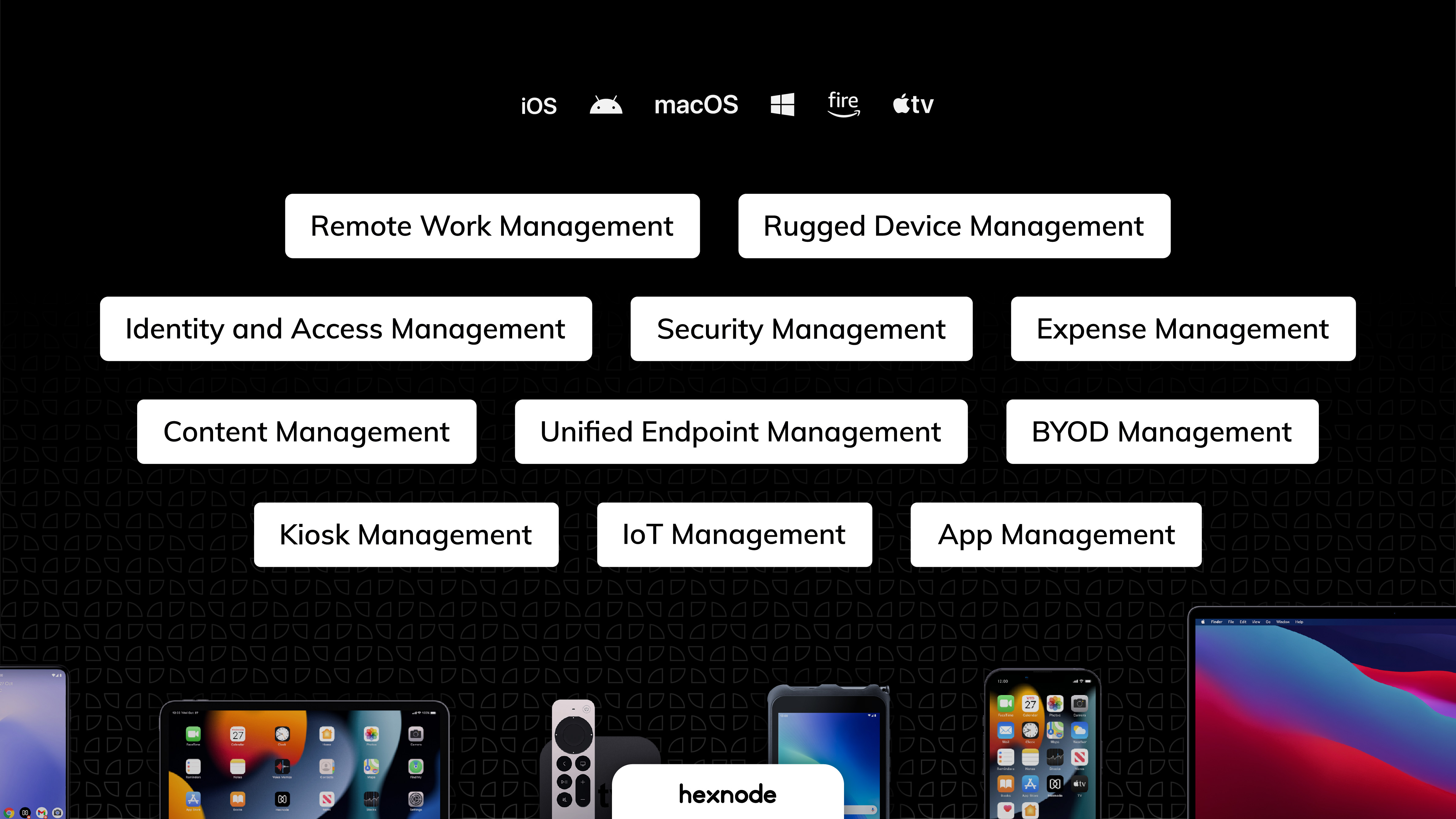
Hexnode is a Unified Endpoint Management solution that aims to simplify the way people work with the help of intelligent tools. The management platform streamlines the device lifecycle model to offer its support at every stage, from device onboarding to the end of its life. It also gives a hands-free experience with automatic enrollment using Zero-touch enrollment, Knox Mobile Enrollment, and ABM and endpoint management with the help of dynamic group allocation in the case of…
$36
per month 15 devices (minimum)
ManageEngine Endpoint Central
Score 9.0 out of 10
N/A
Desktop Central from ManageEngine is a client desktop management with patching, remote control, and configuration.
$795
per year per user
Pricing
BlackBerry UEM
Hexnode UEM
ManageEngine Endpoint Central
Editions & Modules
No answers on this topic
Pro
$2.40
per month per device
Enterprise
$3.60
per month per device
Ultimate
$5.20
per month per device
Ultra
Contact Hexnode for a Quote
No answers on this topic
Offerings
Pricing Offerings
Blackberry UEM
Hexnode UEM
ManageEngine Endpoint Central
Free Trial
No
Yes
Yes
Free/Freemium Version
No
Yes
No
Premium Consulting/Integration Services
No
Yes
No
Entry-level Setup Fee
No setup fee
No setup fee
No setup fee
Additional Details
—
No support costs, No maintenance charges. Per device pricing. Discount available for annual pricing.
While some of these other Windows MDM solutions had some small improvements for something ManageEngine Endpoint Central does not have, I still find that ManageEngine Endpoint Central still has the biggest library, if you will, for functionality.
If you want to connect securely, connect the mobile android or iOS devices to your network for communication purposes, where you have control over all the devices, who can access the network and remove the corporate data from those same devices if the need arises.
We enjoy the ability to remotely support our end users with their tablets while they are traveling. I've had the ability to provide support to some of our remote sales users as they are working at a customers location. However, sometimes the remote view can be a bit of a lagging issue that makes things a bit difficult. Though overall this has been a great experience that helps us support our various users throughout the company.
ManageEngine Endpoint Central is very well suited to most kind of patches, updates, and software deployments. It's able to quickly recognize and update third-party software whenever a new security vulnerability is discovered, and it's able to do this for you automatically. The remote connection and management features allow us to begin troubleshooting immediately once a user reports an issue, regardless of whether or not they're working on-campus or from home. A ticket that might have taken a few days to close out now takes no longer than a couple minutes. If you use Mac, the remote connection feature requires the user to allow Endpoint Central through their system's Security/Privacy settings. This step can be difficult for your less tech-savvy users. You can remotely and silently access a computer's task manager, registry, and command prompt, which is incredibly useful. This saves us a ton of time on having to contact the user and schedule a meeting. The only complaints I have about these management features are that the UI is a little bare bones, and it occasionally has minor problems with responsiveness.
Android zero-touch enrollment allows bulk enrollment of corporate-owned android devices with a single click.
With the help of the dynamic device grouping function, devices may be grouped in accordance with specific pre-configured criteria.
The kiosk mode supports both single-app kiosk mode, in which the device is restricted to using a single app, and multi-app kiosk mode, in which the device is in kiosk mode but has access to a number of other programs and files.
We set alerts when a devices gets low on disk space. That is automatic and creates a ticket in ME SDP. We are then able to Add space to a VM Desktop, and then go thru ManageEngine Endpoint Central to extend the drives so the entire process can be done without interruption to the end user.
Using the patch scans we can easily see what patches have been installed for all manufacturers not just Microsoft, without having to physically go to the device. It also allows us to choose which patches we want to push out and automate the process so we can be hands off, freeing up out time for other things.
Remote access to devices. This allows us to remotely make changes, not just via remote control but also make registry changes and clean up space without going to the device and without interruption to the end user.
Alerts. We have set up to get email alerts when new hardware is plugged into any computers. This lets us know if someone is bringing in un-authorized equipment (thumb drives, hubs, etc) to better manage what is/is not on our network.
One thing which is annoying to me is that after every 5-10 minutes, I need to log in again with my credentials to access emails. It could be from a security perspective but in that case the auto log out time should be user configurable.
It's not possible to save or forward attachments from my inbox on my device
Good does allow for synchronizing of contacts in your personal corporate email address book to your personal device address book.
Devices running watchOS cannot be handled or enrolled.
The policies under WIFI, which allowed certain websites to be blocked using website certificates, were complicated .
The app management features provide the ability to push the installation of corporate apps on the devices. Even though it was successful on the Hexnode Portal, this feature periodically malfunctioned, and the apps were not loaded.
The remote CLI/PowerShell interfaces should support tab completion and command history like the real-world versions
Remote control could work better
Having a standalone application, even if just a Java app or something for the remote control/remote command line versus running it out of a web browser
ManageEngine is considered an excellent product due to its comprehensive suite of solutions for IT management, with ManageEngine Endpoint Central specifically excelling in endpoint management. The platform stands out for its user-friendly interface, robust features, and versatility in addressing diverse IT needs. It offers organizations a centralized solution for endpoint security, patch management, software deployment, and asset management
UX is pretty good, but various screens are a bit redundant. Managing user and managing devices is often one in the same operation, but is broken across multiple screens. Device management policies are strange because if you make a "macOS" policy, why does it have all the Windows, iOS, Android etc options? It's unlikely you'll want all of these options for all possible OSes in one policy, but that's the only way to build a policy. Manage policy changes require remote system restart which is highly disruptive to employees.
I gave this rating because ManageEngine Endpoint Central is reliable, easy to use, and delivers strong value for money. It helps us save time through automation and effectively handles patching, remote support, application management, BitLocker security, and corporate data wipe. Although cloud DLP support is limited, the overall performance and stability fully justify the rating.
If you have a serious issue with your on-premise installation, access to support can take a bit to get someone on the phone, and it can take some time to rectify, given the complexity of the software. In my experience, the support team does get you back up and running in critical scenarios, but you more than likely will be on some marathon calls, unless it is a very simple and known issue.
The immediate chat support is great and very helpful. However, if you need escalated support or have a deeper need that the chat tool can't help with, you will experience significant wait times and slow responses. The time zone difference becomes painful to the point of often just giving up.
It seems that the services offered with the purchase change from what is covered to what is an additional cost. Somethings I thought we had ended up requiring an additional purchase if we wanted to continue using the feature.
Well, selecting Good was an organization level decision and not my personal one. I like Good from the security perspective and that it helps our IT department avoid worrying about data theft. Otherwise, from the perspective of user convenience, Outlook scores way over Good with it's real time delivery of email, real time syncing and a host of other features
I am currently using both the platforms, Hexnode UEM and Esper. Esper is used for managing mobile devices and Lenovo Tablets while Hexnode UEM is being used for Microsoft tablets. The basic framework behind both of them is almost the same. Both of them have a clean and interactive UI with good functionality.
This works great. It is super easy to setup automated patching and the patching actually works. When using Solarwinds, we would have to regularly troubleshoot machines and figure out why they were not patching. This is not the case with ManageEngine Endpoint Central. We have seen a significant decrease in number of troubleshooting hours since moving.
We already had someone try to walk away with an ipad after deploying Hexnode, and we were immediately able to force an activation lock telling them to bring it back and they did.
It has saved us a lot of time setting up ios devices as we have a limited amount of IT staff and Hexnode makes it take probably around ten minutes an ipad.
Employee experience has improved since we can reset code remotely and they no longer have to send the ipads back to the corporate office to get reset.
We have been able resolve and complete any requests which include things like software deployment or issues that include troubleshooting, much faster and more efficiently. This has had a sharp decrease in our response times and also time it takes to complete these requests or incidents.
The mobile device management features have allowed us to be able to have a much tighter grip on security. This means we have dramtically decreased our device vulnerabilities and risk of data breaches. This has saved us lots of time and money.
The remote features that are available have helped a lot with user's being able to work remotely and allow our organisation to sustain hybrid work. It means user's can still be as productive and IT support is as efficient no matter where the user is working.