Braze is a customer engagement platform that enables relevant and memorable experiences between consumers and brands. With Braze, global brands can ingest and process customer data in real time, orchestrate and optimize contextually relevant, cross-channel marketing campaigns.
N/A
CleverTap
Score 7.3 out of 10
Mid-Size Companies (51-1,000 employees)
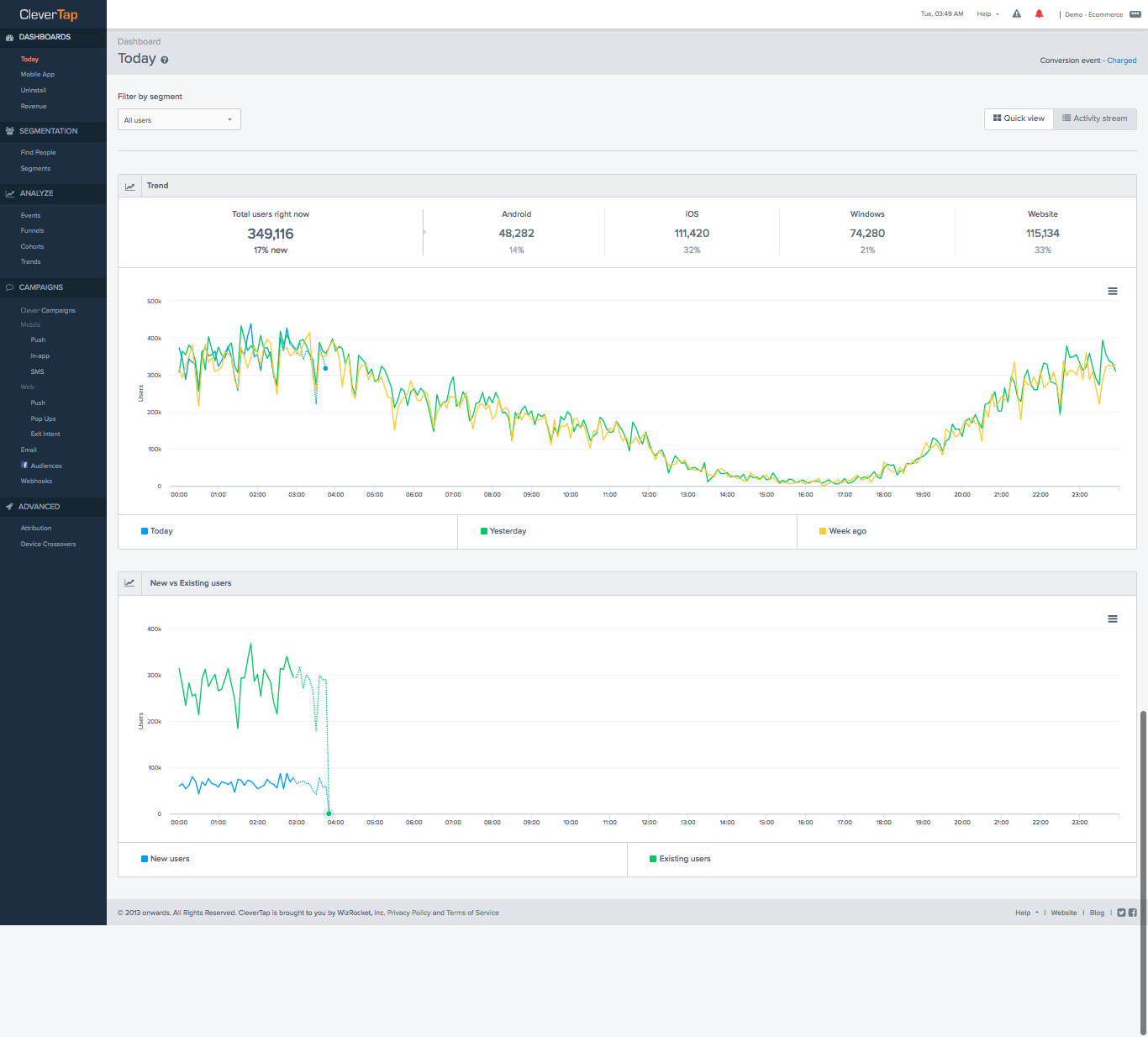
CleverTap is a mobile marketing solution that helps marketers create differentiated customer engagement strategies that are designed to drive growth. The vendor’s value proposition is that thousands of brands continue to build valuable relationships with their customers using CleverTap’s Intelligent Mobile Marketing Platform, which provides actionable, real-time insights for building amazing customer experiences. According to the vendor, key features and…
N/A
Optimizely Web Experimentation
Score 8.7 out of 10
N/A
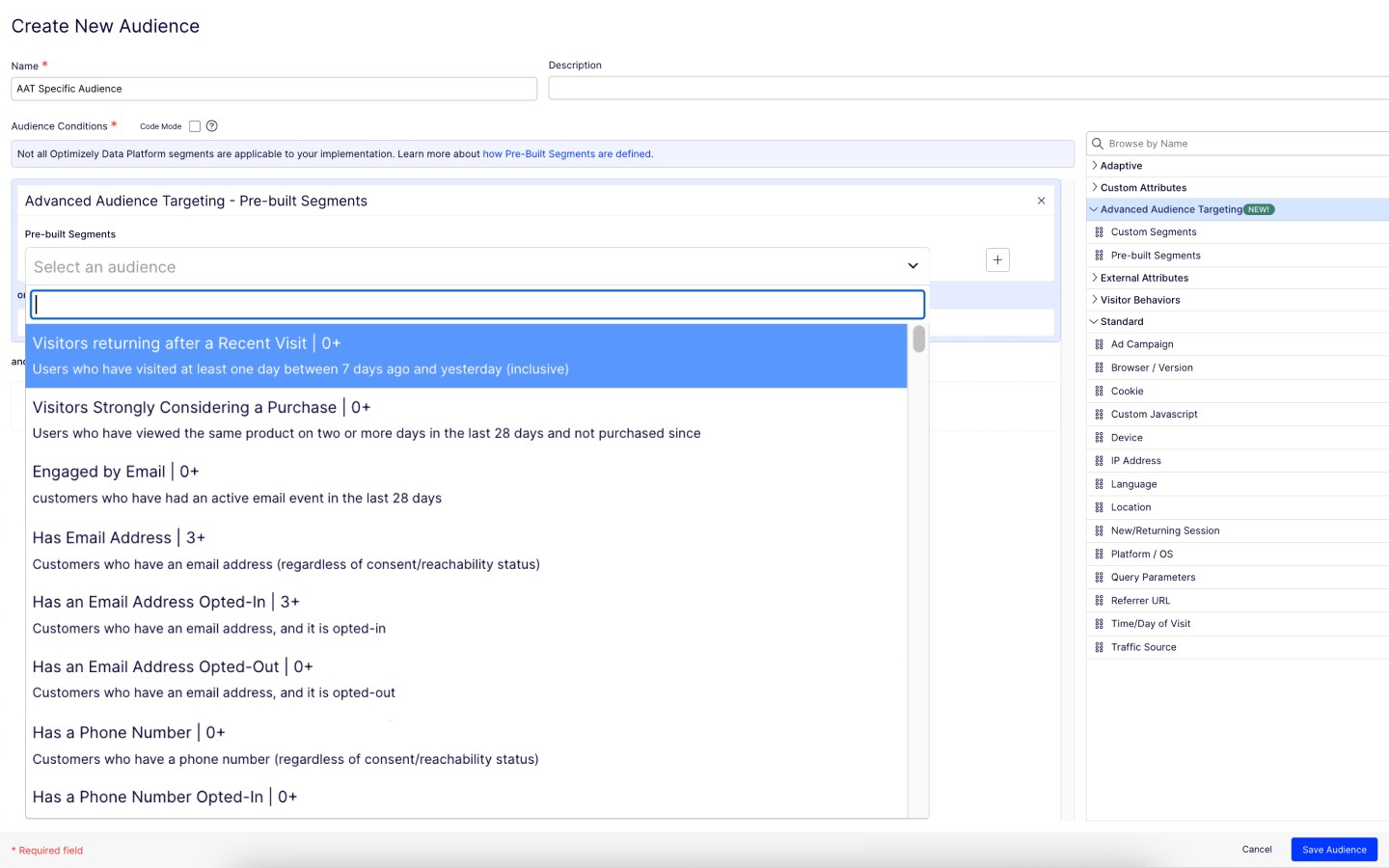
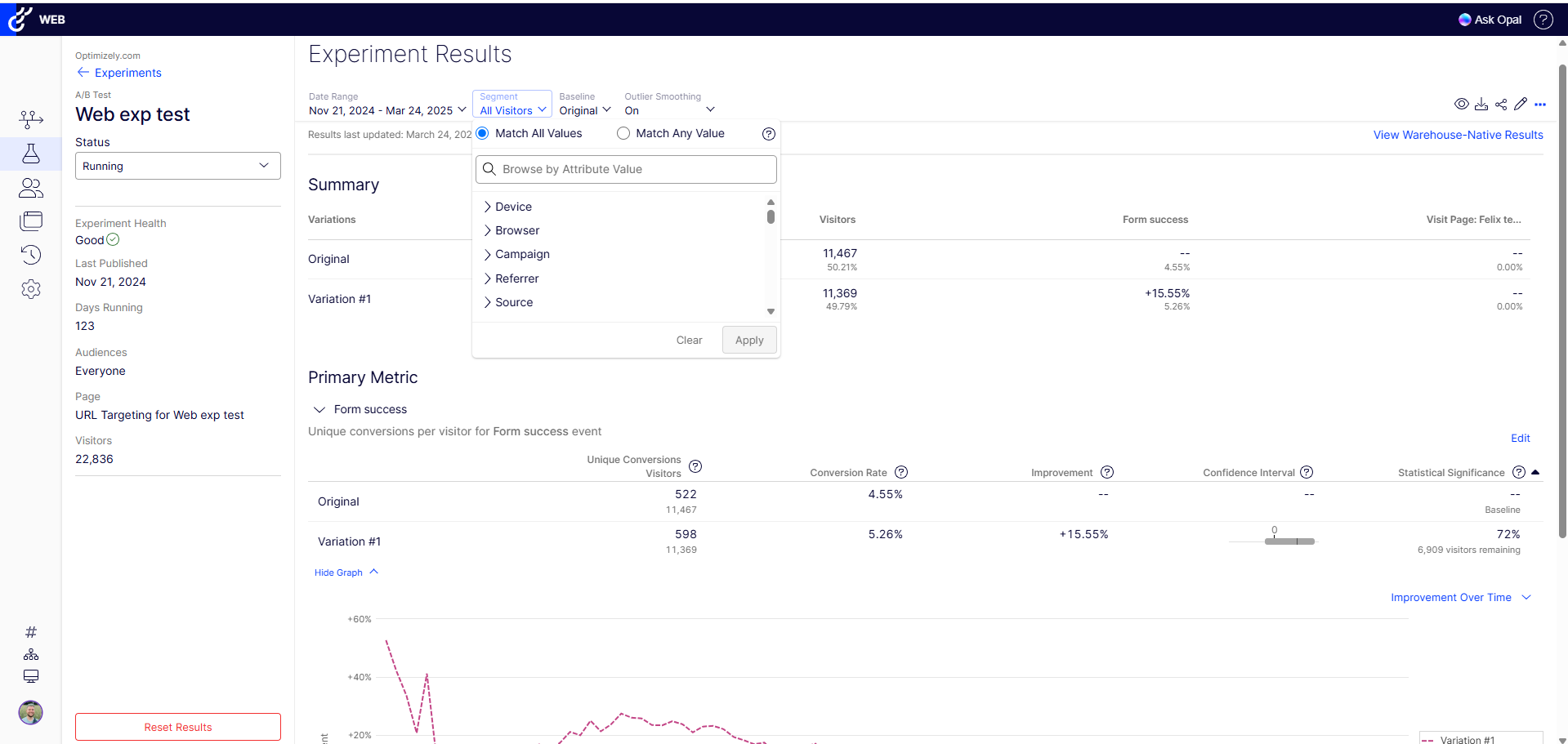
Whether launching a first test or scaling a sophisticated experimentation program, Optimizely Web Experimentation aims to deliver the insights needed to craft high-performing digital experiences that drive engagement, increase conversions, and accelerate growth.
Braze is the best to orchestrate omnichannel communication for apps. It is a powerful solution to segment the user base and triggers the right message at the right moment to the right user. If an app is your main channel, you have to choose a tool that was made with that in …
We have a worldwide userbase, and the fact that Braze has teams all over the world made us feel reassured that we can tap into their expertise if needed.
Verified User
Executive
Chose Braze
Braze has many features that these tools don't, like a heatmap, a catalogue, the ability to create tons of attributes, and easy-to-use template features.
Braze is a fantastic tool if you're looking to build a large number of CRM journeys using complex canvas structures and maximising use of customer data to segment and personalise. There are numerous tools to ensure each channel is maximising impact and engagement. Braze offers great features for testing, managing message frequency and control groups and using dynamic attributes and liquid code. If you're looking to limit your use to single-send campaigns with no or few automations, I don't think this is the right tool. From my experience, many Braze users also use external tools for analytics rather than Braze's native analytics.
It is quite suited for all the SMS, emails, and other in-game campaigns, but wherein the delivery rate I personally feel it is less, and it has [a] limitation on 5 pins for the day for 1 user, it should be unlimited.
I think it can serve the whole spectrum of experiences from people who are just getting used to web experimentation. It's really easy to pick up and use. If you're more experienced then it works well because it just gets out of the way and lets you really focus on the experimentation side of things. So yeah, strongly recommend. I think it is well suited both to small businesses and large enterprises as well. I think it's got a really low barrier to entry. It's very easy to integrate on your website and get results quickly. Likewise, if you are a big business, it's incrementally adoptable, so you can start out with one component of optimizing and you can build there and start to build in things like data CMS to augment experimentation as well. So it's got a really strong a pathway to grow your MarTech platform if you're a small company or a big company.
Canvas feature has been really good for creating customer journey paths and long-term messaging campaigns.
They have been addressing feature requests to continue to improve the Canvas feature. One of the simplest but most-handy features is allowing Delay steps wait for a very specific date on a calendar -- so you can plan seasonal campaigns or when you have evergreen-style drip campaigns it allows for avoiding public holidays/etc.
The catalog feature provides a lot of use-cases and flexibility for personalizing comms or customizing comms for whitelabeled versions of our standard comms (for our B2B2C scenarios).
We use the catalog as a repository of our B2B2C brand info, messaging customization - it basically allows us to offer a whitelabeled configurable version of our optimized automated in-life comms in the branding of our b2b customers.
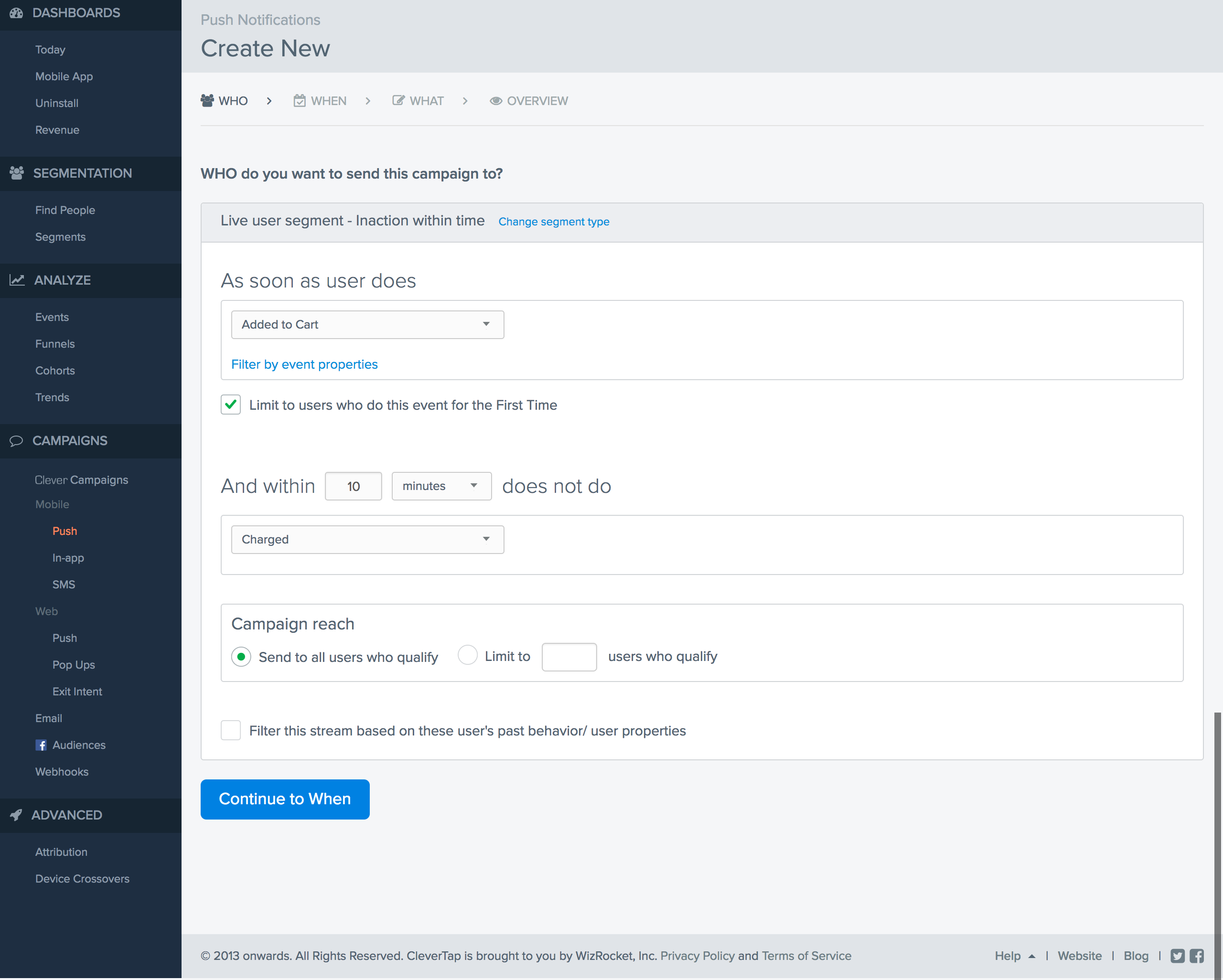
User communication: it provides a single dashboard to help us reach out to our users via email, push, web push, SMS, in-app and now even WhatsApp. Not just that, we can set up various types of targeting, such as one-time, recurring, date/time based, etc.
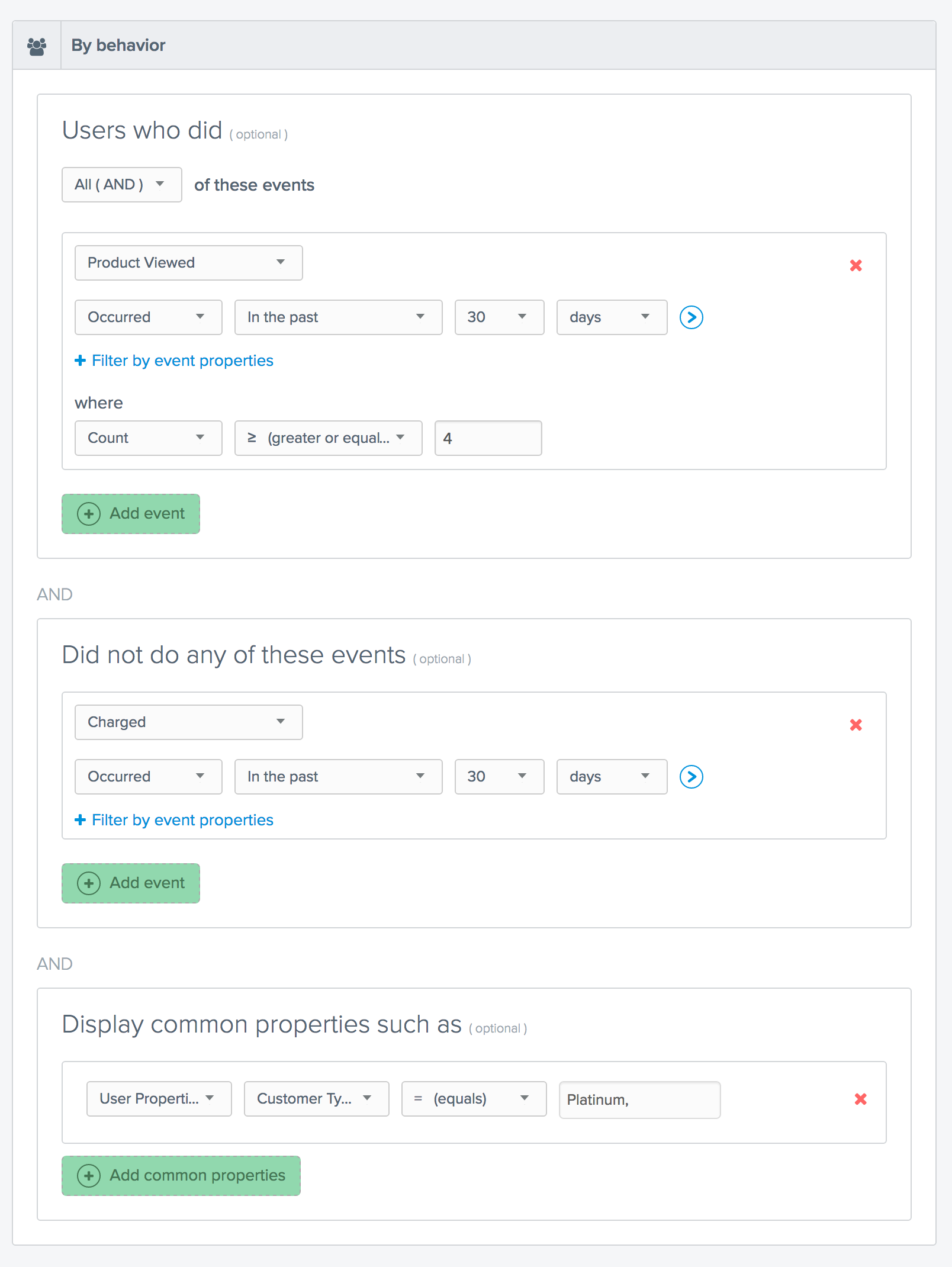
Analytics: it offers various views and cuts to analyze the user data, be it in the form of trends, funnels, recency-frequency, user cohorts and segments, etc.
Tracking: it helps us track the impact of various paid and organic marketing channels, through which we can adjust spends and focus on the channels that make an impact.
The Platform contains drag-and-drop editor options for creating variations, which ease the A/B tests process, as it does not require any coding or development resources.
Establishing it is so simple that even a non-technical person can do it perfectly.
It provides real-time results and analytics with robust dashboard access through which you can quickly analyze how different variations perform. With this, your team can easily make data-driven decisions Fastly.
Enabling GIF/videos to be directly uploaded on to Braze's platform
Easier way of creating canvases; right now it is too complex for someone new who is starting off in the company to understand what things do and where things are
Ability to track duplicate user profiles within the entire audience segment
Automated deduplicating email addresses/phone numbers in each targeting segment; right now it's done manually after extracting csv files
Customer service isn't that great [from my experience], most of the time the team is puzzled or will leave the client puzzled.
Price is very high with respect to the features available. MAU based pricing with a flawed sense of MAU calculation.
The way they calculate MAU is morally wrong. If a customer opens my email that I am sending via AWS, and they don't even come on my app, how can you consider them as active user?
We are on a mission for an omnichannel experience for our customers and are already making good progress with Braze able to fully support and optimise this
I rated this question because at this stage, Optimizely does most everything we need so I don't foresee a need to migrate to a new tool. We have the infrastructure already in place and it is a sizeable lift to pivot to another tool with no guarantee that it will work as good or even better than Optimizely
It is an easy-to-understand platform, thanks to its design and accessibility. You can, for example, easily find any users and their data, check exact volumes of segments, follow the history of messages sent, and create reports. We can connect Braze with other platforms for analysis or email design (Snowflake, Hightouch, Stripo...).
Optimizely Web Experimentation's visual editor is handy for non-technical or quick iterative testing. When it comes to content changes it's as easy as going into wordpress, clicking around, and then seeing your changes live--what you see is what you get. The preview and approval process for sharing built experiments is also handy for sharing experiments across teams for QA purposes or otherwise.
I would rate Optimizely Web Experimentation's availability as a 10 out of 10. The software is reliable and does not experience any application errors or unplanned outages. Additionally, the customer service and technical support teams are always available to help with any issues or questions.
I would rate Optimizely Web Experimentation's performance as a 9 out of 10. Pages load quickly, reports are complete in a reasonable time frame, and the software does not slow down any other software or systems that it integrates with. Additionally, the customer service and technical support teams are always available to help with any issues or questions.
Very responsive and helpful on simple questions, but not great other than that. They do not have a way for the customer/user to escalate a ticket. You have to contact your rep and in some cases, they don't respond within 24 hours so you have no idea if they have escalated it. There is no phone number for an urgent issue - you have to rely on email
They always are quick to respond, and are so friendly and helpful. They always answer the phone right away. And [they are] always willing to not only help you with your problem, but if you need ideas they have suggestions as well.
It's really well explained, there are lots of documentation about all topics. When we want to perform in a specific area, there are always a dedicated path. For each new feature, there is always some videos explaining the purpose and the new functionalities. Also I used to do the certification which allows me to show my achievements in my business environment.
The tool itself is not very difficult to use so training was not very useful in my opinion. It did not also account for success events more complex than a click (which my company being ecommerce is looking to examine more than a mere click).
In retrospect: - I think I should have stressed more demo's / workshopping with the Optimizely team at the start. I felt too confident during demo stages, and when came time to actually start, I was a bit lost. (The answer is likely I should have had them on-hand for our first install.. they offered but I thought I was OK.) - Really getting an understanding / asking them prior to install of how to make it really work for checkout pages / one that uses dynamic content or user interaction to determine what the UI does. Could have saved some time by addressing this at the beginning, as some things we needed to create on our site for Optimizely to "use" as a trigger for the variation test. - Having a number of planned/hoped-for tests already in-hand before working with Optimizely team. Sharing those thoughts with them would likely have started conversations on additional things we needed to do to make them work (rather than figuring that out during the actual builds). Since I had development time available, I could have added more things to the baseline installation since my developers were already "looking under the hood" of the site.
Braze is just the best one when it comes to aesthetics and usability, which matter when you're working every day, making complex or even simple changes to highly contextual campaigns for multiple stakeholders. Even without following tutorials, you just get it instantly and start crafting journeys very quickly. And they continue to keep adding new features at a rapid pace, so credit where it's due.
Edit: Clevertap added attribution tools to its features, making it possible to track your user acquisition sources. CleverTap is as complete as Localytics. It provides us good segmentation, analysis and engagement tools for a good competitive price. T̶h̶e̶ ̶o̶n̶l̶y̶ ̶d̶o̶w̶n̶s̶i̶d̶e̶ ̶i̶s̶ ̶t̶h̶a̶t̶ ̶C̶l̶e̶v̶e̶r̶t̶a̶p̶ ̶d̶o̶e̶s̶ ̶n̶o̶t̶ ̶h̶a̶v̶e̶ ̶a̶t̶t̶r̶i̶b̶u̶t̶i̶o̶n̶ ̶t̶o̶o̶l̶s̶,̶ ̶w̶h̶i̶l̶e̶ ̶L̶o̶c̶a̶l̶y̶t̶i̶c̶s̶ ̶d̶o̶e̶s̶. One other major advantage of Clevertap is its customer service. They are always standing by to promptly respond to any question you might have regarding its usability or its development. This kind of careful attention is really appreciated.
The ability to do A/B testing in Optimizely along with the associated statistical modelling and audience segmentation means it is a much better solution than using something like Google Analytics were a lot more effort is required to identify and isolate the specific data you need to confidently make changes
We can use it flexibly across lines of business and have it in use across two departments. We have different use cases and slightly different outcomes, but can unify our results based on impact to the bottom line. Finally, we can generate value from anywhere in the org for any stakeholders as needed.
Our additional revenues from additional in-site promotions during a festive sales jumped 40% after using Clevertap pop-ups that targeted people at the product & category level.
We're able to share definitive annualized revenue projections with our team, showing what would happen if we put a test into Production
Showing the results of a test on a new page or feature prior to full implementation on a site saves developer time (if a test proves the new element doesn't deliver a significant improvement.
Making a change via the WYSIWYG interface allows us to see multiple changes without developer intervention.