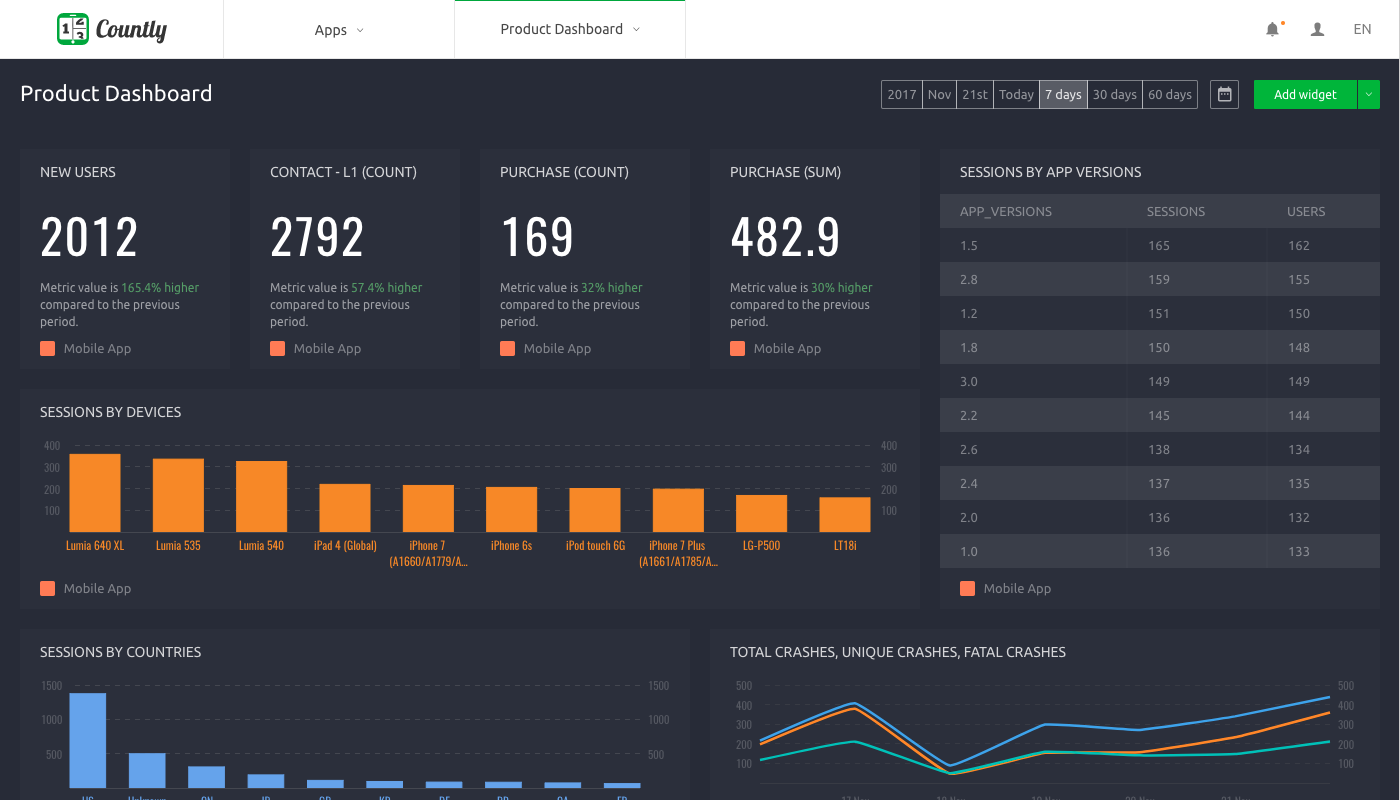
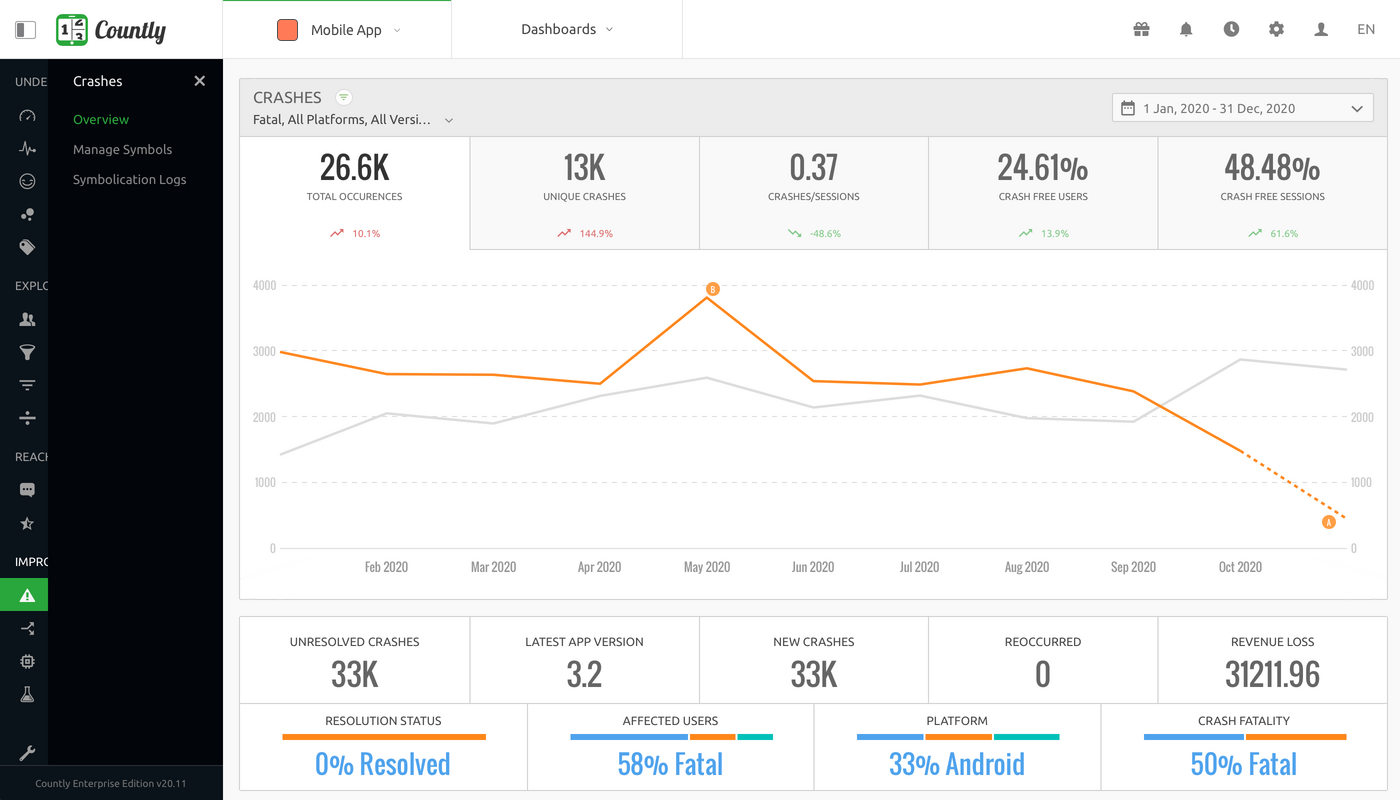
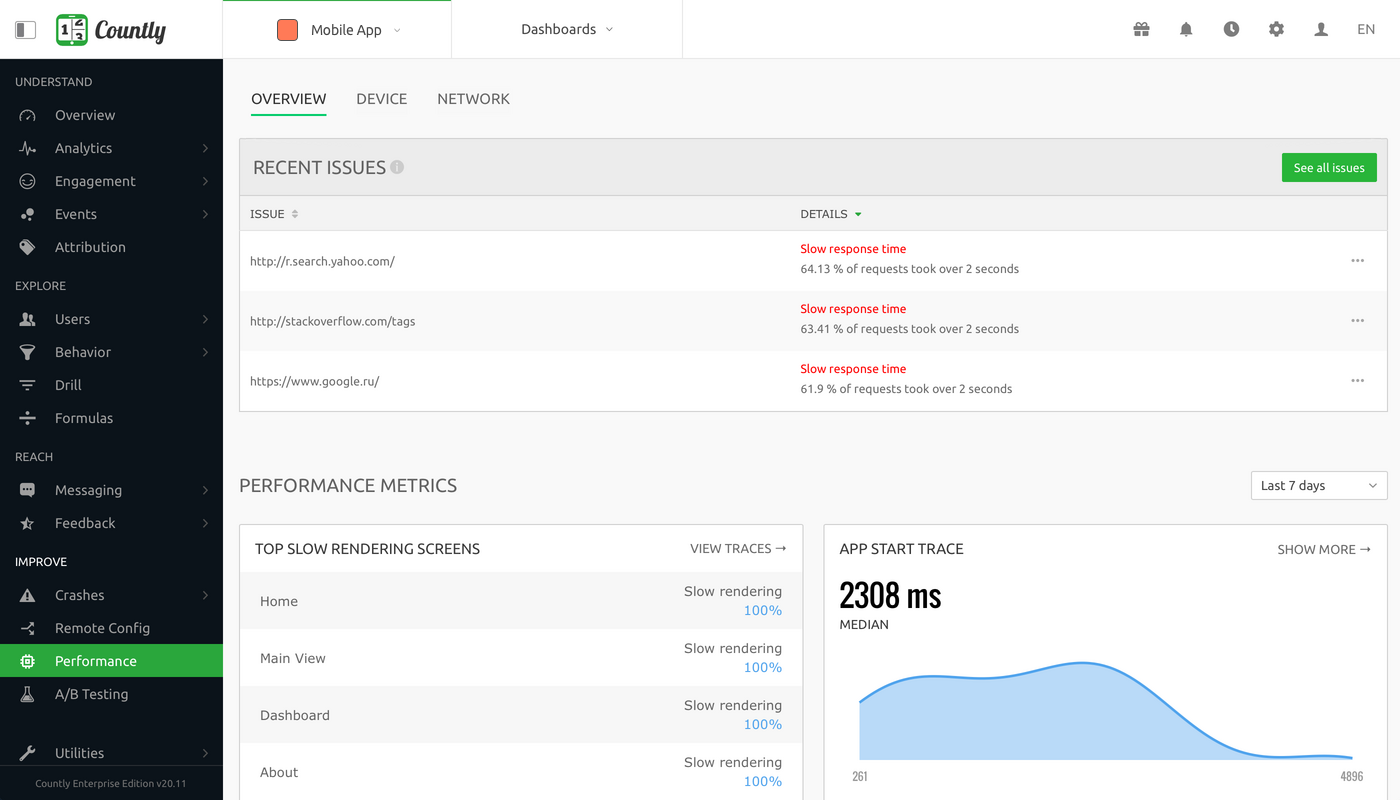
Countly is a product analytics solution and innovation enabler that helps teams track product performance and customer journey and behavior across mobile, web, and desktop applications. Ensuring privacy by design, Countly helps the user to innovate and enhance products to provide personalized and customized customer experiences, and meet key business and revenue goals. Countly empowers companies of any size or location to grow their business by helping them securely process billions of…
N/A
Fullstory
Score 9.1 out of 10
N/A
Fullstory’s behavioral data platform helps technology leaders make better, more informed decisions by injecting digital behavioral data into their analytics stack. The technology's behavioral data transforms digital visit into actionable insights.
N/A
Google Analytics
Score 8.2 out of 10
N/A
Google Analytics is perhaps the best-known web analytics product and, as a free product, it has massive adoption. Although it lacks some enterprise-level features compared to its competitors in the space, the launch of the paid Google Analytics Premium edition seems likely to close the gap.
$0
per month
Pricing
Countly
Fullstory
Google Analytics
Editions & Modules
Countly Enterprise Edition
Personalized Plans
per month per data point
Countly Community Edition
Free Forever
Business
Contact Sales
Enterprise
Contact Sales
Google Analytics 360
150,000
per year
Google Analytics
Free
Offerings
Pricing Offerings
Countly
Fullstory
Google Analytics
Free Trial
Yes
Yes
No
Free/Freemium Version
Yes
Yes
Yes
Premium Consulting/Integration Services
Yes
Yes
No
Entry-level Setup Fee
No setup fee
Optional
No setup fee
Additional Details
Customizable, with free Community Edition (free forever) and free Enterprise Edition trial (free for 1 Month).
—
—
More Pricing Information
Community Pulse
Countly
Fullstory
Google Analytics
Considered Multiple Products
Countly
Verified User
Analyst
Chose Countly
Google Analytics is a big giant and Countly has impressed me with its features. I say well done.
Well, Countly is open-source. It got a very helpful community in its back that will surely help you on your projects. Countly is known for its mobile analytics and marketing platform for businesses. It excels at mobile data analysis and working directly with customers to boost …
Fullstory is really the best at session recording. They are adding new and more features to become more competitive with other web analytics tools (like Pendo, Heap, and GA). But we ultimately keep them because they make it so easy to actually see how people interact with your …
Smartlook seemed very early in its stage, so there seemed to be plenty of bugs with how it worked. FullStory just seemed a bit more put together and ready to service a bigger company like ours. The breadth of features also seemed to be favoring FullStory over Smartlook.
FullStory is simpler to set up and use than some of the other more sophisticated (and expensive!) tools. It's also got a richer feature set than some of the freemium tools in the market. It's a nice 'middle man' in that sense. We wanted it because it was a nice easy way to get …
FullStory takes the best parts of session recording tools and analytics services. While it may not go as deep in the analytics area, it nonetheless provides a good suite of tools to work with. If all you need are the session recording capabilities, then there are few tools that …
Whether you're planning to include it into a website or a mobile application, this arrangement is simple to implement. The best feature has to be its superb "division," which allows you to delve deeper into your data without using SQL-like queries. On Ubuntu, the free "group version" can act organically aided.
It was extremely useful in identifying places in our product where things weren't functioning, or where it looked like action was available to the end user but in reality, it was not and therefore caused lots of confusion. It doesn't help as much in other scenarios to see what catches a user's Eye or where they go if they leave our application as well as an actual in-person interview would help with eye-tracking software.
Google Analytics is particularly well suited for tracking and analyzing customer behavior on a grocery e-commerce platform. It provides a wealth of information about customer behavior, including what products are most popular, what pages are visited the most, and where customers are coming from. This information can help the platform optimize its website for better customer engagement and conversion rates. However, Google Analytics may not be the best tool for more advanced, granular analysis of customer behavior, such as tracking individual customer journeys or understanding customer motivations. In these cases, it may be more appropriate to use additional tools or solutions that provide deeper insights into customer behavior.
Open-source and Self-hosted - Countly can be completely self-hosted, which makes it really easy to offset costs of a competing service like Segment or Mixpanel for early-stage companies.
A large number of SDKs and platform support - Countly provides fairly comprehensive support for mobile applications and general tracking. As a result, it's pretty easy to create comprehensive tracking of events for any company.
Custom queries, access to data - You have instant access to data and extensive customizability which makes this platform fairly easy to use for any purpose of user and market tracking.
The ramp-up time to learn the entire product can take a little while. There are just so many absolutely wonderful tools and different ways to look at the same type of information that it can take a new user a few weeks to understand and then more time to master. However, FullStory has a ton of training resources to help with that! A lot of my own teammates have taught themselves FullStory through those training resources.
The UX of the product is totally wonderful, but there are tiny things that make getting to certain parts of the product slightly more challenging (like clicking into a modal in a modal). Sometimes buttons or links are placed out of my field of view, but those are minor things I notice because I work in UX.
It's been a phenomenal tool for us; every department that uses it has found something new and unexpected that it can do that they're really excited about. Even if we *only* used it for bug triage, it would be worth our time and money. The fact that we can use it for so many other things as well--gauging how customers interact and use our site, identifying UI problems, etc.--is above and beyond
We will continue to use Google Analytics for several reasons. It is free, which is a huge selling point. It houses all of our ecommerce stores' data, and though it can't account for refunds or fraud orders, gives us and our clients directional, real time information on individual and group store performance.
Google Analytics provides a wealth of data, down to minute levels. That is it's greatest detriment: find the right information when you need it can be a cumbersome task. You are able to create shortcuts, however, so it can mitigate some of this problem. Google is continually refining Analytics, so I do not doubt there will be improvements
We all know Google is at top when it comes to availability. We have never faced any such instances where I can suggest otherwise. All you need is a Google account, a device and internet connection to use this super powerful tool for reporting and visualising your site data, traffic, events, etc. that too in real time.
This has been a catalyst for improving our site's traffic handling capabilities. We were able to identify exit% from our sites through it and we used recommendations to handle and implement the same in our sites. We have been increasing the usage of Google Analytics in our sites and never had any performance related issues if we used Analytics
They have been overall pretty responsive and proactive. The tool is pretty straightforward to use. Most of the questions we have had to work with them on our how to use new features or adjust our integration to ensure we are gathering all the data from all of our tools.
The Google reps respond very quickly. However, sometimes they can overly call you to set up an apportionment. I'm very proficient and sometimes when I talk to reps, they give beginner tutorials and insights that are a waste of time. I wish Google would understand my level of expertise and assign me to a rep (long-term) that doesn't have to walk me through the basics.
love the product and training they provide for businesses of all sizes. The following list of links will help you get started with Google Analytics from setup to understanding what data is being presented by Google Analytics.
To successfully implement FullStory, it is important to plan your implementation carefully by defining your goals and user segments. You should also use tags and filters to analyze your user data, train your team to use FullStory effectively, and use FullStory in conjunction with other analytics tools to get a more complete picture of your user's behavior. By following these tips, you can gain valuable insights into your users' behavior and experiences, and use this information to improve your website or application.
I think my biggest take away from the Google Analytics implementation was that there needs to be a clear understanding of what you want to achieve and how you want to achieve it before you start. Originally the analytics were added to track visitors, but as we became more savvy with the product, we began adding more and more functionality, and defining guidelines as we went along. While not detrimental to our success, this lack of an overarching goal resulted in some minor setbacks in implementation and the collection of some messy data that is unusable.
Countly have two main elements that make it the better option. First is open sourced so you can edit with code new options and new events, also you can use a variety of plugins depending of the necessities of the users and the objectives of every analysis. The second characteristic is that is very easy to use and even if is open source and the code could seem complex everything is very intuitive.
Smartlook is software that records users on a website and mobile app. Finding useful information within thousands of recordings is made quick and easy with features that help you accomplish this. I have chosen FullStory because it is easier to use and has more advanced features compared to Smartlook.
I have not used Adobe Analytics as much, but I know they offer something called customer journey analytics, which we are evaluating now. I have used Semrush, and I find them much better than Google Analytics. I feel a fairly nontechnical person could learn Semrush in about a month. They also offer features like competitive analysis (on content, keywords, traffic, etc.), which is very useful. If you have to choose one among Semrush and Google Analytics, I would say go for Semrush.
Google Analytics is currently handling the reporting and tracking of near about 80 sites in our project. And I am not talking about the sites from different projects. They may have way more accounts than that. Never ever felt a performance issue from Google's end while generating or customising reports or tracking custom events or creating custom dimensions