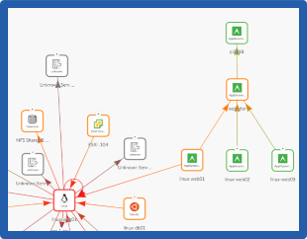
ignio AIOps, from Digitate in Santa Clara, is a solution designed to improve business agility by creating a unified view of the IT estate, connecting business functions to applications and infrastructure. This is combined with behavior profile of systems and applications that is continuously learnt using this blueprint. ignio aims to improve the transparency of complex Enterprise IT landscapes.
N/A
ScienceLogic SL1
Score 8.9 out of 10
Enterprise companies (1,001+ employees)
ScienceLogic is a system and application monitoring and performance management platform. ScienceLogic collects and aggregates data across and IT ecosystems and contextualizes it for actionable insights with the SL1 product offering.
N/A
ServiceNow IT Operations Management
Score 8.8 out of 10
N/A
Built on the Now Platform, the ServiceNow IT Operations Management bundle is designed to help users gain visibility across infrastructure and apps, maintain service health, and optimize cloud delivery and spend.
N/A
Pricing
ignio AIOps
ScienceLogic SL1
ServiceNow IT Operations Management
Editions & Modules
No answers on this topic
No answers on this topic
No answers on this topic
Offerings
Pricing Offerings
ignio AIOps
ScienceLogic SL1
ServiceNow IT Operations Management
Free Trial
No
No
No
Free/Freemium Version
No
No
No
Premium Consulting/Integration Services
No
Yes
No
Entry-level Setup Fee
No setup fee
Required
No setup fee
Additional Details
—
ScienceLogic SL1 offers four tiers:
SL1 Advanced – Application Health, Automated Troubleshooting and Remediation Workflows
SL1 Base – Infrastructure Monitoring, Topology & Event Correlation
SL1 Premium – AI/ML-driven Analytics, Low-Code Automated Workflow Authoring
SL1 Standard – Infrastructure Monitoring – with Agents, Business Services, Incident Automation, CMDB Synchronization, Behavioral Correlation
To get pricing for each tier, please contact the vendor.
From a capability perspective they stack up very similar but from a look and feel, ScienceLogic SL1 one is miles behind the curve on all three. We chose SL because we already had elements of the service in place on our infrastructure from our previous MSP so they were a …
Here are some of PROs and what ScienceLogic does better than our current system: More Visibility ScienceLogic can monitor Video Conference core devices and end-points ScienceLogic can monitor Public and Private Cloud devices ScienceLogic can monitor Applications running on …
ScienceLogic SL1 has a greater understanding and maturity on what Infrastructure monitoring needs to be and has to include at a decent price point for what it offers compared to its competitors.
It's good for issue resolution, user access request automation, standard report generation, health checks, executing self-healing as configured in the attributes. Currently not good at real-time monitoring to trigger an action. Health checks have to be on a scheduled basis.
Appropriate if you are setting up a monitoring suite in new Infrastructure Environment. Definitely NOT suited for Migration Projects. ScienceLogic SL1 cannot cater to a lot of monitoring requirements which already would have been configured in old monitoring suite. Plus, limited support for customizations and having to go to "Feature Requests" route makes in extremely complicated.
[...] is changing the way our internal support staff (not only in the IT field) work and enhancing the experience for employees seeking IT assistance through ServiceNow IT Operation Management. We have moved the usual and personalized IT tools and functions from [...] service-desk to ServiceNow IT Operations Management. These advancements have sparked innovation in various aspects of our IT support management, such as enhancing accessibility, managing incidents, optimizing IT workflows and procedures, enforcing service level agreements (SLAs), incorporating AI/ML technology, utilizing virtual agents, streamlining automation, and sharing knowledge throughout the support team via data visualization, monitoring, and reporting. In brief, our collaboration with ServiceNow IT Operations Management is enhancing the effectiveness of our internal system and benefiting our shared clients.
In platform expertise and workflows, so we don't allows have to build everything from scratch.
Tight integration within ServiceNow (especially ITSM) but also brings information and data in from other sources, so I don't feel we are stuck in a proprietary hole.
Increased investment in AIOps and automation
Relatively fast time to value with out-of-the-box capabilities and automation.
There is a lot more the desktop tool can do. For example, we need to apply an upgrade to get the tool to talk to our infrastructure while employees are working from home. The tool was initially installed with the assumption that the desktops would be in UserLand. Instead after COVID-19 the desktop/laptops have been used for over a year on people's home networks. As of right now, we have to sync when the devices are connected to VPN. Moving forward with the upgrade, we will be getting this data over TLS when they are connected to the untrusted networks.
The concept of ignio AlOps requires OCM efforts within most operational teams. This isn't necessarily the fault of the tool itself, but when implementing ignio, or any AIOps tool, the team will get a lot of pushback as an outside team is centralizing the operational improvements. The tool should have a centralized intake process that will allow the collection, ranking, and management of automation opportunities. ignio AlOps should then simulate the proposed efficiencies from implementing something within the backlog. Right now a lot of local teams are having a hard time getting on the same page as the enterprise teams, and a common methodology for prioritizing (even if overly simplistic) would go a long way to enterprise planning.
These tools are very new and things get added to them all the time. There should be a way for the product's stakeholders and process owners to understand the additional value ignio AlOps is gaining over time.
Dashboards are quite old and are of Iron age. Need to have AP2 dashboards only instead of AP1 and consistent new design across all functionalities.
Reporting is not improved since Y2020 and need to revamp completely. Need to integrate Dashboards and Reporting. PowerBI Like functionality to be given OOTB. Reports should be extracted in Excel, PDF, HTML and should be heavily automated.
Create and Open APIs for basic and advanced monitoring data extraction.
Topology based Event Correlation and Suppression should be improved drastically. Need to identify critical network interfaces based on Topology and monitor them. Basic customization of Dynamic App and/or Powerpack to exclude/include certain metrics/events to be permitted OOTB instead of customizations.
Integration with ServiceNow to be improved and to be taken to next level. Automation Powerpack should be made available OOTB as part of base product and to be priced attractively.
Take product to next level where we can monitor actual impacted IT or Business Service instead of metrics and events BSM and Topology map to be auto discovered and identify the network dependencies and alternate paths automatically instead of manual creation of BSM.
It is simply because of all the best possible autonomy solutions it is providing and getting better day by day. Using AI and Devops along with handy automation, The monitoring and Management of devices becomes much easier and the way it is growing in all the aspects is one the best reasons too. Evolution of the SL1 platform in the autonomy monitoring and management is quite appreciable.
ignio AIOps version upgrades were a heavy lift. Having to learn a new language versus an industry standard language took time. More consideration on overall internal long-term support needs to be determined.
The core functions are there. The complexity is due to the complexity of the space. The score is based on comfort (I no longer notice the legacy UI) and the promise that I see in the 8.12 Unified UI (a vast improvement). It is also based on the fact that with 8.12, you can now do everything in the new UI but you still have the legacy UI as a fallback (which should now be unnecessary for new installations)
We achieved in financial what we are aiming for, as our targets are fulfilled, we solved many issues using ServiceNow, Creation of knowledge article improved, Ticket system got customized, overall survey from the customer is 4 out of 5, customization is done without any hustle and integration was very easy.
SL is always there and online when you need to get info from it. The only times when SL was not available in our own data center, was when network links from out side of the data center was down and those links were not in our controll. Having a central database and people accessing it all over the world, may put a bit of constarin on the performance of the dashboards when reports gets generated, but that is far and few n between.
SceinceLogic SL1 architecture helps the platform to give a top-notch performance in every respect, Data collection to reporting happens very smoothly. With the new user interface pages load much faster. Individual appliances carrying the individual task ensure things are working without lag. Integration with ticketing tool(SNOW) is well managed by the ScienceLogic, no issue or much delay has been observed while interacting with an external tool.
We have built a healthy relationship with the vendor support team throughout the implementation phase, all incidents raised were resolved within the SLA without a fail
So far, it's good as part of my overall experience, except for a couple of use cases. The support team is well knowledgeable, has technical sound, and is efficient. When support escalates to engineering, the issue gets stuck and takes months to resolve.
It was good, Do the online training first and understand it and you will get the most out of the in-person training that way. This also takes you to an advanced level which is very good and the training as been overhauled once again along with new product coming in such as Zebruim / Skylar, worth going through again if it a while back that you first did this.
There are a lot of educational materials and courses on the SL1 training site (Litmos university). However the recording quality is sometimes not very good - screen resolution is low. There is a lack of professional rather than user-oriented documents and there are mistakes in documentation and education is not well structured.
I am happy with the way team has implemented and shared the product for our organization. However, would like to see it get extended to the other line of business too.
As first time developers, getting to grips with powerpack development using SNMP, Powershell and Python etc, was not helped by poor and badly organised online documentation. In many cases, we had to look at existing powerpacks and try to work out what it was doing and why - not always with much success. Even after receiving expert level training, the development of some powerpacks would not have been possible without access to the SL1 support staff.
Science logic SL1 is so user friendly and it's really easy to navigate between function. I would recommend Sciene logic SL1 to all of them who are looking for really useful monitoring tool and expecting easy way of managing it.
We wanted it integrated with ITSM and ITBM. Prioir to that we used JIRA for agile development and SysAid for ticketing. So we started with converting SysAid. We went live with Vanilla ITSM. Then we could have a basis for ITOM. However, we needed to migrated from JIRA to ITSM. Only then we felt mature enough to examine ITOM, which required quite a lot of resources. You need networking, motoring, IT and Cyber security team members in your project!!
Our deployment model is vastly different from product expectations. Our global / internal monitoring foot print is 8 production stacks in dual data centers with 50% collection capacity allocated to each data center with minimal numbers of collection groups. General Collection is our default collection group. Special Collection is for monitoring our ASA and other hardware that cannot be polled by a large number of IP addresses, so this collection group is usually 2 collectors). Because most of our stacks are in different physical data centers, we cannot use the provided HA solution. We have to use the DR solution (DRBD + CNAMEs). We routinely test power in our data centers (yearly). Because we have to use DR, we have a hand-touch to flip nodes and change the DNS CNAME half of the times when there is an outage (by design). When the outage is planned, we do this ahead of the outage so that we don't care that the Secondary has dropped away from the Primary. Hopefully, we'll be able to find a way to meet our constraints and improve our resiliency and reduce our hand-touch in future releases. For now, this works for us and our complexity. (I hear that the HA option is sweet. I just can't consume that.)