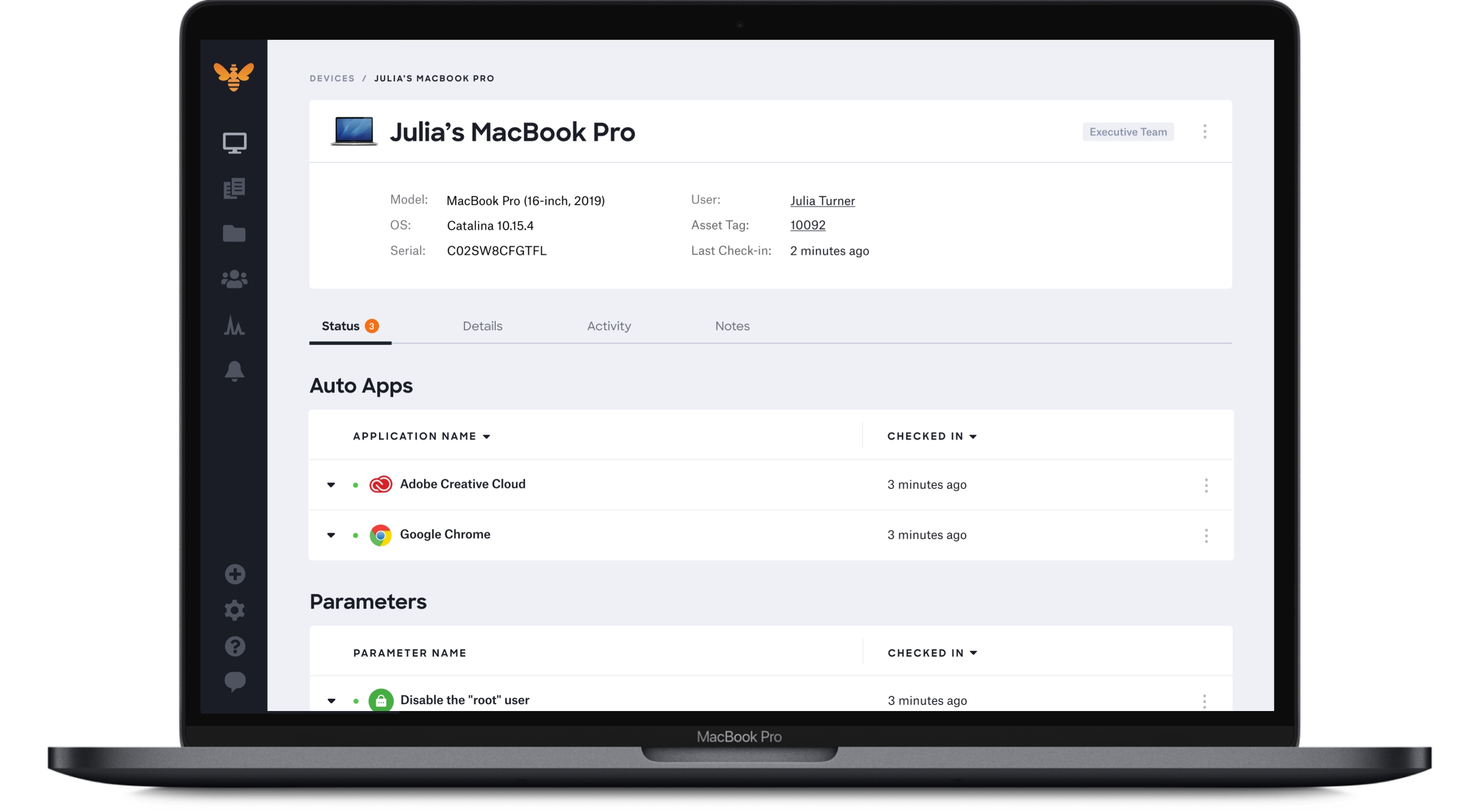
Jamf Pro (formerly Casper Suite) is designed to automate device management for users while driving end-user productivity and creativity. According to the vendor, it is the EMM tool that delights IT pros and the users they support by delivering on the promise of unified endpoint management for Apple devices.
N/A
Kandji
Score 8.4 out of 10
Mid-Size Companies (51-1,000 employees)
Kandji is an Apple device management software solution for macOS, iOS, iPadOS, and tvOS, from the company of the same name in San Diego.
N/A
ManageEngine Endpoint Central
Score 9.0 out of 10
N/A
Desktop Central from ManageEngine is a client desktop management with patching, remote control, and configuration.
$795
per year per user
Pricing
Jamf Pro
Kandji
ManageEngine Endpoint Central
Editions & Modules
No answers on this topic
No answers on this topic
No answers on this topic
Offerings
Pricing Offerings
Jamf Pro
Kandji
ManageEngine Endpoint Central
Free Trial
Yes
Yes
Yes
Free/Freemium Version
No
No
No
Premium Consulting/Integration Services
Yes
No
No
Entry-level Setup Fee
No setup fee
No setup fee
No setup fee
Additional Details
$3.33 per month per iOS device
$6.25 per month per Mac
Education and volume discounts available.
Onboarding
3-Day for Mac + iOS: $7,500
2-Day for Mac only: $6,000
4hr Remote for iOS only: $750
Billed Annually
Kandji is easier to pick up and use. Jamf Pro has a learning curve but offers more functionalities
Verified User
Employee
Chose Jamf Pro
We briefly looked at the Kandji MDM, and at the time found the product was not as mature and widely supported as Jamf Pro. This may change sometime in the future but for now Jamf is the king in the Apple MDM space. The community and training opportunities etc around Jamf Pro …
Verified User
Engineer
Chose Jamf Pro
While Kandji is impressive, it's not really parity equal to Jamf. Kandji has a lot of nice features, and the management pedagogy is very different from most other MDM solutions. However, it just doesn't quite stack up to Jamf, especially for a similar (if not more expensive) …
Jamf is apple first and apple only. The architecture of the application screams that refined polishedness you'd get from Apple. The other applications that I've had experience with are not near as polished - especially for the apple ecosystem. I'd recommend Jamf for the …
I felt Jamf was a better choice. Partly because I had used it before but also they have JamfNation which is the best way to learn and troubleshoot issues you might be having.
Kandji
Verified User
Administrator
Chose Kandji
Overall, my organization is an iOS-heavy company, and Kandji struck a good balance of user experience and good automations.
We had 3 key points in mind on our market research when selected the MDM solution. This where: Best integration across multiple OS vendors; Ease of use of the management console; Licensing model per endpoint and agents. If we were to have a Windows only environment, then …
I came into the company while the already had ManageEngine Endpoint Central. Frankly, I have attempted to switch our company to a different platform due to its confusing interface, lack of quality support when I have connected support, and lack of features then I have used in …
Most of the software packages would handle 1 aspect of what ManageEngine Endpoint Central does for us. They might do patching well or device configuration well, but ManageEngine Endpoint Central allows us to handle all of the required tasks we need for Server, Desktop, and Pi …
While some of these other Windows MDM solutions had some small improvements for something ManageEngine Endpoint Central does not have, I still find that ManageEngine Endpoint Central still has the biggest library, if you will, for functionality.
Verified User
Engineer
Chose ManageEngine Endpoint Central
Jamf was always easier to use and than our Intune and SCCM setups. ManageEngine gives us that usability across all our supported platforms instead of just Apple, enough that we are now considering retiring Jamf
Well suited for any organization that wants to manage apple products. It's extremely easy to integrate and has many connectors for existing enterprise infrastructure applications. Certificate management is a breeze. Not so suited for smaller businesses that only have 10-20 devices. Jamf has another product called JAMF Now that would suffice for those areas.
Kandji is well-suited for the following: - Onboarding remote employees (we are a remote company). Kandji offers zero-touch deployment via Apple Business Manager, making it incredibly easy to configure our Macs. -Maintaining security and compliance for Apple devices -Managing a fleet of iOS devices in the field. Where it's less appropriate: -When there is a mixed OS environment -If you have a highly custom or script-heavy environment.
ManageEngine Endpoint Central is very well suited to most kind of patches, updates, and software deployments. It's able to quickly recognize and update third-party software whenever a new security vulnerability is discovered, and it's able to do this for you automatically. The remote connection and management features allow us to begin troubleshooting immediately once a user reports an issue, regardless of whether or not they're working on-campus or from home. A ticket that might have taken a few days to close out now takes no longer than a couple minutes. If you use Mac, the remote connection feature requires the user to allow Endpoint Central through their system's Security/Privacy settings. This step can be difficult for your less tech-savvy users. You can remotely and silently access a computer's task manager, registry, and command prompt, which is incredibly useful. This saves us a ton of time on having to contact the user and schedule a meeting. The only complaints I have about these management features are that the UI is a little bare bones, and it occasionally has minor problems with responsiveness.
Jamf Pro's Self Service is a great mechanism for making software available to end uses as they need it.
Jamf Pro is also great for creating plans called PreStage Enrollments that allow for computers to skip many of the setup screens, as well as automating account creation.
Jamf Pro in combination with Apple Automated Device Enrollment (formerly DEP) allows for devices to supervised and managed, this combination allows for locking, remote wipe of devices, and finding locations of devices when put into lost mode.
We set alerts when a devices gets low on disk space. That is automatic and creates a ticket in ME SDP. We are then able to Add space to a VM Desktop, and then go thru ManageEngine Endpoint Central to extend the drives so the entire process can be done without interruption to the end user.
Using the patch scans we can easily see what patches have been installed for all manufacturers not just Microsoft, without having to physically go to the device. It also allows us to choose which patches we want to push out and automate the process so we can be hands off, freeing up out time for other things.
Remote access to devices. This allows us to remotely make changes, not just via remote control but also make registry changes and clean up space without going to the device and without interruption to the end user.
Alerts. We have set up to get email alerts when new hardware is plugged into any computers. This lets us know if someone is bringing in un-authorized equipment (thumb drives, hubs, etc) to better manage what is/is not on our network.
Finding what you need in Jamf Pro can be tough at times. The interface is not what I would call friendly.
You'll need static credentials for Jamf Pro. They don't integrate with the Jamf Account, and it doesn't offer 2FA. SSO is an option, but it's not simple to set up.
Problem after problem after problem with employees getting locked out of their laptops, (which was the whole reason we switched to Kandji - to prevent that from happening), employees ultimately having to factory reset their laptops to get back in, pop-ups that never go away, and continuous password sync issues.
The remote CLI/PowerShell interfaces should support tab completion and command history like the real-world versions
Remote control could work better
Having a standalone application, even if just a Java app or something for the remote control/remote command line versus running it out of a web browser
We stepped away and are looking at different products that integrate with our entire fleet MDM solution rather than focusing specifically on Apple products. An all in one solution fits our needs better and is more cost-effective in the long run. Jamf Pro needs to improve some features and support but overall its a good product.
ManageEngine is considered an excellent product due to its comprehensive suite of solutions for IT management, with ManageEngine Endpoint Central specifically excelling in endpoint management. The platform stands out for its user-friendly interface, robust features, and versatility in addressing diverse IT needs. It offers organizations a centralized solution for endpoint security, patch management, software deployment, and asset management
Jamf Pro has done pretty much anything we've needed with little setup headache. If we hit a wall, the Jamf user community and tech support departments both are more than willing to help solve problems. Tech support is excellent, but the surprising thing is the user base is by far the biggest resource. Jamf users love to help each other, by directly chatting about issues, posting best practices, or just posting info on the forums.
I gave it an 8/10 because overall, it offers a spotless and intuitive interface that makes routine device management easy. Features such as onboarding, app deployment, and compliance enforcement are handy, thanks to the various blueprints we can set up. The only reason I didn't give it a 10 is that it lacks some advanced configurations, and the reporting aspect is not as customizable.
I gave this rating because ManageEngine Endpoint Central is reliable, easy to use, and delivers strong value for money. It helps us save time through automation and effectively handles patching, remote support, application management, BitLocker security, and corporate data wipe. Although cloud DLP support is limited, the overall performance and stability fully justify the rating.
Jamf Support is very responsive and usually assists in any challenge we are tackling. They are also very transparent when they are allowed to be. I personally love our Jamf Pro support rep and don't fear messaging their support team.
The immediate chat support is great and very helpful. However, if you need escalated support or have a deeper need that the chat tool can't help with, you will experience significant wait times and slow responses. The time zone difference becomes painful to the point of often just giving up.
The training session was beneficial because it expanded my knowledge about Jamf products and really learn what I am capable of doing with Jamf Pro in terms of managing Apple computers and devices. Immediately after the training course, I was able to implement what I learn to our cloud instance.
Migration from an existing MDM requires device wipe and reenroll for full supervision of the device. It's somewhat painful. User enrollment makes things easier, but you miss out on full management.
It seems that the services offered with the purchase change from what is covered to what is an additional cost. Somethings I thought we had ended up requiring an additional purchase if we wanted to continue using the feature.
Even thought we are using this solutions for different purposes (macOS device management VS mobile device management), I think at the end Jamf Pro is more focused or aimed for macOS management, and mobile device management is just a good addition to that. Same I can tell about Ivanty, is more about iOS/Android management rather than macOS
With Intune, they aren’t friendly with Macs. We had to add each app individually and constantly update the packages for updates. Even when we do everything right, it still doesn’t work all the time
This works great. It is super easy to setup automated patching and the patching actually works. When using Solarwinds, we would have to regularly troubleshoot machines and figure out why they were not patching. This is not the case with ManageEngine Endpoint Central. We have seen a significant decrease in number of troubleshooting hours since moving.
Jamf Pro has allowed us to minimize the time it takes to deploy devices. We can use zero-touch deployment methodologies which allow devices to go directly to end users and allow end users to get up and running without needing IT's help.
We have implemented both a third-party & macOS patching service, which allows us to ensure all apps and versions of macOS are updated and secure.
They promised us we could add devices as needed. I even had that written in an email. However, they rescinded that promise and required us to add devices in buckets of 50. That means, since we had 55 users, we had to pay for 100 licenses.
Password issues were made much worse by using Kandji instead of our old MDM (Hexnode).
Overall, Kandji created major headaches with laptop instead of improving.
We have been able resolve and complete any requests which include things like software deployment or issues that include troubleshooting, much faster and more efficiently. This has had a sharp decrease in our response times and also time it takes to complete these requests or incidents.
The mobile device management features have allowed us to be able to have a much tighter grip on security. This means we have dramtically decreased our device vulnerabilities and risk of data breaches. This has saved us lots of time and money.
The remote features that are available have helped a lot with user's being able to work remotely and allow our organisation to sustain hybrid work. It means user's can still be as productive and IT support is as efficient no matter where the user is working.