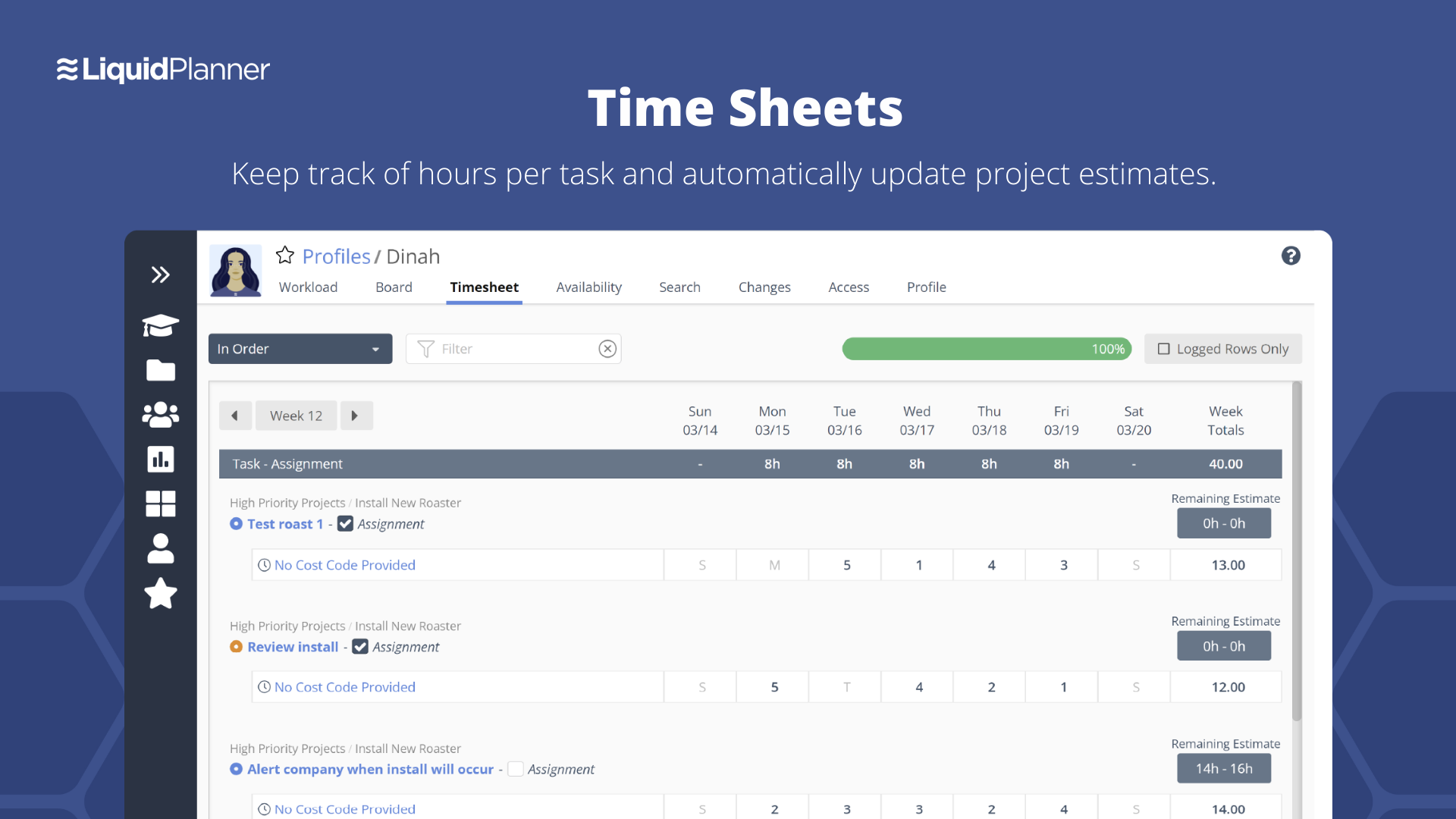
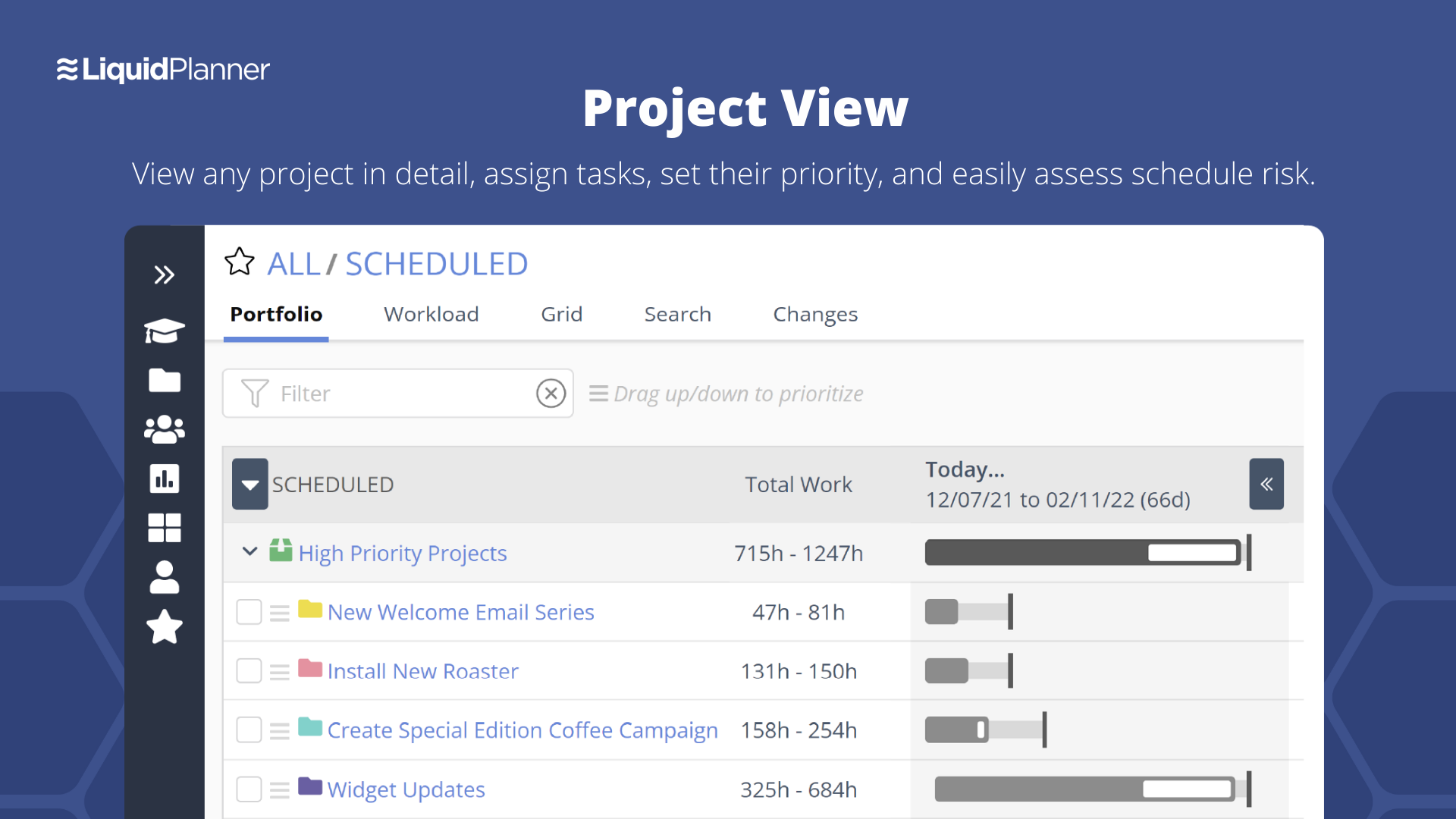
LiquidPlanner is a cloud based predictive project management solution. Some key features include: Dynamic Timeline View, Workload View, and Real-Time Activity Stream.
$0
per month per user
Microsoft Project
Score 7.9 out of 10
N/A
Microsoft Project is a project management software. It provides core PM functionality, including agile workflow support and resource management. Project can be deployed in the cloud or on-premise.
$120
per year per user
Planview Portfolios
Score 8.5 out of 10
N/A
Planview Portfolios is an end-to-end project portfolio management and enterprise architecture management tool. It includes two components: Portfolio and Resource Management and Capability and Technology Management. The platform is available as a cloud-based or on-premise service.
We ruled out Microsoft Project because of its complexity, cost, and perception that is is more of a project manager's tool rather than a collaborative solution that anyone could use. We evaluated Clarizen quite rigorously alongside LiquidPlanner, but we selected LiquidPlanner …
MS Project is more complicated to use, we needed a more simple solution that is based around collaboration, and MS Project wasn’t suitable for this and costs more.
MS Project was much more difficult to use for entering tasks. LiquidPlanner was more user-friendly. MS SharePoint was not used for Gantt charts, but really excelled in document and data sharing between different teams.
MS Project is most familiar to our users, so the learning curve is easiest. However, MS Project doesn't allow our teams to collaborate nor does it track actual vs. planned effort (time reporting). Hence it's not the only tool we use. We typically plan with MS Project and use it …
These other products are much simplified and easier to use due to not having all of the advanced features that Microsoft Project has built-in. However, they have all the necessary functionality to meet the needs if you're not trying to use all of the extra advanced features.
Microsoft Project is better suited to layout and manage project schedules. In regard to building project schedules with dependencies and resource loading, There is more flexibility and ease of use in Microsoft Project over Planview Enterprise.
MS Project Server and MS Project provided MANY more capabilities for detailed project planning than Planview. Unfortunately, I did not select Planview.
Vice President Information Technology Administration
Chose Planview Portfolios
In a mature SharePoint environment the Microsoft Project Server can be an appealing option - in prior environments I saw very easy integration between Project Server and SharePoint. Microsoft Project is a great tool for projects that are conducted in isolation, meaning they …
HP PPM and MS Project Server were past predecessors to PVE1, and both fraught with misconfiguration, lack of top-down support, and neither had effective resource management capabilities. We sort of backed-into PVE1, as we were initially entrenched with Projectplace. As luck …
Planview and Microsoft Project have many similar features. However, the direct contact with the Planview team for questions, tech support, and training is unprecedented and appreciated. Microsoft Project: -Weaknesses: Limited to single project management, lacks risk and time …
Planview Portfolios is the market leader in the area, the flexibility of the product and the continuous investment by Planview makes Planview Portfolios currently the best in the market. The support organisation for implementation and run of Planview Portfolios rounds off the …
Verified User
Manager
Chose Planview Portfolios
We are just in the process of deploying AgilePlace and will connect with Portfolios Smartsheet, which does have the functionality we need. We are just starting to use AgilePlace. We have a business group doing a proof of concept.
Planview has much more potential in terms of it's products and capabilities. It can integrate more easily with many more of our other products and software. Planview reporting is much more intuitive.
We find Planview Portfolios gives us a better platform to work with projects and with the use of Planview ProjectPlace can run our stand-ups and interact with the cards on the boards more readily.
Compared with other systems, Planview is much easier to use. It has the right balance between functionalities and configuration. It offers a good value against the cost. It offers also a cloud service that help companies to start with the right effort.
Planview is a much more robust Resource and Portfolio Management tool. It is easier to use and provides drill down visibility to address critical issues.
They don't have a resource management feature, no portfolio feature, it would have cost hundreds of thousands each year for us to have our data transferred to our data warehouse nightly in order for us to do real time reporting.
LiquidPlanner is amazing for any time of project management scenario where you have to manage several teams and details. Running a project through LiquidPlanner is so easy because it lets you break down the project into sections and folders and small tasks that you can assign to specific people. With a small to medium size team-- LiquidPlanner is amazing for organizing and tracking details. If you have a huge team or not a ton of details to track LiquidPlanner might not be right for you because it is a software that requires some good training to learn and has tons of functions that can be utilized so it seems better suited to be used by a smaller group looking to coordinate or for people who have lots of details that can be difficult to track.
Microsoft Project Online is suited to Turnkey Projects where more Collaboration is required in Project Progress monitoring, risk assessment and conveying, issue recording and tracking. It is less appropriate when ERP Suites other than MS Dynamics are used, i.e when Enterprises need to integrate Finance / Accounting with It and having straight project management workflow
Planview Portfolios is well suited to provide a single, central, view of the truth. There is clear expansion capabilities to integrate it as a true Enterprise toolset with existing organisation wide (not just delivery) - you can pick and choose what you need to implement and that list gets longer. The ability to quickly gain an understanding of resources within the overall portfolio and some really clever tools regarding capacity and demand modelling. I think the only challenge we have encountered is modelling our Business as Usual activity to a level of detail - this is due to other tools being very embedded not just in the organisation but across a lot of industries.
Priority based planning. Every other planning software we've used relies on dates and therefore needs constant attention. Priority based planning means that the plan is always up to date.
Ease of use. LiquidPlanner has a very short learning curve. This is critical to getting team members to use it.
Forecasting. LiquidPlanner makes it very easy to run scenarios by simply dragging and dropping projects and reassigning resources.
Awesome Support. I get personal responses very fast. Usually within a couple hours. And, they listen and ask for more information.
I love the Gantt Chart that Microsoft Project offers me, because it provides me with a view from various aspects, it provides me with exact details about the fulfillment of tasks over a period of time, it also allows me to make comparisons with the necessary data and the fulfilled data. by the employees, in order to know exactly if the project's expectations have been met.
I love the Gantt Chart that Microsoft Project offers me, because it provides me with a view from various aspects, it provides me with exact details about the fulfillment of tasks over a period of time, it also allows me to make comparisons with the necessary data and the fulfilled data by the employees, in order to know exactly if the project's expectations have been met.
The alert system for the fulfillment and delay of assignments is perfect. Microsoft Project allows me to configure the task system, I can assign the necessary tasks to fulfill the project, and the software alerts me immediately if the managers are fulfilling the assignments.
The interface is messy and cluttered. The best way to find things and see what you actually want to see is the main Projects view which is also the most cluttered and hardest to maneuver in.
Clicking an external link someone posted in a comment or task description doesn't open in a new window by default, so we are constantly having to go back to get to LiquidPlanner again.
The way that the interface saves your state globally (rather than per tab instance) means that if you click a link from someone else to a task that's not yours, then it adjusts your filters on the Projects page. Then if you refresh another LiquidPlanner window where you were on the Projects tab, suddenly all of its filters are updated and what you were looking at may no longer be there.
It might just be the way that we use the system, but the Home and My Work tabs are fairly useless for us. They typically don't show the tasks we're actually looking for.
We may not renew LiquidPlanner's contract, but only because my company has recently been acquired and we'll be adopting some of the software that they're using to standardize process. LiquidPlanner's development team releases new features pretty often, so it seems like the gaps and inefficiencies are slowly getting smaller/less frequent
We have been a Planview customer since 1999 and have seen it grow and mature as a tool. We have looked at other tools and have found that PV continues to meet our needs and is easy for our resources to use. They work to stay up on the project management industry and the direction it is going, keep on on current technology so that we can work more effectively, provide excellent customer support and have great pricing for what they offer. We can purchase only the modules we need versus buying a tool where we would only use a portion of the functionality.
Microsoft Project is easy to operate because data could be inserted, changed and deleted like you are in an Excel timesheet. Besides, it provides a great level of automation beween his fields allowing few data changes. Also, its funcionalities are well defined and grouped in upper menus, so you can find a funcionality quickly
Perfect tool for planning resource time management. Giving flexibility with ease in uptodate . Team collabration . Team aligment. Top management aligment. Close the project with feed back . Team aligment. Expert contribution in task . Task management easy for project manager . Nice tool to have for project manager. Cost contol & project management is very easy with Planview
We are long time Planview users and its availability is only limited to our internal SLAs for nightly backups. I have never experienced any unexpected or prolonged software downtime from Planview itself.
There are occasions when the system is a bit sluggish. However, it may not always be on the Planview side. We are investing in better tools to monitor our network performance, which will help us diagnose issues more effectively in the future.
They have been great in trying to come up with creative solutions to help us do what we want to do with the platform. I would say their support has been exceptional because we have hit them with some complex requests.
Microsoft in recent years has transformed itself and gives a positive feeling when one interacts with the company. The company is focusing on its customers and willing to go extra mile to make customers happy.The company continues to invest in its products and bringing new features from time to time. Overall it is a positive feeling to be associated with such an iconic company.
Going through proper channels of support is fine for minor to moderate issues. However, lately the critical issues that arise have been frequent and the standard support cases do not always seem to relay just how critical these issues are and we have to utilize our customer rep to help escalate. Fortunate to have that escalation method.
Always have a pre-implementation meeting or conference call with Planview to ensure all are on the same page, disclosure of all and any customization (including reports) and plan for support after implementation of a specified amount of time with the assigned implementation resource. And document everything
Miro is a more versatile tool, but not quite made for planning and organizing. LiquidPlanner is very intuitive, fast to learn and easy to communicate. The added value of prioritizing tasks, personalized boards and gantt charts are really important during the planning and design thinking in the business. LiquidPlanner is simplified yet more helpful.
While many of the above tools are extremely well-versed, Microsoft Project's largest advantage comes from it being related to the largest business productivity company in the world. Project does have its sharing limitations - but regardless, offers one of the most robust tools in the market today. Microsoft Project is built with large-scale projects in mind but is more than up to the task for smaller projects as well. However, there are options available (especially cloud-based options) that may be more fitting for higher-level projects that do not require going into the weeds.
We are currently using Planview AgilePlace. Also we use Tasktop Hub for integrating with other applications within the organization. We would like to use ProjectPlace which is integrated with Planview Portfolios in the future.
We are constantly growing and expanding. It is challenging to accommodate different user needs, but the system does provide means of doing that as we desire.
LiquidPlanner really forces you to map out your workflow. For me, honing into a template that I can later adjust as needed has been huge, as there is less time at the beginning of a project trying to assign and figure out what needs to happen when usually it never changes.
Communication between employees, especially ones not immediately available in the office has been very welcomed. It helps having conversations documented in a public, logical place that is easy to find and refer to as the project continues.
Our productivity has definitely skyrocketed as we've really gotten a feel and committed to using LiquidPlanner daily. As we move forward, we continually try to add more and more ways for us to use the service.
Project saved me, as the project manager, countless hours of digging through tickets and schedules to plan everything out. It also saved me time in adjusting the project triangle as needed, since it does so much automatically.
It is costly, and since it requires extensive training to master, it's not just the high licensing cost that you need to take into account.
The reporting features - even just printing out Gantt charts - makes it far easier to communicate with stakeholders. That means less time for PMs doing all of this manually, and it means less follow-up questions and delays moving forward.
The positive impact is the ability to manage our projects enterprise wide.
Managing and reporting on projects and programs via portfolios makes it easy to identify troubled projects/programs that need immediate attention.
The negative is that pushing too much change too quickly is hard for us. We need to get our users focused on the basics of PM before we can adopt everything else. We need to introduce change to different companies based on their maturity level. Too much change too quickly is not always beneficial. We need to focus on core competencies.