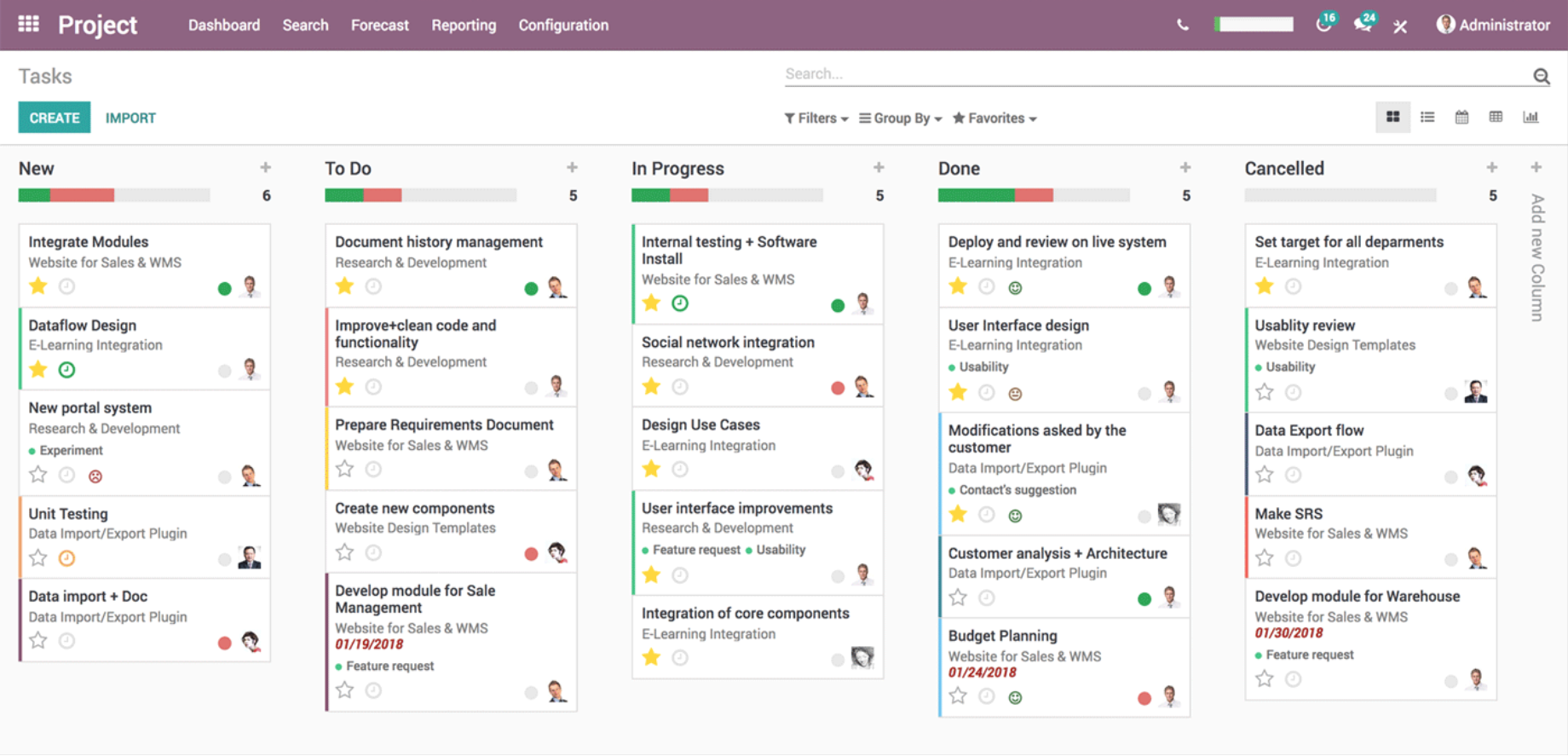
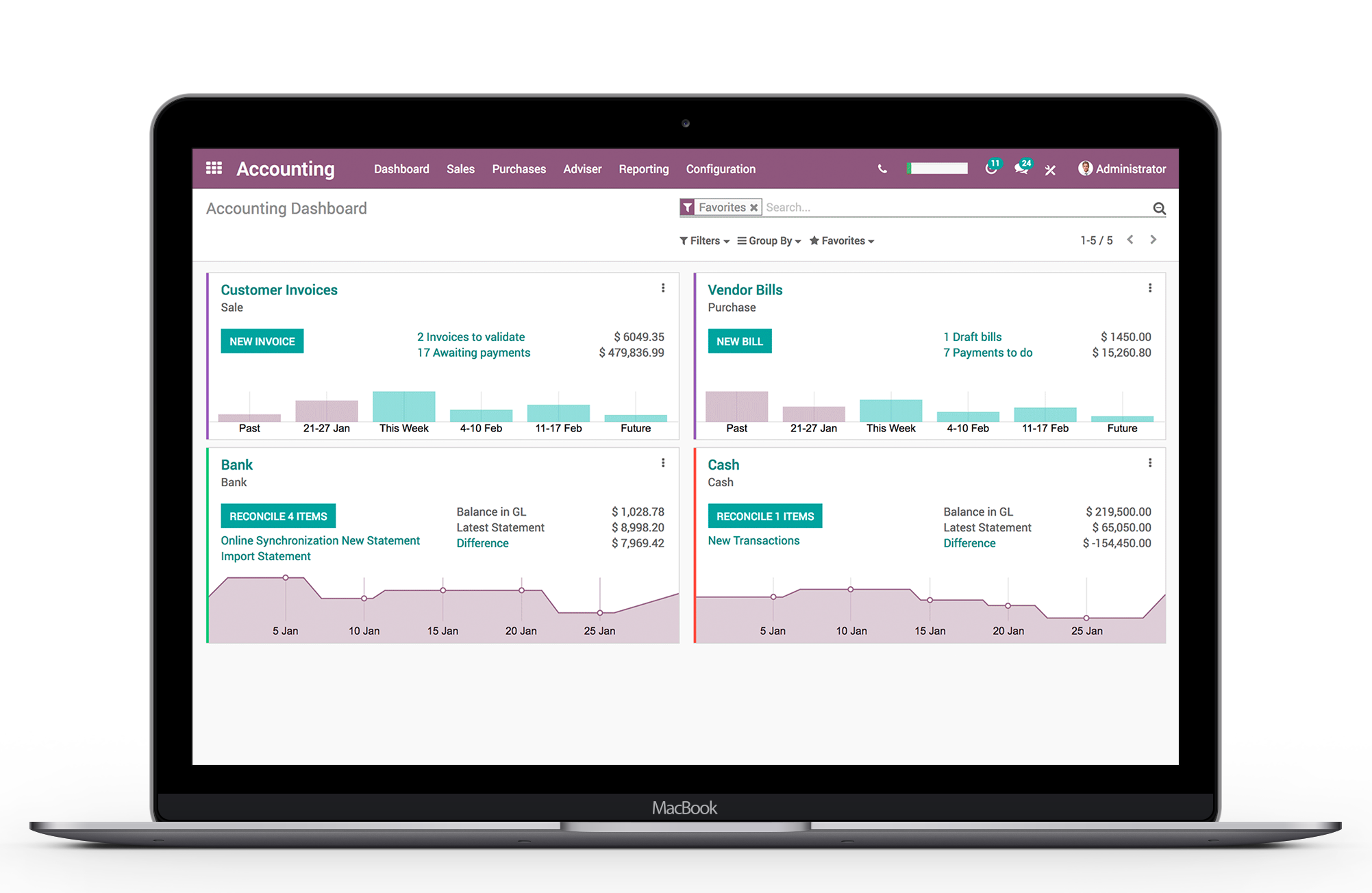
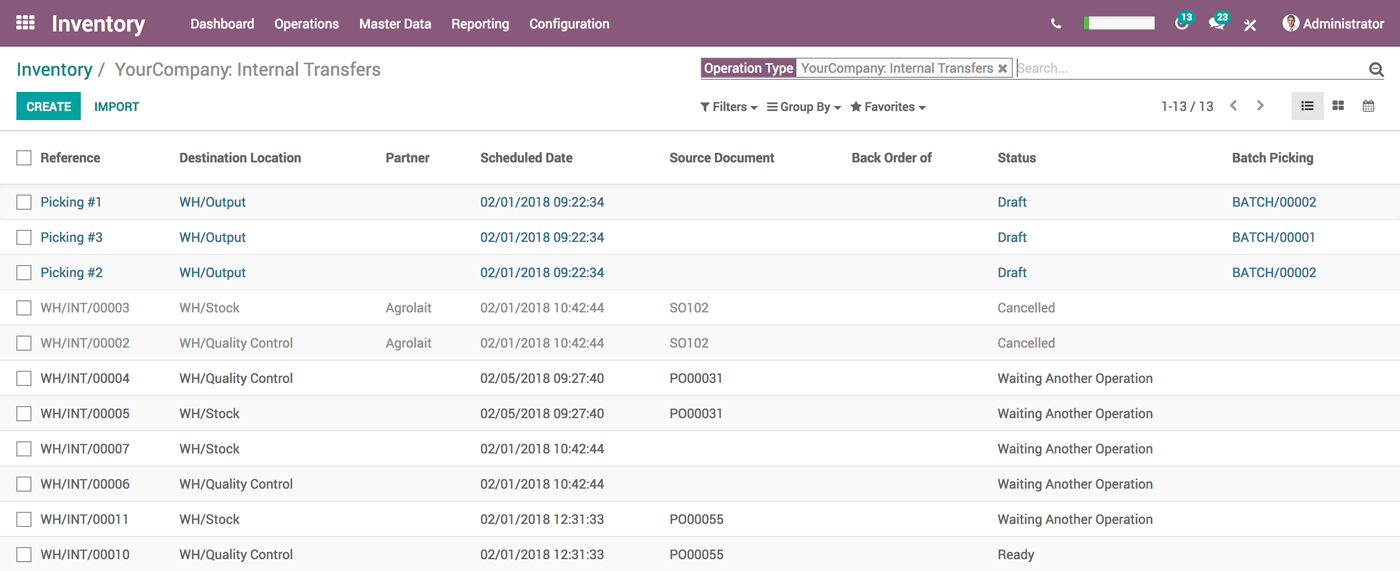
Odoo, from the Belgium-headquartered multinational company of the same name, is a suite of business applications for managing the sales pipeline. It also comprises a PoS and inventory management modules, scaling to a warehouse or retail management solution.
$31.10
per month per user
SAP Cloud ERP
Score 8.6 out of 10
N/A
SAP Cloud ERP (SAP S/4HANA Cloud) is a modular ERP that enables users to run mission-critical operations in real time from anywhere, introduce new business models in any industry, and expand globally. SAP Cloud ERP is a SaaS product and can also be deployed in a hybrid landscape for quicker time to value. SAP Cloud ERP is a foundational component of the
N/A
Workday HCM
Score 7.9 out of 10
N/A
Workday Human Capital Management is a cloud-native system offering a globally
consistent user experience. Workday HCM is part of an intelligent, unified system with other
Workday products.
N/A
Pricing
Odoo
SAP Cloud ERP
Workday Human Capital Management
Editions & Modules
Standard
$31.10
per month per user
Custom
$46.70
per month per user
No answers on this topic
No answers on this topic
Offerings
Pricing Offerings
Odoo
SAP Cloud ERP
Workday HCM
Free Trial
Yes
Yes
No
Free/Freemium Version
Yes
No
No
Premium Consulting/Integration Services
Yes
Yes
No
Entry-level Setup Fee
-$49,321,250 per app/ per user/ per month
Required
No setup fee
Additional Details
A discount is offered for new users for the first 12 months of use for the initial users purchased. ($24.90 instead of $31.10 for Standard)
What other products like SAP S/4HANA Cloud have you used or evaluated?Select from the list of products, or give insights on products your peers may not know about in the space below.Describe how SAP S/4HANA Cloud stacks up against them and why you selected SAP S/4HANA Cloud.
Oracle Cloud ePm helps in financial planning and analysis, Faster closing, and accurate reporting. It provides comprehensive financial management. It also helps with strategic planning and economic insight. Workday Financial Management has helped us manage our financial …
In our quest for an ERP solution, we evaluated alternatives such as Oracle ERP Cloud and Microsoft Dynamics 365. However, SAP S/4HANA Cloud's reputation for advanced analytics, scalability, and seamless integration with other SAP solutions made it the natural choice for our …
We were an Oracle shop before, and SAP was the clear (and only choice) that we considered. SAP was very open to our feedback and would consider making our needs part of the standard solution (where it made sense for their broader user community) for future releases. It offered …
The Central Finance module with embedded BPC and Disclosure Management suite integrated sounded like a winner. We still think Disclosure Management has room for improvement.
It is well suited for inventory tracking, shipping and sales work flows. While some customization is needed to make it functional, if done correctly Odoo can serves as a powerful one stop shop for all of a businesses needs. The ease of customization for email templates, both for sales communications and marketing outreach leaves something to be desired. Perhaps our team hasn't explored this fully enough. I have personally found it intimidating in trying to construct a news letter using the email marketing module
SAP Cloud ERP is best suited for medium- to large-sized organizations seeking scalability, real-time insights, and standardized processes. It will help them streamline financial operations & core HR functions, optimize inventory management & procurement process. Its intelligent automation will help them automate repetitive, routine tasks and use machine learning for predictive analysis.
I would say it's well suited in every environment because I think it does so much. It's like the holy grail of HRIS systems is what I like to call it because thinking about all parts of the employee lifecycle, it lives here in Workday Human Capital Management. So I love the fact that you can do the people data analytics, you can store employee records, the talent acquisition pieces there. I'm thinking I can't think of anything negative right now except for the fact that I can't drill down into the data for the people analytics side. Other than that, I think it's literally, yeah, the holy grail of HRIS systems, I love it and I would highly recommend it.
The creation of products is extremely simple, I like that it does not complicate you to put a lot of detail, of course if you want to put more detailed information later it allows you to do it without problems
The fact that I can manage my inventory of my warehouse is very convenient, I only generate my stock report of the products we have in stock and taking inventory is easier
The management of opportunities in the CRM is also great, because the guys from the sales department generate their opportunity, place what their client is requiring and we, the logisticians, can automatically generate the quote for what they are requesting, and from there they can only download their quote and send it to their clients.
The software helps in forecasting and identifying potential challenges that would affect our organisation in the near future. This enables us to prepare in advance and also adopt practical and viable measures.
It enables faster and accurate data processing, which enhances decision-making.
It's easily customizable according to specific organizational needs. This promotes overall efficiency and productivity of the organization.
Groups employees in management hierarchies and creates Org Charts that are easy to navigate and allow for visualizing management chains regardless of employee locations
Intuitive and easy to use. The Workday search functionality works very much like Google; one can search for anything that they have access to in the database and drill down into the various details. All information is connected through hyperlinks and users can easily keep digging into the details for as far as their security access would take them.
Tasks such as to do, review or approve items are sent to the user's Workday Inbox, very much resembling email. Notifications about outstanding "to do" items are also sent to each the user's work email address on a daily basis.
Customer service is nonexistent. You will need a 3rd party to assist you.
The system has an open app for integrating with other programs. These are developed by third parties and can be hit or miss in functionality.
The system offers great flexibility; however, it is too much and requires coding. For example, changing a Sales order PDF requires coding to modify the document.
Initial implementation is clunky and seems to require a 3rd party just for setup.
The cost of SAP as an ERP is quite high and the switching costs associated with ERP systems are even higher. That being said moving from one ERP to another only happens once in a great while for large organizations. Those switching costs include retraining, IT hardware requirements, outside consultants and more
It is work to make one system the source of truth for our data, but now that it is done, there is less work involved in staying on this path. This means for us that maintaining and/or implementing new modules like performance, finance, talent, etc. is simple. It's a no-brainer
Once you complete the training with Odoo, you have a great grasp of how the system works, and most every feature is intuitive- There is rarely a task within Odoo that I get frustrated trying to figure out- I can typically look through the system and find what I need to do, and if I ever do need support, the Odoo Support team is excellent
SAP Cloud ERP is a useful solution for automating and streamlining business processes. It offers modern technologies such as built-in AI, machine learning, and real-time data analytics. It offers multi-currency, multi-language support to manage international operations smoothly. It comes with a modern, role-based user interface that enhances your user experience and lets you perform tasks smoothly.
Workday's on a great path in terms of user experience. Their goals is to deliver a use experience that doesn't require training or instruction, like Amazon on the consumer side for example. That's hard to do when you're talking about complex business processes and important and sensitive employee information, but they're doing it well
In 2014, Workday has changed the update process. There will be two updates a year; the updates will be delivered to customers typically in a 24 hour window during these two weekends a year. They also keep the Community up-to-date about any planned outages, etc. There is weekly scheduled downtime on Friday night.
From my perspective, the system runs like a well oiled machine and I have not had any issues with customers complaining about speed. If a report is taking long to run, the report can run in the background and you can go about your business. For larger enterprises, there is additional space and machines to process the application in what Workday refers to it as Extended Configuration Tenant
Easy - there is NO SUPPORT (like in ABSOLUTELY NOTHING!!!!!!!). Even for legally mandatory requirements where the system MUST work, they will gladly take a month to get back to you with a NON-answer. We couldn't even get our bank statements correctly into Odoo for 2 months - leading to no reconciliation and the company accounts were a mess (still are!!) as a result - Completely irresponsible. Have not EVEN had an apology from Odoo - they couldn't care less !!
The support system I find great as whenever I run into problems they rectify them quickly as possible they never reacted late the support is just up to the mark for me. They provide many solutions to the problems I faced the [technical] team support is always amazing they [listen] to mean work accordingly.
Workday is still learning about the needs of higher education. I have seen rapid improvement in support and knowledge over the last year so am confident this will continue to improve. Overall however, I have found the Support Team to be extremely responsive and Workday offers the advantage of having support across several timezones so that we never wait more than a few hours for a response.
Some training is offered online. Cost is per-person. This also gets quite expensive. Training doesn’t follow a logical path A to B. Starts in middle. When you try to do it afterwards at your desk, difficult. • Training scenarios are not very real
I have done for report writing and mass imports (EIBs). They give materials and you run through examples, i.e. you don’t just watch them do tasks, so that is helpful. Training is expensive – a single reporting writing class is $600 per person for virtual training
SAP requires a lot of internal and external resources to complete its successful implementation. The cloud version requires a deeper understanding of the different capabilities of the local systems (hardware) and the connection towards your local IT team. We found several problems on our systems that we couldn't foresee before the implementation and roll out.
It was implemented before my joining the company. At my last company, we used Workday professional services.
Based upon my experience at my last company, I would rate the implementation experience an 8/10. There are different ways to set things up and we had different people telling us different things. It set us back a couple of times.
Regarding configuration advice, we could set things up where every manager has supervisory organizations, or have it financially based i.e. aligned to cost center/department. We chose the individual manager path and I think we should have chosen a department route. Going down the individual manager path, to maintain the information, we have to inactivate a supervisory org whenever a manager changes/leaves.
We decided to go with Odoo over Netsuite due to a few factors. Price was a big reason why, Netsuite is the most expensive ERP we vetted. I also did not have a great experience with Netsuite at my last job. I was on the roll out team and it did not work as promised for POS, inventory managing or reporting, it crashed constantly in the middle of using it. Just over all very poor. Considering it is owned by Oracle and the most expensive, you would think it would be able to function on some sort of base level. That company ended up terminating their contract with Netsuite early and going with a different company.
We don't have crashing or error issues. I can complete receives, cycle counts etc and all of my information saves. Visually, Odoo is more satisfying also.
The platform utilizes advanced predictive analytics to anticipate operational bottlenecks and put them out of commission before the problems become larger. We can proactively develop effective strategies that help keep service quality in the face of unexpected changes in the market, or external disruptions, by continuously analyzing historical performance data as well as elements of the current market
Workday is an incomplete product, by this I mean it must work alongside other products and does not work by itself. Trying to make several different products work smoothly together becomes very challenging. As compared to ADP products, when purchased all together work very well all together. Also, ADP has extensive Training programs and extensive Customer Support. So ADP's products are far superior to Workday's products in my opinion.
Workday has released Financials and is continuing to develop it's Human Capital Management footprint with the addition of Workday Recruiting. I think customers will find that is easy to add on additional functionality in the system. Workday does make it easy for customers to make changes without relying on IT resources. The Business Process framework is a visual tool that allows functional resources to make changes and see the flow of the transaction
Positive ROI, we were one of the first organizations that went with Workday HCM, and we received numerous discounts. Cloud systems are the way to go and we feel the system is stable for our growing work force.
The user conferences have been helpful to network and learn more deepness in the modules and functionality.
Right off the bat, our implementation costs were lower than budgeted and we had less 'billing' surprises.