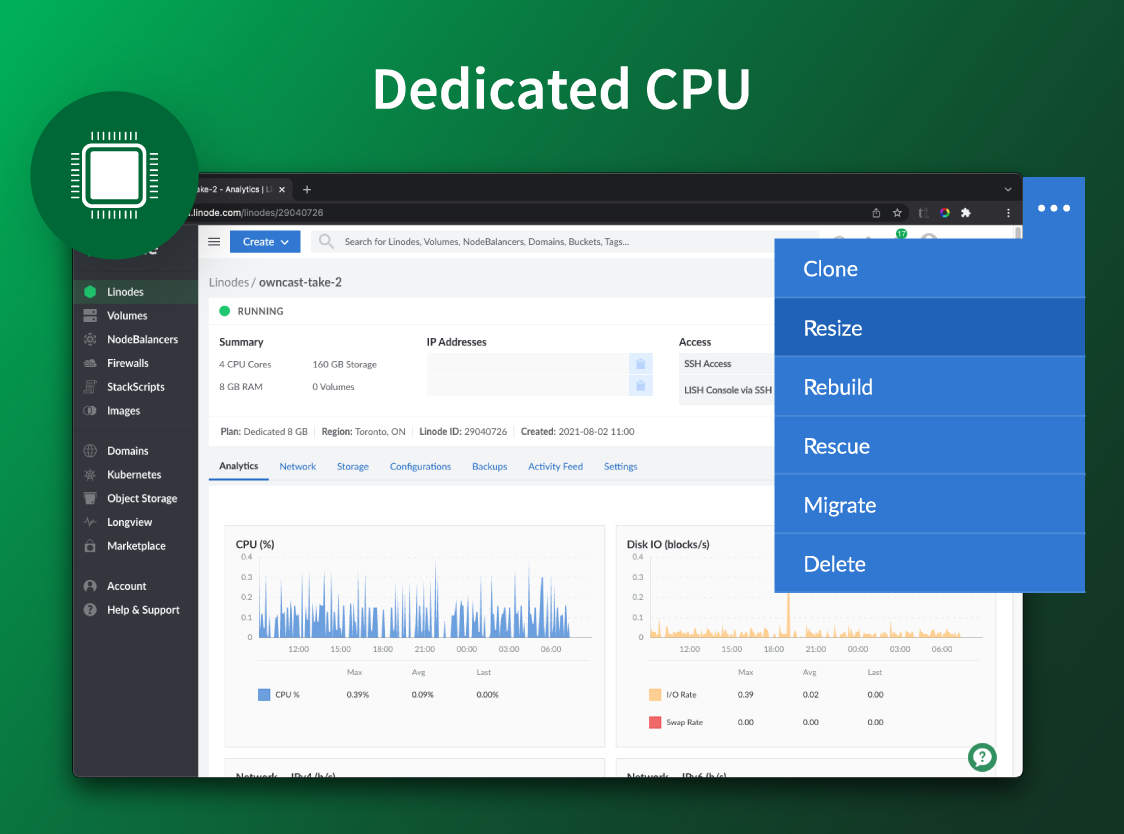
Akamai Cloud Computing (formerly Linode) include scalable and accessible Linux cloud solutions and services. These products and services support developers and enterprises as they build, deploy, secure, and scale applications.
$5
per month
DigitalOcean
Score 8.5 out of 10
N/A
DigitalOcean is an infrastructure-as-a-service (IaaS) platform from the company of the same name headquartered in New York. It is known for its support of managed Kubernetes clusters and “droplets” feature.
$5
Starting Price Per Month
Vultr
Score 8.7 out of 10
N/A
Vultr is an independent cloud computing platform on a mission to provide businesses and developers around the world with unrivaled ease of use, price-to-performance, and global reach.
$2.50
per month
Pricing
Akamai Cloud Computing
DigitalOcean
Vultr
Editions & Modules
No answers on this topic
1GB-16GB
$5.00
Starting Price Per Month
8GB-160GB
$60.00
Starting Price Per Month
Block Storage
$1
per month
Cloud Compute
$2.50
per month
Object Storage
$5
per month
Kubernetes Engine
$10
per month
Load Balancers
$10
per month
Managed Databases
$15
per month
Optimized Cloud Compute
$28
per month
Cloud GPU
$90
per month
Bare Metal
$120
per month
Offerings
Pricing Offerings
Akamai Cloud Computing
DigitalOcean
Vultr
Free Trial
Yes
No
No
Free/Freemium Version
No
No
No
Premium Consulting/Integration Services
Yes
No
No
Entry-level Setup Fee
Optional
No setup fee
No setup fee
Additional Details
CPU, transfer, storage, and RAM are bundled into one price. Storage capacity can be increased with additional Block Storage or S3-compatible Object Storage. Instant Backups can be added with complete independence to the stack. Linode NodeBalancers ensure applications are available.
—
Pricing is based on specifications chosen in each product category. Bandwidth is also included up to a certain amount per month.
I am still evaluating DigitalOcean Droplets as their pricepoint has moved more towards Linode, but so far I am leaning back towards Linode. They also don't have the GPU machines. But they do have a wider range of options for CPU. At present if you do lscpu on Linode it lists …
While SiteGround, GoDaddy, and DreamHost all offer ease of use and work OK when they're working, their performance is not consistent. All three can become very slow for even very low traffic sites. Linode, in comparison, offers much more consistent performance and any issues …
Linode has a much better range of data center locations than DigitalOcean. DigitalOcean has slightly better pricing and included backups( not extra backup fees like with Linode)
Linode's offering is almost identical to DigitalOcean's, but I find Linode's customer service better AWS, Azure and Google Cloud provide all services Linode does, but provides a much large set of other features and customizations.
Compared to the big cloud players like Amazon Web Services, Google Cloud Platform, MS Azure, Oracle Cloud, and co., Linode's product is simpler and cheaper. For quick and straightforward client engagements, the power and flexibility afforded by the previously mentioned vendors …
We evaluated DigitalOcean vs. Elastic Beanstalk before Linode, which was pretty cost intensive for deploying basic machines in the cloud for experimentation purposes. So, we had to switch to Linode for cost-effectiveness and default security mechanisms built inside Linode.
We switched to Linode from Namecheap due to poor uptime, and never had any issues with stability ever again after switching. We also cut our costs in half by switching. We compared Linode to DigitalOcean and Vultr, with the primary factor that caused us to go with Linode …
I've used a few other platforms, DigitalOcean is probably the closest, but Linode always had better backend tools aimed at geeks whereas DigitalOcean just focuses too much on blank whitespace on their control panel, while offering less functionality.
I moved to Linode for the pricing, but quality of service is pretty good. Heroku is great for novice programmers with no DevOps experience, but you pay an extra cost for it. DigitalOcean has much better docs and tutorials than Linode (BTW, these material apply for Linode as …
AWS is more expensive and less predictable. I get the feeling AWS might scale better for huge sites but cannot say for certain. DigitalOcean Droplets seems to be on a par with Linode, and cost-wise they are very similar. I've tried using Thema few times but always come …
It is more user-friendly than the big three cloud providers like AWS and GCP. The interface blows them out of the water; pricing is so much more competitive—no egregious bandwidth fees like AWS. As a small startup, cutting out the overhead of ultra-complex UI and pricing …
Information Technology Specialist, Digital Strategist
Chose Akamai Cloud Computing
There are a lot of very good cloud operations. Linode, for us represents a good offering. It offers a simple way to control infrastructure, without being overly simplified. For us, it was a good median giving us the flexibility to explore, experiment and still build for scale. …
Linode's price for performance is unmatched. The scalability and customizability of their offerings is likewise superlative. Uptime is great and they have servers in all of the places we need them. Security is on par with the rest. Their web interface is useful. Their …
Linode ultimately has better value for money. Not as many features/services as AWS but they do cloud computing very well. Managed databases are something we’d like to see and it’s on Linode’s roadmap. AWS nickels and dimes you for everything. We’ve also considered UpCloud, …
Most of my knowledge of competing products is secondhand. Linode has never given me much reason to look elsewhere—they’ve been so competitive on price and performance. The main competitor has been on-premises or collocated servers, but those are obviously completely different …
The thing that caught my eye was the price to start with. I move to Digital Ocean because they had better options for virtual network isolation, but I came back as soon as Linode fixed the issue. There support is great and things just work.
Linode delivers higher performance cloud servers, within an easier web interface, simpler API, and better cost-benefit. Amazon has a complex interface that many times make the customers spend much more time in order to finish simple tasks and use "AWS-terms" so even if you need …
I've tried all of Digital Ocean, AWS EC2 and AWS Lightsail - I found Linode to give the best price/performance for a VPS. However, compared to serverless functions like AWS Lambda, there's a lot of maintenance work if you want to keep your VPS up-to-date. If you're looking for …
DO doesn't take debit card, only credit card. Not good for many people because taking a credit card in many countries has certain legal requirements that many people don't have. Plus their OS-Image storage costs money. Vultr doesn't offer resizing. Moreover, if you have a …
I just like the Vultr environment. DigitalOcean, for example, has many restrictions about the configuration of 25 ports (email server) and this is really bad for my business. Linode has had security issues in the past, someone has stolen data from one user on their platform. I …
Verified User
Employee
Chose Vultr
AWS and Google Cloud are great platforms, but the price is complex and their VMs are rather expensive for what they are. I believe these services may be better for more mission critical servers or taking advantage of being able to use their cloud servers rather than just run a …
Digital ocean is not an option. I find digital ocean's platform to feel better polished (even if it is not actually). while Vultr has a lot of promise, and definitely delivers, it still feels like an upstart where digital ocean feels more established. this was fine for a while, …
Vultr has a greater offering of servers whilst staying reasonably priced compared to some of the larger infrastructure providers. They may not have all the services as some of the other providers but they don't need it when they can do what they do with the services they provide.
Vultr has better support and competitive pricing. The network is solid and globally deployed. IP reputation is clean, and security is tight. Ease of use and documentation is really good. User experience has been the best I ever experienced. Low stress, reliable …
From the perspective of the above, Vultr provides the best balance of cost vs. performance for us. Cloudways stacks a large fee for each VPS you spin up, and this quickly escalates. Linode comes closest (at least when I used it a few years ago) to Vultr, and 3 years ago this …
Verified User
C-Level Executive
Chose Vultr
Linode: Similar pricing, changed our business over to Vultr to save credit card fees by using Crypto. Digital Ocean: Fast and reliable, same pricing didn't stay because the payment methods (Similar case to Linode) Hetzner: Good pricing, good reputation, limited locations.
The Linode data center in Dallas is absolute trash. Nothing but constant issues. I moved a server to Vultr Dallas and it was 1000% better. Digital Ocean is OK, but I'm baked into Vultr for quite some times. Re-architecting would be cost-prohibitive.
Linode is a more old-school offering. Linode pricing model and infrastructure rely on classic Virtual Machines. What we like about Vultr is that they offer the same at the front, but in the back, the machines are much more flexible and can be tailor-made to our needs, which of …
In its price range I would say Vultr is above the competition, while the "premium" providers are too expensive and don't bring significant improvement.
Verified User
General Manager
Chose Vultr
OVH is cheaper overall, but Vultr is more reliable. Especially with support. Even when I have issues that sometimes shouldn't be covered by Vultr they point me in the right direction so I can get things moving. Not that it happens often. I've probably contacted Vultr a total …
Vultr started out primarily as a VM-only provider, but has since expanded offerings and locations to be a serious alternative for a lot of businesses currently using a large, expensive cloud provider. Vultr may not be for everyone or every workload, but there are many …
Features
Akamai Cloud Computing
DigitalOcean
Vultr
Infrastructure-as-a-Service (IaaS)
Comparison of Infrastructure-as-a-Service (IaaS) features of Product A and Product B
Akamai Connected Cloud Linode would be a good service to host a content delivery network (CDN) because of its edge network but I'd prefer not to use Akamai Connected Cloud Linode for tasks that need GPU power such as Machine Learning or Artificial Intelligence (AI) because Akamai Connected Cloud Linode lacks deep GPU compute compared to AWS or Google Cloud or Microsoft Azure
DigitalOcean is perfect for hosting client websites, running marketing tools, and managing media storage with Spaces and CDN. The use of Droplets to quickly launch landing pages or WordPress sites for campaigns is a Godsend. It’s great for fast, cheap, and scalable solutions. But for complex microservices or projects needing strict compliance (like HIPAA), DigitalOcean may not always be the best fit, but that depends heavily on your project.
I've been with Vultr over 5 years hosting multiple businesses and email related services. I never experienced a significant outage or data loss. Migration has always been successful as well. Support is top tier and IP reputation is clean. I like the choices of OS, ease of platform use and multiple hosting/ region options.
Some products/services available on other Cloud providers aren't available, but they seem to be catching up as they add new products like Managed SQL DBs.
While they have FreeBSD droplets (VMs), support for *BSD OSs is limited. I.e. the new monitoring agent only works on Linux.
There are no regions available on South America.
They don't seem to offer enterprise-level products, even basic ones as Windows Server, MS SQL Server, Oracle products, etc.
I've been with them a long time. They provide me with the capabilities I need coupled with knowledgeable support that's not pay-for-extra. However, if I move to a non-Linux OS, the level of support by necessity will drop off. I can still ask questions about the infrastructure but I my ability to ask about OS features will decrease.
Just a great product with no bells and whistles, which is the advantage. We spend very little time learning and using Vultr and more time using the systems we have in Vultr to complete our tasks. Not having to worry about the IT overhead is huge and saves a great deal of time
Simple and clear, no BS interface. From a design perspective it's no Apple or Stripe, but it does what it needs without making me want to stick a fork in my eyes, like when being forced to use Azure, AWS or GCP.
I honestly can't think of an easier way to set up and maintain your own server. Being able to set up a server in minutes and have fully control is awesome. The UX is incredibly intuitive for first-time users as well so there's no reason to be intimidated when it comes to giving DigitalOcean a shot.
easy to use and configure. great bang for the buck. I need an affordable solution to host in the cloud data from systems installed at our client's site with the ability to drill down and change the configuration remotely. Vultr enabled us to do that in an efficient and affordable way.
There is very little planned downtime. Whenever planned downtime is necessary I'm always given lots of advanced notice and an explanation that I can pass along to my users that they'll understand. I really appreciate that Linode appreciates my commitment to reliable service to my users. It shows that they believe they've been successful when I'm successful.
Servers are well dimensioned and price performant. Of course one always wants more, so if they were to upgrade their hardware for the same price I'd consider moving more workloads. Networking - never had an issue. Hardware speeds - disks are fast and can grow to great size.
Support was excellent and fast. The documentation is extensive and helpful. I learned many things from their online documentation. I did not contact them by phone, but email took a day or less. Complex problems would probably need a service contract. I liked the friendly and polite tone of the support.
They have always been fast, and the process has been straight-forward. I haven't had to use it enough to be frustrated with it, to be honest, and when I have an issue they fix it. As with all support, I wish it felt more human, but they are doing aces.
Vultr makes it easy to contact technical support. The techs are very competent. In a number of occasions they have bounced the responsibility back to me when they could have saved us all time and heartache by simply implementing the solution directly
We got kick started with an initial walkthrough along with some free credits. The initial walkthrough helped us to understand Linode's ecosystem and start our hands on with Linode. We tried out some apps from Marketplace initially with the free credits, which not only helped us understand Linode better, but also those apps. We had implemented many such apps to our customers with Linode
We're a small organization. The implementation of our Linode solution was trivial. Once I justified a cloud server to my bosses over a co-location -- the co-lo wasn't as fast as our linode server in load tests -- it was a matter of moving one Linux implementation to another. Trivial.
Vultr implementation seemed based on open-source tools and basic cloud principles - some things were more complicated to do compared with more developed cloud providers, but on the other hand it was more extensible by open-source tools.
We switched to Linode from Namecheap due to poor uptime, and never had any issues with stability ever again after switching. We also cut our costs in half by switching. We compared Linode to DigitalOcean and Vultr, with the primary factor that caused us to go with Linode initially being their documentation. After using Linode for 3 years, their amazing support is another reason why we wouldn't consider anyone else at this point.
DigitalOcean is an inexpensive product as compared to other products available in the market. The UI is easy and the beginner can also understand the UI with the step by step guide. It provides a lot of custom features and the user needs to pay only for what they are using. Amazon has a complex UI and is on the expensive side. DigitalOcean is simple to use and is easily manageable and the servers can easily be set up without additional cost and such.
Linode is a more old-school offering. Linode pricing model and infrastructure rely on classic Virtual Machines. What we like about Vultr is that they offer the same at the front, but in the back, the machines are much more flexible and can be tailor-made to our needs, which of course also impacts the costs of running the infrastructure.
Although I use only a fraction of their product offerings, the total set makes scalability an easy goal to shoot for. As I said, I have a few customers that use the services my Linode provides...and I like it that way. However, should I need to scale up, I can...without incurring any more cost than I need to.
Positive - Elastic computer instances make it possible to pay for only for what you need.
Positive - Competitive pricing - some of the products that DigitalOcean offers are much cheaper than those offered by competitors.
Negative - Having to go to other cloud computing platforms for more specific, advanced services like Computer Vision optimized services, GPU cloud compute instances, etc...