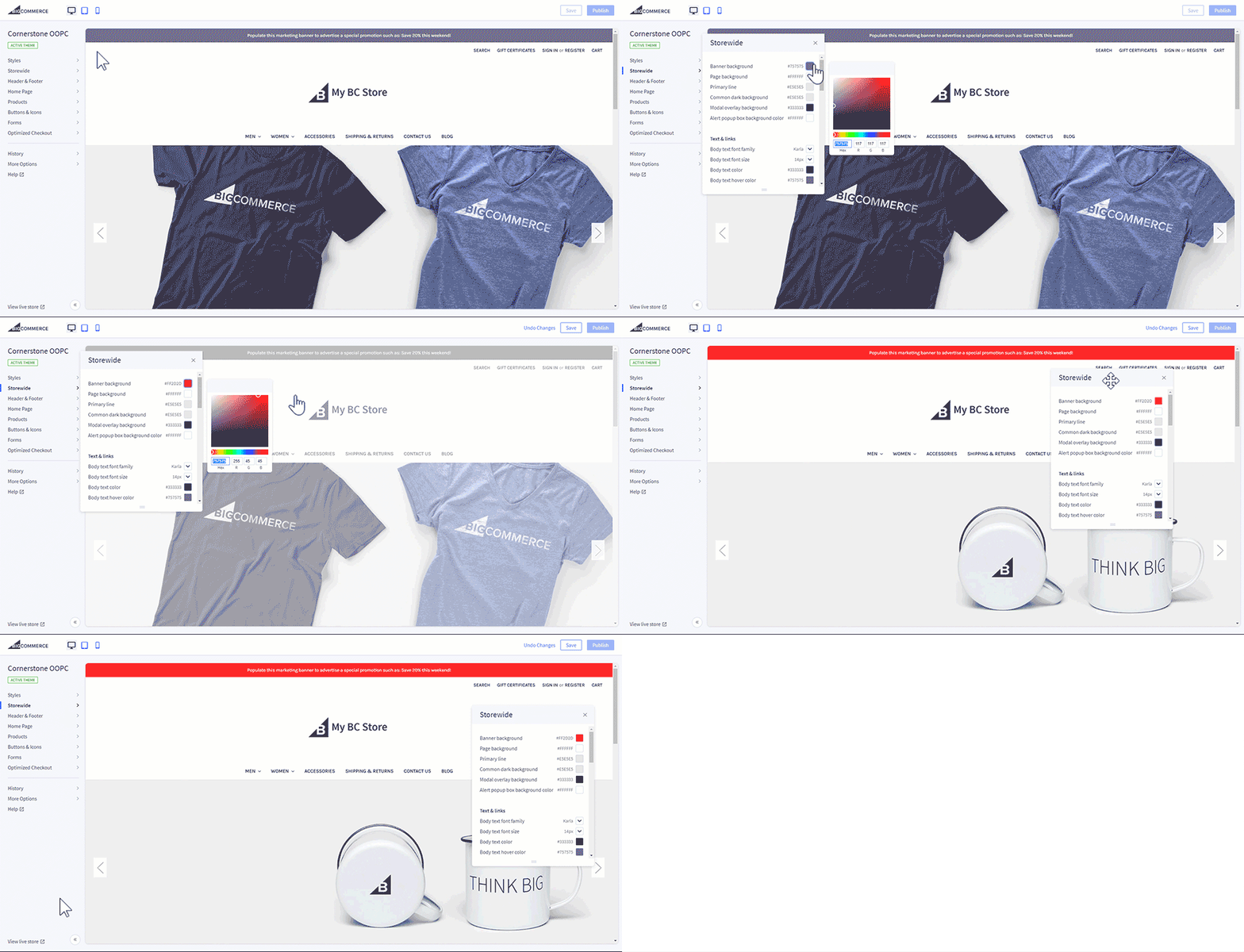
BigCommerce is a SaaS platform that allows SMBs to develop eCommerce sites. Features include the capabilities to design the storefront, configure products, manage payments, generate traffic, and optimize conversion.
$39
per month
PrestaShop
Score 7.8 out of 10
N/A
PrestaShop is a free, open source e-commerce solution available under the Open Software License and officially launched in August 2007. The software is written in PHP and based on the Smarty template engine and is currently used by 165,000 shops worldwide. The PrestaShop group was founded in Paris, with a second Headquarters opened in Miami in 2011. PrestaShop is translated into 63 languages, with English, French, Portuguese, German, Spanish, Italian, Dutch, Polish and Russian having full…
$24
per month
Salesforce Experience Cloud
Score 8.2 out of 10
N/A
Salesforce Marketing Cloud Engagement (formerly Salesforce Experience Cloud or Salesforce Community Cloud) is an online forum powered by Salesforce that enables businesses to connect with their employees, customers, partner organizations, and prospects. Designed to help facilitate communication and information sharing, customers can ask questions and request help, administrators can integrate data from third-party apps, and employees can collaborate across projects and…
We started our online quest with PrestaShop many years ago. As a small startup then, Free had an amazing sound to it. It served its useful purpose but was held together with bubblegum and duct tape. The included functionality was always buggy and we needed to pay a coder to …
With BigCommerce you have great support (not with the open-source alternatives) without the high order fee that comes with Shopify. You also never have to worry about server settings or up-time. And you still have a lot of freedom with the design and functionality.
Interestingly, this choice was made by a member of our Accounting Department after thorough research, who was computer savvy but not at all a developer. I took over wielding the platform to our needs just as I became part of the company, but I'm a developer so many things were …
I've also used Ultracart, Wix, and Square for shopping sites. Amoung the hosted platforms it's hands down my favorite. It's most similar to Shopify except that Bigcommerce has more native features, which is a good thing. With more native features there is less dependence from …
It's a no-brainer for e-commerce stores. BigCommerce and Magento both far out-distanced PrestaShop in every major category. If you're just getting into e-commerce, I would highly recommend either BigCommerce or Magento. Their online documentation and support far outweigh any …
In the past I have used Magento, which is a very popular platform, but personally it didn't sit well with me because of the complexity of the back-end and how inconvenient it was for developers. Shopify is more for a quick setup and hands-off approach. It's good for those who …
BigCommerce is really well suited for someone who wants to get selling quickly, but may not have endless developer experience, or even web design experience for that matter. Their templates, even the free ones, are very attractive and supported by tons of third party apps. I think the only times it is not a slam dunk recommendation would be if someone is dead set on using another solution like Shopify, or if they are not looking for an ecommerce site and more of a flat website, this would be overkill.
This is a great system for small and medium businesses dealing from 1 product to 100,000 products. It is elegant to use and very stable. The system may not be great for converting into a marketplace and the handling of > 1million products. The system is also not suitable for services selling like events, registrations, subscriptions and ticket bookings etc.
For well-suited, this product is great for your external clientele groups that you would not necessarily want to have a high user fee rate for. So basically general public or a group that will be authorized to come in and just do a few things here and there, but you don't necessarily want them access to all of your systems and your data points for groups that it would not be a great use for. I'd say probably your high level internal staff, they're going to be using a lot of the backend functionality automations, evaluating data, managing data, and doing custom inputs. That's just not what's intended for.
The PayPal button modality was integrated with the PrestaShop system, which helped our clients to complete payments digitally in just a few seconds, this integrated button allowed to streamline many transactions.
Performing inventory reviews and modifying the PrestaShop catalog was one of the things that I liked the most, I could make changes to the catalog, make changes to the conditions of the products in the catalog and all those changes were reflected on my website in a instant, no need to wait some time.
The PrestaShop system created a digital invoice for each client who made the advance payment of a property, which made it even easier to complete the property negotiation. Customers came to our company with the digital invoice for the advance payment and it was easy to identify the property that was paid, thanks to the digital invoice.
Easy to use, just like Salesforce's other products. Many users can sit down and figure it out in no time, and with a little training become power users.
Fast and secure - Salesforce is a leader in the cloud world so you get consistently fast results and security that is top notch in the industry.
Accessible from anywhere - if you use cloud CMS already this is a no-brainer, but for those that do in-house CMS still, this is a major difference. Mobile access from anywhere on the planet without a VPN is something you just can't do without the cloud.
In my experience, customer support FAILS terribly in knowledge of getting a BC site live
In my experience, the back side/ dashboard is very archaic compared to Volusion, will add hours of work to your week.
In my experience, pretty much anything you NEED is done with an "app" at additional cost. I think we have a few hundred dollars in apps already on top of cost of BigCommerce.
I feel coming from Volusion to BigCommerce was so depressing but we do feel secure that the company will remain in business. We are looking for something else already.
Unlike other CMS platforms like Wordpress and Adobe Experience Manager, Salesforce does not provide a fully featured editor with a drag-and-drop design tool.
Our content creators and marketing team often struggle with permissions and how to distribute content across different experience cloud sites.
Also, there is no side-to-side comparison view for content editors to update the content easily.
I personally would not even consider another e-commerce website platform.
Bigcommerce may have the same (or close to the same) functionality and integrations as other SaaS platforms but they excel at customer service and tech support. At the end of the day you need a company that will answer the phone in less than a minute especially if you're having a 5 alarm issue. That said, we hardly ever have any issues. The site was down for a few minutes one time 5 years ago. Sometimes we have issues with coding or apps and they help me with that too. They even walked me through installing our new theme when the contracted developers told me that wasn't included in the development of our new website.
Bigcommerce comes out with new innovations every year, not including apps that other people write for the platform, and there are a lot of those and new ones all the time. And there are a LOT of awesome themes to choose from (Halothemes are the best).
And the price is reasonable!
I'd give Bigcommerce my business any time and recommend them to anyone looking to run an e-commerce website. You could even use them for a non-shopping site, we have one of those too!
I think that overall it has a great front end for the customer. On the back end, it takes a little spin-up time, but in just a couple of hours you can really have your head wrapped around everything you're going to need 99% of the time. It takes me about 5 minutes to train a new user on how to interact with customer orders.
Strengths: - Intuitive for Salesforce Users – If you’re already working within the Salesforce ecosystem, the Salesforce CMS is easy to navigate, with a clean UI, drag-and-drop content management, and reusable assets for quick updates. - Seamless Integration – Since it connects natively with Experience Cloud, Marketing Cloud, and CRM, it allows for efficient multi-channel content distribution without needing extra third-party tools. - AI-Powered Personalization – The ability to deliver dynamic content based on user profiles and engagement data is a huge plus, making content delivery more relevant and impactful. Challenges: - Learning Curve for New Users – If you're not already familiar with Salesforce, the interface can feel overwhelming, requiring training to fully leverage all features. - Limited Customization & Workflow Automation – While it works well for structured content, advanced approval workflows and deep editorial customization are limited compared to enterprise CMS platforms like Adobe Experience Manager. - Media & Design Limitations – Salesforce CMS is not as robust for managing rich media-heavy content, which can be frustrating for teams needing more flexibility in multimedia presentation.
So far in my time with BigCommerce I have not had any down time when it comes to my webstore or accessing it at any time I need to. Knowing that they have such a good uptime, it makes me feel comfortable that my customers can access things anytime, but also keep sales going 24/7
I have not had any issues with pages loading slow or any real other issues, not that I have encountered so far. Speed of the site and images loading are fantastic and everything just seems to work nicely, which may seem like a simple thing to say about things, but when something just WORKS! Its rather nice vs fighting with things to work right.
Again, since we provide and recommend solutions, I can't speak to every client's individual experience, but can offer general reflections as to keep their collaborations private, that they are satisfied with the experience. We hear a lot about how this system helps to encourage collaborations between their own business partners, customers, and internal members, and enables quality integrations with other products that help drive revenue.
Because they are always there no matter how simple or complex the question is, if they don't know the answer they don't fake it and just make you go away feeling frustrated.. they get you to someone that does know the answer. I always appreciate their help and their honesty!
Since we use PrestaShop OpenSource there is only community support. What we found is that many other users fight with the same problems and there seems no solution or input from the PrestaShop developers' side.
Although support from Salesforce itself can be quite unresponsive sometimes, the community hub is incredibly helpful. The large user base of Salesforce products contribute to troubleshooting and the forums are a powerful tool for finding solutions and possible bugs and response times can be quite fast compared to your regular support channels.
They have a comprehensive online help file system that makes it easy to do almost anything. They cover just about everything you'd want to do with your online store with images, clear descriptions and in some cases video. I will, however, say the videos should be a little more professorially done and not sound like the employees are doing it in their cubical.
A certified BigCommerce design and solution partner will usually comprise a team of highly experienced designers, developers and marketers. It is our view that in the vast majority of cases, this will pay dividends in the long-term - especially for those teams that could use the extra support.
BigCommerce even with add-ons such as a PIM and B2B functionality wins for small businesses on affordability and ease of use. No servers or updates to worry about and no expensive agencies to pay. This being said, if the budget were no issue, for larger organisations Magento is perhaps a better option.
It's a no-brainer for e-commerce stores. BigCommerce and Magento both far out-distanced PrestaShop in every major category. If you're just getting into e-commerce, I would highly recommend either BigCommerce or Magento. Their online documentation and support far outweigh any advantages you'd have over going with an open source software like PrestaShop.
Salesforce Experience Cloud was selected due to its tight integration with our existing Salesforce CRM platform. Customization of the portal was much, much simpler compared to Sharepoint - especially with role-based security parameters that are ultimately inherited based on attributes within the Salesforce CRM platform. Salesforce Experience Cloud was a natural fit for this customer-facing purpose.
I believe after seeing all of the parts of this platform, one is able to develop the business and keep adding on select features for the business. There are multiple options for purchase with the various platforms once the business grows more. The different features being offered by the platform can lead us to scalability.
Provides a robust platform to sell a high-risk product.
Page Builder saves you time and money by negating the need to buy a template.
Includes robust promotion settings that allow for codes and automatic discounts, bulk discounts, and customer groups (i.e. military discount), all native options.
It slowed down our Hosting service. Our website took a long time to fully load on our clients' devices due to the high consumption of the integration with the PrestaShop service.
It provided us with a fast billing service, where our clients obtained invoices in PDF mode for the electronic payments they made for the properties. These digital invoices helped us to recognize the property they wanted faster and streamlined the negotiation process.
The templates that had an optimized design, were too expensive, this caused that our catalog design was very simple and did not capture the interest of customers.