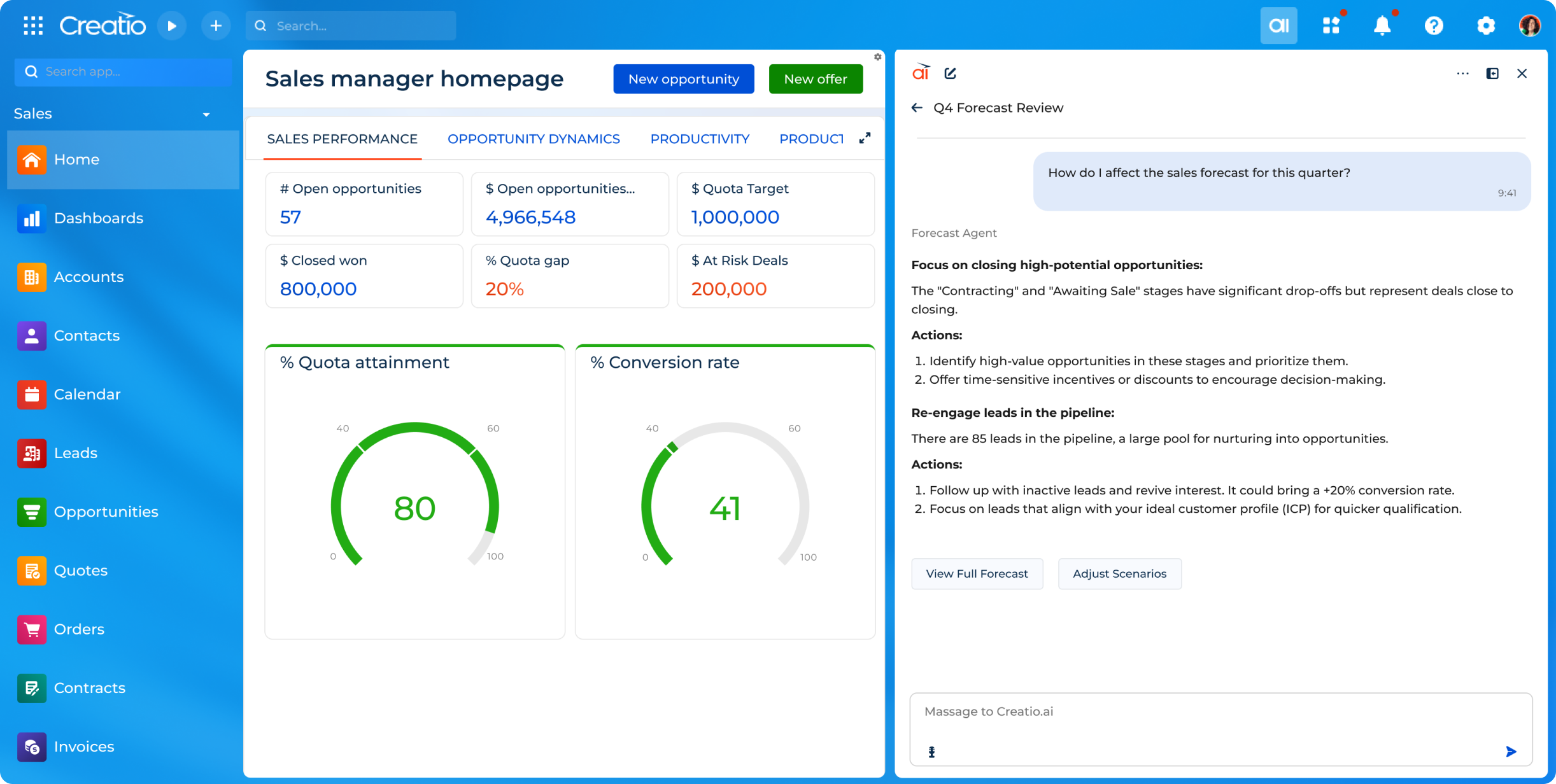
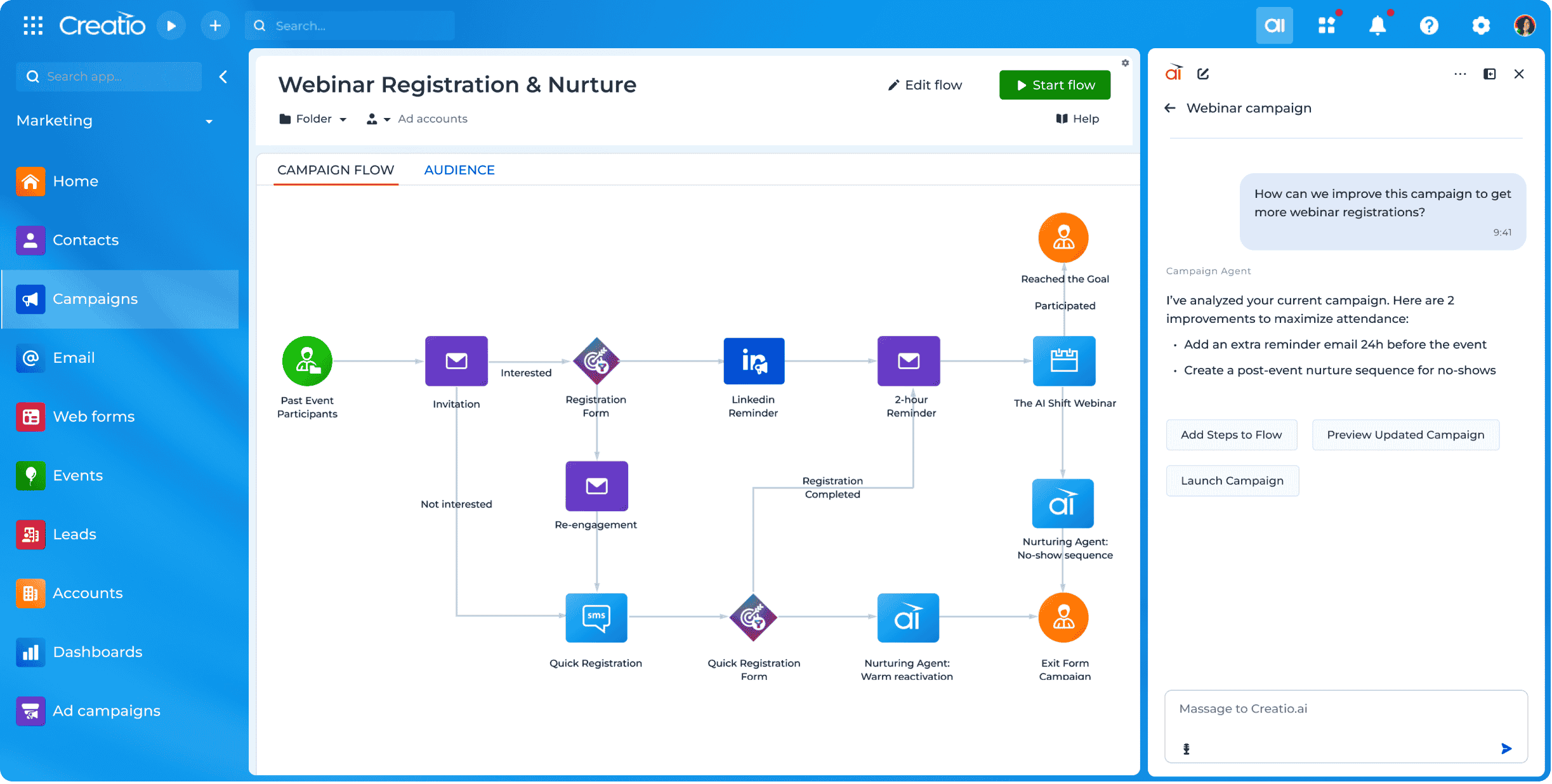
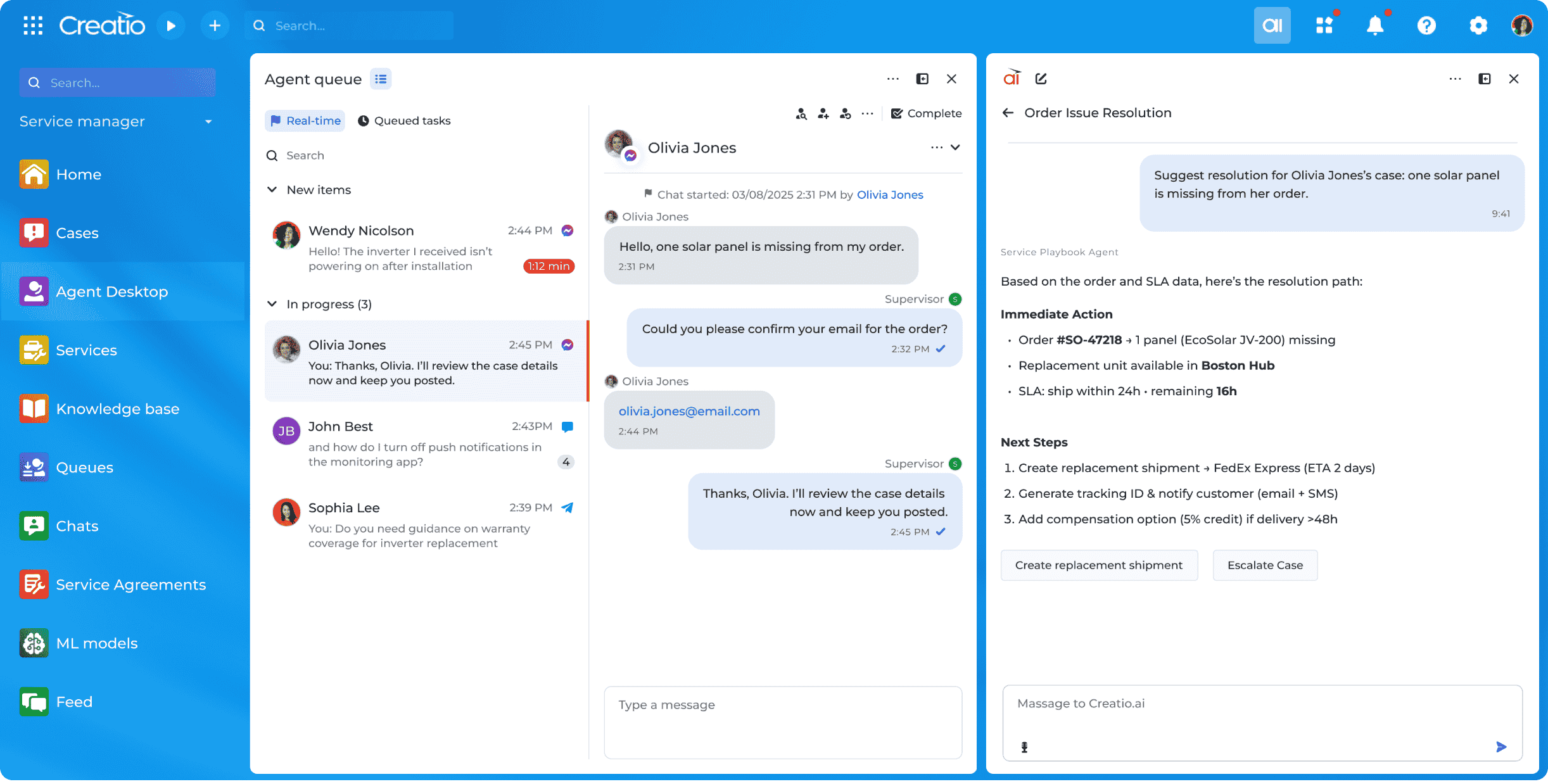
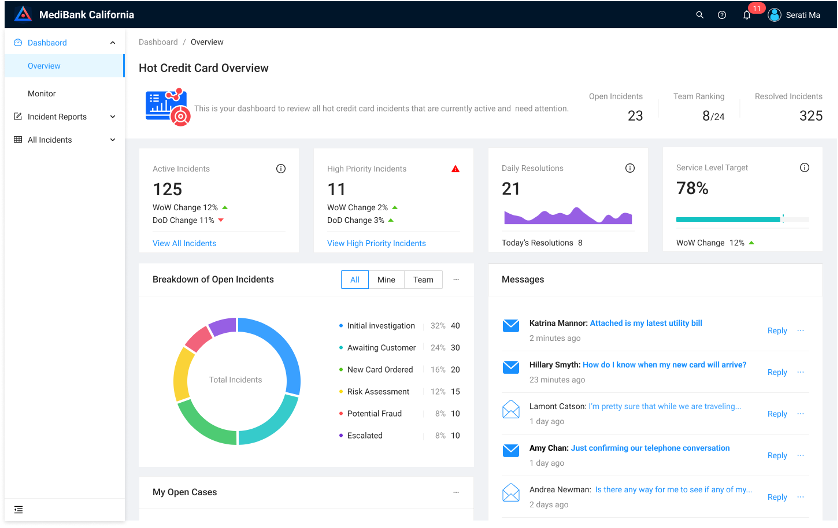
Creatio offers an agentic CRM and workflow platform. Its offerings include Creatio Studio, a no-code agentic platform to build applications and AI agents with natural language and visual designers, and a CRM suite with embedded AI agents across Creatio Marketing, Sales, and Service. The platform also includes industry workflows across 19 verticals and a range of marketplace add-ons. Creatio products can be purchased separately or as a unified CRM solution to…
$10,000
per year (minimum price for new users)
Nintex
Score 8.0 out of 10
N/A
Nintex offers a platform that helps companies discover, automate, and optimize business processes.
$480
Minimum 1,000 users per user
Agentforce Sales
Score 8.7 out of 10
N/A
Salesforce' Agentforce Sales (formerly Salesforce Sales Cloud) is the company's flagship CRM platform. The AI CRM for Sales features data built right in.
$25
per month
Pricing
Creatio
Nintex
Salesforce Agentforce Sales
Editions & Modules
Growth
$25
per month per user
Enterprise
$55
per month per user
Unlimited
$85
per month per user
Enterprise - Process Platform
$480
Minimum 1,000 users per user
Starter
$25.00
per month per user
Professional
$80.00
per month per user
Enterprise
$165.00
per month per user
Unlimited
$330.00
per month per user
Agentforce 1 Sales
$550
per month per user
Offerings
Pricing Offerings
Creatio
Nintex
Agentforce Sales
Free Trial
Yes
Yes
Yes
Free/Freemium Version
No
No
No
Premium Consulting/Integration Services
Yes
Yes
No
Entry-level Setup Fee
No setup fee
Optional
Optional
Additional Details
Creatio Sales, Creatio Marketing, and Creatio Service are available as add-ons for $15 per month, per user. Creatio AI is included in every tier of the Creatio platform (Growth, Enterprise, and Unlimited). Creatio AI starts at $5,000 per year
Creatio was both more affordable and easier to customize than Salesforce, if slightly less robust, and represented an easy decision when we made the switch.
Verified User
Director
Chose Creatio
We previously used Salesforce as our CRM. While it has great functionality, we found it to be cost prohibitive to always require consultants to configure and update as our business needs or processes changed. No other platform reviewed ticked as many boxes as we needed in its …
The user-friendliness of Creatio was a big selling point along with the low-code initiatives, both of which were important to our business. With Salesforce, unlimited wasn't really unlimited. You couldn't deploy an on-site instance and the overall cost of the system far …
When compared to bpm'online they are too convoluted and the support system is shoddy at best. We've had multiple issues with their support team, including some instances where the support staff provided inaccurate information. GoldMine has an extremely dated user interface …
It's much more reasonably priced and we were able to actually experience the platform for a bit before we made a decision. And by the time our demo was finished we had already started depending on it for some of our processes so it would've been very hard to separate from it.
I use Nintex Promapp and Nintex Workflow cloud. Nintex Promapp allows process mapping exercises with ease; it gives you three different views of a process. The information is filled out using texts, and that information is captured in visuals and text form, whereas the other …
Technical staff thinks Nintex stacks up against Power Automate well, short of a string "Connector" story and it is at a disadvantage due to Power Automate being "part" of M365 marketing against that is near impossible. For the most part, we have kept the Nintex platform because …
Overall, the K2 Platform is too powerful for small and medium-sized enterprises. It is a BPM platform with many intergrative solutions. Nintex is much lighter and easier!
As a rule of thumb, we generally don't support SPD workflows as in a lot of cases an end user will build them and then leave the company and nobody knows what they did or can truly support them. We encourage our end users to adopt Nintex products as it's much easier to cross …
Nintex is the only document merge / generation app for salesforce that i have personally used. However, we use several other apps for different applications and Nintex Doc Gen is one of my favorites for ease of use, flexibility, and ROI.
We used Conga to generate our templates, but the back-end aspect was not made for the non-technical person. We would have to get Conga support on the phone, walk them through what we needed and have them build the solution. This was cumbersome and time consuming, although the …
Most of this review compares Nintex Workflow to SharePoint Designer, as that is what it replaces. However, as stated previously, you can use both. Nintex will usually be the tool of choice though, since it is much faster and easier for most tasks. There are only a few things …
We evaluated workflow products from Nintex and K2 and felt that both were comparable. Nintex had a slight better user experience for OOB drag and drop capabilities while K2 offered better customization opportunities. In the end we purchased Nintex since our target audience was …
Creatio is well suited in following scenarios: Complex Business process modelling and automation, Low code No code development which is best for efficient timelines, customized reporting and dashboarding, seamless integration with other technologies. Scenarios where Creatio is less appropriate: Solutions which require high cutomizations on the frontend side as this can be done by javascript modifications but it increases the load on the page and slows it down.
We use Nintex to automate fundraising outreach at scale. It helps us send personalized emails to a large contact list, and we’d also like to automate follow-ups when there’s no reply. If you need highly customized solutions or clean, fully controllable code, I wouldn’t recommend Nintex. It has many features, but it’s not the same as building your own system from scratch. That said, it can save a lot of time for standard automation workflows.
Obviously, for any business, there are two main areas to focus on — the sales path and the service path. Sales Cloud wouldn’t be suited for a company that’s primarily into support services. For those kinds of companies, Salesforce has a different product — Service Cloud. So, for anyone in the support or service space, Sales Cloud isn’t the right fit.
Creatio's client success team is super. The team is collaborative, solution-oriented, and client-driven. We have weekly meetings with the team. They show up prepared with solutions/ideas to business requests and they are clearly engaged.
Creatio's infrastructure team has been critical to our ability to execute our cloud strategy. They have worked with us to set up our testing and production environments within Azure, assisted in testing, and are responsive and flexible to our unique requirements.
Creatio has been very flexible to requests for customization. We have taken their low-code out-of-the-box solution and "Ringlerized" it. The benefit for us is an application that meets our niche business needs.
Integrations with other services using various secure authentication methods, along with the seamless integration with SharePoint, are the icing on the cake. This makes it superior to other BPM tools available in the market.
Flexibility in application development - The diverse configurable properties offer multiple ways to utilise the controls and events, affording the flexibility to expand your scope and enabling the creation and use of processes in a myriad of ways.
The streamlined and efficient deployment process significantly accelerates release management, allowing for faster and smoother implementation of updates and new features.
The user interface of the pages offers a more refined and appealing look and feel compared to most other BPM tools.
The customizations - We have an organization that operates differently from most companies, so we’ve had to implement quite a few customizations — and Salesforce allows us to do that quite quickly. Most of the time, delays come from dependencies on other internal parties rather than the system itself.
From my perspective as a consultant, one of the biggest advantages is that everything is in Salesforce — all the details, all in one place. The ability to customize it easily is a big plus; there’s really a lot you can do with it.
When we started using Creatio in 2022 the new user interface had just been released and did not include all the features we needed; however, we used a more classic user interface and were still satisfied with the results.
The ability to capture a digital signature directly within the application was missing in the base system; however, Creatio connected us with a partner that provided a solution for this specific situation.
If you are creating a process with parallel subprocesses, there's no way to see, in a single view in Nintex, all the steps for the subprocesses. You have to view each sub-process in its own view, so it's hard to see what's going on at a high level.
There isn't an easy way to filter the processes by another user (not yourself) in Nintex. There is a report that shows processes and objects by user, but that's not as convenient. This is something that I've seen in other tools (OpenPages by IBM) so I am surprised that it is missing.
Nintex doesn't really have a way to capture iterative processes (which we have a lot of). It's designed for linear processes.
We still need to include the production part. We started using Salesforce to sell the seeds — our inventory is in SAP — and from there we handle sales and track the process of planting, harvesting, selling, and then collecting payments. But we don’t yet manage the earlier production processes, like production planning. We handle allocation, but not full production planning, and that’s an area where we still have room for improvement.
We have always used a CRM and Creatio has proven to be much more effective in meeting our needs than our previous provider. Its customizability will allow us to adapt this product as our business may change in the future.
We are currently investigating which collaboration platform best suits our needs. Chances are that we move to SharePoint Online and then we're going to also consider the microsoft power platform (power automate and power apps) to develop forms and workflows. Aspecially the pricing model for the cloud is currently a blocking factor to go for the Nintex solution in the Cloud.
There are days when I wish we hadn't switched, but I know that if we put in the time, we will get to where we want to be with the software and that it has many more capabilities than anything else we looked at. However, the amount of time and onboarding we need to do is also far greater than we realized/were told when we originally bought the product. They told us we should hire onboarding support, but at the end, after we had already reached our budget maximum for this, so it's been slower than we had hoped.
Because it is so easy to use and navigate through - even the most technophobic people in our company are using it on a regular basis. It is easy to change around and switch through different sections and keep neat and tidy.
Based on the on-prem experience with this tool, I believe that they have a lot of potential to help the online version catch up to where the on-prem left off. Nintex developed their online version and it is not as fully formed or capable compared to the on-prem version, and the licensing model scales back what we would have liked to be an expansion or at least continuous improvement of existing flows. It is also not near as user friendly specifically to non-developers and has an uncanny similarity to Microsoft Flow in the online instance. Consistent with my reviews of the tool - I believe they have some good approaches to design thinking that, if translated well from on-prem to online, could make this a clear winner again.
Because I think it could be easier. We have different standards today since we’re used to interacting with consumer apps like Starbucks, where all you do is scan your card. Then, when you use Sales Cloud, there are still a lot of manual inputs. So my mission with AI is really about figuring out how to make that easier.
Other than the daily maintenance window where the server may be inaccessible for a few minutes, there have been no issues with accessing our Creatio site. The daily maintenance window is outside normal business hours so it does not affect our Users - just myself when I am looking to implement changes.
The Nintex Process Platform has never crashed or had any availability issues during my usage. However there was an issue that was of my own making that caused a slowdown of the system. I had set up a process to run once a day and check for employees on a list that had certain parameters selected, and for some reason that I had to troubleshoot, the process instead ran constantly, which filled the cache quickly. I ended up having to dismantle that process so the system didn't crash.
Salesforce is always available securely from any internet-capable device anywhere in the world, UNLESS you choose to set security measures so that ONLY trusted IP ranges may access the system at certain times of the day. It's all about choice and flexibility with Salesforce products.
Some Users have reported slow responses from the server at times which seems to be localized. Users are based across four different time zones and the issue is intermittent.
Unlike any other process automation product out there. Not only is it a low-code, easy to use tool for building processes in environments like SharePoint or Salesforce, they have really started to expand their tool-set by offering tools to manage other things like process mapping, RPA, mobile,etc.
Salesforce performance in general is excellent. "The cloud infrastructure beneath Force.com has been fine-tuned over the past 10 years. It powers nearly 100,000+ businesses running more than 185,000 applications that 3 million users count on every day." Points per Salesforce - 1) Multitenant kernel - With a multitenant platform, each business that uses the app doesn’t have its own copy. Instead, all businesses share a single copy and then customize it for their specific needs. 2) ISO 27001 certified security - You can’t compromise when it comes to enterprise-level security. Force.com is road-tested and trusted by nearly 100,000+ companies, including many of the world’s most security-conscious organizations, such as banks and health care providers. 3) Proven reliability - All Force.com apps run on world-class data centers with backup, failover, and disaster-recovery facilities. Force.com has had a proven 99.9 percent uptime record for years. 4) Proven, real-time scalability - Force.com is used by many of the world's largest enterprises, including Cisco, Japan Post Network, and Symantec. Applications can automatically scale from a few users to millions of page views, as needed. 5) Real-time query optimizer - You need fast access to your data. The Force.com query optimizer delivers under 300ms response time, at a massive scale. 6) Real-time transparent system status - You can always see real-time system performance, availability, and security information at trust.salesforce.com. 7) Real-time upgrades - Unlike traditional software platforms, our upgrades never break your customizations, code, or integrations. We upgrade the platform for you 3 to 4 times each year. As a result, you’re always on the latest version, with access to the latest features, performance, and security enhancements. 8) Real-time sandbox environments - With a single click, you can create copies of your applications, configuration, and data in separate environments for development, testing, and training. 9) Three global production data centers and disaster recovery - Force.com runs on three geographically dispersed, mirrored data centers with built-in replication, disaster recovery, a redundant network backbone, and no single points of failure
The people at the Creatio offices world wide are very friendly, patience and always happy to help. I have a huge respect for them, especially the people that were based in the Ukraine. Still in these strange times they always keep the focus on the customer, where we would have totaly understanded it if it was any different. So huge compliments to the whole team, keep up the energy and the good work
The support team works as fast as they can and they are usually fast to solver the issues. Sometimes they need more time to solve one of them because our workflows and so on are more complex than usual clients.
The overall support has been good. More and more features are being released quite frequently. Very small features are also making big difference in how the tool can be adapted and used better. If there is anything we need or are stuck, the support team sets up a call and helps in resolving the issue/provides workarounds.
I attended two training sessions. I would rate them a 4 as an advanced user. It was very basic – great for someone new – would give 8+ for new person.
I had 3 years of experience at the time. I skipped basic and went onto advanced and still not helpful. A lot of it was best practices that didn’t feel relevant for our business
Most of the roadblocks to learning were not discovered until the users were actually in the system using it on a day to day basis. Our Customer Success Manager has offered to setup additional training sessions as needed to close the gaps in our learning. Some areas which required some additional training are setting up filters, dashboards, and generating reports.
I used the Nintex training software, it was easy to watch and follow along. It didn't go too fast and was descriptive enough to understand what the steps needed were in order to produce efficient workflows and user friendly forms.
I have gone through multiple. The content that’s delivered is quite basic – I wish they had more advanced training.
We are grandfathered into premium support plus training. We get unlimited access to instructor led and online training for free. We have taken advantage of this
The project manager for our implementation was great to work with and took the time to understand our business. We felt very comfortable going into the project with a reasonable scope of work to provide us with a functional version of Creatio to meet our needs. Unfortunately, we came across multiple challenges with this partner in their deliverables and timelines. Thankfully Creatio was able to provide support resources to ensure we were able to launch. We have since changed partners for our third-party support.
1.Start with Simple Workflows: Begin with basic workflows to gain user confidence before tackling complex processes. 2.Involve Stakeholders Early: Engage business users and IT early to align workflows with real business needs. 3.Comprehensive Training: Invest in user training to ensure smooth adoption and reduce resistance. 4.Leverage Prebuilt Templates: Use Nintex’s templates to speed up implementation and maintain consistency. 5.Iterate and Optimize: Continuously improve workflows based on user feedback and performance metrics.
Just from an organizational standpoint - we standardized our data prior to moving to Salesforce. But we essentially standardized it wrong. That's created a big disgusting mess for us know that I'll have to deal with as the Admin. Be sure you think through use cases prior to doing something like that - seek outside opinions on how the data will work best, especially depending on what else you're going to integrate with Salesforce.
The user-friendliness of Creatio was a big selling point along with the low-code initiatives, both of which were important to our business. With Salesforce, unlimited wasn't really unlimited. You couldn't deploy an on-site instance and the overall cost of the system far outweighed the ROI. These are all things Creatio offers, out-of-the-box.
Microsoft environment does not have the scalability of Nintex; it is perfect for small and medium-sized companies, especially in environments where Microsoft environment is almost entirely used. Although Microsoft offers options to connect to other applications, its platform lacks the development and robustness that Nintex provides. Nintex not only covers Microsoft environments but also Google and other important platforms.
So I've evaluated, implemented Microsoft Dynamics in the past. I've used Oracle CRM solutions. I've used Daylight, which is a very niche CRM system the last couple of years. And I've evaluated a variety from Legacy Microsoft Ones to Zoho and Sugar when making implementation decisions at other companies. But usually I've gone with Salesforce. I'd say it's better than most. The only one that I generally prefer, and last time I chose an implementation from scratch, I did Microsoft Dynamics. And the reason is for small mid-size organization, Microsoft Dynamics, if you already have Microsoft Office products, it's much better integrated to all of the Excel, Word, OneNote, Outlook email than what you get from Salesforce. And so that's the only one that if someone's a Microsoft organization and small sized company, it'll save a lot of integration things, a lot of security, a lot of login and access and IT management by just sticking within the Microsoft ecosystem. But outside of that, if you don't use Microsoft or if you're a large organization or have other needs that you want, Salesforce I'd say is better than all of the other CRM offerings out there. It's the easiest to use and the most robust and the most vendors and products for the ecosystem.
Salesforce is the most widely used CRM system. Professionalism tends to increase when things go wrong for market leaders. Salesforce considers us as users because they own the market. Having all of our data in one place and all of our teams working within Salesforce. Anyone who uses Salesforce is impacted by it, even if they don't.
The scalability is really bottlenecked by the imagination of the user. I was able to make processes for my own personal usage, making my daily tasks easier. I was also able to make processes that affected hundreds of employees, making large standardization and efficiency gains. So either way, the system is used the same way, and I was the limiting factor.
It's very scalable as it has a ton of features (but you do need an admin who understands how to leverage these features). Because of the various features, we've also needed to host onboarding sessions with our users so that they can familiarize themselves with the platform, which isn't always super user-friendly or intuitive.
Using Salesforce.com has made my daily routines more efficient and simplified the manual tasks I had to perform independently. I can now access data from any device, online or offline, and provide better guidance to my team about the forecasts provided by the built-in artificial intelligence (AI). A chat with a Salesforce support specialist would be great. The knowledge base has a community forum where Salesforce users can ask questions and learn more about the product.
We went from manually processing Work Orders into Invoices once a day - representing significant impact to turn around speeds - to submitting automatically in real time, eliminating a great deal of human transcription errors and freeing up a great deal of operations time
Custom Implementation automation in Creatio has eliminated 4-6 hours of configuration work per sale in comparison to our old manual methods
People have woken up to the amount of overlap after mapping their processes.
People can be resistant to process changes. You need to have the support from above or support from the 'business' that you are process changing to be able to see the positive impacts.
Numbers talk. if you can get a general salary figure from your HR dept to show savings for 'employee bands', then when you present reports, they will be all the richer in data.
It allows me to keep a close eye on all of my performance metrics through the Dashboard Reporting, ie what my sales pipeline looks like, how much it's changed in the last 60 days, new opportunities created in the last 7 days, # of emails sent for the week, etc. The ease of the design and output make it really easy to check my progress throughout the day to find where I have holes and am falling short on my personal and work goals. It's resulted in greater transparency with my Mgmt Team and shorter 1-on-1 mtgs with my boss as he can see exactly where I am at all times (to be fair, I'm a senior sales rep, so he pretty much lets me do my job completely unfettered), but it does prove that I am continually producing which recently resulted in a raise I didn't even ask for.
The SF repository is so detailed that I don't have to spend tons of time finding frequently used websites attached to a client or see what all interactions with the company look like. Even though I don't use SF for my bulk emails and email sequences, SF provides me with an email to use in the bcc of these emails which links everything back to SF. I find that extremely helpful. This really impacts my efficiency and I can honestly say that once I started using all the functionality of data management, it saved me about 20% of my time/week that I could then allocate towards other revenue-generating tasks like prospecting and account management. The more time I have for those, the better. My year-over-year on accounts 1 year and older just grew by 17% this last year.