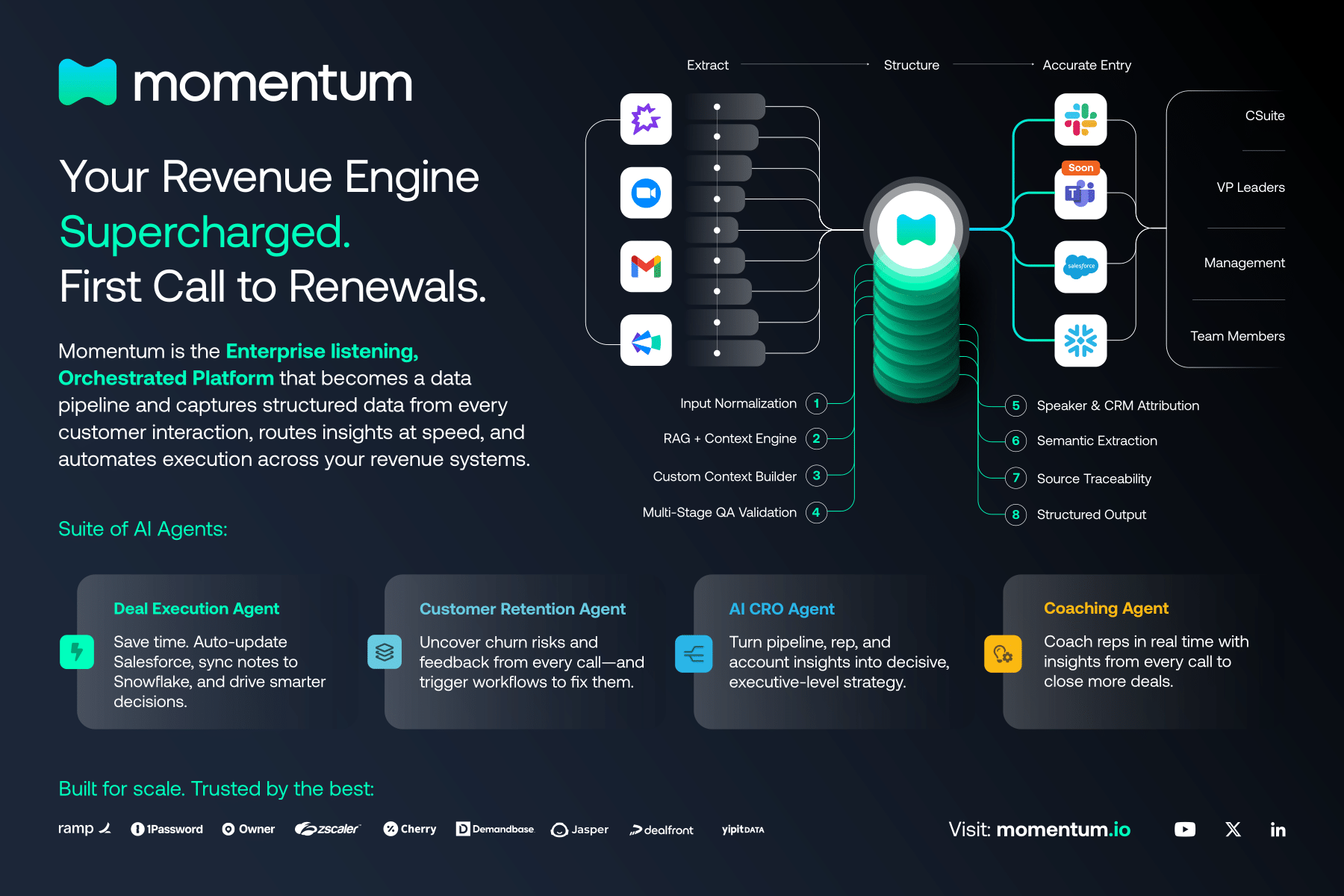
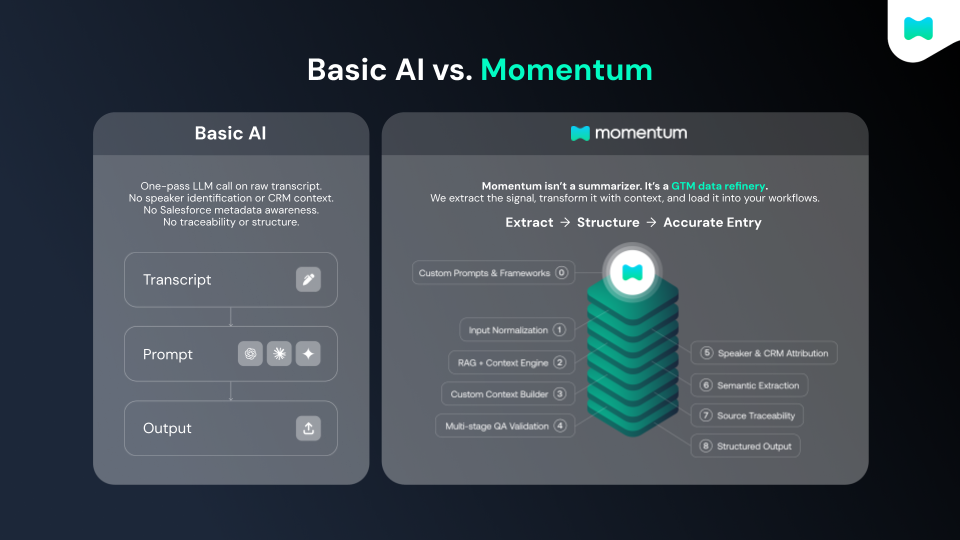
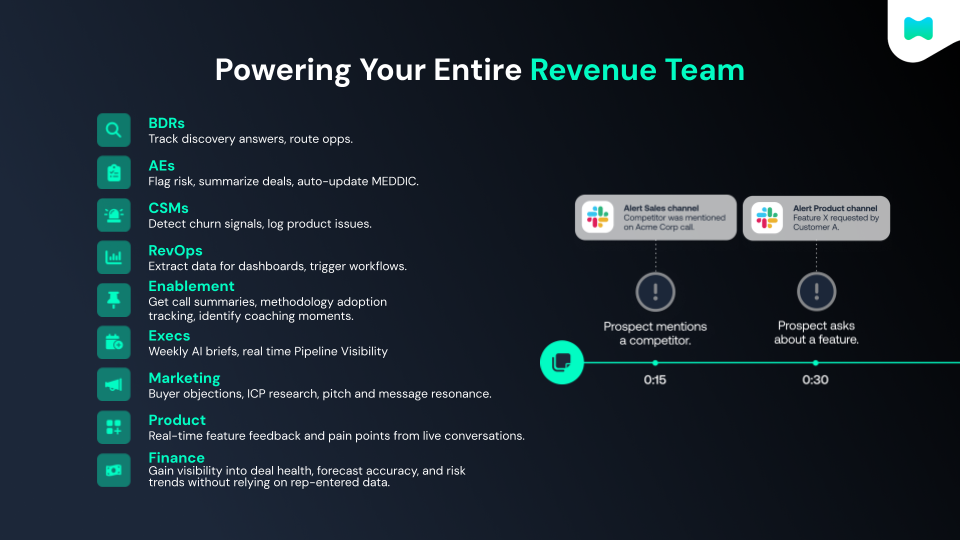
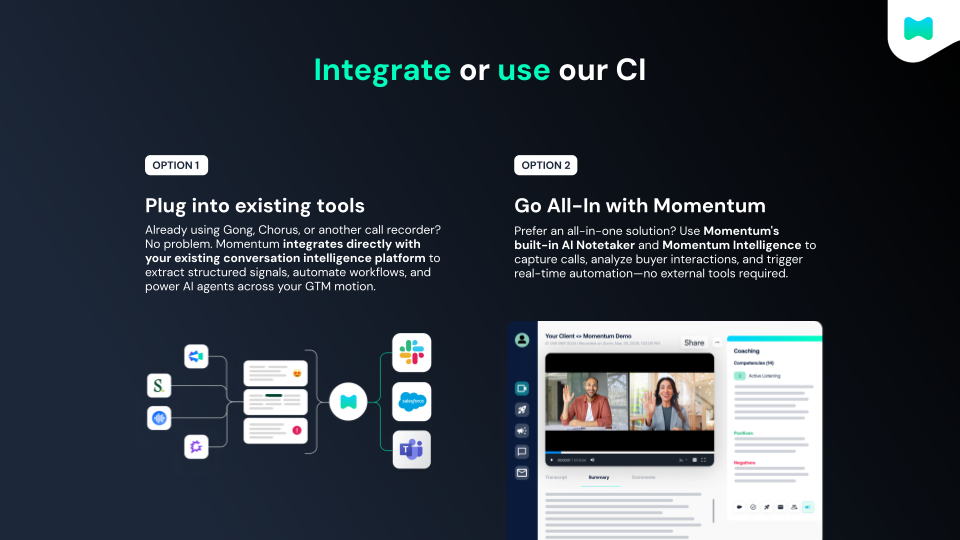
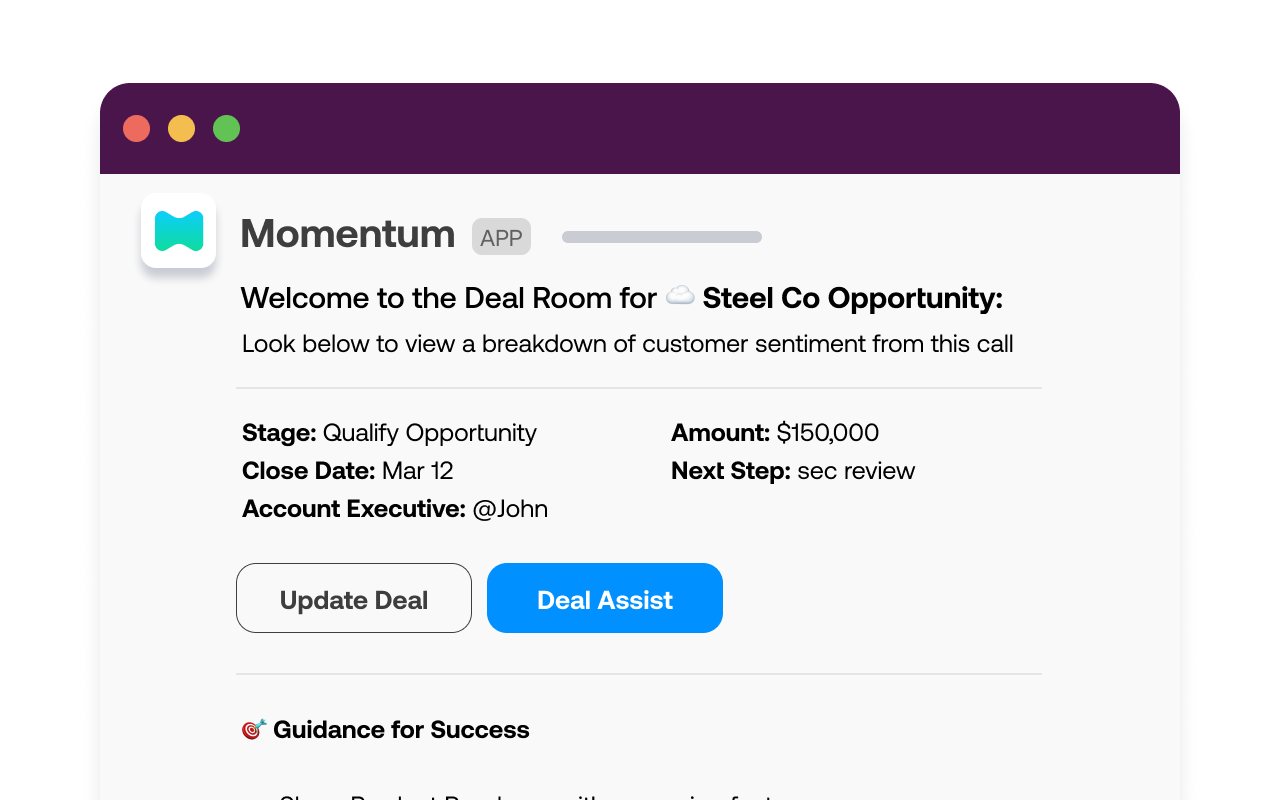
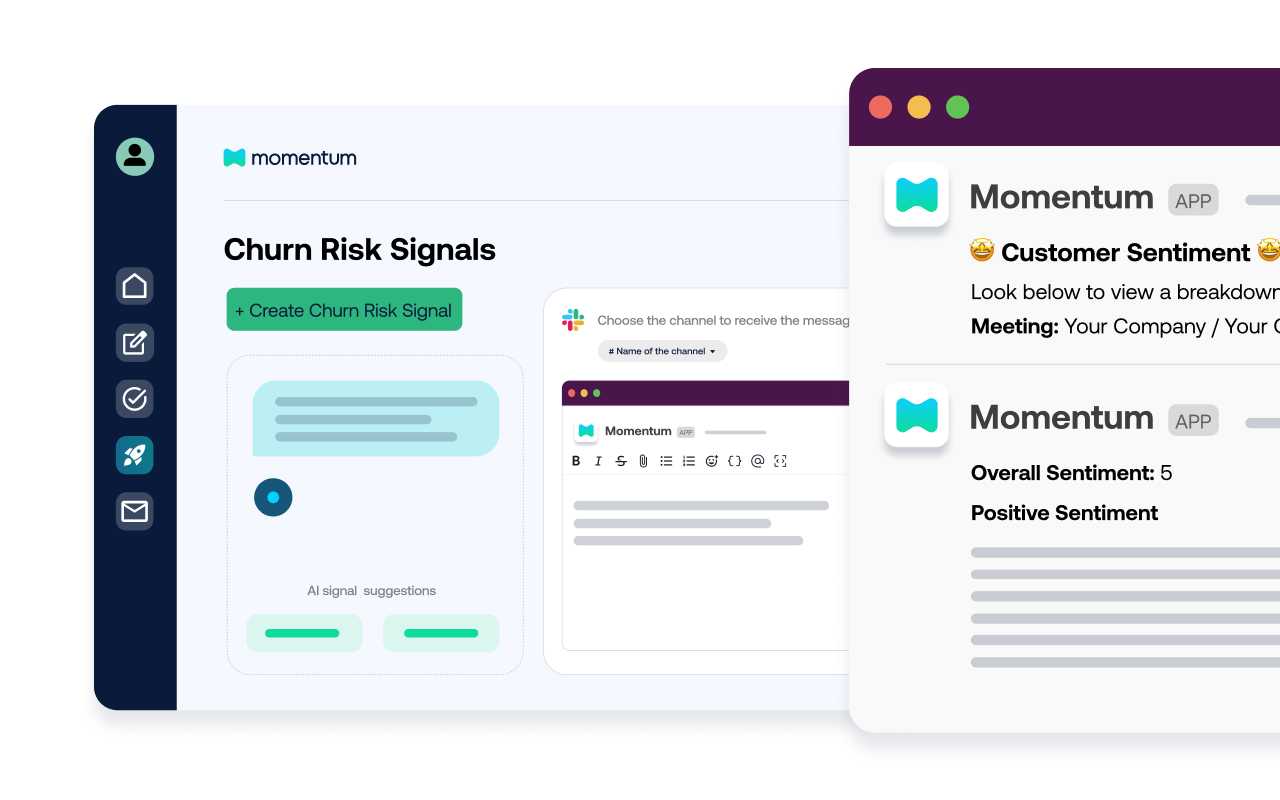
Momentum is a no code platform to automate sales workflows. Embedded into existing sales-first tooling, from Slack and Salesforce to Asana and Outreach, Momentum's access gives revenue team the building blocks to operationalize sales motions.
$828
per year per user
Salesforce Sales Cloud
Score 8.8 out of 10
N/A
Salesforce Sales Cloud is a platform for sales with a community of Sellers, Sales Leaders, and Sales Operations, who use the solution to grow sales and increase productivity. The AI CRM for Sales features data built right in, so that companies can sell faster, sell smarter and sell efficiently. Salesforce Sales Cloud is used for, and supports: Buyer Engagement Sales Engagement Enablement Sales AI Sales Analytics Team…
$25
per month
Pricing
Momentum.io
Salesforce Sales Cloud
Editions & Modules
Business
$69
per month (billed annually) per user
Transformation
$99
per month (billed annually) per user
Enterprise
Custom
Starter
$25.00
per month per user
Professional
$80.00
per month per user
Enterprise
$165.00
per month per user
Unlimited
$330.00
per month per user
Agentforce 1 Sales
$550
per month per user
Offerings
Pricing Offerings
Momentum.io
Salesforce Sales Cloud
Free Trial
Yes
Yes
Free/Freemium Version
No
No
Premium Consulting/Integration Services
No
No
Entry-level Setup Fee
No setup fee
Optional
Additional Details
—
—
More Pricing Information
Community Pulse
Momentum.io
Salesforce Sales Cloud
Considered Both Products
Momentum.io
Verified User
Administrator
Chose Momentum.io
It's been a while since I used Chorus. But compared to Zoom Revenue Accelerator, Momentum is much more intuitive and flexible. With the immediate Slack notifications and ability to customize, if you want to push data to SFDC or just alert in Slack is helpful to tailor the tool …
They don't have any true end to end competitors. Gong would be a competitor in the call recording space, as would Salesloft and a variety of other recording software like Fathom ect. However, Momentum.io is doing much more than that. You'd need 3-4 tools to get the …
Both LevelJump and Totango had some overlap (despite being CSP's). Specifically, when it comes to account handoffs. Momentum doesn't go as in depth but still provides an easy handoff from AE > CSM > AM, and tracks the process well.
Both products are great, but Momentum does a better job at summarizing. I believe Momentum also has the better UI and share link ability. I never had trouble finding my calls or teammates calls whenever using Momentum and that has been great for everyday tasks and call reviews. …
The other solutions we looked at in the space were more focused on coaching and a more rich experience in the call library. Momentum.io was much better positioned to deliver value directly to our reps. The level of customization you are able to use when choose what data to …
Stacks up great against them - I think most people will compare and contrast Gong as the large player in the field - has similar features but does specific items very well
Verified User
Employee
Chose Momentum.io
i have used other similar solutions but unfortunately do not recall the names off the top of my head
If you are a lean organization with looking to find a revenue orchestration and AI tool for call summaries, automatic field updates, etc. then I think Momentum is worth considering since there aren't many "small-player" alternatives in the market. The pricing is much better than comparable larger-players (i.e. Gong), and the Momentum is quick to iterate on their existing features and resolve bugs quickly.
Obviously, for any business, there are two main areas to focus on — the sales path and the service path. Sales Cloud wouldn’t be suited for a company that’s primarily into support services. For those kinds of companies, Salesforce has a different product — Service Cloud. So, for anyone in the support or service space, Sales Cloud isn’t the right fit.
The customizations - We have an organization that operates differently from most companies, so we’ve had to implement quite a few customizations — and Salesforce allows us to do that quite quickly. Most of the time, delays come from dependencies on other internal parties rather than the system itself.
From my perspective as a consultant, one of the biggest advantages is that everything is in Salesforce — all the details, all in one place. The ability to customize it easily is a big plus; there’s really a lot you can do with it.
We still need to include the production part. We started using Salesforce to sell the seeds — our inventory is in SAP — and from there we handle sales and track the process of planting, harvesting, selling, and then collecting payments. But we don’t yet manage the earlier production processes, like production planning. We handle allocation, but not full production planning, and that’s an area where we still have room for improvement.
There's no doubt in this of renewal. We are all set and planning in phases to acquire more and more licenses. We provide AI licenses to sales account managers on the very first day. This is a mandatory onboarding step. Everything is going well.
There are days when I wish we hadn't switched, but I know that if we put in the time, we will get to where we want to be with the software and that it has many more capabilities than anything else we looked at. However, the amount of time and onboarding we need to do is also far greater than we realized/were told when we originally bought the product. They told us we should hire onboarding support, but at the end, after we had already reached our budget maximum for this, so it's been slower than we had hoped.
The learning curve is extremely low. Almost anyone can get started building workflows. To the point, we have many sales reps who can create their own alerts and/or determine deal room criteria. I had never used Momentum before I joined Ramp and was building and updating existing workflows on my first day.
Because I think it could be easier. We have different standards today since we’re used to interacting with consumer apps like Starbucks, where all you do is scan your card. Then, when you use Sales Cloud, there are still a lot of manual inputs. So my mission with AI is really about figuring out how to make that easier.
Salesforce is always available securely from any internet-capable device anywhere in the world, UNLESS you choose to set security measures so that ONLY trusted IP ranges may access the system at certain times of the day. It's all about choice and flexibility with Salesforce products.
Salesforce performance in general is excellent. "The cloud infrastructure beneath Force.com has been fine-tuned over the past 10 years. It powers nearly 100,000+ businesses running more than 185,000 applications that 3 million users count on every day." Points per Salesforce - 1) Multitenant kernel - With a multitenant platform, each business that uses the app doesn’t have its own copy. Instead, all businesses share a single copy and then customize it for their specific needs. 2) ISO 27001 certified security - You can’t compromise when it comes to enterprise-level security. Force.com is road-tested and trusted by nearly 100,000+ companies, including many of the world’s most security-conscious organizations, such as banks and health care providers. 3) Proven reliability - All Force.com apps run on world-class data centers with backup, failover, and disaster-recovery facilities. Force.com has had a proven 99.9 percent uptime record for years. 4) Proven, real-time scalability - Force.com is used by many of the world's largest enterprises, including Cisco, Japan Post Network, and Symantec. Applications can automatically scale from a few users to millions of page views, as needed. 5) Real-time query optimizer - You need fast access to your data. The Force.com query optimizer delivers under 300ms response time, at a massive scale. 6) Real-time transparent system status - You can always see real-time system performance, availability, and security information at trust.salesforce.com. 7) Real-time upgrades - Unlike traditional software platforms, our upgrades never break your customizations, code, or integrations. We upgrade the platform for you 3 to 4 times each year. As a result, you’re always on the latest version, with access to the latest features, performance, and security enhancements. 8) Real-time sandbox environments - With a single click, you can create copies of your applications, configuration, and data in separate environments for development, testing, and training. 9) Three global production data centers and disaster recovery - Force.com runs on three geographically dispersed, mirrored data centers with built-in replication, disaster recovery, a redundant network backbone, and no single points of failure
We have a shared slack channel with Momentum and their responsiveness and attentiveness to our concerns and bugs is top notch. They are quick to investigate and do a solid job of providing updates throughout the eval process. They typically resolve and respond rather quickly. The only reason this isn't a 10 is due to what I perceive as occasional resource constraints. Sometimes it does take a bit to hear back and the updates aren't ALWAYS proactive. I'm being nitpicky, but I think there's some room for improvement before calling this a 10/10.
The overall support has been good. More and more features are being released quite frequently. Very small features are also making big difference in how the tool can be adapted and used better. If there is anything we need or are stuck, the support team sets up a call and helps in resolving the issue/provides workarounds.
I attended two training sessions. I would rate them a 4 as an advanced user. It was very basic – great for someone new – would give 8+ for new person.
I had 3 years of experience at the time. I skipped basic and went onto advanced and still not helpful. A lot of it was best practices that didn’t feel relevant for our business
I have gone through multiple. The content that’s delivered is quite basic – I wish they had more advanced training.
We are grandfathered into premium support plus training. We get unlimited access to instructor led and online training for free. We have taken advantage of this
In summary, Momentum.io truly shines when enhancing the Salesforce-Slack experience. However, when workflows become highly complex, require extensive integration outside of its core platforms, demand meticulous governance at scale, or necessitate deep operational analytics, its elegance can give way to a more cumbersome administration and implementation effort.
Just from an organizational standpoint - we standardized our data prior to moving to Salesforce. But we essentially standardized it wrong. That's created a big disgusting mess for us know that I'll have to deal with as the Admin. Be sure you think through use cases prior to doing something like that - seek outside opinions on how the data will work best, especially depending on what else you're going to integrate with Salesforce.
Troops was acquired by Salesforce and is no longer available Gong is focused on convo intelligence and keeps the data fairly locked up in their platform with limited pass through to slack or CRM. AI use cases are one off / blackbox vs customizable for your business needs. Momentum is built on AI, its not a bolt on that other companies are trying to add as a means to catch up.
So I've evaluated, implemented Microsoft Dynamics in the past. I've used Oracle CRM solutions. I've used Daylight, which is a very niche CRM system the last couple of years. And I've evaluated a variety from Legacy Microsoft Ones to Zoho and Sugar when making implementation decisions at other companies. But usually I've gone with Salesforce. I'd say it's better than most. The only one that I generally prefer, and last time I chose an implementation from scratch, I did Microsoft Dynamics. And the reason is for small mid-size organization, Microsoft Dynamics, if you already have Microsoft Office products, it's much better integrated to all of the Excel, Word, OneNote, Outlook email than what you get from Salesforce. And so that's the only one that if someone's a Microsoft organization and small sized company, it'll save a lot of integration things, a lot of security, a lot of login and access and IT management by just sticking within the Microsoft ecosystem. But outside of that, if you don't use Microsoft or if you're a large organization or have other needs that you want, Salesforce I'd say is better than all of the other CRM offerings out there. It's the easiest to use and the most robust and the most vendors and products for the ecosystem.
Salesforce is the most widely used CRM system. Professionalism tends to increase when things go wrong for market leaders. Salesforce considers us as users because they own the market. Having all of our data in one place and all of our teams working within Salesforce. Anyone who uses Salesforce is impacted by it, even if they don't.
It's very scalable as it has a ton of features (but you do need an admin who understands how to leverage these features). Because of the various features, we've also needed to host onboarding sessions with our users so that they can familiarize themselves with the platform, which isn't always super user-friendly or intuitive.
Using Salesforce.com has made my daily routines more efficient and simplified the manual tasks I had to perform independently. I can now access data from any device, online or offline, and provide better guidance to my team about the forecasts provided by the built-in artificial intelligence (AI). A chat with a Salesforce support specialist would be great. The knowledge base has a community forum where Salesforce users can ask questions and learn more about the product.
Momentum.io makes the whole customer onboarding process faster and smoother, which leads to a better customer experience, faster time to value and eventually less churned customers
Lower customer aacquisition costs due to integrated workflows through Slack and Salesforce
Improved forecasting due to better visibility through integrations