Google Analytics is perhaps the best-known web analytics product and, as a free product, it has massive adoption. Although it lacks some enterprise-level features compared to its competitors in the space, the launch of the paid Google Analytics Premium edition seems likely to close the gap.
$0
per month
GoSquared
Score 9.0 out of 10
N/A
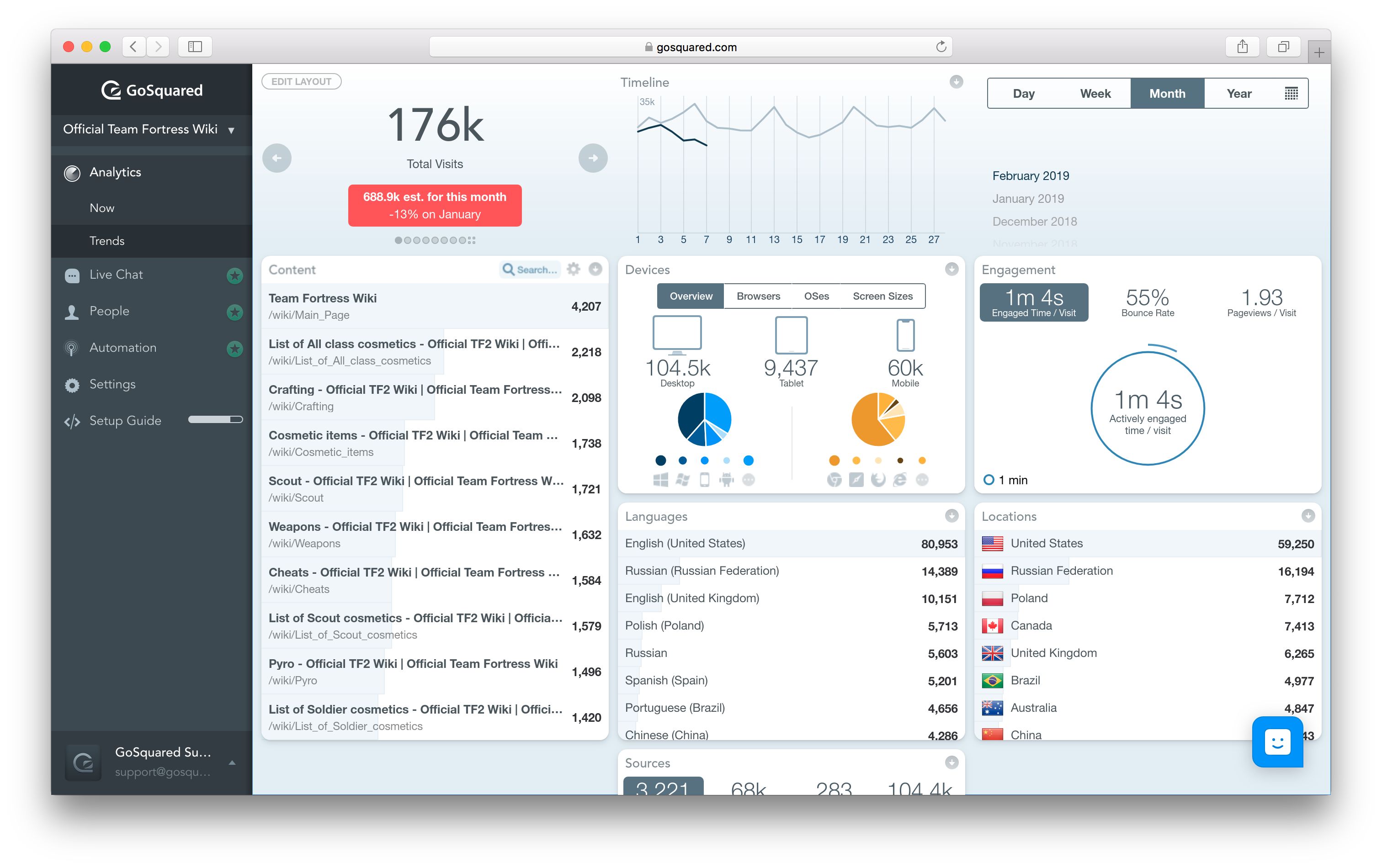
GoSquared provides real-time website analytics to sites of all sizes. The real-time dashboard displays website analytics on an individual visitor basis. The Now App displays concurrent analysis (the visitors who are on your site right now) of your site performance. The Trends App displays historical, trends and comparison analysis on real-time data. You don't have to wait 4 - 24 hours in order to compare todays current performance against last years. The Ecommerce App displays the same freshness…
$0
Per Month [Unlimited Users]
Twilio Segment
Score 8.3 out of 10
N/A
Segment is a customer data platform that helps engineering teams at companies like Tradesy, TIME, Inc., Gap, Lending Tree, PayPal, and Fender, etc., achieve time and cost savings on their data infrastructure, which was acquired by Twilio November 2020. The vendor says they also enable Product, BI, and Marketing teams to access 200+ tools (Mixpanel, Salesforce, Marketo, Redshift, etc.) to better understand and optimize customer preferences for growth— all integrations are pre-built and…
$120
per month
Pricing
Google Analytics
GoSquared
Twilio Segment
Editions & Modules
Google Analytics 360
150,000
per year
Google Analytics
Free
GoSquared Free - Access to the Now and Trends realtime web analytics dashboard.
$0
Per Month [Unlimited Users]
GoSquared Analytics - Everything included in free plus premium analytics features.
$29
Per Month [Unlimited Users]
GoSquared Suite - The most popular GoSquared plan, full access to our real time analytics dashboards, intelligent live chat and customer data hub.
$79
Month [Unlimited Users]
Free
$0.00
Includes 1,000 visitors/mo
Team
$120.00
Includes 10,000 visitors/mo
Business
Contact Sales
Custom Volume
Offerings
Pricing Offerings
Google Analytics
GoSquared
Twilio Segment
Free Trial
No
Yes
Yes
Free/Freemium Version
Yes
Yes
Yes
Premium Consulting/Integration Services
No
Yes
No
Entry-level Setup Fee
No setup fee
No setup fee
No setup fee
Additional Details
—
GoSquared Free, track up to 1000 pageviews a month. GoSquared Analytics, track up to 100k pageviews a month with pricing starting at £29/month. GoSquared Suite, track up to 100k pageviews a month with pricing starting at £79/month.
—
More Pricing Information
Community Pulse
Google Analytics
GoSquared
Twilio Segment
Considered Multiple Products
Google Analytics
Verified User
Executive
Chose Google Analytics
Honestly, I don't think any other options really stack up at all but these have a few great features... Matomo - planned integrations with Google Ads, Bing Ads, and Facebook Ads. Woopra - real-time, on-the-fly things like sending a message to a sales Slack channel right when a …
For simplicity & real-time data, GoSquared beats Google Analytics easily. However, for more complex analytics requirements, GoSquared simply doesn't support the vast array of reporting abilities which Google Analytics affords.
Google Analytics is massively bloated and can be difficult to configure, navigate and understand. While GoSquared doesn't provide the feature set that Google Analytics does it focuses on providing the best experience for the features it does offer. If you just want to know who …
GoSquared acts as an end-to-end tool taking care of most of the needs of the organizations unlike most of the competitors. Even while covering a vast scenario, GoSquared handles all the tasks pretty well.
GoSquared is easier and more intuitive to use, also less advanced but it offers enough functionality for most websites. It can be used in conjunction with more advanced tools.
I use GoSquared in tandem with Google Analytics on my site since I don't need an all-in-one marketing software for this site. I love the clean, easy-to-read reports that I receive from GoSquared on a daily/weekly/monthly basis. The graphs are easy to interpret and it pulls the …
For realtime analytics, GoSquare is my go to pick since it does it really well and is very simple to use. The dashboard is also really great to show the team analytics of our website at a glance.
As I said previously, I rather pay for a superb product than use a good free product. I think GoSquared beats Google Analytics on user-friendliness, usability, and UX. The team seems to not stand still and is always innovating, which I value, too.
Segment is not really suitable for most websites that have more than 10k MTU - If you run a semi-popular website, there are many tools out there that will do basic web analytics, like Google Analytics. Google Analytics provides simple resources for tracking user growth, …
Mixpanel and Amplitude offer strong data analytics and Google Analytics is powerful for web data, but their integration capabilities are less extensive compared to Twilio Segment. It's easy-to-use api and data collection and cleaning capabilities Twilio Segment operates as a …
Segment is considerably cheaper but doesn't have the GUI for non-SQL users. GA Premium doesn't have all the data connectors, and can be more difficult to configure on SPAs.
We tried to set up our entire data analytics process through these tools but there were some parts of the data capture, set-up, analytics that was missing with these tools. None of them could provide the ease of setting up with a complete picture of the data and analytics like …
It's much more personalized and user-focused data available in real-time, and immediately exported to an external database. It's provided more control over how the information is used and displayed for actionable insights.
The competitors above either charge a lot if you want to warehouse your data, don't allow data warehousing, or make it very difficult to warehouse your data (requiring you to write custom scripts and run them on schedulers). Segment makes it easy to warehouse your application's …
See my previous response. Google Tag Manager is great if you are firmly in the Google ecosphere. But they don't have as many integrations as Segment.io
Google Analytics is particularly well suited for tracking and analyzing customer behavior on a grocery e-commerce platform. It provides a wealth of information about customer behavior, including what products are most popular, what pages are visited the most, and where customers are coming from. This information can help the platform optimize its website for better customer engagement and conversion rates. However, Google Analytics may not be the best tool for more advanced, granular analysis of customer behavior, such as tracking individual customer journeys or understanding customer motivations. In these cases, it may be more appropriate to use additional tools or solutions that provide deeper insights into customer behavior.
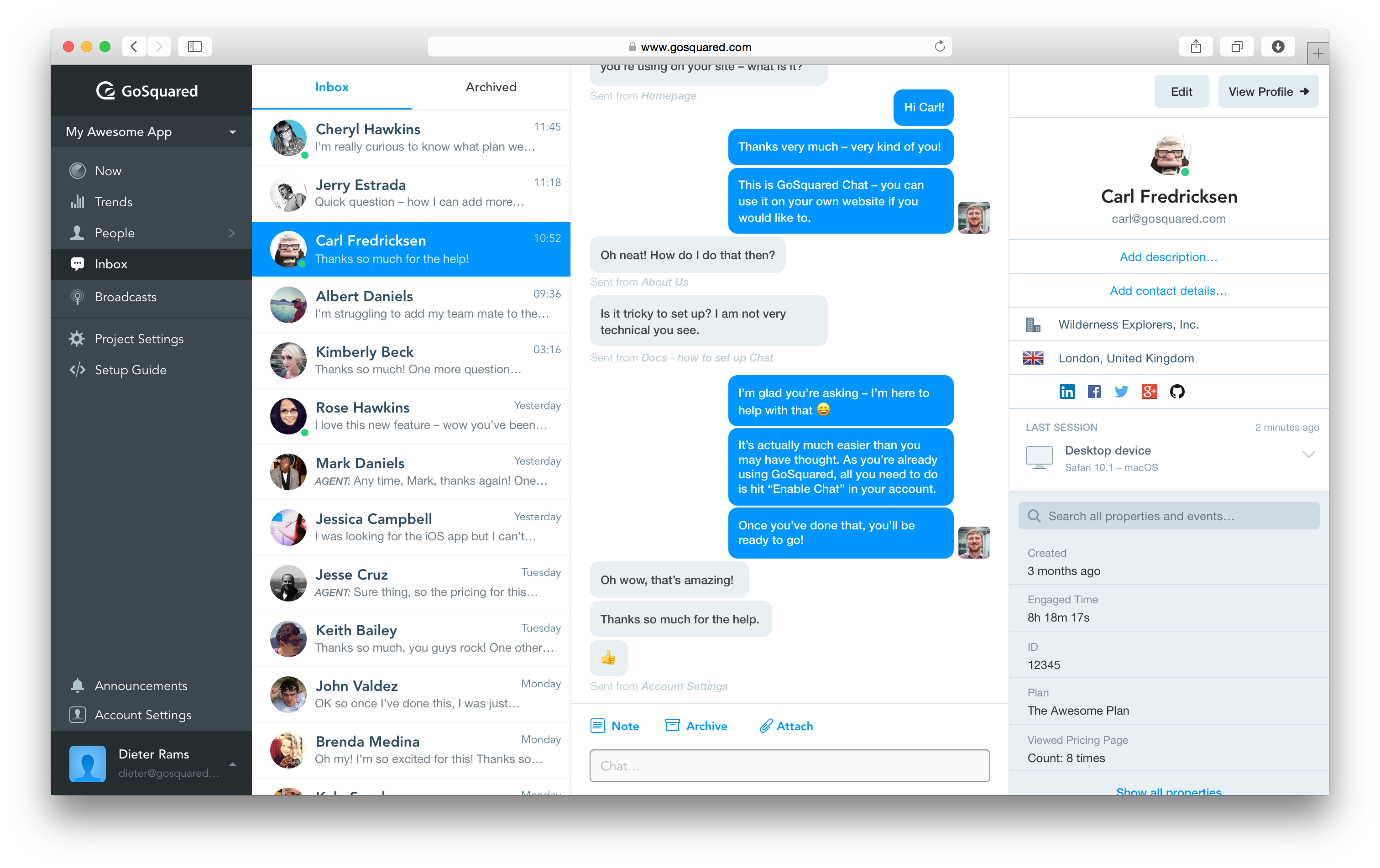
1) Maintaining customer relationships - GS just makes it so easy to respond to our users who use our product more from a tactical point of view 2) Onboarding - I think it's more or less an extension of the first point above but GS does make it easy for us to onboard new clients who are sort of beginners.
Best suited: - Merging emails coming from: Facebook leads forms, Unbounce or landing pages forms, Google forms, any other kind of lead generation tool and bundling all that information together for a single user "profile". - Passing events generated in multiple applications by the same user (product selected in web, product discarded in cart, etc) and delivering those events into other applications (like a CRM) Less appropriate: - Reading/updating data directly from segment from a frontend application
Multi-platform. Segment has easy integrations in many different web, backend, and app platforms/frameworks. We use the Segment SDK in Android and iOS as well as our node.js backend.
Segment is fairly affordable for early-stage companies that are trying out different analytics software. The "developer" plan is free and is suitable for most companies with products that have a small user base.
The UI is great! It is extremely intuitive and easy-to-learn, and this made it take very little time to integrate this software into our analytics and marketing workflows.
More and richer sources. For example, MailChimp is a source but the data you get from MailChimp is quite limited. I ended up writing my own scripts to take better advantage of MailChimp's API because Segment's integration was lacking.
Better examples on how to set up event tracking. Pageview tracking is easy enough, but it would be nice if they had a sample app and corresponding code for it and showed you, via Git commits, how to add various kinds of events.
We will continue to use Google Analytics for several reasons. It is free, which is a huge selling point. It houses all of our ecommerce stores' data, and though it can't account for refunds or fraud orders, gives us and our clients directional, real time information on individual and group store performance.
Not only does the GoSquared application work well, the GoSquared team is constantly making improvements. When I first started using GoSquared, they only offered daily reporting -- now they offer the weekly and monthly feature per popular request. I like that they are always updating the look and feel of the website and emails they send to maintain a modern look. GoSquared is easy to implement and easy to use!
Google Analytics provides a wealth of data, down to minute levels. That is it's greatest detriment: find the right information when you need it can be a cumbersome task. You are able to create shortcuts, however, so it can mitigate some of this problem. Google is continually refining Analytics, so I do not doubt there will be improvements
We all know Google is at top when it comes to availability. We have never faced any such instances where I can suggest otherwise. All you need is a Google account, a device and internet connection to use this super powerful tool for reporting and visualising your site data, traffic, events, etc. that too in real time.
This has been a catalyst for improving our site's traffic handling capabilities. We were able to identify exit% from our sites through it and we used recommendations to handle and implement the same in our sites. We have been increasing the usage of Google Analytics in our sites and never had any performance related issues if we used Analytics
The Google reps respond very quickly. However, sometimes they can overly call you to set up an apportionment. I'm very proficient and sometimes when I talk to reps, they give beginner tutorials and insights that are a waste of time. I wish Google would understand my level of expertise and assign me to a rep (long-term) that doesn't have to walk me through the basics.
Over the period it took us to set up, we kept going back to their enablement team to help us with the setup, and they were always ready and were very helpful in the entire process. Even with their documentation, they took the time out to help us work through the process. We've never had a message/email unanswered for more than an hour on working days.
love the product and training they provide for businesses of all sizes. The following list of links will help you get started with Google Analytics from setup to understanding what data is being presented by Google Analytics.
I think my biggest take away from the Google Analytics implementation was that there needs to be a clear understanding of what you want to achieve and how you want to achieve it before you start. Originally the analytics were added to track visitors, but as we became more savvy with the product, we began adding more and more functionality, and defining guidelines as we went along. While not detrimental to our success, this lack of an overarching goal resulted in some minor setbacks in implementation and the collection of some messy data that is unusable.
I have not used Adobe Analytics as much, but I know they offer something called customer journey analytics, which we are evaluating now. I have used Semrush, and I find them much better than Google Analytics. I feel a fairly nontechnical person could learn Semrush in about a month. They also offer features like competitive analysis (on content, keywords, traffic, etc.), which is very useful. If you have to choose one among Semrush and Google Analytics, I would say go for Semrush.
Google Analytics is massively bloated and can be difficult to configure, navigate and understand. While GoSquared doesn't provide the feature set that Google Analytics does it focuses on providing the best experience for the features it does offer. If you just want to know who is visiting your website and when then GoSquared is a simple way of tracing this information.
We chose Twilio Segment for the good API integration and node resources, I would use Ontraport again, particularly if I didn't have the requirements for API and development/platform integration. Certainly the set up and management is easy and seamless with both the API and the user interface to use depending on circumstances and requirements.
Google Analytics is currently handling the reporting and tracking of near about 80 sites in our project. And I am not talking about the sites from different projects. They may have way more accounts than that. Never ever felt a performance issue from Google's end while generating or customising reports or tracking custom events or creating custom dimensions
GoSquared helps us to react quickly to high volumes of traffic, and allows us to identify very quickly how engaging our content is
Using browser specs helps us to ensure our websites are compatible with as many of our customers as possible, rather than relying on generic global stats
Segment has enabled us to get a full view of our front end activity, join it to our back-end activity, and get full visibility into our funnels and user activity.
Segment lets us send events to ad tools with a full audit trail so all the numbers line up.
Segment also brings data from other sources into our data warehouse, saving our data engineering time from building commodity connectors.