Remote Desktop Services from Microsoft is virtual desktop and remote user session technology.
N/A
Parallels RAS
Score 9.3 out of 10
N/A
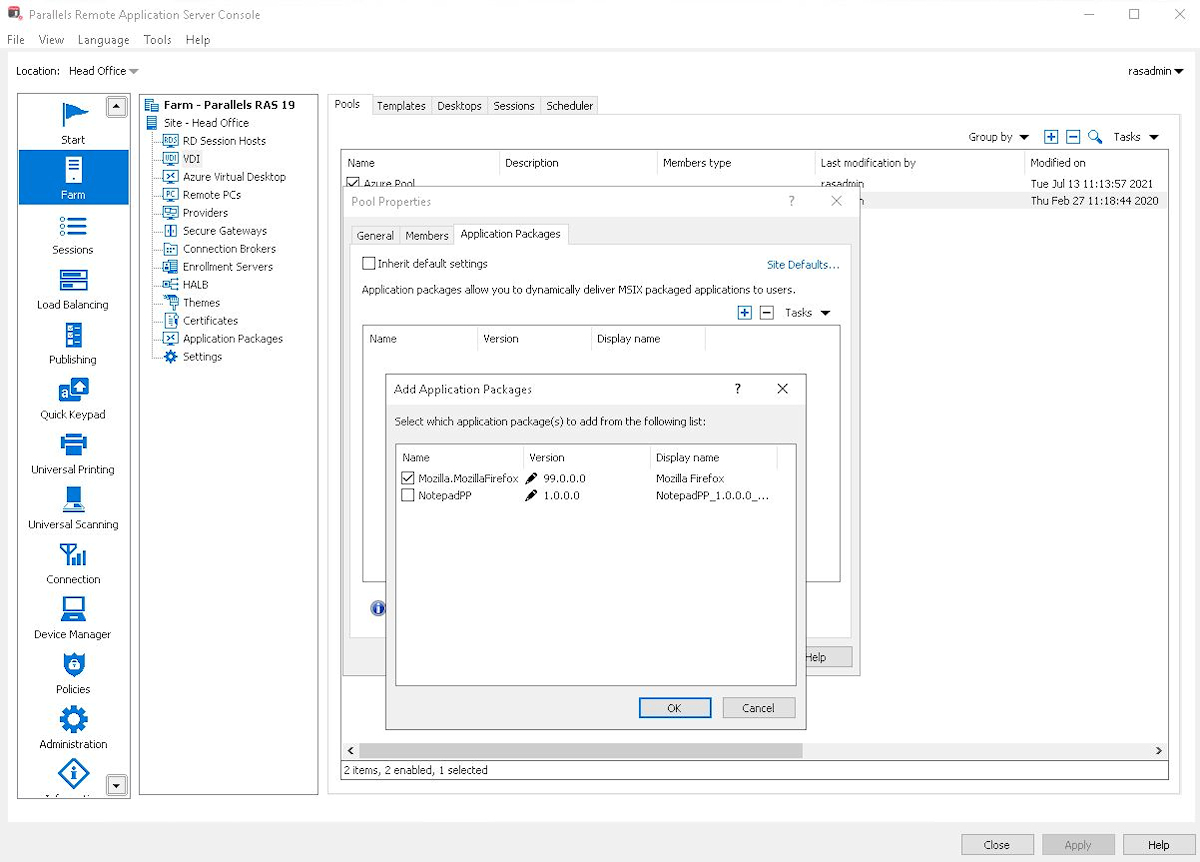
Parallels Remote Application Server (Parallels RAS, formerly 2X RAS), is application virtualization technology, billed as a solution to extend the life of legacy OS (like Windows XP) with its virtual desktop for any device.
Maltese company 2X Software developed the technology, but was acquired by Parallels (in Seattle, WA) in February, 2015 to extend their cross-platform support solutions.
$120
per year per user
TeamViewer
Score 8.6 out of 10
N/A
TeamViewer provides software for both remote management and online collaborations. With TeamViewer, users have access to fully integrated online conference solutions for audio and video communication, including interactive screen sharing and remote access features.
$299
per year
Pricing
Remote Desktop Services
Parallels Remote Application Server (Parallels RAS)
Since Remote Desktop Services comes with the Windows OS, there's no need to install any additional software or agent for it to function. Even on the Mac, there's a client that can be installed for this to run properly. Unfortunately, unlike TeamViewer or Ultra VNC, Remote …
We used RDS on-site primarily because of how easy it is for users to transition from their own desktop to a remote desktop. However, from off-site, there are VPN and other security considerations to take into account, and the process gets a little more complex. In this …
Because it is a built-in, free solution for a small set of managed computers. No extra licenses required. No budget. Setup and configuration is instanteneous.
Solutions can be expensive and often offer more options than you need/want. Paying those extra dollars is tough when you have a budget. RDS in many cases works well and is cost effective.
Chose Parallels Remote Application Server (Parallels RAS)
Parallels Remote Application Server has been easier and less expensive to implement for our clients than VMware Horizon and offers a better experience than Microsoft Remote Desktop Services. All three of these can accomplish similar end results, but when looking at the overall …
Chose Parallels Remote Application Server (Parallels RAS)
Parallels Remote Application Server is pretty different from a lot of remote software. It isn't a VPN or even a remote desktop application though it does have a lot of those same functions available. Parallels is a good software for many of an office's remote needs and …
Chose Parallels Remote Application Server (Parallels RAS)
RDS has few options when publishing apps outside of the organisation vs RAS along with a limited and (since Server 2012) completely bizarre admin GUI. RAS is very simply administrated from locally installed client along with pre-defined admin use permissions.
Chose Parallels Remote Application Server (Parallels RAS)
First and foremost, Parallels Remote Application Server is a game changer in price performance compared to Citrix. In addition, the security and flexibility compared to a traditional Microsoft RDS solution is night and day better both in terms of security and configuration …
Chose Parallels Remote Application Server (Parallels RAS)
Users were formerly using unmanaged remote access programs to bypass the firewall. Previously I had used RemoteApp when the source of users was predictable (and traffic could be limited to a single site).
Easier access faster than some of the others. We love the mobile feature where you can use the app to connect when on the road. Also it has the ability to access cell phones as well, which many times helps us help a client with their iphones. Great feature. There have been …
Overall TeamViewer is superior to other remote solutions that I've used. It is faster and more reliable, with a better overall interface and management console. AnyDesk is generally slower and the interface is not as intuitive or easy to use. Endpoint Central is also slower …
Verified User
Contributor
Chose TeamViewer
Remote collaborative capability is much better in TeamViewer as oppose to competition and fast connection makes TeamViewer as better choice
TeamViewer is significantly easier to set up at a small scale than Microsoft RDP, plus it's cross-platform unlike RDP and provides a better UI and many more capabilities than just remote control, like file transfer and some management controls like reboot.
TeamViewer is a one click solution that doesn’t require the client to be a networking tech savvy to set it up. With TeamViewer, no need to worry about private and public IPs nor firewalls and reverse proxies as the connection can be established through the TeamViewer servers …
I've tried a few different ways to provide remote help over the many years I've been providing technical help (since 1987) and Teamviewer consistetly comes out the best. I've also tried numerous ways to access my own computer and data remotely and Teamviewer is the only one I …
TeamViewer's main advantage is its cross-platform compatibility, meaning that you can use it on other operating systems other than Windows. The main features are present in both tools, like file transfer and taking control of the endpoint machine. Teamviewer is a third-party …
Teamviewer does everything the others do, if not more, but the cost was much better at the time of our purchase. I don't know what the price difference is currently.
TeamViewer is a well-known brand. It doesn't limit us to specific hardware or operating systems. It offers various other services along with screen sharing.
Mac users prefer TeamViewer over both of these hands down, and it is only slightly better on windows. TeamViewer is still far easier to use and more robust. Also, Kaseya suffered a significant breach. Splashtop is more difficult to establish connections with, especially on …
TeamViewer is better than RDS because of the way it handles the video. At the core, they are both remote control applications. However the method for implementation is quite different. RDS gives you 90% experience of physically being at the terminal but TeamViewer gives you …
Since I access several customers and environments, I wanted an easy-to-install/use solution. Team Viewer provides desktop sharing, remote access, and file transfer in a single solution and most of my customers have already used it either personally or in a previous business, so …
Along with TeamViewer we tested LogMeIn and RemotePC. In our environment we found LogMeIn offers a poorer user experience with more lag in the remote sessions in several circumstances, which was not the case with TeamViewer. We also tested RemotePC. RemotePC is a fair tool, …
Chrome Remote Desktop is great for personal and/or casual use but requires use of the same Google account for access, which won't work for many enterprise situations. Microsoft Remote Desktop is truly ideal (for Windows), but requires the use of a VPN or for machines to be on …
TeamViewer's mobile app is powerful and consistently makes the connection to my remote desktop. In the past I found other solutions to be inconsistent in availability leaving me with an unexpected "surprise" when I was unable to connect. I find TeamViewer is able to provide …
Parallels Remote Application Server (Parallels RAS)
TeamViewer
Likelihood to Recommend
Microsoft
This is well-suited if you need to log in to a remote machine on occasion to make updates or change configurations. It is also good for a production environment or for environments where people need to log in to use common applications, so you don't need to install the application on each individual client.
Scenarios where time is a factor in having a solution in place and up and running safely and securely. Where there are older devices that ordinarily wouldn't be up to the task of running modern apps and services. Where users need to work away from the network, and security is a concern.
I think it works well for IT management and help desk support of end users. I find it very useful to help users and send files to their desktop. Remote Workers still run into some problems with MFA and updates, both to the TV Host app and OS updates. However, it does give us secure direct access without the need of a VPN.
When you connect with RDS, everything looks and feels (and is) exactly like you're sitting at that desktop. This is great for us and for users.
You can sign in with RDS and the desktop will be the same as when you left it (if you choose to set it up that way).
Although they take some setup, RemoteApps are a very handy way to let users access a program without requiring them to actually connect to a remote desktop on the server.
The printing driver is quite excellent, both in the Parallels Client and on the HTML5 client.
Setup is incredibly easy; the default setup is very functional, and adding features is a breeze.
Speed is very acceptable in general for end-users, the clients adapt quite well to the amount of bandwidth available, and features are available to adjust further.
Remote Desktop Services currently does not support multiple monitors on the terminal server. Unlike other applications such as Teamviewer, there's no feature to toggle between multiple screens even if they were connected to the terminal server.
Remote Desktop Services should provide an option to scale up or down the screen size after a connection is established. Currently you can only adjust the screen size prior to a connection is established. So you'll have to take a best guess at what display screen resolution will fit best on your screen.
Remote Desktop Services should offer some kind of menu to send special key strokes like Ctrl+Alt+Del to the terminal server. Currently the substitute for that particular combination is Ctrl+Alt+End. But I have yet to discover a replacement for other combination keystrokes such as Alt+PrintScrn.
Parallels Remote Application Server (Parallels RAS) continually improves the product but has broken some features recently. For example the web management portal lost the ability to manage user sessions after a major update. That issue was fixed in a later release
Multi-monitor support beyond 4 monitors (It does handle up to 4 -1080 monitors well)
More options around connection security and MFA. current options are sufficient but limited
We've noticed some performance issues with Windows Server 2019 and 2022. I'd like to see more robust support for remote applications running from those platforms.
With an iPad, you can't take control of the device, so you have to tell someone what to do. Which can be a challenge because the end user doesn't know what to do
With the free version of TeamViewer you cant enter Admin credentials because TeamViewer blocks the windows to fill in the credentials
The free version can be really limited which can be putting off people because they don't see the full potential of TeamViewer
We have been using Parallels since it was called 2X - it is a major part of how we do business. It is fairly simple to use and maintain - staff like it, we like it. It is a product that makes a promise - and it keeps it. As Parallels evolves, and clean bandwidth becomes more readily available everywhere - it just makes sense to continue to use Parallels in our environment
We need this tool in our day to day business. It is what we do all day remoting into clients devices. In this day and age we can access devices all over the world as long as we have secure internet connection. It certainly saves money in gas, and even if you are away you can help.
The initial setup for Remote Desktop Services is complex, and licensing is costly. Each user connects to their virtual desktop hosted by a single server or group of servers, so a change or issue with servers quickly impacts every single user at the same time. Aside from that, users appreciate seeing their same personal desktop from any device or geographical location.
Parallels RAS was easy to setup, with great admin guides and resources. We especially liked the included Visio templates which made diagramming much easier. The reference deployment diagrams also simplified our deployment process. Our end users love Parallels RAS. Apps launch faster than Citrix, and the Parallels RAS client is far more reliable than Workspace.
TeamViewer is a reliable and really strong tool for accessing remote IT platforms secure and fast. We don't know any product that provide us such strong functionality to make our life as a internationally recognized MES provider with DIAMES with an international clientele so easy. We look forward for any new TeamViewer functionality that supports us even more.
If there are any issues with Parallels - they are usually more about the server operating systems than Parallels itself. It would be rare for us to have any reason to take Parallels offline - we schedule a reboot on the servers at 3am to keep the O/S itself fresh, but again - it is not a Parallels issue. If individual users have any issues we ask them to completely log out of parallels - which ends their session - and then back in - and that typically resolves the issue right away.
I am giving Parallels 9/10 on this one because the only application that sometimes seems slow or has issues - is Microsoft Outlook. It is sometimes the result of a pop-up that may not show up in the published application (vs full desktop). Other than that - pages load very quickly - and it does not seem to slow down other applications that are running at the same time. Most of our users run Outlook, softphone and Teams locally - and published applications for everything else. When they do that - it is very solid.
As with any Microsoft Server product, support for Remote Desktop Services requires a paid support package. These are license-based and very costly, on top of the already costly product licensing. Microsoft's licensing is complicated to begin with, so setting up licensing alone essentially requires a licensing expert's counsel. There is community documentation and support available on Microsoft websites, as well as community websites.
Good support in place if required, very helpful when it comes to upgrades or any issues faced. The support team is knowledgeable, friendly, and quick to respond to issues The company also provides a range of online resources, including a knowledge base, documentation, and forums, which can be helpful before raising a ticket
the few times i have had to contact teamviewer support, they were very responsive and give me quick answers and seemed to understand my problems quickly and easily. I did not have to sit on the phone for hours on hold or get passed around to multiple phone support techs before finding a solution to my issues, so i would rate their support very highly.
As expected without any problem! Alternate in-person training is another efficient way to learn how a product works. There are many third party supporters for TeamViewer courses available that can give additional ideas how to use TeamViewer for specific functions and features as we did require in respect of our usage.
I have never used the online training either. I have watched a few informational videos that were helpful when learning how to do a specific procedure within TeamViewer and get the most out of the software by utilizing one of the many features that are available with the software. Again, 5 if for neutral.
Overall, it was pretty simple compared to most other projects. Again, we had a strong familarity with the product so there was not much of a learning curve. Our 'biggest' issue is the end-user understanding of a 'local' application and a published application. For example - Online meetings need to run locally for camera/video to work smoothly so opening a link to a meeting from a published application continues to be an occasional issue.
TeamViewer installation and deployment to other devices is pretty straightforward and does not require much technical know-how. This makes ease of use attractive when supporting both new and existing clients with limited technical knowledge. I think ease of use is a huge factor in getting new clients. TeamViewer handles that extremely well.
We selected Remote Desktop Services based upon price alone. Other solutions on the market are significantly more expensive, but if your company can foot the bill you should seriously consider products that have been on the market for longer. The lack of an ability to easily upgrade farm servers has been a challenge for us - although it is still faster than updating an application on 2000+ machines. The lack of a centralized management console in 2008 R2 is also challenging, but you get by with the tools available to you. If you don't have the money to spend on Citrix or VMWare Horizon, Remote Desktop Services is a decent replacement.
Parallels Remote Application Server (Parallels RAS) provides the finest end user experience while being cost-effective and reducing administrative and support man hours. Parallels Remote Application Server (Parallels RAS) is platform agnostic; it works with various kinds of devices (computers, phones, tablets) and several operating systems (Windows, Linux, Apple, etc.), allowing users to access it on gadgets of their choice.
TeamViewer's cost is much lower than that of other solutions, and its security is far superior to RemotePC's. TeamViewer is also a request-based remote session manager, unlike other software that allows indefinite connection time. TeamViewer's free version makes it even better for one end of the group to find support, while the other end has the paid version.
We added our Integrated Services Staff to parallels, with filtered, published applications - in a single afternoon. We added licensing and installed the desktop client software on multiple platforms both in the office and at remote sites all on the same day - and got remote users that had never used the product up and running - very quickly.
Our customers have had dramatic cost decreases due to no longer needing IT departments to work with our software.
We've been able to charge more for our hosting services due to our customers saving money in the long run. Parallels Remote Application Server has more than paid for itself, and the increased income has gone right back into the business.
Both our customers and our company have benefited from this transition.