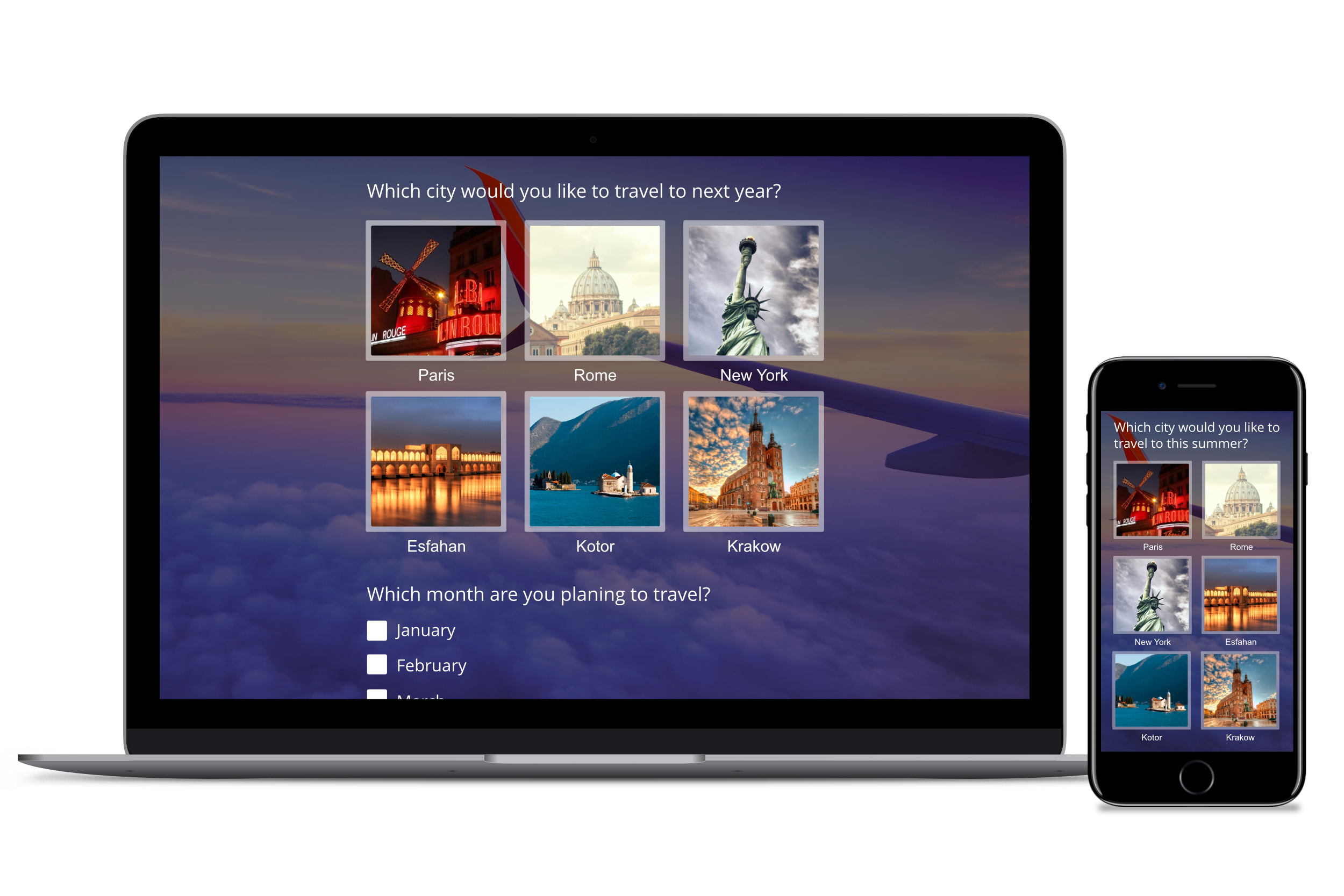
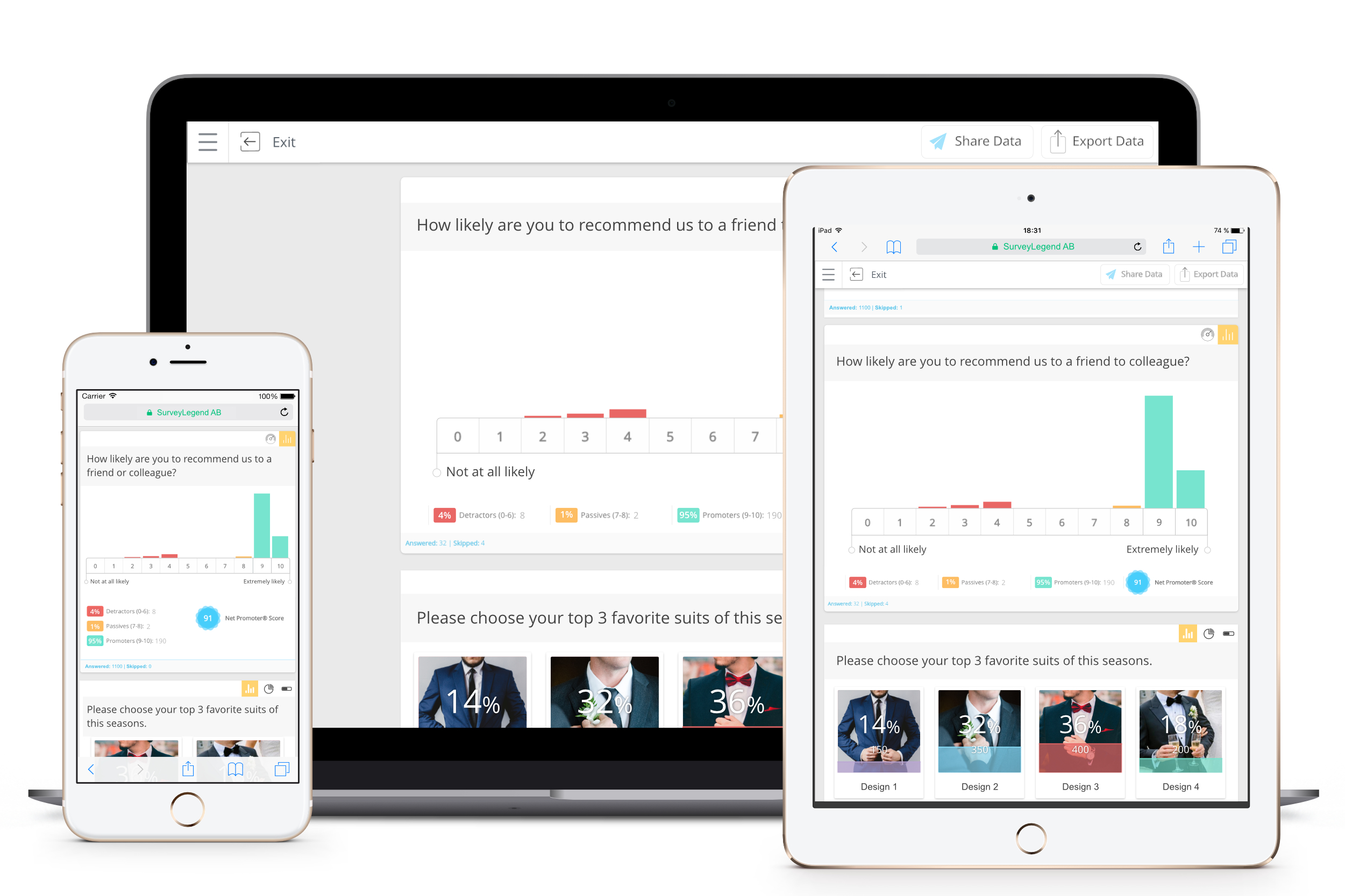
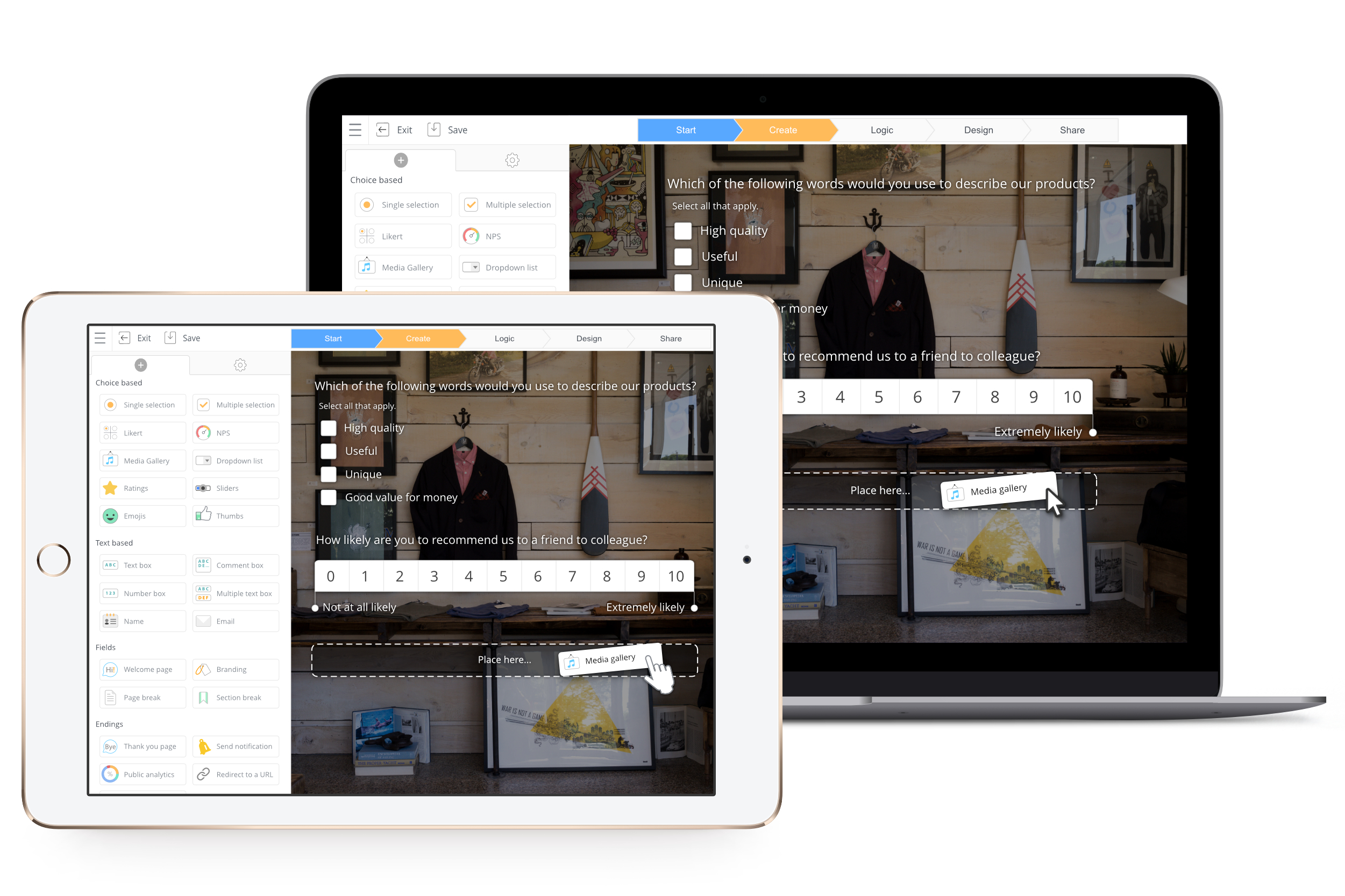
SurveyLegend aims to help individuals and companies create mobile-friendly surveys. Users can create surveys on a computer or tablet device and customize the look of the survey. Data can be displayed with eye-catching and insightful graphics. SurveyLegend's advanced users can take advantage of unlimited features, company branding, white-label questionnaires, skip logic, branching, media-rich questions and more. Customers include L'Oréal, Universal, Harvard, Greenpeace, Airbnb,…
$0
per user
SurveyMonkey
Score 8.2 out of 10
N/A
SurveyMonkey provides free, customizable surveys, and a suite of paid, back-end programs that include data analysis, sample selection, bias elimination, and data representation tools. SurveyMonkey also offers large-scale, enterprise options for companies interested in data analysis, brand management, and consumer focused marketing.
$99
per month
Typeform
Score 8.2 out of 10
N/A
Typeform is online form and survey software, focused on high-quality visuals and user experience. Users can create surveys, registration forms, tests & quizzes, contests, tutorials, shopping carts, and contact forms, without needing to write code. Typeform offers freemium plan pricing. Their basic plan is free for one user; their Pro plan in $35/month for one user (includes logic jump, respondent notifications, calculator, custom thank you screen, hidden fields, payment fields, and 2GB file…
$30
*Per Month
Pricing
SurveyLegend
SurveyMonkey
Typeform
Editions & Modules
Starter (for ever free)
$0
per user
Pro, monthly
$19
per user
Business, monthly
$39
per user
Legendary, monthly
$89
per user
Pro yearly, (save 25% with a yearly plan)
$170
per user
Business yearly, (save 25% with a yearly plan)
$300
per user
Legendary, yearly (save 25% with a yearly plan)
$780
per user
Team Advantage
$25
per month (billed annually) per user (starting at 3 users)
Team Premier
$75
per month (billed annually) per user (starting at 3 users)
Standard Monthly
$99
per month
Individual Plan - Advantage Annual
$468
per year
Individual Plan - Premier Annual
$1,428
per year
Essentials
$30
*Per Month
Professional
$35
*Per Month
Premium
$59
*Per Month
Offerings
Pricing Offerings
SurveyLegend
SurveyMonkey
Typeform
Free Trial
Yes
No
No
Free/Freemium Version
Yes
Yes
No
Premium Consulting/Integration Services
Yes
No
No
Entry-level Setup Fee
No setup fee
No setup fee
No setup fee
Additional Details
SurveyLegend gives a 25 % discount on the yearly plans for everyone.
We believe in being and doing good, so we also offer special discounts for educators and non-profit organizations that can be found here: https://www.surveylegend.com/pricing-education/ and https://www.surveylegend.com/pricing-ngo/
We decided to change from SurveyMonkey to SurveyLegend because it is more complete and allows us to have freedom when creating with the templates. Its complete tools allow us to improve texts and photos to make the questions more objective and receive answers. For users, it is …
Although I used the SurveyMonkey service for a few months, it did not meet the expectations of being able to reach users by sending the surveys in bulk due to their high prices. I am extremely happy with the change I made.
I feel that SurveyMonkey and Typeform are both great platforms; however, Typeform is not for in depth type surveys. SurveyMonkey has an abundance of features that are not offered via Typeform. Both are used on a regular basis by my department.
Honestly, SurveyMonkey was on our radar before most of these other options, and as it has met basically all our needs, we've felt no need to switch. For the record, Typeform's interfaces for their surveys are much more beautiful and enjoyable to use.
SurveyMonkey has the most options in terms of available question formats, analysis and participant tracking, and customizability. Google Forms is a more basic interface with fewer options for tracking and analysis, and Typeform is better in terms of design and branding options …
I actually use all of these services for different purposes. SurveyMonkey we use for larger panel send surveys (love their Audience capabilities) Typeform is for medium-length surveys, generally sending via email
SurveyMonkey is difficult to get a hold of and does not do a good job supporting you in the building process. Typeform is a very agile company, that has maintained it's start-up feel through its growth. When I first signed up we would regularly share information to mutually …
Logic jumps are huge. Typeform is outrageously powerful while it still feels approachable and easy to use. Google Forms is obviously very easy to use, but limited in branding, design, and flexibility. Typeform just blows all other products out of the water. I've used SurveyMonke…
The only option I knew about was SurveyMonkey, and it didn't have the ability (in the free version) to do some of what I needed it to do. Typeform gives us multiple options on each form, as well as the ability to create multiple forms. I can even duplicate a form and use it as …
We like the aesthetics of Typeform, but one thing we love about SurveyMonkey is that it automatically captures the user information (ie email and name) when sent in an email, while Typeform does not.
Visually, Typeform works for most of our needs and offers an experience that …
Typeform is much more user friendly that SurveyMonkey. I find it is much easier to use programs that are user friendly. While SM offers a great deal more features, sometimes offering too many bells and whistles and causing someone to shy away from the program, especially if …
We picked Typeform over Google Forms because it just has a lot more features that we use. Google Forms is great when you need a free, basic survey tool, but it lacks the sophistication that Typeform brings to the table. SurveyMonkey has a lot of the features that TypeForm has, …
Typeform was just much more modern-looking and flowed better than SurveyMonkey. As a SaaS we wanted a survey platform that matched our brand as much as possible and Typeform catered to that much better than Survicate and SurveyMonkey did. Through Typeform we had the …
When I used SurveyMonkey, the user experience was not at the same level as Typeform. It was cumbersome, and the user-interface was not as crisp or as modern. Airtable works like a spreadsheet, but gives you the power of a database. It also has an option to create forms, …
I found Typeform's user interface and design language to be more attractive and intuitive than SurveyMonkey. Typeform also beat them on pricing, so it was a no-brainer.
Verified User
Director
Chose Typeform
While SurveyMonkey certainly has years on its side and Google Forms has deep integration capabilities within the suite of solutions, you really can't beat the design or intuitiveness of Typeform. There are still some things we'd like to change about how the software works, but …
SurveyMonkey is very complicated to use. Its interface is not so intuitive and makes it hard to find what you need to customize a form. The end result is not so pretty and perhaps feels more clunky as opposed to Typeform's sleek presentation of questions. However, they have …
We tried both free & paid products. No doubt Google form does solve a lot of our basic use case but we were looking for lot more customisation as we wanted to open these survey within our app only. We started exploring different options including SurveyMonkey but we stuck to …
The logic mapping in Typeform was the deciding factor for us.
Verified User
Employee
Chose Typeform
Typeform is an exclusive product for this function--mobile first with a modern layout and good interactions. It has some customizations and integrations. Every change made to the template can be observed in real time. It is the best to visualize collected information.
I find the layout and design of Typeform more suited for our academic surveys. There is a crisp, professionalism about the layout and design. I prefer the design features and presentation of the Typeform emails.
Typeform is the best of all the other forms and survey tools we have tried and used. It is superior in both the administration and user experience from all the others. However, we often have to use third-party tools to integrate Typeform with other tools (e.g., connecting …
When looking for a feature rich & flexible / customizable solution, Typeform beats out everyone. However, for specific use cases (like NPS), AskNicely is a clear winner in terms of features, but is much too expensive. Typeform is also fun to use, especially compared to Wufoo …
Out of the box, I think Typeform creates far more beautiful forms, and really sets itself apart from the other survey solutions with its UX. Almost all other form providers by default show form fields that look like normal form fields, grouped together in fieldsets, sometimes …
For us, it is a good service and fulfills its services. Its main functions have allowed us to improve the quality of each of our services by delivering a survey to our clients with special and easy-to-use software and tools. It allows to receive analytics in order to solve problems in all areas in order to improve the organization. I recommend it because its main function is to create surveys but the information received there is possible to use throughout the company.
SurveyMonkey is well suited for external, professional, client-facing forms and complex question types. I've tried generating forms on HubSpot, and it's not nearly as intuitive or clean-looking, and not all question types are supported (e.g. Likert scales). For quick, internal forms that don't need to be as pretty or professional, I find that Google Forms is the quickest and easiest to pull together, especially since it has a single, universal respondent link. If I wanted to embed a link in a mass email, SurveyMonkey doesn't allow multiple respondents to use the same link on my plan.
Typeform is definitely a leader in the online survey space and that's for a reason. Between logic mapping and the ease of use for the end user, it's a solid app. The unfortunate thing, however, is the price tag--particularly considering the protection you receive from bots. Typeform only allows a certain number of responses at certain package levels, ie: the lowest level, you get a very limited number of responses but in order to receive more responses before your survey is locked, you must upgrade. This is what ultimately lead us to cancel with them. When you post a survey on Typeform, that survey is automatically posted publicly on their website--making it widely available to bots. Typeform offers no easy form of protection like a standardized captcha that you can add to the survey in order to filter bots out. Instead, there are several "work arounds" that they advise users to do that have very limited degrees of success. A quick online search shows that Typeform knows this is clearly an issue, yet they have yet to build in a bot-prevention feature. Since their plan prices vary by number of responses, it seems that they have no incentive to limit the amount of bots filling out surveys I believe. Ultimately, we canceled because, although the app is powerful, it just seemed like their business practices were unethical in my opinion.
Visual questions! Survey Legend was the only affordable software I could find that let me add images to questions easily and in a flow that made sense.
Live analytics! Super helpful for us when we were just starting our survey program, to be able to make sure the questions were formatted properly for example.
Lots of flexibility; any type of question I needed was available here.
Being able to close the survey at a set time without having to remember to do so.
Takes the guess work out of response collecting.
Makes it easy to categorize responses within the same survey. Being able to add tags to open-ended questions makes it easy for us to identify patterns in responses.
An array of survey options and questions.
An all around great product that meets multiple needs.
Can have multiple collectors for the same survey to included manual input.
Improved correlation of the data between the analytics tool and the responses (i.e. it says 3 responses have been received, but only shows results for 2)
I would like to have more customizable options for branding it to our hospital colors. Some survey options allow you to enter html color codes. SurveyMonkey allows you to change colors and you have to pick from selected options.
Embedding the surveys into a webpage, like WordPress is not as seamless as other services.
The pricing structure is a little steep, especially for the Pro+ plan. It would be nice if they had an a la carte option because there are some features we are paying for that we will never use.
When creating forms, sometimes the cursor will inexplicably leave the field you are typing in and leave you with incomplete sentences.
Even though we are paying for our use, we still have the Typeform branding on our forms, which I think should be removed once you upgrade from the basic plan.
Compared to other competitors in the market (including a few I've used internally), if you're looking for a survey application, this one does the job and it's quite inexpensive too. Considering the fact that it comes with a handy mobile application too (on iOS and Android), you also get flexibility thrown in the deal too.
It does everything a survey software should do, and it does it very well. I can't speak for how well it would work for a business that was surveying tens of thousands of people - but for a small business of 50 employees with a couple of thousand clients, it does everything it needs to do.
Typeform takes a little bit of getting used to. Compared to Google Forms there are a lot more parts to the software and customizing the form isn't as intuitive. I have also found that embedding it into one smaller section of a webpage seamlessly can be a little tricky. But everything can be figured out eventually and the analytics are very good.
I've never had to contact the SurveyMonkey customer care team directly, but they have a pretty good library of help articles on their website. Everything from designing and executing your survey to account and billing questions. I never had a need for further support from Survey Monkey.
I haven't used the support portion of Typeform, as everything was quite easy to use. I have never encountered a situation where I did not know what to do or how to fix something myself. Typeform is very easy to adopt within any organization, no matter if you understand tech or not.
SurveyMonkey is easier to customize and provides much more in depth analytics. SurveyMonkey also provides better templates providing us with a better presentation to our employees. SurveyMonkey also comes with a more trustworthy platform that ensures confidentiality, which is incredibly important to our employees and means we're getting more reliable results from the surveys.
When looking for a feature rich & flexible / customizable solution, Typeform beats out everyone. However, for specific use cases (like NPS), AskNicely is a clear winner in terms of features, but is much too expensive. Typeform is also fun to use, especially compared to Wufoo which seems so out of date
The speed at which we can develop, program, execute and generate actual usable results provides significant value, particularly when we need fresh numbers to illustrate a point.
The fact that we can execute a research project so quickly means that new research is always a primary option when we're developing campaigns. That's a huge value proposition.
Typeform has helped guide our Customer Success, Product, and Marketing teams in strategizing how to engage with customers better, and it has also given us a quick and easy way to do so! By collecting feedback and being able to share it across internal teams, we can coordinate our efforts to build our customers a better tool.
Typeform has proved to be an elegant solution to one of our earlier vexing problems (previous survey tools that looked annoying, had extremely limited branding options/were not customizable, and didn't integrate well with the rest of our tool set) while not breaking the bank for us - it's a very reasonable price point and does WAY more than the previous tools we were paying just as much for.