Adobe Experience Manager is a combined web content management system and digital asset management system. The combined applications of Adobe Experience Manager Sites and Adobe Experience Manager Assets is offered by the vendor as an end-to-end solution for managing and delivering marketing content.
N/A
Sitecore Digital Experience Platform
Score 8.7 out of 10
N/A
The Sitecore Experience Platform (Sitecore XP) is a digital experience platform used to build websites and create customer experiences online. The solution boasts fast content authoring, built-in personalization features, testing and other optimizations, as well as analytics and marketing features.
N/A
Uberflip
Score 8.2 out of 10
N/A
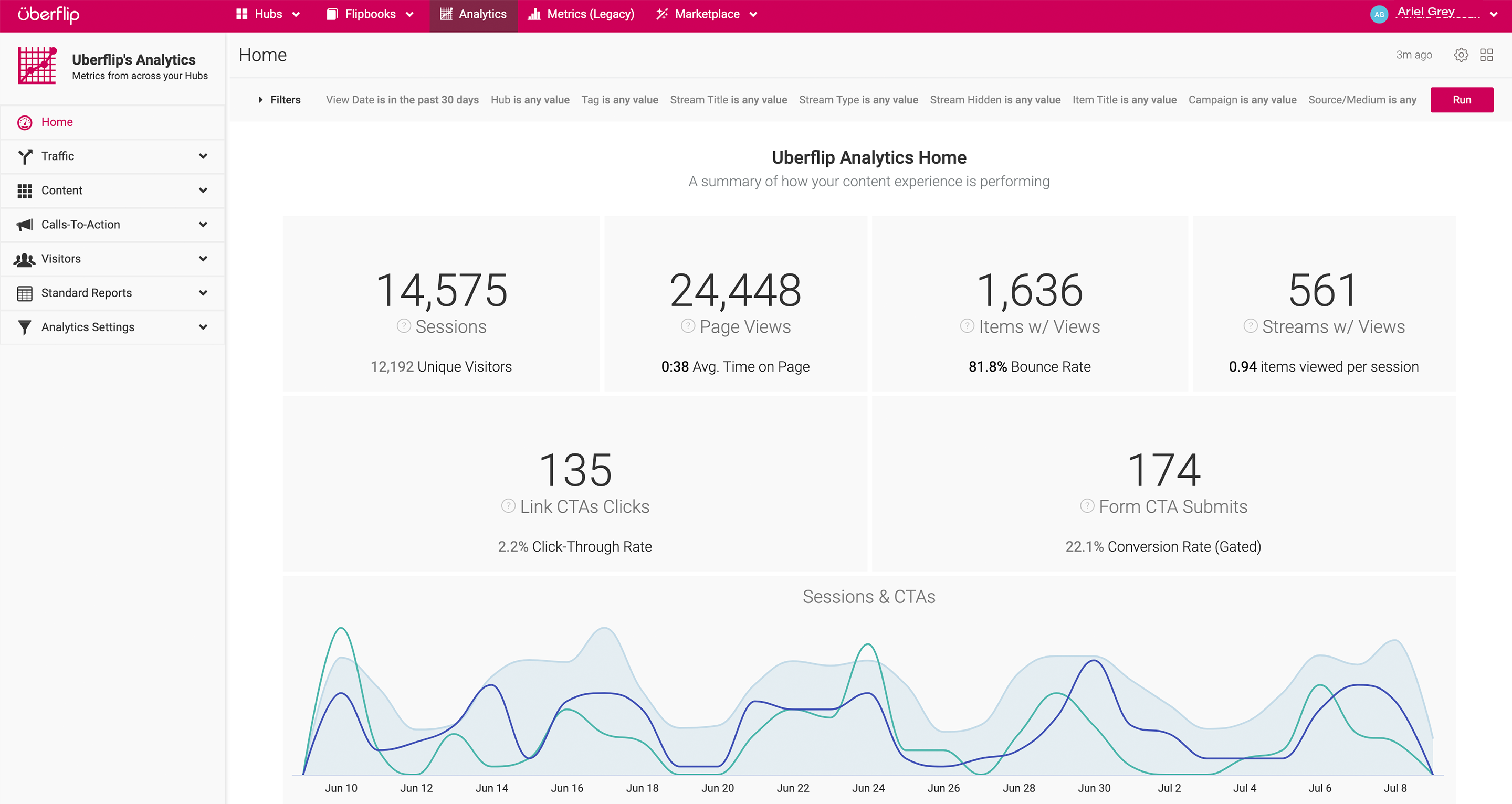
Uberflip is a content marketing platform from the Toronto company of the same name. Central to Uberflip is its content hub for aggregating, centralizing, organizing, and finally curating content for delivery to targeted audiences in streams, culminating in the call-to-action (CTA). Uberflip also contains analytics that show how effective these CTAs are (and in what context they are effective or not) so poor content can be confidently dropped in favor of what works.
For $200 monthly the user…
Adobe Experience Manager, built on Java, means that the pool of developers available to work on the platform is large. Adobe Experience Manager's front-ends and client library management tooling mean that front-end developers can feel at home despite a lack of Java knowledge.
We have selected Adobe Experience Manager for its unified compliance-ready tool kit (e.g AI-driven personalization, RBI- compliant multilingual templates) and enterprise scalability.
Verified User
Partner
Chose Adobe Experience Manager
End to end capabilities as well as integrations with upstream and downstream systems to make work flows, easier and faster time to market
Adobe Experience Manager is an enterprise digital marketing platform that has an edge over other CMS platforms in multiple ways 1. Easy content authoring 2. Pre-defined authoring and publishing workflows 3. In-built multi-site authoring 4. Support for multi-lingual websites.
Flawless management of digital assets and content supporting personalized content delivery. Seamless navigation and user experience on AEM platform WYSIWYG (What You See Is What You Get) editor makes AEM stands out from the crowd which is not available in the Drupal Headless …
First of all, I would say the technological advancement it has. AEM consists of a comprehensive web content management system, including more marketing-friendly site templates, easy-to-use developer tools, and AI-powered content generation tools for [a] better customer …
It really comes down to how much money you are willing to spend (Adobe is more) and the skill set of your developers (Sitecore is .NET vs. Adobe is Java).
Of all the different CMS tools I have used and implemented, Adobe Experience Manager (CQ) is the most robust and feature-full. The reliance on Apache Technologies was a real smart decision for CQ's architecture which ensured future scalability, testability and extensibility.
Really the only comparable product to Sitecore DXP is Adobe Experience Manager. Both are very well established and robust content management platforms. Products like Contentful and Contentstack are very lightweight and do not have as many built-in features like DXP, so it is …
I'll answer the second one because I mean, the first one I don't have an issue with. The second scenario is we oftentimes have the need to spin off very small campaign style sites or sites that generate leads but are unbranded and that sort of thing. So that's hard to do in AEM because you have to then create another organization within AEM to do that. And we're talking about sites that are maybe five to 10 pages in size. So we've been investigating Edge, but then that's a different workflow, so we'd have to train people on that. So it would be nice if there was something within the AEM structure that could allow you to do something very similar to Edge, where you make some small micro sites that are not necessarily branded, that you could still host within the platform and not have to retrain everybody on a completely different platform.
Sitecore offers Content Hub with Product Content Management and Content Management Platform. The Digital Experience Platform and Content Hub can both host structured content and publish the finalized version to Experience Edge. Both platforms offer different ways to manage content. During a technical and business evaluation, the evaluation panel must understand the difference between a Content Modelling focused approach, or a layout management focused approach. Sitecore Digital Experience Platform is also best not to be used to host many files and images in the Media Library. That responsibility should be offloaded to a digital asset management company like Sitecore Content Hub DAM. The technology evaluation panel must also understand how to work with a Headless CMS, where the HEAD needs to be hosted, and the costs associated with the HEAD. Composable DXP is fantastic, but everyone must understand the various cost components. Marketers and the data team will need to go into the CDP and Personalize the platform with an excellent understanding of how a composable "installation" works. All the Martech vendors have similar challenges that data and development teams need to work through with a full experience. Any CDP/analytics platform will, at some stage, require further data enrichment from other sources. Understanding the Sitecore Search features and limitations is also essential.
Uberflip is well suited to bring your larger organization into sharing content. Instead of relying only on marketing to be driving content, Uberflip has made it easy to integrate content into the sales process or client services process, with the ability to make the experience unique to sales or CS. Where Uberflip may not be as suited is if you are looking for landing pages to capture leads, most of the time for landing pages designed to sell a product you want to add specific feature copy and be able to place a gate over content without having a user jumping from page to page, while also having the gate capturing information and allowing you to trigger activities from your marketing automation system. Uberflip doesn't allow you to add copy or manipulate a landing page and only allows you to add information from a gate to a static list, which does not allow you to automate the process.
It allows us to scale so that we can make a change on a global footer. And it applies to all of the different property websites. It allows us to set up components and compartmentalize things in a way. The big thing is that it's scalable. And then it also ties into Adobe Analytics and other Adobe products. So we are a complete Adobe shop. Every Adobe product that we can use, we use. I don't think we do it for marketing so much, but for doing target testing and analytics, data scientists are using the same product and so it all speaks.
Comprehensive Solution: Sitecore offers a fully integrated suite of products that cover the full spectrum of DXP capabilities, including search, personalization experimentation and more, delivering a complete composable DXP solution for customers.
Beyond Headless: XM Cloud provides more than just headless capabilities, featuring in-built tools like authoring host, page editor, etc., enabling faster and more powerful implementations.
Focus on AI: Sitecore has now got an excellent AI offering called Stream; it looks promising; however, it would be too early to give feedback on the same.
Customization: Sitecore's backend is highly customizable, allowing for deep modifications through pipelines and patch configurations.
There are some glitches in permissions inheritance that require us to toggle a save on permissions in groups that inherit from a group that was recently updated.
Large packages require stopping the workflow launcher OSGi components or many workflows will slow down the server.
Locked pages are hard to find unless I use /siteadmin... I often hear that the CQ tools will go away, but if we lose that, some small things might be harder to do, like finding locked pages.
Experience Editor is a little old fashioned and sometimes slow to use.
Bulk operations in the Content Editor
Sitecore serialization is should be part of the Content Editor to provide visual reference for items which are serialized and will be overwritten by future deployments similar to what Unicorn does so well
We had and still have a fantastic experience using Adobe CQ. Lots of flexibility, great integration with other Adobe products we already use and a powerful technology make it a great fit for our corporate environment. Also as the community grows, it makes it easier to network with other developers and users to get new ideas on how to continue to get the best out of the software.
Sitecore has proven that it can deliver on its promise of a robust, reliable enterprise CMS solution with plenty of features. Also, they keep updating it with more and better features. Now that we are highly trained on it we have started on getting the most out of it and we plan to keep doing more of that in the future.
This serves all of our content marketing needs, but our sales team does need a more robust sales enablement solution. It's hard to have the engagement/usage data for different kinds of content in disparate systems. But I've looked for years and been unable to find a one-size-fits-all solution to solve all marketing and sales enablement use cases.
Adobe Experience Manager overall is fairly easy to use and caters to a wide range of users when it comes to their technical abilities. It has the flexibility to enable UI/UX designers to pop in and easily design new content with drop in components. It also has sufficient capabilities for those who are more technically inclined and want to dig more into custom code or solutions
Once you learn how to use the platform and can put a solid strategy in place to manage it long-term, it becomes a lot easier to use. The tricky part is working with resources who are familiar with the platform to navigate some of the common implementation and configuration pitfalls. Although Sitecore has worked very hard to overcome some of these from their earlier product versions by creating wizards and improving their support documentation, at the end of the day it is still a very complex and powerful system that needs to be implemented carefully in order to foster the best possible user experience for authors. So it could be rated very usable or not usable at all based on how much planning took place and the quality of the implementation.
For me this has been very easy to use. Once we got the basics down it was easily repeatable and if we did end up having questions our point of contact was very helpful and fast in getting our questions answered. If it was above their capabilities they brought in a support professional who really made it easy for us to learn and replicate their steps.
Being part of Adobe Suite means you are already notified when the tool has any outages. However, I have never faced unplanned outages. Whenever you face any issue with the site, it is clearly stated if there were any planned outages and how quickly you will be back to normal. So, I will say that even the outages are planned and managed in a great way like their other services.
With respect to performance, Adobe experience manager is one of the best in the CMS space. We didn't observe frequent slowness on platform, however the systems which are accessing experience manager should be of good specifications without which slowness would be observed. Adobe experience manager works well in integration with other solutions, unless the destination application is designed to trigger frequent calls to AEM.
Adobe Experience Manager, in all its capacity, is a great alternative to any other CMS you are using. It helps in rapid development and makes life easier for maintaining the website for multi-language sites. Technical know-how is eliminated at content authoring. Better documentation in terms of live examples with videos would be appreciated.
1. Customized software development & maintenance. 2. Technology Consulting - Consulting-based services for technology solutions data engineering or cloud solutions. 3. Used for tapping into multiple data sources such as CRM and marketing automation systems and, creating automated data extracts with a high-end visual representation of data. 4. Implemented for scheduling an existing report to automatically refresh and be delivered to specific users at a specific regular interval.
The support and the team at Uberflip is THE BEST!!! They are seriously so great. They got to know me on a personal level and really cared about getting my Hub set up the way I wanted and they want my Hub to be successful. They even took a few of us out to dinner when they were in my area for a marketing event. They are always there to help me and only a quick email or phone call away
Sitecore captures and remembers every single interaction your customers and prospects have in any part of the system, allowing you to build comprehensive, ever-learning profiles of each individual. From email marketing, to social media, to online shopping, Sitecore remembers where each interaction left off so you can automatically continue the conversation. Sitecore helps you manage your content for each and every experience your customers enjoy. Customize what content you want and the system will take care of how it's displayed.
It wasn't exactly training but there was a step by step check list of things in a project the Uberflip team shared with me. There were links to helpful articles on it that walked me through how to set things up
Depending on your individual needs, It is really quite simple to create an authoring experience for a website that looks really good. I have been part of many implementations and many teams and have seen many projects that were super successful and others that were not implemented well. AEM has room for a lot of flexibility in the implementation process compared to other CMS like SharePoint
Make sure you work with a partner that can help you take advantage of the entire platform. Specifically we see a lot of customers not taking advantage of Sitecore DMS and thus missing a huge opportunity. Sitecore is a platform that is meant to be constantly optimized and improved upon.
The implementation team was with us every step of the way, helping us map what needed to be done, providing examples of other customers and being as hands-on as we needed
SSO is one fits all, so we don't have to have a separate SSO for each application of Adobe The integration with Analytics works perfectly and bring directly value really quickly Target remains more complicated to set up, but can also bring a lot of value once integrated with the rest of the Adobe platform The fact that the solution is Cloud services is also a big advantage for maintenance
Sitefinity is improving but at the time of decision making it had nothing that could compare with the A/B testing and personalisation features that Sitecore offers. This was a key differentiator and ultimately ensured Sitecore was purchased. WordPress isn't really comparable and isn't within our technology stack, which is mostly Microsoft.
When it comes to asset management, Uberflip has a HubSpot beat. That doesn't mean HubSpot isn't necessary for other functions, but when it comes to the content itself, the backend organization, reporting (item and stream level), and delivery of the content is much more useful in Uberflip. Otherwise, they have the same learning curve.
Instead of being directly involved in the tool purchase, I am involved in analysis or what we can use to maximize the tool. Small organizations may find it expensive. However, if the team or organization focuses more on your ROI or the features you will get, then it will definitely be worth it. Pricing is based on a number of factors, including team size or the use of the tool. The user can select the pricing option that best fits their needs based on the number of form submissions they make or the number of pages they wish to publish on their global/multisite sites.
The professional services team within adobe is one of the best in terms of technical and solutioning knowledge. However, considering the billing charges of adobe professional services team, it is always recommended to involve them during platform initial setup or when a complex solution is to be built with platform customizations.
too soon to tell on increased conversion rates based on external marketing factors in play but having increased visibility into customer engagement trends will most likely lead to improvement of our conversion rates.
There have been productivity gains from the perspective of actually migrating all of our externally managed sites to the same in-house Adobe Experience Manager platform and then being able to utilize those universal components.
ROI depends on what features the customer wants to leverage from Sitecore. Sitecore is not just a CMS. It's CEP platform which comes with Analytics, Personalization, A/B Testing, and Email for marketers modules etc., out of the box.
Based on my experience some of the customers lean towards third party services. This is primarily due to lack of the understanding of these features. If a customer leverages these out of the box features ROI will be high. It depends on how much is being [sent] to third parties services.
Sitecore has very good accelerators in the market. These accelerators allows you to create response sites very quickly. If a simple campaign site takes 50K to build the site may save at least 50% of that cost. Examples of site accelerators are Brainjocks, Keystone, Cognifide etc.