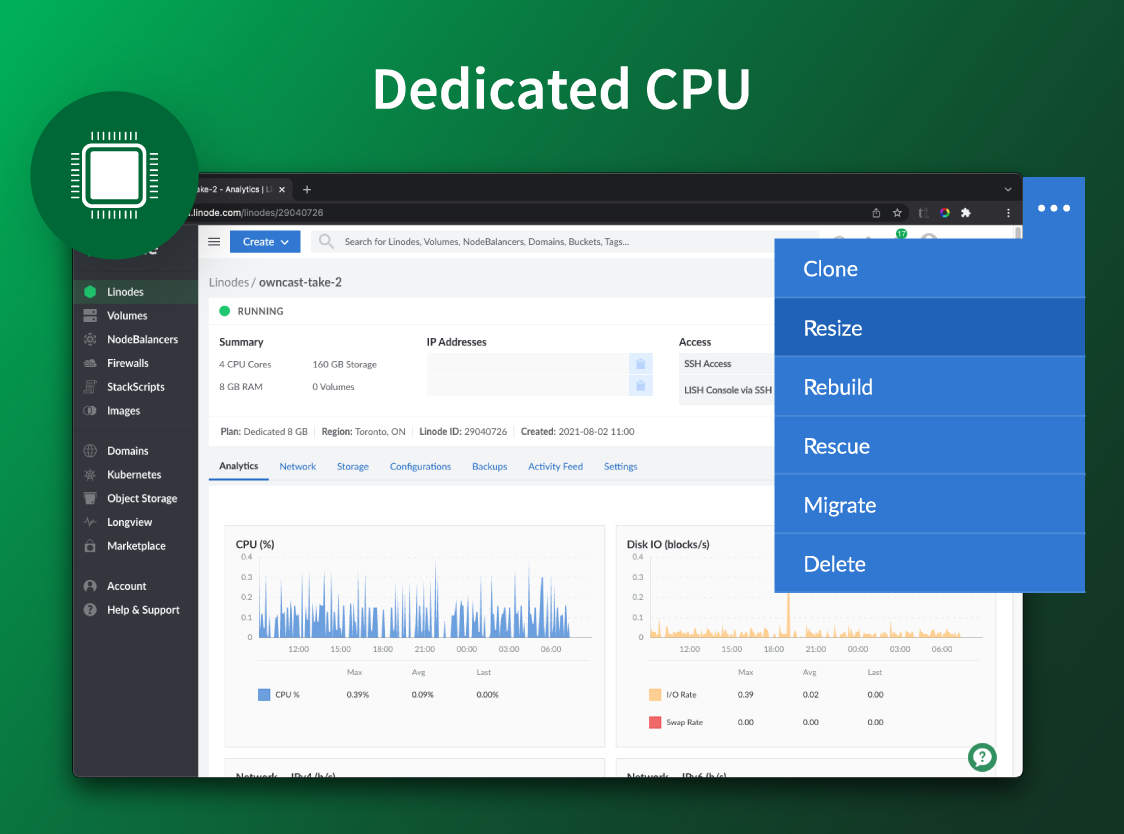
Akamai Cloud Computing (formerly Linode) include scalable and accessible Linux cloud solutions and services. These products and services support developers and enterprises as they build, deploy, secure, and scale applications.
$5
per month
GoDaddy
Score 7.1 out of 10
N/A
GoDaddy Web Hosting provides users with storage, email addresses, and unlimited bandwith.
$9.99
per month
WordPress
Score 8.6 out of 10
N/A
Wordpress is an open-source publishing platform popular with bloggers, and a content management system, known for its simplicity and modifiability. Websites may host their own blogging communities, controlling and moderating content from a single dashboard.
$3
per month 6 GB storage
Pricing
Akamai Cloud Computing
GoDaddy
WordPress
Editions & Modules
No answers on this topic
Basic
as low as $6.99
per month with an annual term
Basic
as low as $10.49
per month with an annual term
Premium
as low as $13.49
per month with an annual term
Commerce
as low as $14.99
per month with an annual term
Personal
$4
per month 6 GB storage
Premium
$8
per month 13 GB storage
Business
$25
per month 50 GB storage
Commerce
$45
per month 50 GB storage
Enterprise
Contact for pricing
Offerings
Pricing Offerings
Akamai Cloud Computing
GoDaddy
WordPress
Free Trial
Yes
Yes
No
Free/Freemium Version
No
No
No
Premium Consulting/Integration Services
Yes
No
No
Entry-level Setup Fee
Optional
Optional
No setup fee
Additional Details
CPU, transfer, storage, and RAM are bundled into one price. Storage capacity can be increased with additional Block Storage or S3-compatible Object Storage. Instant Backups can be added with complete independence to the stack. Linode NodeBalancers ensure applications are available.
Discounts available for annual subscription.
Pricing for Business and Commerce plans vary on number of GB.
More Pricing Information
Community Pulse
Akamai Cloud Computing
GoDaddy
WordPress
Considered Multiple Products
Akamai Cloud Computing
Verified User
Technician
Chose Akamai Cloud Computing
I chose Linode because of its simpler and easy-to-understand pricing structure. Deployment of nodes seemed easier as well. Another thing I may add is that Linode just seems more professional. Linode gives you a lot more flexibility and control compared to GoDaddy. DigitalOce…
I regard it the best of the bunch, Rackspace is reliable but too expensive, OVH is cheap but not that great infrastructure, Namecheap is fantastic, but i have not tested their hosting capabilities in depth, GoDaddy is, in my opinion, the worst of the worst, but they are well …
I first heard about Linode from ads in every episode of Marco Arment's podcasts Under the Radar and Accidental Tech Podcast. They also offered discount codes that amounted to extended free trials. Marco's endorsement, combined with the generous introductory free period and the …
Linode's price for performance is unmatched. The scalability and customizability of their offerings is likewise superlative. Uptime is great and they have servers in all of the places we need them. Security is on par with the rest. Their web interface is useful. Their …
Linode stands tall for Ease of Use and Developer Friendliness. The plans and pricing slabs makes it tough to resist from competition. Also as we get what we are subscribed to, unlike providers like AWS stealing our CPU during high demands, we don’t face issues due to noisy …
We chose Linode on a recommendation from a friend and we could don't be happier. We were sitting on three options, one was we put hardware into a datacenter and leased space, Microsoft Azure, and Linode. Ultimately we settled on Linode, it came at a spectacular price point for …
Setup and management of Linode services were just simpler than similar services from Rackspace or Amazon Web Services, both of which are cumbersome and confusing to the point of frustration.
We switched to Linode from Namecheap due to poor uptime, and never had any issues with stability ever again after switching. We also cut our costs in half by switching. We compared Linode to DigitalOcean and Vultr, with the primary factor that caused us to go with Linode …
While SiteGround, GoDaddy, and DreamHost all offer ease of use and work OK when they're working, their performance is not consistent. All three can become very slow for even very low traffic sites. Linode, in comparison, offers much more consistent performance and any issues …
I've tested many other hosting options... I have the feeling that Linode was superior in terms of technical profile, response time, and overall support.
For us, Linode is a level above the competition. We have tried other hosting providers and found their control panels confusing, customization options lacking, and price points far higher. The ease of use alone is a huge selling point. You can login and have a new server up and …
AWS whilst perfectly fine would require a fairly radical rewrite of the code that exists all ready to fit in with the way AWS works, and we simply don't have the resources for that sort of rewrite and learning how to use AWS in general as it is very complicated. Linode by …
GoDaddy compares well to other options and the tool used for building or updating the site content is relatively easy to use and problem-free. WordPress may have more options as far as templates are concerned, and we sometimes run into those constraints with GoDaddy as far as …
We had considered Wix before selecting GoDaddy, however, it did not seem as easy to use, especially the website templates. The features we needed for the company website were not all readily available in Wix, so we finally chose Godaddy & WordPress hosting for the website. The …
Whenever new clients come to me for website development, I begin our relationship by asking about domain registration and website hosting. I cringe when they say they use GoDaddy and often warn them that additional time and effort may be required to accomplish their goals. …
GoDaddy is able to be integrated from these various platforms. I haven't used much of other services such as Host Gator, but GoDaddy's relative ease of use makes it a relatively simple platform for your small business needs. It does not quite plug and play, but it's not too far …
I mostly went with GoDaddy because they had a regional presence and it offered regional pricing. Also, I had used their support and they really impressed me. I was just beginning website set up and it was important to me to make sure that if things weren't working properly that …
We tried putting one of our internal sites on Namecheap hosting. So far, it's fine. We don't have a lot of traffic to that site anyway, and aren't really needing much in the way of extra services. We primarily use Namecheap for SSL certificates, but GoDaddy is proving to be …
We selected GoDaddy for its brand awareness. Everyone knows of them and there had to be a reason why, right? Other products were much easier to use and much less costly.
I think that GoDaddy is better than both of the companies mentioned above. I've used both and even though the platform for GoDaddy can be a little annoying 1&1 is far worse. Overall it's a pretty good site for hosting and domains, I just prefer to have my own server on Google …
I chose to go with Godaddy because they've been in this space since the 90s. They are a larger organization with over 6k employees worldwide so they're not going anywhere anytime soon. I needed reliable hosting, domain name, and great customer service and Godaddy has provided …
If you want to host your a little mom and pop shop's website, any host will do. Use Bluehost or one of the many other CPANEL hosts out there. If you're in the buisness of doing serious web applications or hosting significant products or sites, then go with Rackspace or AWS. I'm …
I never selected GoDaddy, but when a client doesn't want to upgrade, I won't force the issue. If a client wants a fresh build and are severely budget-constrained, Weebly is my recommendation. Having the money for a quality WordPress build but no stomach for monthly expenses …
To work with WordPress your company needs a developer, no matter what. Unless you have the experienced developer in house, you will need one. Squarespace is superfriendly and easy to work. Has all the features for a simple and clean website. WordPress lacks this part.
I am the biggest fan of WordPress compared to others I've tried because you can further customize and edit your site to your liking. The others feel less intuitive and more cumbersome to update. You need to know more CSS/HTML coding in order to make a change to the other sites. …
It's the best option for hosting a blog on a website where you can also integrate all major marketing tools and platforms. WordPress gives you [the] freedom to use whatever tool works best for you and integrate it with your website and blog. It makes tracking, measuring, and …
It is the best and free platform if you compare others and if you will use WordPress you don't have to know how to code. Basic information will be more than enough to start. Creating pages and editing posts you created is so easy to manage. If you use other platforms, it will …
There are other CMS and website builders in the market and while they do offer their own value, their number of developers, ability to customize and add functionality to the site, is very limited as well as their number of themes. They can't compare SEO-wise, and you can't …
Akamai Connected Cloud Linode would be a good service to host a content delivery network (CDN) because of its edge network but I'd prefer not to use Akamai Connected Cloud Linode for tasks that need GPU power such as Machine Learning or Artificial Intelligence (AI) because Akamai Connected Cloud Linode lacks deep GPU compute compared to AWS or Google Cloud or Microsoft Azure
Good for transferring over an existing site. Truth be told, I haven't used it for building a brand new site-- I know that this is a fairly common thing but I just never needed it. For what I've used it for, it has worked well. For a small business with anyone with a little bit of technical skill, it's surprisingly good.
Wordpress is a great solution for a website of nearly any type. It may not be as suitable if a fully custom solution or app is needed, and it does have some limitations when it comes to connecting it to external products (especially if the product doesn't have any support from a native system), and it does require a lot of testing. Multiple plugins in one install are common but also increase the risk of conflicts, and when those do occur, it can be exceptionally time-consuming and tedious to identify what is causing the issue. As third parties create many plugins, you're also at risk with each potential security breach, which needs to be kept in mind. I would be cautious to use WordPress to store any sort of sensitive PPI. That said, it's a wonderful, easily customizable solution for many, many different types of websites and can allow even inexperienced client users with low-tech knowledge to update basics.
WordPress breaks often so you need to have someone who understands how to troubleshoot, which can take time and money.
Some plugins are easier to customize than others, for example, some don't require any coding knowledge while others do. This can limit your project if you are not a coder.
WordPress can be easily hacked, so you also need someone who can ensure your sites are secure.
I've been with them a long time. They provide me with the capabilities I need coupled with knowledgeable support that's not pay-for-extra. However, if I move to a non-Linux OS, the level of support by necessity will drop off. I can still ask questions about the infrastructure but I my ability to ask about OS features will decrease.
We can't really choose anyone else and the cost/effort of moving all of the hosted data would be extremely large, and we just have to stick to them, and hope they improve service
The complications we have and the lack of support. Every plugin has a differente team of support in charge and make one plugin work with the other one always affects the website performance. It's a thousand times better to have only one provider with all functionalities included unless you are an expert web developer or have a team dedicated to it
Simple and clear, no BS interface. From a design perspective it's no Apple or Stripe, but it does what it needs without making me want to stick a fork in my eyes, like when being forced to use Azure, AWS or GCP.
Extremely easy to use and train users. It took very little time to get everyone trained and onboarded to start using WordPress. Anytime we had any issues, we were able to find an article or video to help out or we were able to contact support. The menu options are well laid out so it is easy to find what you are looking for.
There is very little planned downtime. Whenever planned downtime is necessary I'm always given lots of advanced notice and an explanation that I can pass along to my users that they'll understand. I really appreciate that Linode appreciates my commitment to reliable service to my users. It shows that they believe they've been successful when I'm successful.
Anyone can visit WordPress.org and download a fully functional copy of WordPress free of charge. Additionally, WordPress is offered to users as open-source software, which means that anyone can customize the code to create new applications and make these available to other WordPress users.
Servers are well dimensioned and price performant. Of course one always wants more, so if they were to upgrade their hardware for the same price I'd consider moving more workloads. Networking - never had an issue. Hardware speeds - disks are fast and can grow to great size.
Mostly, any performance issues have to do with using too many plugins and these can sometimes slow down the overall performance of your site. It is very tempting to start adding lots of plugins to your WordPress site, however, as there are thousands of great plugins to choose from and so many of them help you do amazing things on your site. If you begin to notice performance issues with your WordPress site (e.g. pages being slow to load), there are ways to optimize the performance of your site, but this requires learning the process. WordPress users can learn how to optimize their WordPress sites by downloading the WPTrainMe WordPress training plugin (WPTrainMe.com) and going through the detailed step-by-step WordPress optimization tutorials.
Support was excellent and fast. The documentation is extensive and helpful. I learned many things from their online documentation. I did not contact them by phone, but email took a day or less. Complex problems would probably need a service contract. I liked the friendly and polite tone of the support.
I give this rating, which I believe to be a great rating for a community based support system that's surrounding it. Most platforms and products have their own, and as WordPress does have their own team that help here and there, a lot of it's handled by community involvement with dedicated users who are experts with the system who love to help people.
Varies by the person providing training. High marks as it's incredibly easy to find experienced individuals in your community to provide training on any aspect of WordPress from content marketing, SEO, plugin development, theme design, etc. Less than 10 though as the training is community based and expectations for a session you find may fall short.
We got kick started with an initial walkthrough along with some free credits. The initial walkthrough helped us to understand Linode's ecosystem and start our hands on with Linode. We tried out some apps from Marketplace initially with the free credits, which not only helped us understand Linode better, but also those apps. We had implemented many such apps to our customers with Linode
We're a small organization. The implementation of our Linode solution was trivial. Once I justified a cloud server to my bosses over a co-location -- the co-lo wasn't as fast as our linode server in load tests -- it was a matter of moving one Linux implementation to another. Trivial.
WordPress is not a great solution if you have: 1) A larger site with performance / availability requirements. 2) Multiple types of content you want to share - each with its own underlying data structure. 3) Multiple sites you need to manage. For very small sites where these needs are not paramount, WordPress is a decent solution
We switched to Linode from Namecheap due to poor uptime, and never had any issues with stability ever again after switching. We also cut our costs in half by switching. We compared Linode to DigitalOcean and Vultr, with the primary factor that caused us to go with Linode initially being their documentation. After using Linode for 3 years, their amazing support is another reason why we wouldn't consider anyone else at this point.
We use Wix currently for our online store. It is nice and easy to use, but they don't offer the email domains as well (the last time we checked). They have pretty decent customization of the web page, but still limited. We're going to try it with GoDaddy, since we have other services from them already. It just doesn't make sense to pay two different companies for something we can do with one.
WordPress isn't as pretty or easy to use as certain competitors like Jimdo, Squarespace or HubSpot, but it makes up for it with its affordability, familiarity and the ability to find quality outside help easily. The same can't be said for certain competitors, as you might need to find an expert and it could get costly.
Although I use only a fraction of their product offerings, the total set makes scalability an easy goal to shoot for. As I said, I have a few customers that use the services my Linode provides...and I like it that way. However, should I need to scale up, I can...without incurring any more cost than I need to.
WordPress is completely scalable. You can get started immediately with a very simple "out-of-the box" WordPress installation and then add whatever functionality you need as and when you need it, and continue expanding. Often we will create various WordPress sites on the same domain to handle different aspects of our strategy (e.g. one site for the sales pages, product information and/or a marketing blog, another for delivering products securely through a private membership site, and another for running an affiliate program or other application), and then ties all of these sites together using a common theme and links on each of the site's menus. Additionally, WordPress offers a multisite function that allows organizations and institutions to manage networks of sites managed by separate individual site owners, but centrally administered by the parent organization. You can also expand WordPress into a social networking or community site, forums, etc. The same scalability applies to web design. You can start with a simple design and then scale things up to display sites with amazing visual features, including animations and video effects, sliding images and animated product image galleries, elements that appear and fade from visitor browsers, etc. The scaling possibilities of WordPress are truly endless.
GoDaddy reduces our ROI by costing me in non-billable hours. I don't charge clients for sitting on the phone with tech support to power cycle the server or fix the php.ini file, so my $/hr takes a hit.
Their nickel&dime strategy requires I have an additional conversation with clients about their max recurring fees. Small as they are, I need approval for upping their bill. GoDaddy is only the cheap option if you don't value security, stability, or performance.