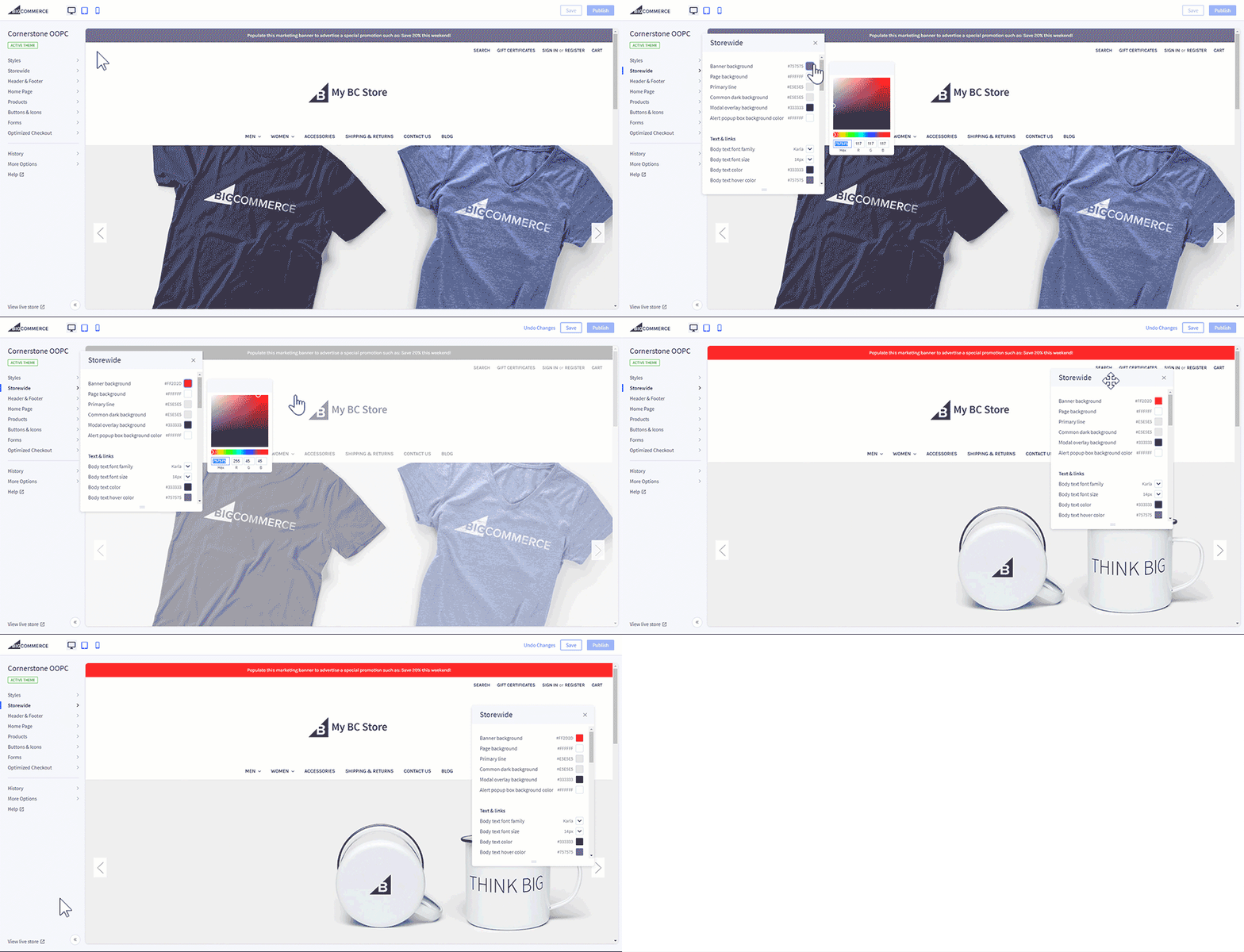
BigCommerce is a SaaS platform that allows SMBs to develop eCommerce sites. Features include the capabilities to design the storefront, configure products, manage payments, generate traffic, and optimize conversion.
$39
per month
Agentforce Sales
Score 8.8 out of 10
N/A
Salesforce' Agentforce Sales (formerly Salesforce Sales Cloud) is the company's flagship CRM platform. The AI CRM for Sales features data built right in.
$25
per month per user
Volusion
Score 4.8 out of 10
N/A
Volusion is a cloud-based ecommerce solution from the company of the same name in Austin, TX. It features an intuitive dashboard, built-in marketing and promos, SEO, templates, and tools to customize look and appearance.
I didn't select BigCommerce. I did use Shopify in a previous role, and they are very similar. Shopify might be a half a step ahead, but BigCommerce is cheaper.
BigCommerce does not stack up well against solutions like Shopify, and we are moving away from BigCommerce as a result. There are virtually no meaningful features that BigCommerce offers that Shopify does not, however there are a plethora of functions and capabilities that …
Pricing is much more reasonable than our previous experience, in addition we can manage in house so that's a great benefit for a small business. Building the site was simple and manageable.
BigCommerce is fully hosted SaaS product which handles the security, performance and upgrades whereas others need my intervention. It has strong built in B2B features that may be lacked in other platforms such as WooCommerce. It has strong APIs and ecosystem of integration …
When you look at the landscape of e-commerce platforms, BigCommerce really sets itself apart by being built for serious growth from day one. While Wix is great for simple drag-and-drop projects and Shopify excels at getting a basic shop live in an hour, they both often hit a …
Ability to handle Large catalog is a big advantage BigCommerce provides strong Headless Commerce Support to the merchant. Faster Implementation time with lower total cost of ownership.
Overall BigCommerce has a great price point and functionalities vs Shopify. We also use WooCommerce for certain situations and appreciate its flexibility and WordPress but BigCommerce is great for some of our main retail sites for which we want minimal maintenance tasks, and a …
BigCommerce is much better than Squarespace in terms of providing more powerful e-commerce tools and allows more integrations especially payment processors. Shopify although a great product is just simply much more expensive than BigCommerce.
When we compared BigCommerce to Shopify Plus, we found that BigCommerce had better SEO benefits available without needing an additional paid app to control it. We were also able to manage listings and orders more efficiently with better value for money. Shopify Plus offered …
Each platform has its pros and cons. However, overall, BigCommerce is the most challenging to work with from a developer's perspective. Simply finding files and locating the code in the theme editor takes too much time.
- Ease of Use: With guided onboarding, BigCommerce enables us to manage stores independently within days, reducing the need for extensive technical support.
-Comprehensive Built-In Features: BigCommerce provides a wide array of native features, minimizing reliance on …
Although k-eCommerce may be a good fit for businesses who's ERP is Microsoft NAV Dynamics, we found the application to be cumbersome and lacking user friendly functionality as compared with BigCommerce. The k-eCommerce support was poor, impersonal and lacked situational …
I personally prefer BigCommerce over Shopify. Shopify is more confusing to use and takes longer to get a site up and running. Shopify also seemed to heavily lack some needed bulk editing tools that bigcommerce has. The only thing I preferred about Shopify was that it had more …
BigCommerce has more built in options than Shopify. While shopify has lots more apps that are available and a lower initial price. The use of third party apps is good to have lots of options but each option needs to be vetted and dealt with independently. They greater number of …
Big Commerce is definitely king in comparison to EvoX. Not only is Big commerce easier to use, it's also just a more powerful platform with many more capabilities (for example, EVOX has analytic capabilities but, nothing to the extent of Big Commerce's google analytics …
I find BigCommerce easy to use from a non computer person stand point. It was easy to quickly get adjusted to and what they charge for building and running a website far surpassed there competitors.
We deal in firearms. I tried Shopify first back in 2016 and that was a miserable mistake, very firearm NOT friendly there. Then we went to Volusion the next month and we were quite happy there for 7-1/2 years and several million $ in sales. The issue is Volusion was losing …
Based on my experience, I’ve used Odoo — it’s an open-source ERP system. It’s not exactly the same as Salesforce or Sales Cloud, but it serves a similar purpose. And I feel that Sales Cloud is better. Personally, I find it easier to use and better than what Odoo offers, …
Over the years, I’ve helped many people move from different sales solutions — like Dynamics, HubSpot, and Act, which was one of the first ones. I’ve supported a lot of organizations in moving from those platforms to Salesforce.
So I've evaluated, implemented Microsoft Dynamics in the past. I've used Oracle CRM solutions. I've used Daylight, which is a very niche CRM system the last couple of years. And I've evaluated a variety from Legacy Microsoft Ones to Zoho and Sugar when making implementation …
Actually, we have not. By the time I joined my company, we already had Sales Cloud. It was already there and the decision was made. I'm sure that there were other small companies that the upper management team evaluated very quickly, but they came to a decision very quickly. I …
Raiser's Edge, CSING. Those are the primary ones. There's no competition at all. I mean, in terms of tracking duplicate contact, I mean contacts ability to be secure and provide the right access for different levels. Salesforce was able to do that. Oh yeah. Yes. Whereas the …
We have used HubSpot and we have used jojo CRM. So the customer who cannot afford the licensing model of Salesforce, jojo CRM is a very good platform and another for assembly level, hub Spot does the work as well.
Salesforce is magnificently more robust and functions much better when managing complex sales cycles with multiple individuals and products. With simple sales cycles and few products, Excel is a strong contender.
Salesforce CMS stacks up as a Customer management system because it has a more user friendly snd intuitive interface. The UX is better and more modern. It can be customised and extended. There are always learning opportunities and updates for the system so it keeps on …
Salesforce more so compliments these products, rather than stacks against them. We don't have any products similar to Salesforce CMS, so in lieu of that, these are the products we were using that mesh the easiest with Salesforce CMS in terms of proceeding through the …
In my opinion, Salesforce CMS is the most complex of these offerings, and probably the most complex platform of its kind. It was selected by another stakeholder - I would likely have chosen something less expensive and more intuitive to use. The robust feature set is amazing, …
We used the Catalyst product of Totango. It was not great as it was hard to navigate, and it did not offer any reporting capabilities at all, nor did it speed up our day-to-day tasks.
We selected Volusion originally because of the price point, but we had NO IDEA how much we would be spending in excess to actually get the functionality that was sold to us by their salesmen and women. We are switching to BigCommerce this spring.
I've also used Shopify as a base platform, as well as Magento. Both are better. My company has looked into moving there twice since I've been here, and the only thing stopping them is the complications of making such a move. I think Shopify offers similar value for the money …
Again, we work with all of these platforms, not just Volusion. However, we do make recommendations for Volusion based on the size of client and the need for additional customization and tuning. For clients who lack major development resources in house to maintain a platform …
Volusion provided the best overall list of features, performance history, and bang for the buck. By not being the new kid on the block, they have worked out a lot the bugs and kinks that plague many ecommerce platforms. They've also refined a system that is very user-friendly …
I would say overall Volusion offers very similar solutions to these other platforms. One of the main reasons I went with it over others was my experience working on Volusion stores for years before we opened our own stores and took on new clients. I'm comfortable with the …
We use Shopify and while the monthly fee is slightly higher than Volusion, working within Shopify and the visual results you get...it's not even close. Volusion seems very outdated and overcomplicated, but looking for positives with Volusion, again, I'm paying an additional $40 …
Verified User
Anonymous
Chose Volusion
We use Yahoo for our wholesale division and I found it to be very difficult to use and their customer support was terrible.
In comparison, we selected Volusion for our retail web store because it was much more intuitive, gave us more design options and the customer support was …
Verified User
Anonymous
Chose Volusion
Volusion blew Miva out of the water. Magento allows for more customization without having to use 'partners' which helps keeps the cost down but requires a great deal more technical knowledge to create and maintain.
I've used Magento and Zen Cart. I think that Volusion is better for the nontechnical people and it comes with a lot that Magento would make you buy or code an extension for.
Volusion makes the creation of a store a simple process even for a beginner. More importantly, for advanced users it allows to work fast, efficiently, and with efficacy due to its bulk import/export functionality. Shopify is aesthetically pleasing and Magento is an open source …
While K-eCommerce was very glamorous to us because it integrates with our main workflow, it just didn't have some of the marketing features that are so integral to the way we do business online. The set-up costs were also way too high. Volusion is so affordable and feature …
Big Commerce is great for managing our items for sale all while serving as a home base for our customers. - Whether they want to buy PPE, learn about PPE or have any questions or concerns, they know they can come to our site and get the service/product they need!
In the end, I think we can always make it fit — and that’s one of the powers of Salesforce. Because of its flexibility and wide range of possibilities, you can really make it work for almost any need. The key, though, is to make thoughtful decisions upfront and plan carefully how you set it up. If you do that, you’ll end up with a truly flexible and effective system.
For a small business in need of a few more tools than basic platforms, Volusion is a good option. However, if you want infinitely customizable [tools] or to have multiple integrations extracting your orders and products data, then Volusion is quite limited. Additionally, if you lack in-house development teams, Volusion is a good product that is friendly for users who are not necessarily tech-savvy.
Easy to Use. Non-technical employees can be simply trained. If you can use a social network, you can manage the backend of Volusion.
All-In-One -- without any add-ons, Volusion is a turnkey solution for eCommerce. No programming knowledge is required, no modules are needed (unless you have very advanced needs), and it features everything from website text, products, email marketing, customer accounts, shipping calculations, and back-end payment and order processing.
Allows for inventory tracking (such as Small, Medium, Large or Male/Female)
Allows for kitting (creating product bundles, up-sells, add-ons, and more)
Easy to customize -- with a little HTML knowledge, you can easily customize the free templates included in Volusion to create a personalized, dynamic web presence without the need for hiring expensive designers
Provides a great experience for the customer. Everything from search results, product display, shopping carts, wishlists, and the actual order process are delivered in a professional manner that will keep your customer feeling confident about making their purchase.
Easily integratable with Google Analytics with Sales Goal tracking -- this allows you to see where customers are coming from, what they are looking at, what they are purchasing, and when they are abandoning their carts.
I’d say the only thing that can be a bit tricky — and I know Tableau helps address this — is that sometimes we’re limited in how deep we can go with the data in terms of reporting. It would be great to have a bit more robustness within the app itself. However, we’ve figured out our workarounds, and overall, I think it’s a fantastic product — which is why I’ve been working with it for 23 years.
Feature implementation. While they have a ton of features, they're often released haphazardly in my opinion. Sometimes it seems like they don't have testers. Typically, I'm unable to use new features until about 6 months after they're released (and over a year after I asked for them) because it takes that long to get the quirks smoothed out well enough for us to use them. It seems that they often don't understand programs that they integrate with well enough to do a proper implementation.
Timeliness of features. This can be taken with a grain of salt for many looking to compare. I'm a super-experienced user with many, many needs. We're often limited when it comes to Google (and other platform) beta programs, and even just early adoption because I have to wait for Volusion to catch up. What's tough is that I often NEED them to make a change in order for me to move forward, it's not my own limitation (but that's what you can expect when you use a third party software to run your site rather than your own team of developers).
Customer service in regards to live chat. While I LOVE that they have live chat (I'm needy, I constantly need support) - the operators are rude 75% of the time. They come into the conversation assuming I have no idea what I'm talking about and have a 'customer's always wrong' attitude. I'm sure it's frustrating to deal with ecommerce customers who don't know the first thing about websites - but I'm not one of those and I deserve respect. Our conversations nearly always begin with "Clear your cache" and "I don't see the problem" from the operator and end in "Oh, you're right. Well I don't know." from them. I will say I've dealt with one or two who actually know what they're talking about. Live chat is useless when the operators know less about the software than I do.
Slow to updates. They are often way behind when it comes to development and code. Example: They use jQuery v 1.4. We're up to 1.10 now and I'm experiencing issues for which the blame has been passed back on to me. I'm keeping up. They should be too. For me personally, the quality of development should come first. THEN worry about all of those features.
New live editor. It's seen a lot of scrutiny, which you'll find easily by Googling. My problem is that I don't need a WYSIWYG. I write in html. You have to pass through the WYSIWYG to get to the html editor. This has caused my javascript to get executed, so once I get to the html editor, I have to re-write my script because it's now shown as the execution. That's poor development. They should have an option to disable.
Inability to access pages in FTP. If you are someone who needs customization and writes in html, have fun. You can't actually access your product or category pages unless you do it through the content editors. You can absolutely access & edit your template and css files. But if you need a unique header in a product page - say a script to run, you'll have to put it in the template - adding overhead to ALL of your pages. The only workaround is hard-coding pages as "articles," which can make a mess of things.
BigCommerce is a great platform! It does the job and has a very good API set. I would definitely recommend it to others, but I would warn them about the cost associated with BigCommerce. There are lower cost solutions, but definitely not as feature rich as BigCommerce. It's definitely not perfect, and has a few wrinkles to iron, but nothing is ever perfect. It does the job for us and I do enjoy using the platform!!
There are days when I wish we hadn't switched, but I know that if we put in the time, we will get to where we want to be with the software and that it has many more capabilities than anything else we looked at. However, the amount of time and onboarding we need to do is also far greater than we realized/were told when we originally bought the product. They told us we should hire onboarding support, but at the end, after we had already reached our budget maximum for this, so it's been slower than we had hoped.
When you spend so much time with a product like this and not only have you witnessed its growth, but you almost feel like you are next those that make the decisions of building features a certain way, you can't help but want to stay and be a part of their continued growth. It's simply a great product. Can it improve? By all means! But it will only improve because of users and avid resellers like me.
I think that overall it has a great front end for the customer. On the back end, it takes a little spin-up time, but in just a couple of hours you can really have your head wrapped around everything you're going to need 99% of the time. It takes me about 5 minutes to train a new user on how to interact with customer orders.
All in all, it's a great product that use all day, every day. It's aesthetically pleasing overall and specifically provides information in a clean, concise way. It's easy to manipulate and seems to play well with the other products I use such as Pardot, Gmelius, and our company's proprietary data system. It increases my efficieny in my admin tasks so I have more time to focus on revenue-generation and account management. It's also easy to use from everywhere where it be on a university campus, in a hotel room, one of a million Starbucks, or at home
So far in my time with BigCommerce I have not had any down time when it comes to my webstore or accessing it at any time I need to. Knowing that they have such a good uptime, it makes me feel comfortable that my customers can access things anytime, but also keep sales going 24/7
All Force.com apps run on world-class data centers with backup, failover, and disaster-recovery facilities. Force.com has had a proven 99.9 percent uptime record for years. Accordingly, I only recall our instance of Salesforce having one unscheduled, brief down time over 6 years. I can't remember for sure, but it may have been due to our Internet Service Provider (ISP) versus Salesforce itself. Also, Salesforce does it's best to keep customers in the loop:
Trust.salesforce.com is the salesforce.com community's home for real-time information on system performance and security. On this site you'll find:
Live and historical data on system performance Up-to-the minute information on planned maintenance Phishing, malicious software and social engineering threats Best security practices for your organization Information on how we safeguard your data
I have not had any issues with pages loading slow or any real other issues, not that I have encountered so far. Speed of the site and images loading are fantastic and everything just seems to work nicely, which may seem like a simple thing to say about things, but when something just WORKS! Its rather nice vs fighting with things to work right.
For a SaaS provider, I'd rate their performance to be one of the best. At times, reporting tends to slow down if the data set is very large, which is the case in any system. But, that's a very rare phenomenon
Because they are always there no matter how simple or complex the question is, if they don't know the answer they don't fake it and just make you go away feeling frustrated.. they get you to someone that does know the answer. I always appreciate their help and their honesty!
The overall support has been good. More and more features are being released quite frequently. Very small features are also making big difference in how the tool can be adapted and used better. If there is anything we need or are stuck, the support team sets up a call and helps in resolving the issue/provides workarounds.
You have to wait on hold for at least 45 minutes every call—the tech support person never knows the answer right away so they put you on 10 minute holds only to come back and say they're still looking for answers. The chat function could take days to get a response. Our "Dedicated Account Manager" never checks in or answers, nor are they ever in the office when we call. It's like they try to be as unavailable as possible until you forget why you even called in the first place. Insane.
I attended two training sessions. I would rate them a 4 as an advanced user. It was very basic – great for someone new – would give 8+ for new person.
I had 3 years of experience at the time. I skipped basic and went onto advanced and still not helpful. A lot of it was best practices that didn’t feel relevant for our business
They have a comprehensive online help file system that makes it easy to do almost anything. They cover just about everything you'd want to do with your online store with images, clear descriptions and in some cases video. I will, however, say the videos should be a little more professorially done and not sound like the employees are doing it in their cubical.
I have gone through multiple. The content that’s delivered is quite basic – I wish they had more advanced training.
We are grandfathered into premium support plus training. We get unlimited access to instructor led and online training for free. We have taken advantage of this
A certified BigCommerce design and solution partner will usually comprise a team of highly experienced designers, developers and marketers. It is our view that in the vast majority of cases, this will pay dividends in the long-term - especially for those teams that could use the extra support.
Just from an organizational standpoint - we standardized our data prior to moving to Salesforce. But we essentially standardized it wrong. That's created a big disgusting mess for us know that I'll have to deal with as the Admin. Be sure you think through use cases prior to doing something like that - seek outside opinions on how the data will work best, especially depending on what else you're going to integrate with Salesforce.
It is best to use the built-in features and recommended services for the most turn-key experience (ie. Skipjack for payment processing so that it can all be done from the Volusion backend).
When you look at the landscape of e-commerce platforms, BigCommerce really sets itself apart by being built for serious growth from day one. While Wix is great for simple drag-and-drop projects and Shopify excels at getting a basic shop live in an hour, they both often hit a "plugin wall" where you have to keep paying for third-party apps just to get standard features. BigCommerce, on the other hand, packs those advanced tools—like faceted search, customer groups, and multi-currency support—directly into the core platform. Compared to WooCommerce, which gives you total freedom but leaves you responsible for all the security patches and server maintenance, BigCommerce offers that "Open SaaS" sweet spot. You get the stability of a hosted platform with the flexibility of open APIs. Plus, the fact that they don’t charge transaction fees regardless of which payment processor you use is a massive win for the bottom line. It’s essentially enterprise-grade power without the usual enterprise headache.
Based on my experience, I’ve used Odoo — it’s an open-source ERP system. It’s not exactly the same as Salesforce or Sales Cloud, but it serves a similar purpose. And I feel that Sales Cloud is better. Personally, I find it easier to use and better than what Odoo offers, especially in terms of customization and achieving business objectives. That’s where Salesforce Sales Cloud really stands out in comparison to Odoo.
I've also used Shopify as a base platform, as well as Magento. Both are better. My company has looked into moving there twice since I've been here, and the only thing stopping them is the complications of making such a move. I think Shopify offers similar value for the money with a cleaner albeit more minimalist look. Both are better options in my opinion. I would only recommend Volusion if someone had used it before and doesn't plan on making it a crucial part of their business plan.
I believe after seeing all of the parts of this platform, one is able to develop the business and keep adding on select features for the business. There are multiple options for purchase with the various platforms once the business grows more. The different features being offered by the platform can lead us to scalability.
It's very scalable as it has a ton of features (but you do need an admin who understands how to leverage these features). Because of the various features, we've also needed to host onboarding sessions with our users so that they can familiarize themselves with the platform, which isn't always super user-friendly or intuitive.
It helps us achieve our objectives, especially now with Agentforce — we can get more insights to help our sellers sell more. It’s really nice because it’s almost like you can use the standard part of Salesforce to train your agents and teach your sellers how to improve their sales. So that’s really nice.
Increased product database efficiency. It's really easy to import and export products/categories. Has likely saved us hundreds of hours.
Integration with other platforms. Integrations with comparison shopping feeds, email auto-responder tools and fulfillment tools is quite easy. This saves us on the cost for custom integrations.
Because it is a hosted solution, Volusion takes care of all the PCI and other security compliancies. Not having to monitor this and update ourselves saves money and gives us piece of mind.