Google Analytics is perhaps the best-known web analytics product and, as a free product, it has massive adoption. Although it lacks some enterprise-level features compared to its competitors in the space, the launch of the paid Google Analytics Premium edition seems likely to close the gap.
$0
per month
Smartlook
Score 8.6 out of 10
Small Businesses (1-50 employees)
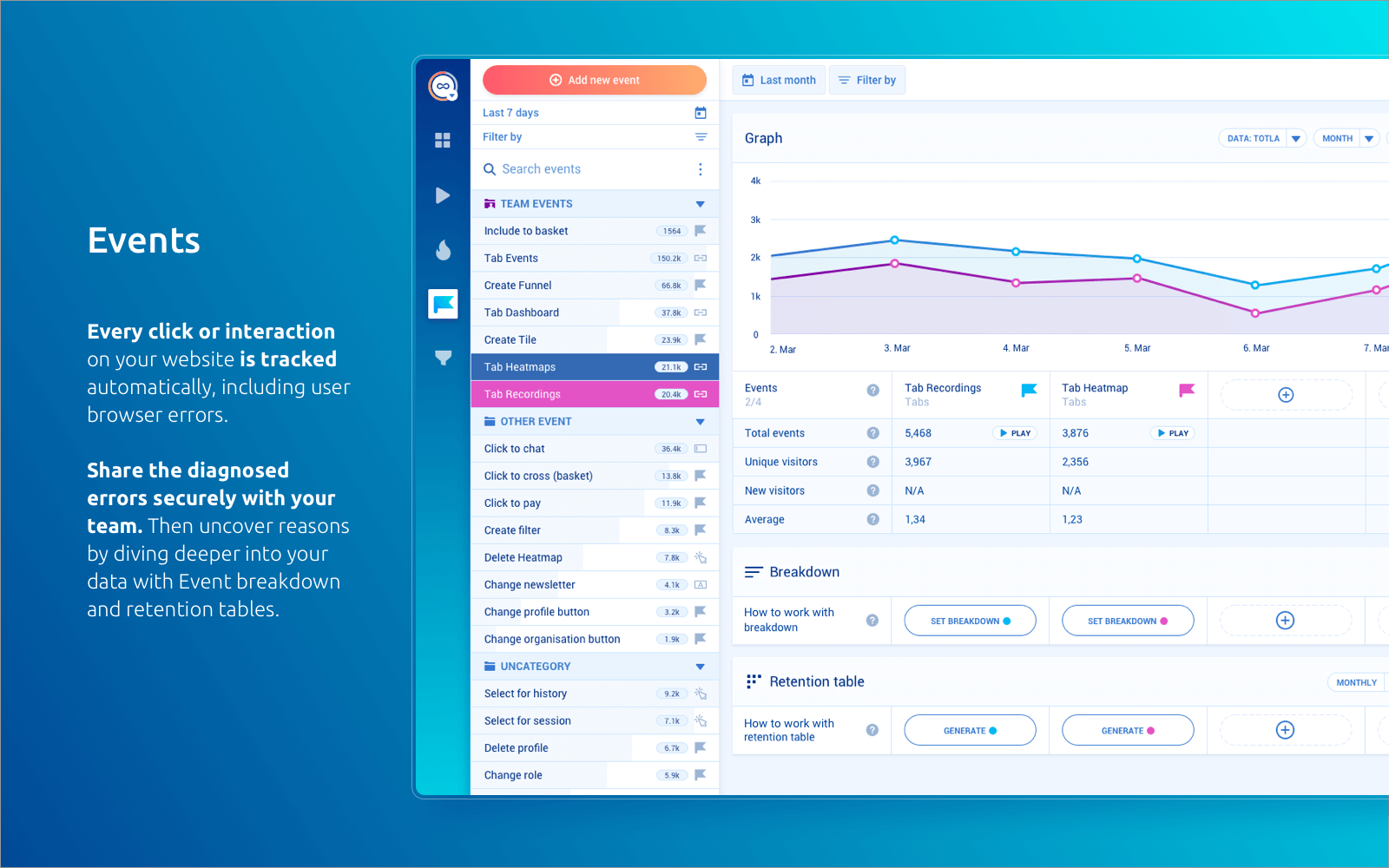
Smartlook is an analytics solution tool for websites, iOS/Android apps, and various app frameworks, that answers the "whys" behind users' actions. It helps users understand precisely how customers interact with website and app — watch recordings, create heatmaps, use automatic tracked events, and build conversion funnels. Data is seen on one central dashboard, which enables sharing and collaborating with colleagues. This is to support clear, data-driven decision-making for product managers,…
$55
per month 5000 sessions
Pricing
Crazy Egg
Google Analytics
Smartlook
Editions & Modules
Crazy Egg
$24.00
per month
Google Analytics 360
150,000
per year
Google Analytics
Free
Pro
$55
per month 5000 sessions
Free
Free forever
per month 3000 sessions
Enterprise
Custom pricing
Offerings
Pricing Offerings
Crazy Egg
Google Analytics
Smartlook
Free Trial
No
No
Yes
Free/Freemium Version
No
Yes
Yes
Premium Consulting/Integration Services
No
No
Yes
Entry-level Setup Fee
No setup fee
No setup fee
Optional
Additional Details
—
—
All Smartlook packages support both web and mobile app platforms.
I'm an advanced user of Google Analytics and have used their 'In Page Analytics' reporting before quite a bit. Google Analytics has one advantage in this regard, in that the click maps within these tools are integrated into all of the other metrics which GA provides. That said, …
Google Analytics has its place and is very useful but Crazy Egg provides that extra visual benefit that makes the analytics easy to understand for everyone involved.
Google Analytics offers features similar to Crazy Egg, but Crazy Egg's heatmap takes it over the edge. The heatmap goes beyond what a click-log offers by offering a big-picture view of user behavior.
Crazy Egg is much better than Google Analytics at user experience analysis and making real, practical improvements to the website, but falls short on audience demographic information. We use both for different types of analysis. I prefer the user experience and ease of use in …
We felt that Crazy Egg is easy to set up and use when compared to other tools. Also, the pricing is affordable so we gave it a try and it works for us.
We selected Crazy Egg because it was cheaper and simpler to implement than other tools we evaluated. Other tools felt too complicated for the first step in heat mapping, but as a growing organization trying to learn more about our users, it felt like the optimal first step for …
I have not used another software all that similar to Crazy Egg. I find Crazy Egg to be a unique tool to incorporate into your analytics, though I have seen similar software out there.
It is very simple to use, everything from setting up to seeing the results. You can easily export everything into a JPG or PDF and share it with clients. CrazyEgg is also more value oriented with a lower price point.
There are a lot of tools with similar feature and closely equal pricing- This factor is the most confusing. As we need something for our website and not every tool has everything and it took time for us to understand this. We choose Crazy Egg for its ease of using and anyone …
Crazy Egg a bit low on features and has a not so friendly interface. But depending on the complexity of your team/projects/experience in digital marketing, it is a great place to start. It's budget friendly. If you have an advanced analytics or A/B testing solution it's a nice …
The company actually still uses Optimizely and Google Analytics as well. Optimizely works well with Crazy Egg because we can do beta testing not only to see if the conversion rate goes up (Optimizely), but also see how the user is interacting with the change (Crazy Egg). Google …
Crazy Egg is a heat-mapping program that shows where users are clicking on a page, even if there isn't a link. It's a great companion piece to Google Analytics, but I wouldn't use it as a one-for-one replacement. Together, they can provide a great deal of help. VWO allows for …
Handles the basics better with minimal training and investment, but falls short at optimization work. Google Analytics has remained the backbone of our web analytics work for a very long time, so it is a nice "default" option to always have present in our programs even if we …
Smartlook is a complement of these tools. Google Analytics and Facebook are recording only numbers. Smartlook is recording the screen. Google Analytics tells you, how many people end up on that page. Smartlook tells you, where are people looking, what they write on that page …
It's a combination of all those softwares, but not great at beating all. Maybe it's better than Crazy Egg because I think all that software does is heat maps.
We use both intensively in our agency. Google Analytics is our first go-to analytics suite, but we often combine it with Smartlook to prove or disprove our hypotheses. Both our web design and marketing projects benefit greatly from this synergy. Google Analytics offers better …
For me, Smartlook gathers everything a product designer or even a product manager needs. We have everything gathered in a single platform, and it's very powerful we can analyze everything we need. It's the only product where recordings are as well done. The UX/UI of the …
I tried out both Hotjar and Smartlook free trials, but I ended up using Smartlook for reasons I cannot recall now. It might have been a limitation I ran into with the free plan or just that Smartlook had a better user interface. I am very happy with Smartlook so long as it is …
Smartlook used to be a "young brother" of these two competitors, but now it might even be better than them. You have to try for yourself. All of these products have some pros and some cons.
+ I strongly believe that this tool helps when a firm has good user count (depends on business model) as most of these tools are data friends. More data - more valuable insights+ Best fit if someone who is looking for deeper insights of individual page - Not suggested for very fewer visits of a website. Suggested toimprove better visit count
Google Analytics is particularly well suited for tracking and analyzing customer behavior on a grocery e-commerce platform. It provides a wealth of information about customer behavior, including what products are most popular, what pages are visited the most, and where customers are coming from. This information can help the platform optimize its website for better customer engagement and conversion rates. However, Google Analytics may not be the best tool for more advanced, granular analysis of customer behavior, such as tracking individual customer journeys or understanding customer motivations. In these cases, it may be more appropriate to use additional tools or solutions that provide deeper insights into customer behavior.
Smartlook is best for screen recordings. Especially when you are running MVPs. However, its pricing is very high. If your daily visitors are too much then either you will have to lose many of your recordings or you will have to pay too much money.
Provides heatmaps that shows you the elements on your site that are and aren't performing well.
Provides scrollmaps so you can see how far down a page users are scrolling and which content never gets seen.
Screenshots show you how your website looks across a variety of different devices.
Provides a type of clickmap called confetti that enables you visualise clicks by segments - device, new/returning visitors, campaigns and other metrics.
The largest thing we've struggled with is the Optimizely integration. I've contacted customer service a few times to get it properly setup. Customer Service is always friendly and helpful; they provide clear steps to get it setup. Unfortunately despite clear instructions, they are tedious, and if not completed in the correct order, the integration with Optimizely does not work. My success rate with the integration is less than 55%.
It's a great tool considering how inexpensive it is. If used correctly and you have a plan for tracking your websites, this tool can make a world of a difference. If you are not going to sit down and take the time to make a plan for how to use this tool, I would say it is not worth your time. Yes, you can look at items on your website that need to be changed, but without a consistent plan, other important items that need changing can be lost in the mix. Make sure you have enough time and energy to invest in this and it will be well worth it
We will continue to use Google Analytics for several reasons. It is free, which is a huge selling point. It houses all of our ecommerce stores' data, and though it can't account for refunds or fraud orders, gives us and our clients directional, real time information on individual and group store performance.
As my ratings show, I have been absolutely delighted with Smartlook in terms of usability, cost, support, and its benefit to our organization. I have given it such high ratings because I think it has really benefitted our organization and I think it could do the same for other companies too.
Crazy Egg is extremely easy to set up and use, and very well done from a user experience standpoint. It is really helpful that I can give stakeholders access to the interface and get them interacting with it with minimal training. The A/B testing is the easiest I have ever used, with minimal performance impact to the website.
Google Analytics provides a wealth of data, down to minute levels. That is it's greatest detriment: find the right information when you need it can be a cumbersome task. You are able to create shortcuts, however, so it can mitigate some of this problem. Google is continually refining Analytics, so I do not doubt there will be improvements
Every page, the tool setup pages and dashboards are built very well, the site structure is perfectly designed and intuitive to use. All functions are well documented and the help sections are really everywhere, you don't have to search for answers, as they are just popped up or max. a click away for your service.
It's slow to post data, and slow to get a snapshot to finally be active (i.e. not pending). Not intolerable, but would be nice to see data within a couple hours. Often have to wait to the next day.
We all know Google is at top when it comes to availability. We have never faced any such instances where I can suggest otherwise. All you need is a Google account, a device and internet connection to use this super powerful tool for reporting and visualising your site data, traffic, events, etc. that too in real time.
This has been a catalyst for improving our site's traffic handling capabilities. We were able to identify exit% from our sites through it and we used recommendations to handle and implement the same in our sites. We have been increasing the usage of Google Analytics in our sites and never had any performance related issues if we used Analytics
I think support is an area where Crazy Egg is lacking. I would love to have a quarterly check-in with a Crazy Egg rep to understand what kinds of changes have been made to the platform and what is on the horizon. I also think a quick consulting sessions with a rep could be extremely beneficial, as I'm sure there are ways to use the tool that we haven't even thought about yet that would be extremely insightful for our team.
The Google reps respond very quickly. However, sometimes they can overly call you to set up an apportionment. I'm very proficient and sometimes when I talk to reps, they give beginner tutorials and insights that are a waste of time. I wish Google would understand my level of expertise and assign me to a rep (long-term) that doesn't have to walk me through the basics.
Sofia P. is being our point of contact with the issues we faced. I was unsure about how to explain to her what was going on with the recording numbers (the recording has stopped before we were expecting to), but she readily understood and came with a solution for us in the same day. The problem was blocking our developer to test the integration, so it was great to have support so fast that he could continue his work.
love the product and training they provide for businesses of all sizes. The following list of links will help you get started with Google Analytics from setup to understanding what data is being presented by Google Analytics.
I think my biggest take away from the Google Analytics implementation was that there needs to be a clear understanding of what you want to achieve and how you want to achieve it before you start. Originally the analytics were added to track visitors, but as we became more savvy with the product, we began adding more and more functionality, and defining guidelines as we went along. While not detrimental to our success, this lack of an overarching goal resulted in some minor setbacks in implementation and the collection of some messy data that is unusable.
I will say that I didn't evaluate or select Crazy Egg, it's been a legacy tool that has been at the company before me. Honestly, we're not even sure of all of the features/functionality that we can use. Me, as a UXR, I think there are some other tools that would help me more in gaining visibility into what our users are doing on our website. I've evaluated other tools that are more aligned with UXR. However, if we properly paired it with experimentation, this might be more of a valuable tool for us.
I have not used Adobe Analytics as much, but I know they offer something called customer journey analytics, which we are evaluating now. I have used Semrush, and I find them much better than Google Analytics. I feel a fairly nontechnical person could learn Semrush in about a month. They also offer features like competitive analysis (on content, keywords, traffic, etc.), which is very useful. If you have to choose one among Semrush and Google Analytics, I would say go for Semrush.
It has been a year between the time when I last used Hotjar and first started using Smartlook. I would say both tools are more or less equal when it comes to features, the only 2 differences I can think of are - price and customer support. Smartlook is cheaper and has superior customer services. You have the feeling when interacting with them that they genuinely care.
Its reliability (not scaleability, as the question asks for, sorry) is pretty good but through our testing we know that some clicks do not get recorded. It doesn't bother us a lot because we look at the aggregate of thousands of visits, but we do know it misses things. As for scaleability, it's about right. You really don't want zillions of clicks per snapshot - the screen just turns to 100% dots and you lose the ability to differentiate different screen areas. We find that 25,000 clicks for a page gives us a really good view.
Google Analytics is currently handling the reporting and tracking of near about 80 sites in our project. And I am not talking about the sites from different projects. They may have way more accounts than that. Never ever felt a performance issue from Google's end while generating or customising reports or tracking custom events or creating custom dimensions
Smartlook is used by different individuals from different organizations to have insights into different parts of products. It is used as the sole developer of our website as well as marketing campaigns.
Smartlook has an amazing feature which is tracking the activities of return users.