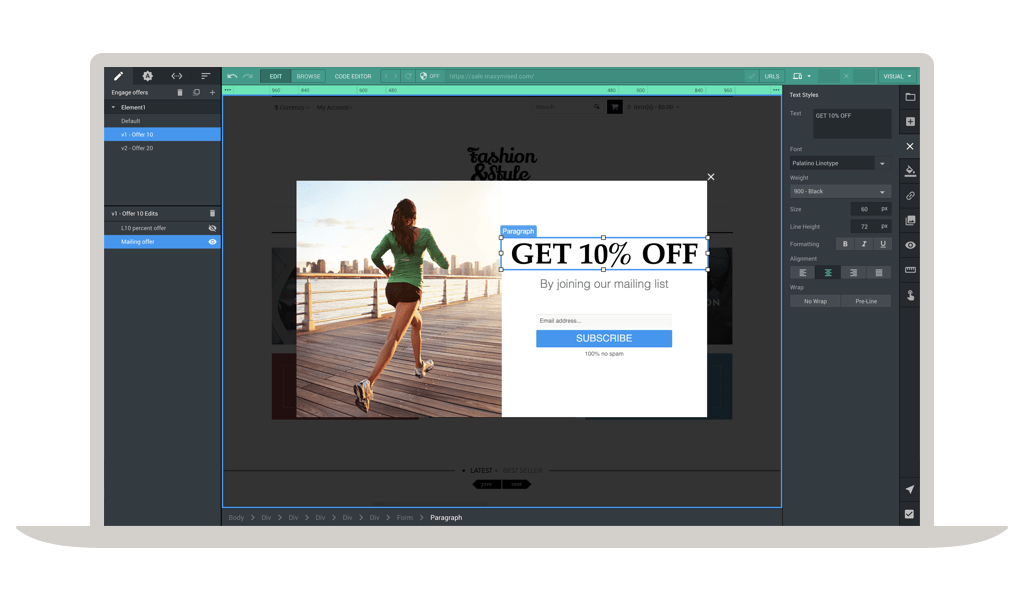
Google offers the Optimize A/B testing tool for testing website content and versions.
N/A
Oracle Marketing
Score 7.0 out of 10
N/A
Oracle CX Marketing (formerly Oracle Marketing Cloud) is a solution designed to enable marketers to plan and execute automated marketing campaigns via email, display search, video advertising, and mobile while delivering a personalized customer experience for their prospects.
$2,000
per month
VWO
Score 8.2 out of 10
N/A
VWO is an A/B testing and conversion optimization platform that enables growing businesses to conduct qualitative and quantitative visitor research, build an experimentation roadmap and run continuous experiments on their digital properties. With its 5 capabilities Plan, Track, Test, Analyze, and Target, it brings the entire CRO (conversion rate optimization) process at one place. VWO helps online businesses follow the process- and data-driven conversion…
$49
per month
Pricing
Google Optimize
Oracle Marketing
VWO
Editions & Modules
Google Optimize
Free
No answers on this topic
Subscription
$99.00
per month
TESTING
Get a Demo
The classic VWO A/B testing solution
CONVERSION OPTIMIZATION
Get a Demo
The all-in-one platform for all your optimization needs
ENTERPRISE
Get a Demo
Customized solution with advanced AB testing and conversion optimization capabilities
Offerings
Pricing Offerings
Google Optimize
Oracle Marketing
VWO
Free Trial
No
No
Yes
Free/Freemium Version
Yes
No
No
Premium Consulting/Integration Services
No
Yes
Yes
Entry-level Setup Fee
No setup fee
Optional
No setup fee
Additional Details
—
CX Marketing pricing is a function of usage.
—
More Pricing Information
Community Pulse
Google Optimize
Oracle Marketing
VWO
Considered Multiple Products
Google Optimize
Verified User
Manager
Chose Google Optimize
Google Optimize being part of the Google stack makes it great in reporting and analysis. Wish Google would add more features like dynamic tests, multi funnel tests, conversion calculator based on the total number of traffic of the page being tested instead of using the websites …
I used Google Optimize when it had just launched. It was therefore not yet a competitor to VWO. I haven't used it in roughly half a year time, so a lot has probably changed.
I still use Hotjar for certain features that VWO offers, but which I think function better in Hotjar. I …
VWO is by far the easiest tool to use among all experimentation tools. It is like the experimentation tool for dummies and works as well as the others. A highlight would be the reports on every test because compared to the others, in VWO is way much easier to understand the …
Basically, they have the same features but VWO is much cheaper than the paid version of optimize. If you don't need to do more than 5 experiments at a time, then the free version of Optimize is great. If you do need to be able to do more than that, then VWO is a great …
While there are many free or cheap options for A/B and multivariate testing out there (and we have tried several), VWO provides the right balance between cost and capability for our agency. That, and the level of customer service provided when we need it makes VWO our choice …
VWO is way more comprehensive and powerful. We selected VWO because of multiple factors including pricing, capabilities, and last but not least, support. It's quite important to be able to liaise with the platform when building tests.
It is a little too limited for a full stack experimentation programme. Many times we required development support or tech advise but we were simply unable to get this due to it being google. This was a big problem for us. However it is quite good if you were looking to get started in experimentation and didn’t have the budgets for a wider tool
A duration of one and a half years is enough for us to recognize the capabilities of a tool and in my opinion, this one is just a great tool to manage marketing campaigns of even massive-sized firms. Its marketing automation tool and its way of managing campaign and the way it executes digital initiatives is enough to get an inkling of its abilities. Less favorable for the people who want to have something at a cheap price and are more dependent on the reports as its reports have nothing much in detail.
It works better for either small or big companies because small companies can start with the free plan which is very decent and has everything they need. Also for big companies who get the best paid plans they get a lot of premium functionalities, the insight module, outstanding reports. But for medium size companies who can only afford the basic paid plan, it may not be the best tool as it is very limited. For example, they cannot analize a/b tests for new and ruturning visitors, neither based on the users device category.
Easy to follow set up procedures. Once I walk a client through the process, it's effortless for them to emulate on subsequent tests.
Lots of geo and user attribute customization features to be able to drill down into specific targeted audiences — all based on the power of Google's immense data system.
Google Optimize is the logical choice for many people to start with since most are already familiar with and using GA.
VWO is pretty easy to implement on websites and doesn't require a heavy technology lift
The VWO interface is pretty intuitive and let's non-technical users make variants for testing
The VWO reporting dashboard is excellent for determining statistical significance and understanding whether differences in conversion rates are meaningful or not
Integration options outside of auto-syncs. I am currently having an issue trying to find an adapter to use with Eloqua to API into our data warehouse but keep the functionality on the Eloqua side.
To provide more transparency and visual details of the syncs (integrations of outside data) from any other system that is feeding Eloqua, like what is being updated or changed, better explanations of errors, drill down to newly created records.
Custom Objects - Need to have a way to create CDOs outside of just form submissions and uploading of lists, like if you needed to import a file nightly to feed that CDO data but automate the import and make sure it maps to a contact record.
Import of data from a file on SFTP - There is no way to filter or create logic to control what is being fed into Eloqua. Currently, that manipulation has to be done by the IT side first. Less flexibility.
Better auditing capabilities within the canvas. meaning, sometimes if something is changed or not working the problem may not necessarily show up in immediately, the pattern could take a while to present itself. For example, the feeders into the program. If there is a problem, I don't know that maybe contacts are not entering the program until we do reporting that month and realize there was a lull of contacts going through. Then we have a whole month of missed records or other potential data issues. When you get do large and your Eloqua machine is very robust, the harder it is to see everything
Be able to add more than 250 custom contact records. That definitely inhibits my organization in how we need to use that record.
The user interface within VWO does take a bit of time to get used to, especially as it pertains to switching back and forth between tests. When running multiple experiments on a site at a time, a clear and succinct dashboard for everything in one place would be helpful (as opposed to needing to switch between A/B, multivariate, etc).
We have been able to automate so many marketing processes with Eloqua over the past 5 years that the only direction would be to adopt the latest and greatest features Eloqua adds. The alternative would be to go back to the marketing stone-age and start over again. And we would rather move forward with increased automation and efficiency.
It's great value and we think we've ironed out all the major teething troubles. However, if we experience any more bugs or problems that significantly slow us down then we're seriously considering switching to Optimizely, which I haven't personally tested but have heard great things about from my CRO peers
Personally, I find it quite easy to use. But for those members of our team who have little or no testing experience, it's been a bit more difficult. There's also training required for development teams in order to have your campaigns coded and set up in the most efficient way. Our developers have been able to do basic and intermediate tests with no difficulty, and they find the interface itself quite intuitive... it's just the extremely complex tests that require a bit more understanding.
I gave Visual Website Optimizer a rating of 8 because it is overall a great product to use. Setting up and keeping track of various tests is easy and straight forward. The only reason why this product is not rated higher is because the support documents online leave a lot of room for improvement.
There are occasional complaints about slowness to refresh a screen or build a report. However, this is as much a factor of network access speeds as the system itself, since often the complaints occur when someone is accessing on a wireless network.
VWO doesn't appear to slow down our website at all, though some customers with adblockers like UBlock Origin have been known to not see entire pages if VWO is making changes to the page at a macro level (background, font, etc). This is rare though.
We found that we often were telling support people how the system worked. Because we were on E9 that created a lot of support issues as well since few people on the support team seemed to know how E9 worked. That was mostly okay except when we had major system issues (like SSO preventing us from logging in after an update), it became really hard to get answers that weren't vague. It was always the issues that had the highest visibility within the organization (like with Sales) that seemed to take forever to resolve and didn't have a clear escalation path. When Oracle switched Eloqua over to the Oracle support portal it just got worse
While their online document support is lacking a simple email to their support team will almost always get responded to the next day. It has however taken more than one email to explain the problem to the support team till they understood the problem. The solution I was given also only half fixed the problem the rest I figured out on my own.
They offer very basic classes which are required for master certification.
After having been through it, I would not consider anyone with a master certification any more qualified, unlike Salesforce.com certification which is a more difficult thing to acquire. For example, one of the classes towards certification was around social media. I would have expected examples of how to incorporate into campaigns in the product, with a demo and hands-on test. Instead, it was a powerpoint slideshow that went on way too long and covered really basic stuff like “what is Facebook, what is Twitter”
Ok, so, this sounds like it could be horrible because it was all remote, but we loved it... the Adobe training environment was easy to use, and the trainers were engaging. It was simple to switch back and forth between the meeting and the hands-on exercises in their training instances. We took the fundamentals training early in our implementation-- before the consultants came onsite-- and I know this made a big difference in our implementation, because we were able to ask informed questions throughout
Training was good, just limited to the onboarding process. They walked through all of the steps it takes to get started in VWO and each of the modules, along with giving us ideas for starting our first test. I feel like it could be better if there was a guided process within the VWO program to continue to educate you along the way, and a way to turn that off for experienced users.
I give it a 10 because the only issue we had was a result of not following the guidance we were given. Maxymiser provided a customized implementation guide for each site where we were adding the code. On our site implementations when we followed that guide to the letter, it was extremely fast and easy and has worked very well.
Overall, the implementation of VWO is straightforward. If you've got a straightforward way of deploying code to all of your test pages, either a good CMS or a TMS, then implementation should be a breeze. There is no tweaking to be done to the code itself, and once deployed it has the flexibility to cope with different VWO modules (tracking, conversion analysis, session analysis) without modification.
Google Optimize being part of the Google stack makes it great in reporting and analysis. Wish Google would add more features like dynamic tests, multi funnel tests, conversion calculator based on the total number of traffic of the page being tested instead of using the websites total traffic. Should integrate form analysis, heatmap, and page analytics.
It was quite complex to generate segments with Adobe analytics and I wasn’t personally satisfied with the overall performance of Adobe Analytics and wasn’t enough flexible in any way. So we decided to switch to something else better than Adobe Analytics and is available in the market at a cheap rate and we ended up doing our research for the most suitable tool at Oracle Infinity and we don’t regret our decision.
There are significant differences in each platform when it comes to Optimizely and vwo. From a functionality and performance perspective they each have their pros and cons. It is important to go through the feature sets of each and ensure the solution you select will work specifically with your business objectives and conversion rate optimization goals
Eloqua is definitely good for larger companies that have 100,000+ contacts and complex marketing workflows and data. Personalization is fairly robust with Eloqua for larger campaigns with smart content and features. Scaling across channels is also seamless - as the platform has great options for non-email channels like SMS, Direct Mail, Chat, etc.
The product seems infinitely scalable for our needs (small business) and we've never had any issue with loading VWO-edited elements. I will say, though, that online customers with ad blockers have been known to not see certain VWO elements as their third-party scripts are disabled.
We are able to use it to help our clients scale through testing
We have been able to measure the impact of our events and sales events so we can determine which events to continue in the future and determine future investment
Launch a new brand out of Eloqua and measure awareness