Salesforce Sales Cloud is a platform for sales with a community of Sellers, Sales Leaders, and Sales Operations, who use the solution to grow sales and increase productivity. The AI CRM for Sales features data built right in, so that companies can sell faster, sell smarter and sell efficiently. Salesforce Sales Cloud is used for, and supports: Buyer Engagement Sales Engagement Enablement Sales AI Sales Analytics Team…
$25
per month
TeamSupport
Score 8.5 out of 10
Mid-Size Companies (51-1,000 employees)
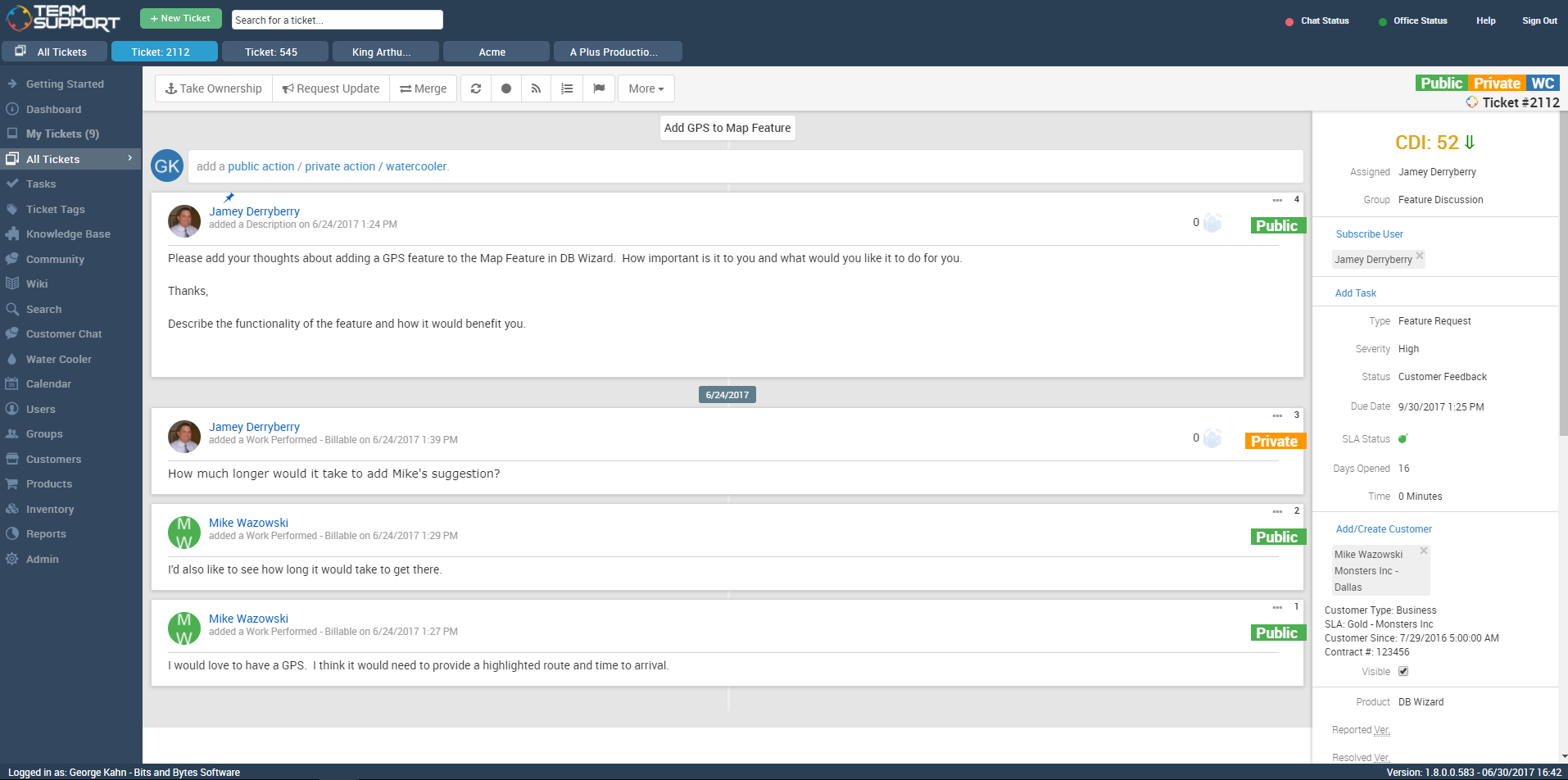
TeamSupport is customer support software built for B2B software and technology companies. The solution offers ticket management, a customer and contact database, reporting and analytics, multi-channel support, built-in collaboration tools, and many native integrations.
$45
per month per user
Web+Center
Score 8.0 out of 10
Enterprise companies (1,001+ employees)
Web+Center is a suite of open source, web-based help desk applications that run onsite or in the cloud and support all browser-based devices, including PCs, Macs, smart phones and tablets. With access to 100% of the source code, organizations can create the ideal customized solution for their unique business needs for applications such as IT help desk, customer support, asset tracking and facilities management. According to the vendor, community colleges, hospitals, small businesses,…
I belive that ticket tracking service of Salesforce was another name when we evaluated it but TeamSupport provides a robust solution that works with SaaS providers at a fraction of the cost.
Our main reason for choosing TeamSupport was the functionality was equal or better to other software trialled but also there was the added bonus of being able to synchronise with Salesforce CRM without the need to upgrade Salesforce as was the case with other help desk …
We looked at two other systems and I can not honestly remember their names at this point. TeamSupport was heads above their competitors and it was not a hard decision to make, once we saw the TeamSupport demo.
TeamSupport gives us a flexible, effective, and reliable platform. While other platforms may have a bell or whistle that's slightly better, TeamSupport combines solid functionality in all areas to meet a B2B support team's needs. The combination of effective functionality and …
We've only worked with two of the competitors of TeamSupport, Salesforce.com and osTicket, and the differences are staggering.
Salesforce.com can be extremely complex and overly cluttered, where TeamSupport is simple and concise. TeamSupport is not simple in that it is without …
Verified User
Engineer
Chose TeamSupport
Zoho Zendesk Sysaid
Web+Center
No answer on this topic
Features
Salesforce Sales Cloud
TeamSupport
Web+Center
Sales Force Automation
Comparison of Sales Force Automation features of Product A and Product B
Salesforce Sales Cloud
8.2
269 Ratings
5% above category average
TeamSupport
-
Ratings
Web+Center
-
Ratings
Customer data management / contact management
8.9269 Ratings
00 Ratings
00 Ratings
Workflow management
8.4258 Ratings
00 Ratings
00 Ratings
Territory management
7.7211 Ratings
00 Ratings
00 Ratings
Opportunity management
8.9259 Ratings
00 Ratings
00 Ratings
Integration with email client (e.g., Outlook or Gmail)
8.0244 Ratings
00 Ratings
00 Ratings
Contract management
7.9215 Ratings
00 Ratings
00 Ratings
Quote & order management
7.7198 Ratings
00 Ratings
00 Ratings
Interaction tracking
8.6229 Ratings
00 Ratings
00 Ratings
Channel / partner relationship management
8.0190 Ratings
00 Ratings
00 Ratings
Customer Service & Support
Comparison of Customer Service & Support features of Product A and Product B
Salesforce Sales Cloud
7.8
104 Ratings
2% above category average
TeamSupport
-
Ratings
Web+Center
-
Ratings
Case management
8.2102 Ratings
00 Ratings
00 Ratings
Call center management
7.782 Ratings
00 Ratings
00 Ratings
Help desk management
7.486 Ratings
00 Ratings
00 Ratings
Marketing Automation
Comparison of Marketing Automation features of Product A and Product B
Salesforce Sales Cloud
8.1
244 Ratings
5% above category average
TeamSupport
-
Ratings
Web+Center
-
Ratings
Lead management
8.2239 Ratings
00 Ratings
00 Ratings
Email marketing
8.1206 Ratings
00 Ratings
00 Ratings
CRM Project Management
Comparison of CRM Project Management features of Product A and Product B
Salesforce Sales Cloud
8.1
248 Ratings
6% above category average
TeamSupport
-
Ratings
Web+Center
-
Ratings
Task management
8.3236 Ratings
00 Ratings
00 Ratings
Billing and invoicing management
7.478 Ratings
00 Ratings
00 Ratings
Reporting
8.5201 Ratings
00 Ratings
00 Ratings
CRM Reporting & Analytics
Comparison of CRM Reporting & Analytics features of Product A and Product B
Salesforce Sales Cloud
8.3
260 Ratings
9% above category average
TeamSupport
-
Ratings
Web+Center
-
Ratings
Forecasting
7.9228 Ratings
00 Ratings
00 Ratings
Pipeline visualization
8.2247 Ratings
00 Ratings
00 Ratings
Customizable reports
8.6257 Ratings
00 Ratings
00 Ratings
Customization
Comparison of Customization features of Product A and Product B
Salesforce Sales Cloud
8.6
252 Ratings
12% above category average
TeamSupport
-
Ratings
Web+Center
-
Ratings
Custom fields
9.0249 Ratings
00 Ratings
00 Ratings
Custom objects
8.8239 Ratings
00 Ratings
00 Ratings
Scripting environment
8.2176 Ratings
00 Ratings
00 Ratings
API for custom integration
8.6209 Ratings
00 Ratings
00 Ratings
Security
Comparison of Security features of Product A and Product B
Salesforce Sales Cloud
9.0
253 Ratings
7% above category average
TeamSupport
-
Ratings
Web+Center
-
Ratings
Single sign-on capability
9.0221 Ratings
00 Ratings
00 Ratings
Role-based user permissions
8.9225 Ratings
00 Ratings
00 Ratings
Social CRM
Comparison of Social CRM features of Product A and Product B
Salesforce Sales Cloud
8.2
160 Ratings
10% above category average
TeamSupport
-
Ratings
Web+Center
-
Ratings
Social data
8.4158 Ratings
00 Ratings
00 Ratings
Social engagement
8.0156 Ratings
00 Ratings
00 Ratings
Integrations with 3rd-party Software
Comparison of Integrations with 3rd-party Software features of Product A and Product B
Salesforce Sales Cloud
8.1
217 Ratings
9% above category average
TeamSupport
-
Ratings
Web+Center
-
Ratings
Marketing automation
8.2213 Ratings
00 Ratings
00 Ratings
Compensation management
8.1146 Ratings
00 Ratings
00 Ratings
Platform
Comparison of Platform features of Product A and Product B
Salesforce Sales Cloud
7.8
232 Ratings
4% above category average
TeamSupport
-
Ratings
Web+Center
-
Ratings
Mobile access
7.8232 Ratings
00 Ratings
00 Ratings
Incident and problem management
Comparison of Incident and problem management features of Product A and Product B
Salesforce Sales Cloud
-
Ratings
TeamSupport
8.2
12 Ratings
0% below category average
Web+Center
8.6
2 Ratings
5% above category average
Organize and prioritize service tickets
00 Ratings
8.012 Ratings
10.02 Ratings
Expert directory
00 Ratings
7.01 Ratings
7.01 Ratings
Subscription-based notifications
00 Ratings
10.05 Ratings
7.01 Ratings
Ticket creation and submission
00 Ratings
8.012 Ratings
10.02 Ratings
Ticket response
00 Ratings
8.012 Ratings
10.02 Ratings
ITSM collaboration and documentation
00 Ratings
00 Ratings
7.42 Ratings
Self Help Community
Comparison of Self Help Community features of Product A and Product B
Salesforce Sales Cloud
-
Ratings
TeamSupport
8.0
12 Ratings
0% below category average
Web+Center
8.7
2 Ratings
8% above category average
External knowledge base
00 Ratings
8.08 Ratings
8.42 Ratings
Internal knowledge base
00 Ratings
8.011 Ratings
9.02 Ratings
Multi-Channel Help
Comparison of Multi-Channel Help features of Product A and Product B
Obviously, for any business, there are two main areas to focus on — the sales path and the service path. Sales Cloud wouldn’t be suited for a company that’s primarily into support services. For those kinds of companies, Salesforce has a different product — Service Cloud. So, for anyone in the support or service space, Sales Cloud isn’t the right fit.
TeamSupport is a great ticketing/help desk platform for small companies. It gets the job done and allows for multiple teams to manage workloads. It is not best for bigger organizations as there are lots of lacking features (mobile app, integrations, robust Jira/Confluence like system). The support for TeamSupport is great too. They usually get in touch with customers quickly when the system is down and they resolve issues quickly as well.
It works well with any type of help desk/support system. This includes information technology but could be applied to any type of technical support service. It can also be modified quickly to create a totally different type of software package such as an indexing program for libraries and archives or it could be used as a permit management system. The software is very flexible and can be tailored to almost any need.
The customizations - We have an organization that operates differently from most companies, so we’ve had to implement quite a few customizations — and Salesforce allows us to do that quite quickly. Most of the time, delays come from dependencies on other internal parties rather than the system itself.
From my perspective as a consultant, one of the biggest advantages is that everything is in Salesforce — all the details, all in one place. The ability to customize it easily is a big plus; there’s really a lot you can do with it.
There were other customer support software companies that I looked into at first, however TeamSupport provided exceptional customer service themselves. I paid close attention to how they handled me as a customer to see if they were a company that would understand my desire to give exceptional customer service to my clients and if they had the tools to make the experience easy. Every interaction with them was very positive.
Since we needed TeamSupport's software embedded into our software application to give our users easy access to the support tools, the staff at TeamSupport needed to answer many questions and work with our developers to make this possible. They were always willing to take the extra step to ensure a smooth set up.
As we continue with TeamSupport, I am especially impressed with the sincerity of the CEO, Robert C. Johnson, and his commitment to us so that together we can deliver exceptional customer support.
We still need to include the production part. We started using Salesforce to sell the seeds — our inventory is in SAP — and from there we handle sales and track the process of planting, harvesting, selling, and then collecting payments. But we don’t yet manage the earlier production processes, like production planning. We handle allocation, but not full production planning, and that’s an area where we still have room for improvement.
We would like to see a structure to the ticket numbering system. In a previous system we had a numbering system like this mmddyy-xxxxxx This was very easy to see when a ticket was created based on just it's number. Currently with TeamSupport they assign a random number to tickets that is not very informative without a created date field.
Reports are nice but lack some rollup capabilities that are needed. Any given report can only work against two data tables at max. This is a limitation that we had to create custom contact fields to get around. They store phone, address and base contact info in separate tables. This makes it impossible with a standard system to create a report of all tickets along with the ticket and contact information in one report. The previous system we were on, allowed you to tie as many related data tables together that was needed to create one high level report.
Need Ability to notify external users of ticket activity in regions. So what I mean is we have FAE's in the field that want to know what their customers are asking for their region. They don't want or need a TeamSupport account but want simple e-mails of activity. This has been a lost feature for us going to a new system. I have to create a manual report each week and forward to the people that want this kind of information.
Ticket Automation rules will only run against a ticket one time. I understand why they did this to prevent uncontrolled loops but it would be nice to be able to set a limit that was greater than one. This limitation often causes us to have to write multiple rules to handle certain ticket cases.
I have read reviews where some people comment that the interface "looks dated". I am a believer in function over form. The interface is just eye candy and if it works well, why would you want to re-code software just to make it look different? I like the interface and can quickly find the functions I need. As for room for improvement? Well, that would depend on your location and what types of data you prefer to have access to. For me, the program is great the way it is.
There are days when I wish we hadn't switched, but I know that if we put in the time, we will get to where we want to be with the software and that it has many more capabilities than anything else we looked at. However, the amount of time and onboarding we need to do is also far greater than we realized/were told when we originally bought the product. They told us we should hire onboarding support, but at the end, after we had already reached our budget maximum for this, so it's been slower than we had hoped.
We are very likely to renew. We have been using TeamSupport for years and have tested a few other ticketing software solutions. We utilize several project management solutions to date and are always looking for better more efficient ways. Team Support is great at working with us and allows us to report issues well.
Because I think it could be easier. We have different standards today since we’re used to interacting with consumer apps like Starbucks, where all you do is scan your card. Then, when you use Sales Cloud, there are still a lot of manual inputs. So my mission with AI is really about figuring out how to make that easier.
I think some things could be a little more user-friendly: specifically the dashboard. Although it's fantastic and makes life so much nicer, I'd like to have more control on it's customization. I'd like to be able to default what's collapsed and what's expanded...instead of everything expanding by default each time I load it. But the portal offers great tools and guides on workarounds.
Salesforce is always available securely from any internet-capable device anywhere in the world, UNLESS you choose to set security measures so that ONLY trusted IP ranges may access the system at certain times of the day. It's all about choice and flexibility with Salesforce products.
Salesforce performance in general is excellent. "The cloud infrastructure beneath Force.com has been fine-tuned over the past 10 years. It powers nearly 100,000+ businesses running more than 185,000 applications that 3 million users count on every day." Points per Salesforce - 1) Multitenant kernel - With a multitenant platform, each business that uses the app doesn’t have its own copy. Instead, all businesses share a single copy and then customize it for their specific needs. 2) ISO 27001 certified security - You can’t compromise when it comes to enterprise-level security. Force.com is road-tested and trusted by nearly 100,000+ companies, including many of the world’s most security-conscious organizations, such as banks and health care providers. 3) Proven reliability - All Force.com apps run on world-class data centers with backup, failover, and disaster-recovery facilities. Force.com has had a proven 99.9 percent uptime record for years. 4) Proven, real-time scalability - Force.com is used by many of the world's largest enterprises, including Cisco, Japan Post Network, and Symantec. Applications can automatically scale from a few users to millions of page views, as needed. 5) Real-time query optimizer - You need fast access to your data. The Force.com query optimizer delivers under 300ms response time, at a massive scale. 6) Real-time transparent system status - You can always see real-time system performance, availability, and security information at trust.salesforce.com. 7) Real-time upgrades - Unlike traditional software platforms, our upgrades never break your customizations, code, or integrations. We upgrade the platform for you 3 to 4 times each year. As a result, you’re always on the latest version, with access to the latest features, performance, and security enhancements. 8) Real-time sandbox environments - With a single click, you can create copies of your applications, configuration, and data in separate environments for development, testing, and training. 9) Three global production data centers and disaster recovery - Force.com runs on three geographically dispersed, mirrored data centers with built-in replication, disaster recovery, a redundant network backbone, and no single points of failure
The overall support has been good. More and more features are being released quite frequently. Very small features are also making big difference in how the tool can be adapted and used better. If there is anything we need or are stuck, the support team sets up a call and helps in resolving the issue/provides workarounds.
TeamSupport's ease of use and the way it benefited our company overall. From cost improvements, ROI, and overall management of team members it gets high marks. We are better able to support our customer base by providing improved support in a more timely fashion. The End User view of IT Support overall has improved just through using this platform in our company.
I attended two training sessions. I would rate them a 4 as an advanced user. It was very basic – great for someone new – would give 8+ for new person.
I had 3 years of experience at the time. I skipped basic and went onto advanced and still not helpful. A lot of it was best practices that didn’t feel relevant for our business
I have gone through multiple. The content that’s delivered is quite basic – I wish they had more advanced training.
We are grandfathered into premium support plus training. We get unlimited access to instructor led and online training for free. We have taken advantage of this
Just from an organizational standpoint - we standardized our data prior to moving to Salesforce. But we essentially standardized it wrong. That's created a big disgusting mess for us know that I'll have to deal with as the Admin. Be sure you think through use cases prior to doing something like that - seek outside opinions on how the data will work best, especially depending on what else you're going to integrate with Salesforce.
Data import was the most difficult hurdle for us to get over. The mass import was handled through an Excel spreadsheet. TeamSupport doesn't use Microsoft Office products for the most part so they were relying on Google Docs which has limitations over Excel. Special characters and html in import cells can be a issue with importing. When creating a data export from your current system, special care needs to be taken so that the data is able to be processed into TeamSupport without issues.
So I've evaluated, implemented Microsoft Dynamics in the past. I've used Oracle CRM solutions. I've used Daylight, which is a very niche CRM system the last couple of years. And I've evaluated a variety from Legacy Microsoft Ones to Zoho and Sugar when making implementation decisions at other companies. But usually I've gone with Salesforce. I'd say it's better than most. The only one that I generally prefer, and last time I chose an implementation from scratch, I did Microsoft Dynamics. And the reason is for small mid-size organization, Microsoft Dynamics, if you already have Microsoft Office products, it's much better integrated to all of the Excel, Word, OneNote, Outlook email than what you get from Salesforce. And so that's the only one that if someone's a Microsoft organization and small sized company, it'll save a lot of integration things, a lot of security, a lot of login and access and IT management by just sticking within the Microsoft ecosystem. But outside of that, if you don't use Microsoft or if you're a large organization or have other needs that you want, Salesforce I'd say is better than all of the other CRM offerings out there. It's the easiest to use and the most robust and the most vendors and products for the ecosystem.
TeamSupport is a much more modern, intuitive and user-friendly version of NetSuite with many additional bells and whistles. NetSuite has a business only facade with a rather clunky interface and system. TeamSupport compares favorably and meets business needs while being a much more advanced and modern solution.
We've been using Web+Center so long, that I can't even remember what offerings we evaluated. We haven't felt the need to look at others because Web+Center just works for us.
Salesforce is the most widely used CRM system. Professionalism tends to increase when things go wrong for market leaders. Salesforce considers us as users because they own the market. Having all of our data in one place and all of our teams working within Salesforce. Anyone who uses Salesforce is impacted by it, even if they don't.
It's very scalable as it has a ton of features (but you do need an admin who understands how to leverage these features). Because of the various features, we've also needed to host onboarding sessions with our users so that they can familiarize themselves with the platform, which isn't always super user-friendly or intuitive.
TS keeps adding new features without making sure the program is reliable as-is. The program is frequently offline which makes for significant frustration on my part
Using Salesforce.com has made my daily routines more efficient and simplified the manual tasks I had to perform independently. I can now access data from any device, online or offline, and provide better guidance to my team about the forecasts provided by the built-in artificial intelligence (AI). A chat with a Salesforce support specialist would be great. The knowledge base has a community forum where Salesforce users can ask questions and learn more about the product.
I looked for years trying to find a great software package that did not require a loan to purchase. Web+Center was the perfect fit. Pricing is very affordable even for very small organizations. It is dependent on the number of technicians, not the number of customers.