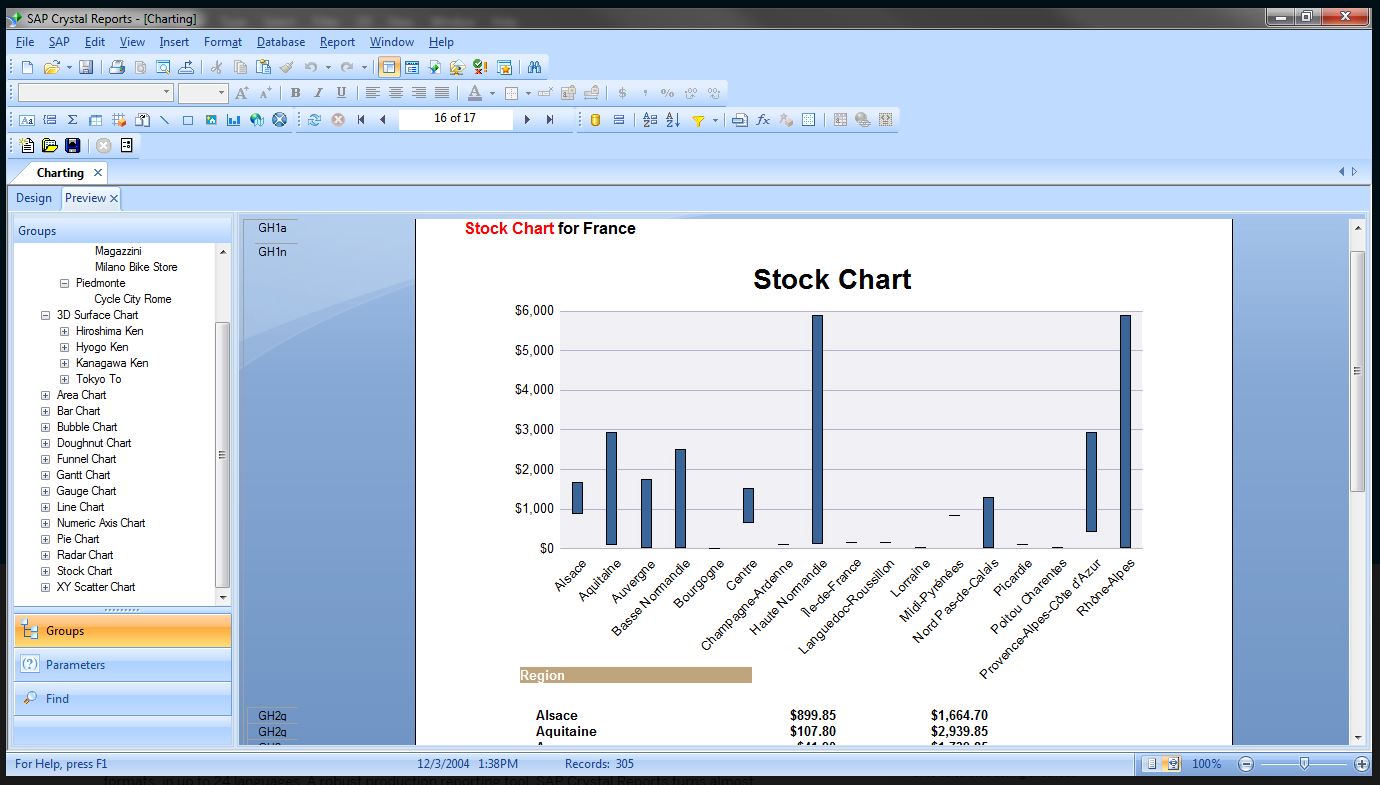
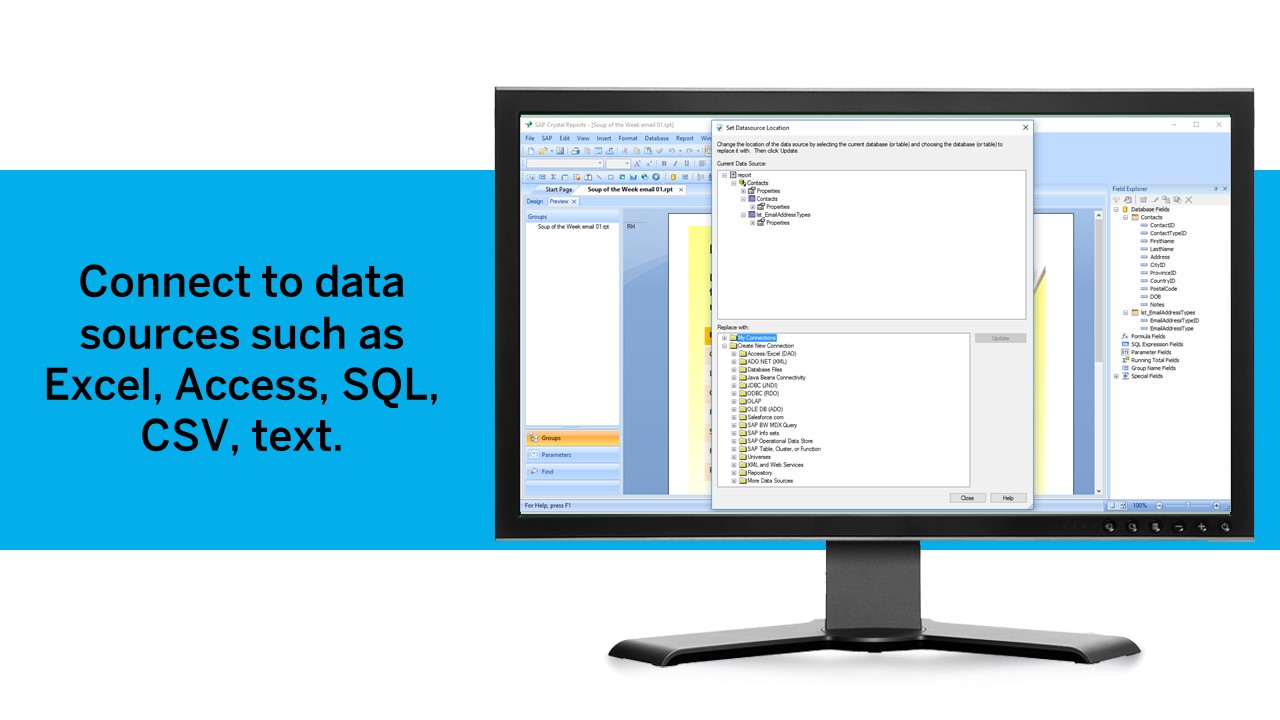
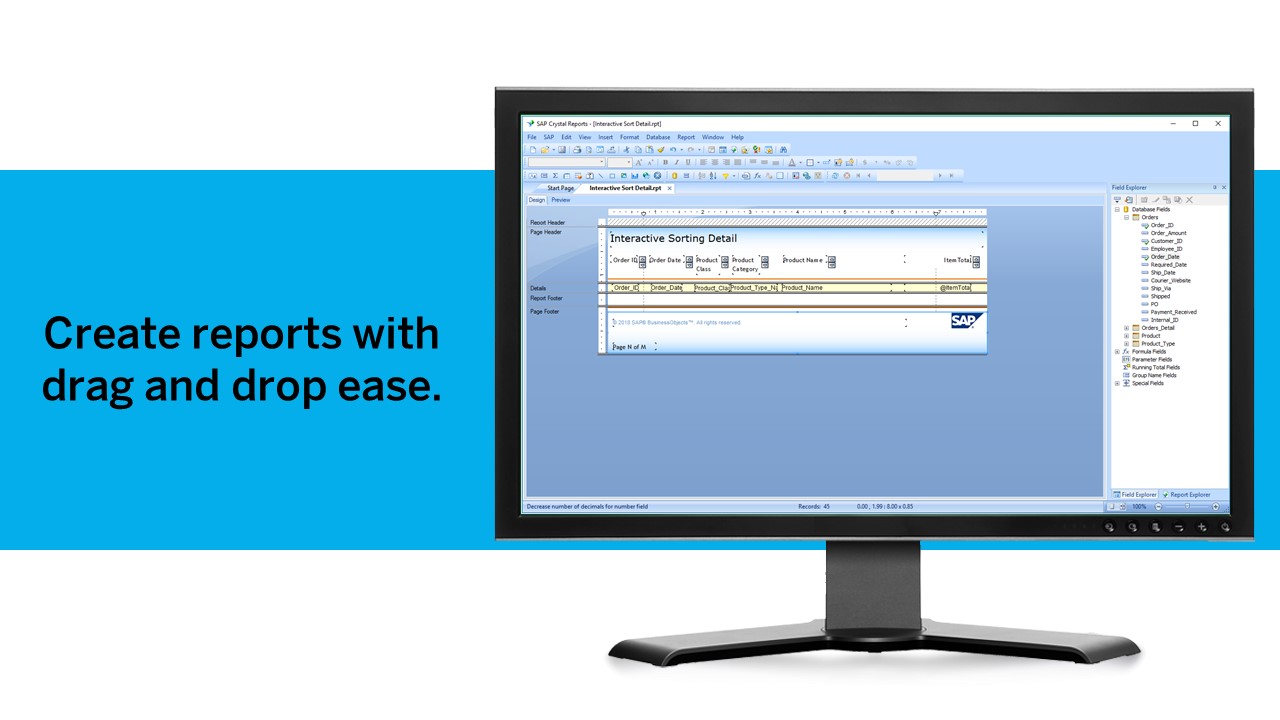
SAP Crystal is an analytics and reporting software solution for SMBs. SAP Crystal comprises Crystal Reports for pixel-perfect reporting, and SAP Crystal Server for automated distribution and self-service access to reports, dashboards and data exploration.
$295
per single user license
Tableau Desktop
Score 8.4 out of 10
N/A
Tableau Desktop is a data visualization product from Tableau. It connects to a variety of data sources for combining disparate data sources without coding. It provides tools for discovering patterns and insights, data calculations, forecasts, and statistical summaries and visual storytelling.
$1,380
per year (purchased via a Creator license)
Tableau Server
Score 7.6 out of 10
N/A
Tableau Server allows Tableau Desktop users to publish dashboards to a central server to be shared across their organizations. The product is designed to facilitate collaboration across the organization. It can be deployed on a server in the data center, or it can be deployed on a public cloud.
$12
Per User Per Month
Pricing
SAP Crystal
Tableau Desktop
Tableau Server
Editions & Modules
Upgrade Version to SAP Crystal Reports 2020
$295
per single user license
SAP Crystal Reports 2020 64-Bit
$495
per single user license
SAP Crystal Reports 2016 32-Bit
$495
per single user license
SAP Crystal Server 2020 1 NUL
$869
per user license + first year maintenance to be added
SAP Crystal Server 2020 5 CAL
$8,744
5 concurrent users + first year maintenance to be added
Tableau Creator License
$115
per month (billed annually) per user
Viewer
$12.00
Per User Per Month
Explorer
$35.00
Per User Per Month
Creator
$70.00
Per User Per Month
Offerings
Pricing Offerings
SAP Crystal
Tableau Desktop
Tableau Server
Free Trial
Yes
No
Yes
Free/Freemium Version
Yes
Yes
No
Premium Consulting/Integration Services
Yes
Yes
Yes
Entry-level Setup Fee
Optional
No setup fee
No setup fee
Additional Details
* SAP Crystal Reports 2020 Viewer allows you to view static data within a SAP Crystal Reports file.
* SAP Crystal Reports 2020 - Full version allows you to create powerful, richly formatted, and dynamic reports from virtually any data source, delivered in dozens of formats, in up to 28 languages. If you already have an older version of Crystal Reports, buy a license for SAP Crystal Reports 2020 - Upgrade at a discounted, upgrade price.
* SAP Crystal Server 2020, 1 NUL includes 1 license of: SAP Crystal Reports 2020 - SAP Crystal Server 2020.
* As an add-on to SAP Crystal Server 2020 1 NUL, SAP Crystal Server 2020 5 CAL allows you to support a wider, intermittent audience of end users, up to five logged on at the same time.
All pricing plans are billed annually. A Creator license includes Tableau Desktop, Tableau Prep Builder, and Tableau Pulse. Discounts sometimes available for volume.
Crystal Reports fits a niche for us in standard reporting. We don't use it for creating dashboards or interactive data analysis. That's where Tableau excels. For on-demand reports, we prefer Microsoft Reporting Service and Analysis Services. Crystal Report is very good when it …
SAP Crystal Server stacks up better than Tableau Desktop and Google Charts because we found it was easier to customize and for what we needed it was easier to create the reports. So that is why we went with SAP Crystal Server over the other options that we had considered.
Tableau was a great and user-friendly tool to use for a long time; however, it did not manage various users and their security access very well nor did it provide the level of reporting variation that was necessary at my company. SAP Crystal took some legwork, in the beginning, …
Based on our organization policy we had to use this software. Tableau is also an equally solid software for preparing reports with an upper hand over business users - they don't require any coding experience. As opposed to Crystal Reports, it requires developers to do the work. …
Crystal offered a more straightforward implementation for our situation. While Tableau offers well-designed reports, the overall functionality regarding data manipulation and analysis is behind Crystal.
For automating documents and reports, I personally believe there is no better solution. However, for the sheer fact, it can't compare/combine two sources, I'd recommend pairing it with another BI tool. For example, Qlik, whereby you can create dashboards and compare multiple …
Qlik is better in terms of reading data from different sources but it doesn’t have the auto doc ability like SAP Crystal Tableau. It is a decent visualization tool but doesn’t have the same ability in terms of rendering output reports into a suitable format. Plus the cost of Tab…
Vice President, Chief Architect, Development Manager and Software Engineer
Chose SAP Crystal
We found that Crystal was a little more intuitive to our team members than the other products. All of the products were excellent choices but we liked the ability to code stored procedures to gather our data. While each product has very similar features, we went with …
I found Crystal much more flexible and easier to use for report building than Cognos. Crystal's menu system is similar to Microsoft Word and Excel, so it instantly seemed familiar. I had to do much more hunting in Cognos to modify the properties and formatting of a report. …
I have to use Crystal Reports with our third party software, and it does make the pretty formatting easy, but it's actually less intuitive than the software with less of a GUI.
The presentation level is compatible and is clear and concise. However, there are limits to customize and formatting As a large organization we were required daily to provide reports to our customers for various projects, data and financial information.
SAP has a very sophisticated environment. It is very good to provide interaction in between different teams. I work in communications and to interact with air traffic control there is a good amount of interaction when using SAP. What I feel is that if you have an SAP database, …
Due to its bigger brand and excellent user support, it is better than many competitors. If you have huge organization support, then operating it will make your reporting system much better. Otherwise, you might need better employee support for operating it. Otherwise, the whole …
Excel has some competitive features with Crystal Reports, especially if you have it connected directly with the database, however, it's overall very different. With Crystal, it allows you to enter values before running a report to really compare between different parameters. It …
SAP Crystal Server is exactly what we need for our reporting, both internally and externally, and we consistently use the scheduled reporting option and set up automatic delivery to save us time. These features are the main reason why we decided that this program was the …
As already stated, some businesses may find SAP Crystal Reports too expensive. While there are cheaper alternatives, it will all depend on your business' specific needs which product to choose. Another factor to consider is, what is the product, the majority of your clients is …
When we evaluated several options, we found SAP Crystal Server to be more reliable than some of its competitors. We wanted something that we could customise to use in several departments and for all different types of situations where reports would be useful. We also use other …
We have a lot of clients who use SAP Crystal Server that we collaborate on reports with and this was a big reason for why we work with SAP Crystal Server. If I had to rate all the other analytics programs that I have worked with against SAP Crystal Server I would rate SAP …
When we first looked at getting a visualization software for analytics we looked into two options Microsoft Power BI and Tableau Desktop, and even though Power BI is more cost-effective we decided to go with Tableau Desktop as it had more options that we are looking for such as …
Microsoft PowerBI could potentially be a better fit for organizations on Office365, it's a close call though. Google Data Studio has potential but is still far behind Tableau on the "user-friendly" factor. Tableau still seems to dominate for the "recommended" analytics tool, …
Tableau is next generation tool where other two are old traditional BI tools Other tools are very slow and difficult to use, and required lot of technical expertise to use them. Tableau's look and feel is much nicer than those two.
Against the usual incumbents within the pharmaceutical industry, Tableau has much better and faster access to database data especially stored in the Oracle database, without needing any interim transformations or data universe needing to be created. Also it has comparatively …
If any changes had to be made to existing visualizations when we used QlikView, a lot of security constraints existed and I had to run to the IT team for every change I had to implement.
Tableau gives easy security change rights to the developer environment.
I feel like Tableau is easier to use and offers a greater selection of visualizations. I feel that the dashboards are easier to put together and offer a great amount of flexibility for the end-user. Tableau has an excellent user support group. I find the community to be …
Excel is the ultimate jack-of-all-trades Swiss army knife approach. You can do almost anything but it is missing much of the polish of dedicated applications of Tableau. Great for the initial approach to a new dataset. I have created some custom Excel macros that go in and run …
My current work environment uses both Tableau Online, MicroStrategy & SSRS in parallel. Tableau is much closer to the SSRS in terms of visualization tool where as MicroStrategy is an enterprise data modeling and reporting tool.
Based on the use case we use different tools. Here …
I have used SSRS, Crystal Reports, Microsoft Excel, and Business Objects. Tableau offers more functionality than the rest and is pretty intuitive. I think SSRS is the easiest to use. Query speed is excellent with SSRS (at least when you are connected to SQL Server). Microsoft …
In comparison to Tableau, the other dashboarding/BI tools I've used feel clunky, are very slow to develop in, and seem to lack features of a more modernized tool like Tableau. In Pentaho Analyzer, for instance, trying to include multiple worksheets or reports in a single …
As far as I know, we do not currently use Domo, however I've seen some demos of their product. Domo is very good with cloud-based software and it also incorporates social media data. Domo is also good at using cloud-based excel file building vs. building spreadsheets on my …
Renowned digital analytics consultant, innovator, speaker, thought leader
Chose Tableau Desktop
I haven't used other tools for a number of years - when I made the selection my criteria were ease of use (including, slicing & dicing data at will), connectivity to various data sources (especially REST API - which Tableau doesn't support natively but now has a way to use …
Cass evaluated Domo, QlikView and Birst prior to selecting Tableau. It came down to cost (and by a significant margin); the others have relatively high implementation, hosting and other costs. Additionally, based on a recent Gartner "Magic Quadrant", Tableau exceeds all others …
I had the trial version of Tableau Desktop downloaded, installed, configured and was creating meaningful dashboards in almost 15 minutes. While other software we used had great features, none of them were able to compare with this trial experience. Tableau's user forums were …
Tableau is the only tool that can be exposed to end users so that they can build their reports and dashboards and can publish these without the help of a dedicated developer.
Python is programming tools, while Tableau is an easy to use drag and drop data visualization tool. This may not be an apple to apple comparison. Compared to Excel, Tableua is way over the top when it comes to data visualization.
Tableau is by far the superior product when it comes to analysis, ease of use, and end user experience. People are usually more familiar with Excel so it can be difficult to break them out of their comfort zone. Lastly, when it comes to subscriptions, SSRS is the tool I prefer. …
The primary factors for choosing Tableau were the licensing costs; ability to view data from multiple data sources; the ease of infrastructure to setup; and ability for users to create and maintain their own worksheets without the need for IT assistance.
Verified User
Analyst
Chose Tableau Desktop
Tableau Desktop needs no to minimal coding experience. It easily integrates with various data sources. It is very easy to create usable smart reports.
We evaluated QlikView and Tableau for a Fortune 500 corporation 15 months ago in full disclosure. To be all too brief we found QlikView to be a very good tool but more IT dependent than Tableau. Newer features and functions may offset some this one significance.
Tableau is the most powerful and easy to use of the alternatives, as long as the data sources are properly connected. None of the other tools have allowed us to connect and integrate data into one report in the way that Tableau's data connectivity allows us to. Then the ability …
Today, if my shop is largely Microsoft-centric, I would be hard pressed to choose a product other than Power BI. Tableau was the visualization leader for years, but Microsoft has caught up with them in many areas, and surpassed them in some. Its ability to source, transform, …
The choice to use Tableau Server is really made for you if you already have adopted Tableau Desktop. If you're focused on an on-premise solution, Tableau is probably the way that you'll have to go. Looker and Mode are cloud-based (so is Tableau Online) and offer a true …
There were a lot of reasons why we chose Tableau and the least is the cost but also the way Tableau stores data in the columnar fashion instead of in Cubes. We went through a painstaking selection process and at the end, came down to a couple of vendors and we ended up with the …
We still use Microsoft Excel for much of the lighter, day-to-day pivot tables or calculations. We see Tableau as the future however and are slowly tying more and more of our standard work with Tableau. Smartsheet isn't a 1:1 example, but it was considered for importing …
I did not choose Tableau for my organization, but did choose my organization in part because they use Tableau! Fantastic flexibility combined with relative ease of visualization.
A comprehensive proof of concept study done. We evaluated different vendors and also consider strategic reports (like Gartner) to make a decision. Tableau was the winner. The developers especially liked it, because integrating it to the existing system was very easy.
Sisense was another tool I came across, but I chose Tableau over Sisense as an end-to-end tool for data visualisation and BI. Tableau is the complete data visualisation tool, which is what I was looking for. So, I chose Tableau. Plus, it's easy to use and there are no complex …
Tableau is better than Splunk in analyzing the unstructured data and displaying all relevant information to the user. I have used Splunk but it does not provide the information of every component of a system, it just drills down to log analytics. Tableau is beyond Splunk, as …
QlikView, Tibco Spotfire, SAS, and SAP. At the time, all cost more than Tableau for our (small) needs, SAS and SAP were in some ways overqualified in terms of breadth, and none of them had the ease of use of Tableau.
Tableau Server has many competitors, two primary ones would be SAP Business Objects and Microsoft PowerView through Tabular Analysis Services. I have worked with all three products. First and foremost, in terms of data visualization Tableau is the best by far. However there are …
This search turned up a number of candidates. I think the main alternative considered was SiSense. Tableau Server with Tableau Desktop was the most expensive solution but I was convinced it actually represented the best value.
Tableau by far has the most intuitive interface and best out of the box looks for presentation. The speed of development and ease of development is unbeatable.
QlikView can't connect to live data (in general) Licensing Costs of QlikView and Cognos are expensive. Cognos doesn't have excellent Graphics embedded within the tool
I've personally have used a vast majority of the Business Intelligence products on the marketplace. I've used all of the Oracle products over the past few years. I've used all of the products in the Microsoft stack, along with Cognos, Qlikview, etc. Each are effective if your …
Sr. Data Analyst and Tableau SME for North America
Chose Tableau Server
We also looked at Spotfire and Qilkview
Verified User
Administrator
Chose Tableau Server
Three "self service" BI tools were looked at: Tableau, Spotfire & Qlikview. To put it very simply, Spotfire had a lot of overlap with a tool that was already present at the bank, SAS. QlikView's biggest negative was that everything was brought in via RAM, and there are gigantic …
Vice President of Product Management & Engineering
Chose Tableau Server
We evaluated Tableau Server against all the major players out there. We had a bad experience with one of the major players and switched them out for Tableau. It was one of the best business decisions we have made due to our experience with Tableau and their team. Tableau offers …
Generation of templated reports is the strong suit of SAP Crystal. Allows users to change formats in templates bases on requirement with minimal effort. Automated report delivery requires the user to be aware of sql which cannot be expected from all users. Should support more document export formats and improve the UI for SAP B1 Users
The best scenario is definitely to collect data from several sources and create dedicated dashboards for specific recipients. However, I miss the possibility of explaining these reports in more detail. Sometimes, we order a report, and after half a year, we don't remember the meaning of some data (I know it's our fault as an organization, but the tool could force better practices).
Whole funnel and specific channel performance from upper to lower funnel metrics. The ability to view full channel performance for some time, such as weekly, monthly, or quarterly, has truly been monumental in how my team optimizes specific channels and campaigns. Daily performance tracking is a bit overwhelming, with load times and having to refresh specific live views over time. It can be challenging to do so at times, as extensive dashboards take much longer to load.
Crystal Reports allows us to create a consistent template for all of our reports.
Crystal Reports and Server allows us to house a repository for all of our reports to make them easy to find and update when necessary.
Crystal Reports can connect to a wide variety of data sources.
Crystal Reports can be a little daunting when first implementing. There are a lot of nuances in learning how to truly master this software and it can be frustrating at times.
An excellent tool for data visualization, it presents information in an appealing visual format—an exceptional platform for storing and analyzing data in any size organization.
Through interactive parameters, it enables real-time interaction with the user and is easy to learn and get support from the community.
It's good at doing what it is designed for: accessing visualizations without having to download and open a workbook in Tableau Desktop. The latter would be a very inefficient method for sharing our metrics, so I am glad that we have Tableau Server to serve this function.
Publishing to Tableau Server is quick and easy. Just a few clicks from Tableau Desktop and a few seconds of publishing through an average speed network, and the new visualizations are live!
Seeing details on who has viewed the visualization and when. This is something particularly useful to me for trying to drive adoption of some new pages, so I really appreciate the granularity provided in Tableau Server
Tableau Server has had some issue handling some of our larger data sets. Our extract refreshes fail intermittently with no obvious error that we can fix
Tableau Server has been hard to work with before they launched their new Rest API, which is also a little tricky to work with
We have been using this product for so many years and it has truly become a cornerstone to our business processes when it comes to developing and distributing information via reports. We currently have over 500 reports developed to date over about 30 systems and that will continue to grow as user needs change.
Our use of Tableau Desktop is still fairly low, and will continue over time. The only real concern is around cost of the licenses, and I have mentioned this to Tableau and fully expect the development of more sensible models for our industry. This will remove any impediment to expansion of our use.
It simply is used all the time by more and more people. Migrating to something else would involve lots of work and lots of training. The renewal fee being fair, it simply isn't worth migrating to a different tool for now.
Crystal is very robust, but not always easy to use. It create wonderful looking reports, and so deserves a high rating. However, I have to take a couple of points off for the simple fact that I cannot hand it to a user and expect them to be able to do development with it.
Tableau Desktop has proven to be a lifesaver in many situations. Once we've completed the initial setup, it's simple to use. It has all of the features we need to quickly and efficiently synthesize our data. Tableau Desktop has advanced capabilities to improve our company's data structure and enable self-service for our employees.
Tableau Server takes training and experience in order to unlock the application's full potential. This is best handled by a qualified data scientist or data analytics manager. Tableau user interface layout, nomenclature, and command structure take time and training to become proficient with. Integration and connectivity require proper IT developer support.
When used as a stand-alone tool, Tableau Desktop has unlimited uptime, which is always nice. When used in conjunction with Tableau Server, this tool has as much uptime as your server admins are willing to give it. All in all, I've never had an issue with Tableau's availability.
Our instance of Tableau Server was hosted on premises (I believe all instances are) so if there were any outages it was normally due to scheduled maintenance on our end. If the Tableau server ever went down, a quick restart solved most issues
Tableau Desktop's performance is solid. You can really dig into a large dataset in the form of a spreadsheet, and it exhibits similarly good performance when accessing a moderately sized Oracle database. I noticed that with Tableau Desktop 9.3, the performance using a spreadsheet started to slow around 75K rows by about 60 columns. This was easily remedied by creating an extract and pushing it to Tableau Server, where performance went to lightning fast
While there are definitely cases where a user can do things that will make a particular worksheet or dashboard run slowly, overall the performance is extremely fast. The user experience of exploratory analysis particularly shines, there's nothing out there with the polish of Tableau.
The support community can be difficult to navigate. I've also run into issues with my login. The SAP system has a bizarre mechanism for validating users that requires users to have what is called an S-ID. A basic ID may not give you access to all the features in the portal. The limitation may include not being able to perform a simple task like downloading patches and updates. This isn't a big deal for single user license but for teams it can be a pain.
Tableau support has been extremely responsive and willing to help with all of our requests. They have assisted with creating advanced analysis and many different types of custom icons, data formatting, formulas, and actions embedded into graphs. Tableau offers a weekly presentation of features and assists with internal company projects.
We have consistently had highly satisfactory results every time we've reached out for help. Our contractor, used for Tableau server maintenance and dashboard development is very technically skilled. When he hits a roadblock on how to do something with Tableau, the support staff have provided timely and useful guidance. He frequently compares it to Cognos and says that while Cognos has capabilities Tableau doesn't, the bottom line value for us is a no-brainer
It is admittedly hard to train a group of people with disparate levels of ability coming in, but the software is so easy to use that this is not a huge problem; anyone who can follow simple instructions can catch up pretty quickly.
In our case, they hired a private third party consultant to train our dept. It was extremely boring and felt like it dragged on. Everything I learned was self taught so I was not really paying attention. But I do think that you can easily spend a week on the tool and go over every nook and cranny. We only had the consultant in for a day or two.
I think the training was good overall, but it was maybe stating the obvious things that a tech savvy young engineer would be able to pick up themselves too. However, the example work books were good and Tableau web community has helped me with many problems
The Tableau website is full of videos that you can follow at your own pace. As a very small company with a Tableau install, access to these free resources was incredibly useful to allowing me to implement Tableau to its potential in a reasonable and proportionate manner.
Just like any other implementation: When designing the differing reports, get end users' input, make sure to design the reports so that they display the information that the company requires, in the best and clearest way possible.
Test, test, test, revise when needed, and, particularly, do sufficient training so users are comfortable using Crystal Reports!
Again, training is the key and the company provides a lot of example videos that will help users discover use cases that will greatly assist their creation of original visualizations. As with any new software tool, productivity will decline for a period. In the case of Tableau, the decline period is short and the later gains are well worth it.
Implementation was over the phone with the vendor, and did not go particularly well. Again, think this was our fault as our integration and IT oversight was poor, and we made errors. Would they have happened had a vendor been onsite? Not sure, probably not, but we probably wouldn't have paid for that either
Crystal reports is useful in case we want to import data from data base . We can write queries in it but Google Charts require to be implemented in our application using code so crystal reports is better than Google Charts.
I have used Power BI as well, the pricing is better, and also training costs or certifications are not that high. Since there is python integration in Power BI where I can use data cleaning and visualizing libraries and also some machine learning models. I can import my python scripts and create a visualization on processed data.
Today, if my shop is largely Microsoft-centric, I would be hard pressed to choose a product other than Power BI. Tableau was the visualization leader for years, but Microsoft has caught up with them in many areas, and surpassed them in some. Its ability to source, transform, and model data is superior to Tableau. Tableau still has the lead in some visualizations, but Power BI's rise is evidenced by its ever-increasing position in the leadership section of the Gartner Magic Quadrant.
Tableau Desktop's scaleability is really limited to the scale of your back-end data systems. If you want to pull down an extract and work quickly in-memory, in my application it scaled to a few tens of millions of rows using the in-memory engine. But it's really only limited by your back-end data store if you have or are willing to invest in an optimized SQL store or purpose-built query engine like Veritca or Netezza or something similar.
It is a decent buy for specific departments in terms of reporting capabilities but updates and cost (frequent) demands are higher with the benefits offered.
So long as the requirements are not ever changing, with scheduling functionality, it's a handsome tool.
Tableau was acquired years ago, and has provided good value with the content created.
Ongoing maintenance costs for the platform, both to maintain desktop and server licensing has made the continuing value questionable when compared to other offerings in the marketplace.
Users have largely been satisfied with the content, but not with the overall performance. This is due to a combination of factors including the performance of the Tableau engines as well as development deficiencies.
Tableau does take dedicated FTE to create and analyze the data. It's too complex (and powerful) a product not to have someone dedicated to developing with it.
There are some significant setup for the server product.
Once sever setup is complete, it's largely "fire and forget" until an update is necessary. The server update process is cumbersome.