Semrush is a relatively popular search engine optimization tool set from the company of the same name based in Pennsylvania and founded in 2008. Largely the platforms relies on competitive intelligence, and features SEO staples like backlink checking, keyword analysis to refine SEO and PPC campaigning and locate low-cost / high-yield keywords, analysis of competitors who co-occupy desired ad and listing spaces, domain vs. domain analysis, as well as site audit and domain tracking.
Semrush can…
$139.95
per month
SpyFu
Score 7.0 out of 10
N/A
SpyFu is the eponymous SEO and PPC research platform from the company in Scottsdale, Arizona focused on "spying" on competitors, or basically using their behaviors to refine your own through keyword and content analysis, and backlink poaching. This positional search engine optimization and paid listings management platform touts the ability to lower costs and raise rankings via a Kombat-oriented approach... basically a cute way of saying "it makes comparisons" of how well your site does in niche…
$39
per month
Webtrends Analytics
Score 4.4 out of 10
N/A
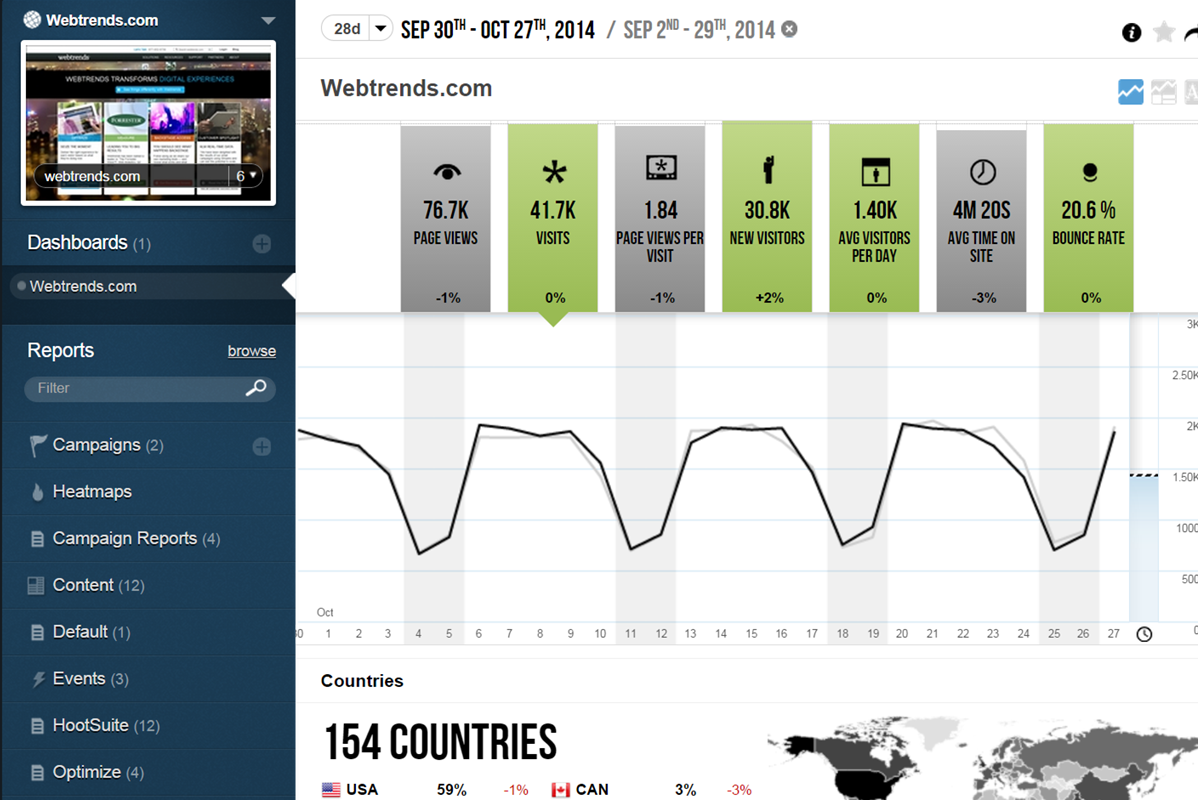
WebTrends provides an enterprise web analytics platform and, according to Forrester, has a strong focus on support for mobile and social channels and a very open platform. Webtrends competes directly with Adobe Site Catalyst, IBM Coremetrics. and comScore DigitalAnalytix.
We have used a few similar products to SEMrush at different points. Generally the breadth of information in SEMrush is one of the biggest reasons to use it. If your focus is more specific on SEO Moz Pro might be a better choice. If you are exclusively focused on SEM/PPC it …
SEMRush is definitely better than SpyFu in terms of the amount of data you get, the detail of the data, and the accuracy of the data. SpyFu is like a beginner's version of SEMRush. SpyFu is great if you're smaller, less experienced, and want to spend less money - but SEMRush is …
Compared to Moz: SEMRush is more down to the nitty-gritty. Less fluff. Compared to SpyFu: SEMRush has more functionality and is easier to use. Compared to BrightEdge: in an ideal world I'd want both SEMRush and BrightEdge in my MarTech stack, but SEMRush is inexpensive, and Brig…
Semrush is nice and working on integrating more SEM. It still does not have as many reporting features for SEM as RavenTools, but you can tell they are working on it. It has more features than SpyFu or BrightLocal. Although I like BrightLocal's interface a little better, …
I've reviewed a number of tools, and continue to periodically. Semrush easily wins for the breadth of coverage, and it does them well. Some tools designed for a single task win in those tasks, but none compare overall. Some other tools I've looked at are: Authoritas
SEMRush is my personal favorite SEO paid or free tool to use. I personally love the way it breaks up individual projects and allows you to work on each client's site as a whole separate from your other internal or external work. I also love how it allows quickly exported …
SEMRush has more limited functionality than some of the full-suite options like BrightEdge and Searchmetrics, but the tool is more affordable and still performs to our expectations. We find it to be a good medium-use tool, and combined with some additional keyword-tracking …
SpyFu is less robust than SEMRush in a lot of ways. Its keyword tool for example severely lags behind SEMRush. However, SEMRush does not have a solid PPC insight tool like SpyFu. This is reason alone to use both instead of just using SEMRush. We also see that SpyFu does a …
As an independent company working on our own behalf, SpyFu seemed like a better fit than SEMRush, which appears to be geared more towards agencies or consultants. Additionally, SpyFu offers a lot more features than Linkody, which will be beneficial in the long term.
I prefer SpyFu to SEMRush because, for a free version, SpyFu gives more information and has a better, easier to use interface. SpyFu also doesn't give you a max amount of times you are able to view it on the free version which I love and also use often.
SpyFu is definitely a lower-cost, more simplistic, easier-to-use, less robust tool compared to SEMRush. However, they provide similar information in similar ways. I would say for the serious, large business looking to invest in a hardy tool, SEMRush is great. For the smaller …
Personally, the only tool I use as often as SEMRush. If you have the SEMRush paid version, I personally choose to use that over SpyFu. SpyFu is the best free search analytics tool online though. It has the greatest offerings in its free pack and allows you to have the most …
It isn't fair to compare these two tools overall. They have a few shared pieces, but SEMRush is much more expensive but includes many more tools making it a full SEO suite. When looking strictly at the shared tools from both companies (the competitor keyword tools), they stack …
When it comes to assessing the competition, SpyFu is fantastic. I prefer its competitor analysis features much more than SEMRush or any other platform out there. That is what I use SpyFu for. Regarding reporting and integrations, it doesn't quite seem like it's the best option …
Currently we actively use Semrush and Similar Web, along side SpyFu. To be honest, the platforms are fairly interchangeable. Each one has one or two unique things that the other doesn't have. None of it is totally earth shattering. So often it comes down to price, and SpyFu is …
I spent years exclusively using Semrush for this kind of competitor PPC data, and have used Moz in the past on several occasions. I feel that SpyFu is more well-rounded and provides deeper insights than these other products, and honestly, it's just more updated as well. Easier …
SpyFu has what we needed from Semrush, and Spyfu is more reasonably priced. Spyfu does not have some of the higher level and specific tools, but is great for the price.
Spyfu fails to hit the mark at least when it comes to SEO since both Ahrefs and Semrush has a bigger directory and fetches data from more countries than Spyfu does, however Spyfu offers a great deal when it comes to cost effective solution to almost every digital marketing …
Compared to Semrush or Ahrefs, neither of the competitors stacks up against SpyFu in terms of competitor insight of paid ad performance. It can even identify specific ad copy changes, which can be crucial for high-demand periods like Black Friday. In my opinion, SpyFu is an …
I was surprised to find I preferred Semrush when it comes to keyword research. SpyFu is great (and less expensive than Semrush), but I felt the data Semrush provided was vaster than SpyFu. I was able to get more competitors spending insights in Semrush than SpyFu. Overall, I …
SpyFu is more cost-effective than both (Ahrefs and Semrush), but we have to compromise on the data's accuracy. However, the data reporting and user interface of SpyFu make it easy to decipher. For Paid Ads keyword lookup, we prefer SpyFu to any other tool maybe, because it's …
It's a great little tool that offers pretty much everything you can get from Moz or Semrush at a fraction of the cost. My company uses a few different tools but I always come back to SpyFu because it is so easy to use and their build-in reporting is great.
I've used Semrush as well. Semrush does organic SEO analysis better than SpyFu and backlink research. I find the data more intuitive. I much prefer SpyFu for their advertising/PPC analysis and use SpyFu when researching competitors' advertising campaigns. These are the main two …
I use Ahrefs for Site audit, Keyword Research, Backlink analysis, and some parts of competitor analysis. SpyFu I always wanted to keep primary, but it's not doable with the limitation of their database, which forces me to use Ahrefs for that reason.
SpyFu offers the best keyword research platform out there. I have used this for many companies that are still using this tool today. It's always been one of my first marketing software recommendations to companies I work with. For those who understand digital marketing such as …
It's a key element to my Digital Marketing surveying efforts. Often it proves to have been more accurate, once I have access to Analytics tools such GA or SiteCatalyst, in comparison to its own competitor-set.
Webtrends Analytics
Verified User
Employee
Chose Webtrends Analytics
Webtrends has its work cut out for itself considering you have the behemoth Google Analytics and Google Analytics Premium having a strong offering and brand recognition for the price of free. After reviewing the paid service I'd suggest you start off with GA as a cheaper …
This is suited to plan for keywords in a single market, but it struggles when you need to consolidate several markets. It is well-suited to discover new keywords directly related to the ones being used currently to expand the content the company is creating to get better results.
If you have a Google ads PPC campaign and then I would say this is more or less essential if you want to know what your competitors are doing. You can get very useful data out of it even if you subscribe for one month. And the pricing is very reasonable. Even if you don't use Google ads, I would say this is still useful for your SEO/SMO team since it gives you a great idea of what keywords and traffic your competitors are working on.
Scenarios 1. If you want to use web server log files as input to your web analytics, then Webtrends will provides a good product, with great ease of implementation. Don't even think about being cheap on hardware, and make sure Webtrends runs on real servers, not in a VM environment. 2. If you want to use Data Tagging, similar to Google Analytics or Site Catalyst, Webtrends has a powerful product, just be prepared to pay. 3. If you are new to Web Analytics, but it is the strategic direction, start with Webtrends on Premises. Questions to Ask 1. What are you trying to accomplish? 2. Can you place a dollar value on the benefit that you expect/need from Webtrends? 3.Can you live with Webtrends running SaaS?
Control privacy, data sharing and competitive industrial knowledge using Webtrends on premises
Great control over custom reports, custom dimensions and metrics
Flexible tool which allows multiple methods of data capture. To my knowledge it was the first tool with a Tag Builder / Tag Management function built in via a supporting website.
The big downside, the elephant in the room, is that it does not (as of right now) have on-demand segmenting, drilldowns, etc. You have to think of what you want in advance and create those reports then analyze some data. This is huge. You can, of course, re-analyze old data after creating new reports but you still have to wait. (This deficiency may become obsolete with the release of Webtrends Explore later this month (May 2014).)
It has fewer mature integrations with other products and databases than competitors do, although I'm told it works with SharePoint better than anything else does.
Its attribution modeling capability is behind Google Analytics'. In my humble opinion, this could be changed quickly if Webtrends would make some tweaks to its standard visitor history files (i.e. preserve the order in which past visits were sourced beyond the single most recent one, rather than storing all those past sources as a randomized list).
It doesn't incorporate statistical tests, confidence intervals, or statistical associations. However, this same criticism can be applied to its competitors (other than A/B Testing products). It's a tabulation program, as they all are. In this respect, web analytics tools as a group are relatively primitive. Sorry to bring this up as a criticism of Webtrends but it's my pet peeve about the whole industry and I just have to say it. (p.s. take advantage of the heavy-duty Webtrends Scheduled Export functionality to get really granular data that you can feed to a stats program to get significances.)
Although the documentation, help screens, phone support and the knowledge base have improved tremendously in recent years, there is still a pretty steep learning curve because it is different from the tools that entry-level users may have already been exposed to. This can be a shock and many users are alienated at first because they just don't get some of the fundamentals at first. I'd like to see much better help screens that are thoroughly interlinked with the KB and documentation. Having superb online support would make a world of difference with the adoption of this basically powerful tool.
Love this tool but would like insights from all 3 major search engines not just Google. I would also like deeper understanding of the placement for local businesses on Google Places/Maps. Insight into mobile search rankings and best landing pages per industry would also help :) Overall, SpyFu is a necessity for serious search marketers.
I would be willing to try Webtrends again AFTER some research from other users. I would need to see that users mention better and faster customer support on questions and issues that arise while using the software. The software is capable of vast and incredible things, but if it isnt properly set up and supported during use, it is just a big hassel and waste of everyones time and money.
The interface is a little less intuitive than it could be. The data is often available but filtering and manipulating the data can be a little difficult at times. Expanded comparisons would be helpful since most of the time seeing more than a few competitors at a time allows for a better sense of how to forecast.
SpyFu is an easy to use tool, and has a self -explanatroy dashborad to generate the data needed to provide insights into any B2B SEO and PPC campaign. It is not comprehensive, but it certainly provides good enough insight to make it a valuable part of any agency tool stack
If I could give it a 0, I would. Not having an intuitive user interface made it impossible to convince non-analytic business users to use the tool on their own. Even as a seasoned analyst, frequent calls were needed to get what should be simple tasks done. Account managers don't understand the tool either, and have to refer you to technical support
The v9 admin interface and v10 reporting interface work as well as expected, but have a tendency to be pokey, especially for bulky reports and whenever you're connected to wifi. I much prefer using the REST API for all reporting for this reason, which simply dumps out the data and doesn't bother with the user interface.
I'm in a FB group for Semrush paid users and it amazing! They are fast to respond, take suggestions and help with questions. I have not felt alone in using this product at all. Highly recommend their support team. When I had an issue I can jump into the group and they will help get me the right person to help or even tag their programmers to look at something that is going on. Love the group!
SpyFu comes with a link to tutorial videos. I recommend you watch them. The software is capable of so much you really need to watch the videos and learn how to get the most out of it. When I have a question 90% of the time it's there. When it isn't, and I reach out to them, support is always quick and concise.
I once went on to Twitter to ask for help from my network of analytics people, and Webtrends themselves responded. They have been an excellent partner in making sure that their product is being used to the best of it's ability and I greatly appreciate that. Both Omniture and Google Analytics, do not have that level of support over social media
The in-person training was comprehensive enough to get you started, but I strongly recommend having a more experienced person when beginning with the tool.
Webtrends provides several free webinars over the course of the year, many of which I would expect to pay for. The people providing the webinars seem to have a good feel for real-world application of the product.
Careful planning and patience. Use a non-public test site to fine tune tags and reporting. Despite best laid plans, there will be surprises when you collect the data, run the analysis and begin generating reports using the tool. Perform a tag audit to ensure tags fire as desired.
We have used both Ahrefs and Semrush extensively at our agency and Semrush remains the tool of choice. We find that Semrush has the largest selection of tools & features to use, with the highest accuracy, and provides top-tier analysis recommendations. It's really is the ultimate all-in-one tool when comparing other performance measurement tools in the digital marketing space.
I was surprised to find I preferred Semrush when it comes to keyword research. SpyFu is great (and less expensive than Semrush), but I felt the data Semrush provided was vaster than SpyFu. I was able to get more competitors spending insights in Semrush than SpyFu. Overall, I liked the ability to use both in our keyword research for both paid and organic marketing.
Webtrends has its work cut out for itself considering you have the behemoth Google Analytics and Google Analytics Premium having a strong offering and brand recognition for the price of free. After reviewing the paid service I'd suggest you start off with GA as a cheaper alternative that is just as robust, if not much more flexible in regards to the reporting and goal tracking needs for our company.
Using Semrush on behalf of our clients, we have seen some impressive growth in organic visibility, traffic, conversion and revenue, across multiple industries.
The site checks available with Semrush have helped us to pitch and sell our services, securing new clients.
Webtrends has had a positive impact on site visitation because it allowed us to understand the sources by domain for site traffic and find out ways to increase visits from those domains.
Webtrends has also allowed us to understand areas of optimization on the site, which has had a positive impact on the overall user journey on the site, likely leading to longer site duration and engagement.