Adobe Marketing Cloud is a suite of products including analytics, social, advertising, targeting and web experience management. It comprises foremost the popular integrated web content management and digital asset management (WCMS / DAM) solution Adobe Experience Manager, Adobe Campaign's cross-channel campaign management and marketing resource management capabilities (based on technology acquired with Neolane in 2013), the Adobe Audience Manager data management platform, analytics, and other…
N/A
Adobe Workfront
Score 8.3 out of 10
N/A
Adobe Workfront, acquired by Adobe in late 2020, is a web-based project-management tool. It is designed for both IT and marketing teams, but can be implemented for any kind of project. Workfront offers all the features standard to project management platforms, as well as resource allocation, automation, and agile workflow.
N/A
Asana
Score 8.5 out of 10
N/A
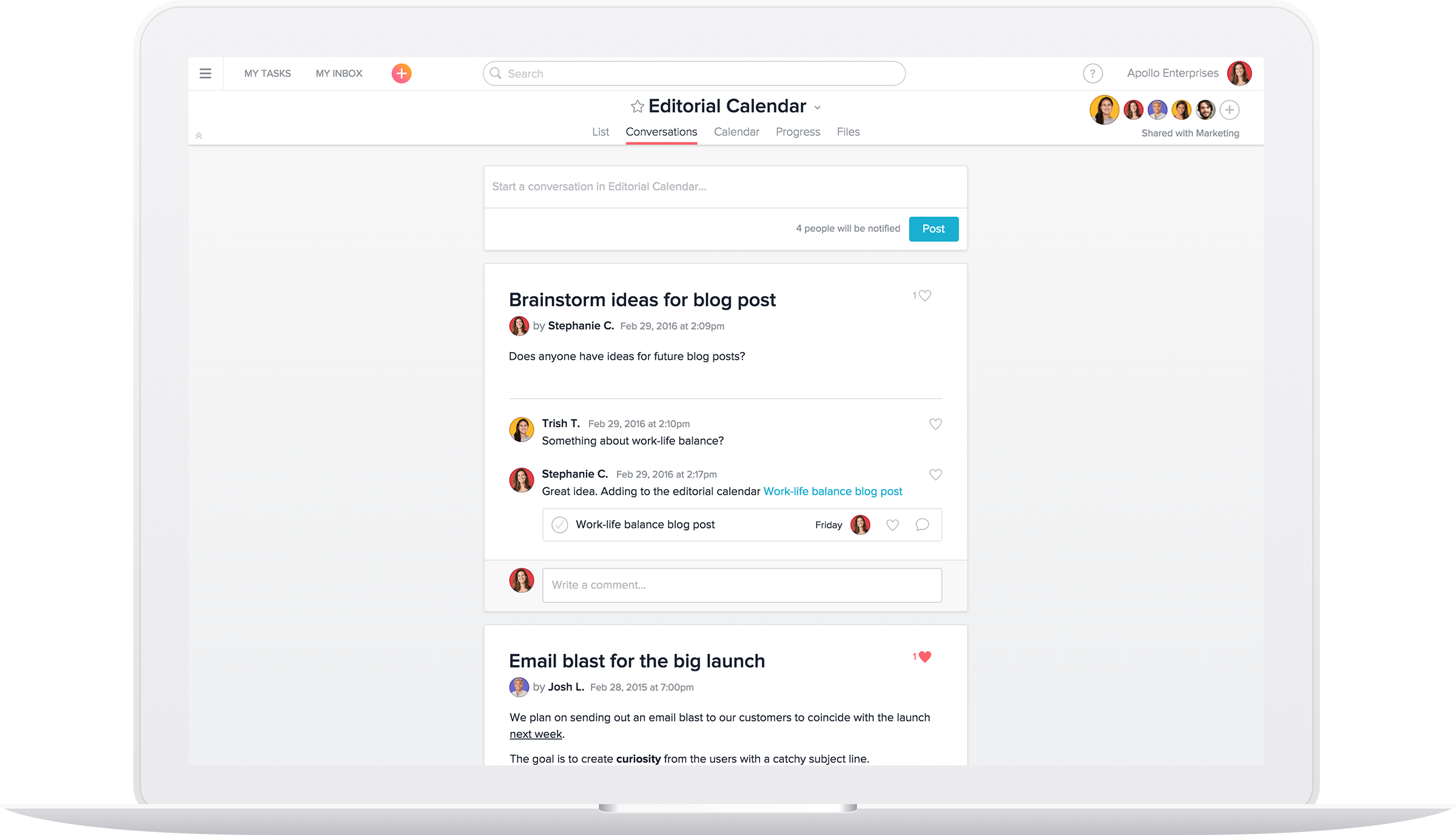
Asana is a web and mobile project management app. With tasks, projects, conversations, and dashboards, Asana lets an entire team know who's doing what by when, enabling workload balancing. Users can also add integrations for GANTT charts, time tracking and more.
I would say it is the leader in the industry and was easily the number one choice in two of the three places I have implemented a marketing automation platform. Hubspot is its closest competitor and ended up being the better choice for a membership association but the Adobe …
We have also used CMS. That software is very outdated and is causing a constant headache for my company, Marketo and Adobe Marketing Cloud are far easier to use and have more options
Marketo, Hubspot, Act-On, Salesforce Marketing Cloud are a few of the competitors. However, we decided to implement Adobe Marketing Cloud because of its end to end capabilities to better manage content, campaigns and understand user engagement with analytics by sharing the same …
In comparison to other services, Adobe is particularly robust, and the platform is better suited to customers with a high level of maturity in the digital environment, who need a platform to overcome and solve day-to-day problems.
Adobe marketing cloud was a strong fit for our agency, considering we already take advantage of Adobe Creative Suite for creative projects. Competitor marketing platforms have often been tempting to evaluate considering they are often far less expensive, but the extra costs of …
Adobe's feature set is more robust and progressive. I don't want to invest significantly in technology, just to feel like I'm going to have to upgrade within a few years. I have more confidence that Adobe's products will scale over time than I do in IBM's products, with the …
As an agency, we are vendor agnostic so we typically recommend a tool based on our client's specific needs. Both Google Analytics 360 and Adobe Marketing Cloud are powerful tools, but if a client does not have the appropriate organizational pre-requisites to leverage the …
We really have not evaluated any other products. I have used the Adobe products in the past and realized that the costs of purchasing the individual programs would have been too much for our organization. Using the cloud gives us tools we never thought we would be able top have …
Adobe Marketing Cloud is really the best program out there, I'm not sure how it stacks up against most other analytical clients, because I either don't use them as often, or my clients specifically request Adobe Marketing Cloud. Adobe Marketing Cloud (AMC) is basically the …
If you are an enterprise, there is simply no comparison. The sampling in Google Analytics will lead you astray. The lack of pathing will leave you unaware of how people navigate. You will essentially be making all of your decisions based on bad data. There's a stunning lack of …
Adobe Marketing Cloud is a great solution if you need individual-user level analytics, a high degree of customization and integration with sales or customer management systems.
However, if you want to understand how segments behave in an aggregate level, understand the sources …
Before Adobe Search & Promote, we used, if I am not mistaken, a system called Easyask. But whatever it was, we needed to host it ourselves and give the proper maintenance. It consumed a lot of our time, which we now save by using Adobe.
Much increased functionality and templating aspects. While I liked JIRA's setup, the Workfront is so much more flexible. The moving away from Jira i was able to show the possibilities of what a full pm software could accommodate and how it all connected in. Also, the pluses of …
Adobe Workfront doesn't stack well with these other tools. monday.com and Airtable have great interfaces and are very easy to set up and use. That is what my team currently uses.
I like both Jira and Asana. They both help streamline campaign processes and provide visibility into the work being completed by multiple departments. However, with Workfront, it syncs with other Adobe products, giving it an edge over other products.
AEM is a little bit easier to use. We selected Workfront as we already have a contract and relationship with Adobe through AEM services, and for integration purposes.
JIRA is better for the day to day type work that is done by individuals or teams, Adobe Workfront excels at the high level day to day work that is done by an entire organization.
Adobe Workfront reminds me of Filemaker Pro. Especially in the way you can customize it (and the way you have to build it - it's not an out of the box solution at all).
I like the look and feel for Adobe Workfront better. It's cleaner and easier to read my work order. Asana looks a bit TOO complicated to navigate and often time it's harder to find things.
But I do like Asana's tabs better than Adobe Workfront. I like Adobe Workfront's pin …
Asana is a highly effective instrument for managing teams and projects. The paid edition provides a multitude of features that can be tailored and used in accordance with the organisation's specific requirements.
Email integration facilitates notifications that remind team …
Overall for the money Asana brings a lot of value for organizations who want to do more with less and need a task and project management solution as a small company is growing and scaling to get to the next level. In the space when we evaluated didn't find a lot of other …
Against Jira it offers a more modern experience with less complex user interfaces. The admin and setup experience is also way faster with less (or no) legacy complexity.
Against other modern players like Linear and Basecamp it offers way more integrations so we can pull in data …
Asana is a top-tier project management software that helps us organize and track projects from start to finish. It allows us to apply tasks/to-dos to multiple projects without duplication, divide complex projects into smaller tasks, and track project progress. It also helps us …
Asana provides a mix of features between notion and Jira. Unlike Notion, it helps ease up the collaboration on vast projects and between multiple teams. Jira proved to be a little expensive with similar set of features if not more and which is why we thought of going with Asana.
I believe that Asana is more professional than Trello. I used Trello a long time ago, but it looked more suitable for a student project rather than for a professional team or business environment. I believe it has great features to help companies in different stages and of …
Since I have tried the two applications and saw their advantages and disadvantages, I see that Asana is much better in terms of dealing with files, ease of use, and the many features and characteristics that it has. Also, I noticed that it does not consume much space on my …
Side by side with the other two Asana by far beats Monday.com and is comparable and slightly better than ClickUp. Monday is completely browser-based and is hard to navigate and figure out how to set up. Asana and ClickUp are the exact opposite. Both are easy to set up and …
I like how extensive the capabilities are for Asana. With other softwares it seems there are many things lacking. I feel like Asana is also a very user friendly platform and aesthetically pleasing which is important in a modern office. We have many young people entering our …
Asana compared to Jira is certainly better in terms of user experience, since most of the people can start using it basically without having any kind of training or previous explanation, which makes it really useful not only for people already used to project management but …
Asana is amazing for a remote team, that we are currently as its accessible seamlessly to all our team member no matter where they are in the world. Its very easy to onboard new members to this platform as its very intuitive and easy for new people to get a hang of it. It has …
Basecamp was a great tool, but it was paid and things like recurring tasks and opening new projects was a pain. Asana, as a free tool, has been better for our organization as it serves the basic functions very well and is not complicated otherwise. I really like the …
This is definitely a tool for enterprises. You need to have a certain level of complexity before you pay for this tool. You should have multiple funnels, websites, or an insane amount of content. If you are involved in ecommerce, this is a worthwhile investment. However, if you have a smaller site, little content, only a single funnel, or don't sell anything online, this is a much less worthwhile tool for you.
It works super well for creative brief intake and brand reviews. It took us more time than I'm willing to admit to get it all set up, but for our limited use case, it's working very well now. I'm not sure where it wouldn't be a good fit, honestly. As a newer user, it's still something I'm getting to know and learn.
The usability of Asana is broad since it's available in a variety of platforms that are widely used nowadays. I think that it would be great for people who are constantly on the move and switching devices, since it has allowed me to work from my phone, too. I also think that Asana has proven itself to handle a large quantity of work
Adobe Marketing Cloud provides strong capabilities and applications that help better run digital marketing campaigns, manage content and understand an insight.
Adobe Marketing Cloud also provides tools to A/B test, CMS, and manage digital campaigns.
It also provides strong capabilities to get an insight with Analytics to better understand the user journey.
Adobe Marketing Cloud is fairly expensive compared to some of the other tools out there. While it does provide an excellent tool for the price, it can be a little daunting to some.
The learning curve with Adobe Marketing Cloud is fairly steep. When we bring on new employees that will work directly with the tool, it can take weeks until they are up to speed.
Like it mentioned before, the initial implementation was a fairly lengthy and complicated process. Staying on top of new campaigns does require quite a bit of knowledge of the tool and our process in order to be properly launched.
Allow nonusers to add requests, our organization has no need to add all 10,000+ team members to Adobe Workfront, but would like them to be able to send requests to our team
Although a powerful tool, Google Analytics has been catching up in capabilities and is much simpler to use. As analytics move to the spotlight, more sections in a company want to have access to it. However, creating straightforward reports/dashboards and sharing them with different groups is not a strength of Adobe Marketing Cloud.
Workfront is sometimes a bit clunky to use, but overall it works well for our teams when it comes to project management and collaboration across multiple, involved teams. It also has flexibility that allows us to adapt it to diverse use cases, some of which aren't necessarily always the first things that one would think of using workfront for.
I just can't see us getting it off of Asana any time soon, despite the many headaches it has caused us. We have too much data in there, too much time & training invested into it, too much at stake to move. If we were just starting out today, fresh, I don't know for certain that I would absolutely go the same direction, but I *think* I still would. I just haven't seen anything better yet. Maybe if Podio's support staff hadn't treated me like a worthless nuisance to them, I might feel differently, but the fact is that their task management is simply inferior to Asana's. That can't be denied, and in fact Podio said it themselves: "Tasks are a simple function. They cannot be customized. Tasks in Podio can be used for quick to-do's for you and your team members." In our operation, however, prompt task completion is a big deal; one task can't be completed until another one is done first, and closing the gaps between those tasks is critical in meeting deadlines and servicing our customers. Asana gets us there, the others don't.
Workfront is overly complex, but it is functional as a tool to keep track of projects. It is a shame that sometimes it takes a lot of clicks to find anything. Workfront is slowly modernizing its interface but at the same time, hides certain information away thus making the experience feels worse.
It is very user-friendly. Takes a new employee an hour to start figuring out how the system works. That's an important factor. You don't want to encounter the issue where employees need a week to understand how the system works. For example, JIRA, I tried using it for a week and I still don't understand the complicated layout. Asana has a simple interface. Once you see it, you get it type of program.
Maintenance is required, but usually after work hours, Some days the proofing tool function is not operational, but this is a new function of the tool that WF is working out. the kinks on. Chrome is the best browser to use the system in and we find Firefox and Explorer lose some view functionality - Gantt Chart, Resource Grid
I think overall, Adobe Workfront performs well. There have been some times when it doesn't load or run as quickly as our team would like. This is frustrating when it is such a crucial tool that our team utilizes on a daily basis. It can show our workflow when it lags.
I know that this particular company has it's own Adobe Workfront employee that builds out things they need from the software, and meets with them regularly to troubleshoot. I'm not part of this process, but it's refreshing to see Adobe provide this level of customer service to people, and they're expedient.
I haven't had to use their support so I can't rate it. The fact that I haven't needed them reflects the ease of use of the product. I would recommend that any new users schedule a complete demo of the product to ensure that they are using it to it's fullest (there's a lot of useful features).
The training is very easy to use and you can simply choose the topics included in the course(s) that are most important to your training needs. After each training course, you are tested on what you have learned. If you need a refresher course, they provide Course Catalogs as well as instructor-led courses & workshops.
The most important thing that you can do when implementing Workfront is to have your back end data prepared ahead of time. What resources are in what departments? What amount of allocatable hours does each employee have? What are the cost models for each employee and resource? Having all of this information available will allow you to fully utilize Workfront's features.
Adobe marketing cloud was a strong fit for our agency, considering we already take advantage of Adobe Creative Suite for creative projects. Competitor marketing platforms have often been tempting to evaluate considering they are often far less expensive, but the extra costs of Adobe Marketing Cloud have been considerably offset when taking into account how much overhead and internal efficiency has been added to our process. That said, Moz and HubSpot, the two primary competitor platforms I have sampled, both had much better billing and estimating tools, a critical part of agency life. They also better handled the ever-changing social media landscape and were often quicker to adapt to emerging marketing trends.
Much increased functionality and templating aspects. While I liked JIRA's setup, the Workfront is so much more flexible. The moving away from Jira i was able to show the possibilities of what a full pm software could accommodate and how it all connected in. Also, the pluses of connectivity with the Adobe suite for our creative teams were excellent. From providing updates within other programs, it allowed a much more fluid working process and instant communication.
Asana is a top-tier project management software that helps us organize and track projects from start to finish. It allows us to apply tasks/to-dos to multiple projects without duplication, divide complex projects into smaller tasks, and track project progress. It also helps us organize work on Kanban boards or linear lists. It stands out from the crowd in a big way compared to the competition.
We have been using Workfront for about 3 years. During this time they continue to be a very stable project management system. Workfront's overall scalability is able to handle increased loads of work. When using Workfront for a project management tool for the web team, we store documents, images & video's without any issues. They work with their customer's to provide the best project management system in the market today! I highly recommend Workfront for all project management needs. Workfront strives to deliver unique technology solutions to growing companies!
Allowed us to increase the number of emails that went out the door without inundating our members with more email due to the levels of segmentation we could now activate.
We can add communication limits to make sure people only get a certain amount of messages from s in a given time period.
We decreased the time it took for a lead to make it to the sales team to a matter of seconds.
Increased efficiency in threaded updates to Outlook emails - no time wasted looking for things in email vs Workfront - they automatically are in both places.
Time tracking allows us to average out how much time tasks & deliverable types take, allowing better long-term forecasting.
Planning has given us a system of record for campaigns, allowing us to easily find historic plans and/or view calendar views of upcoming ones.