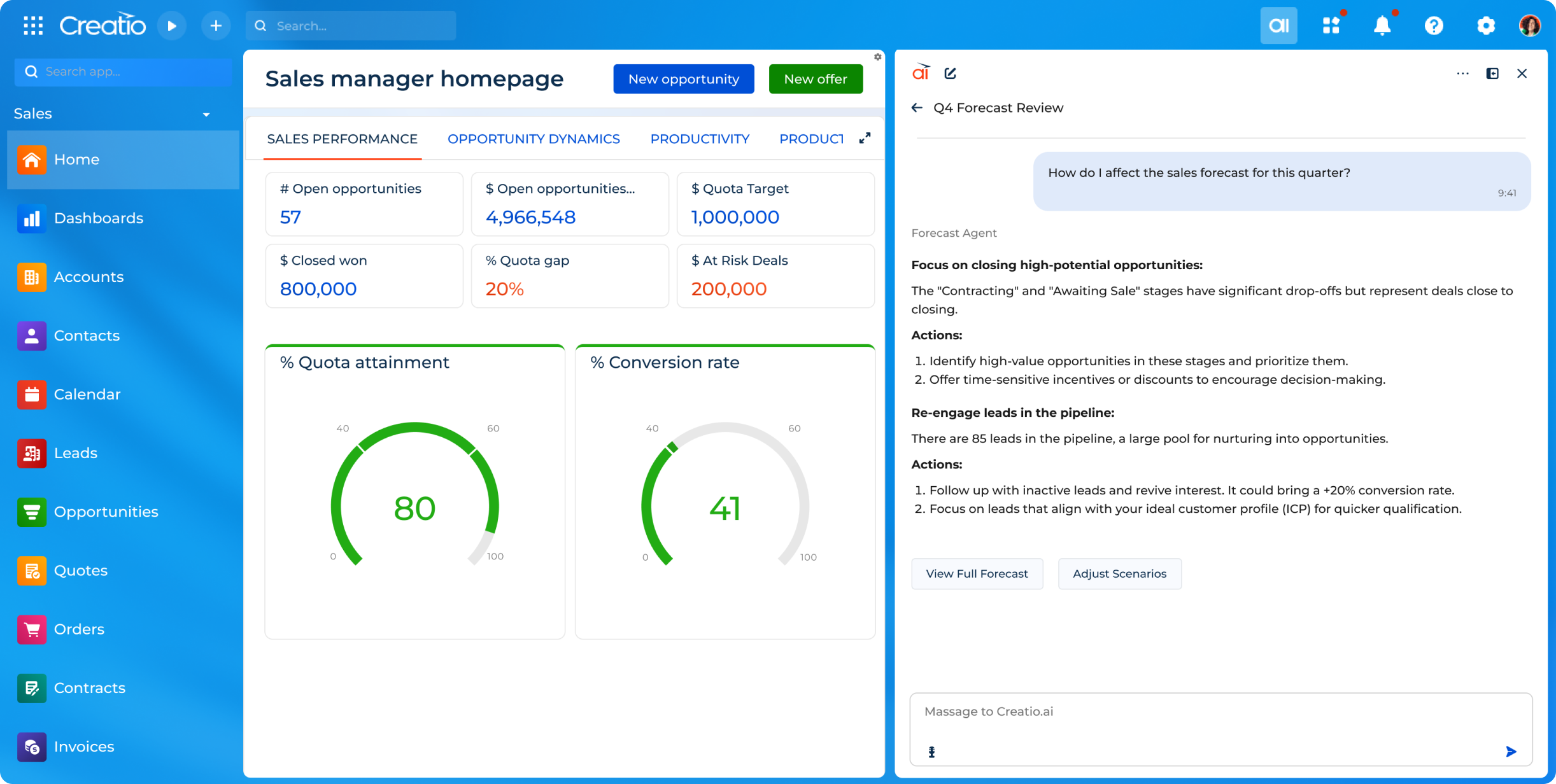
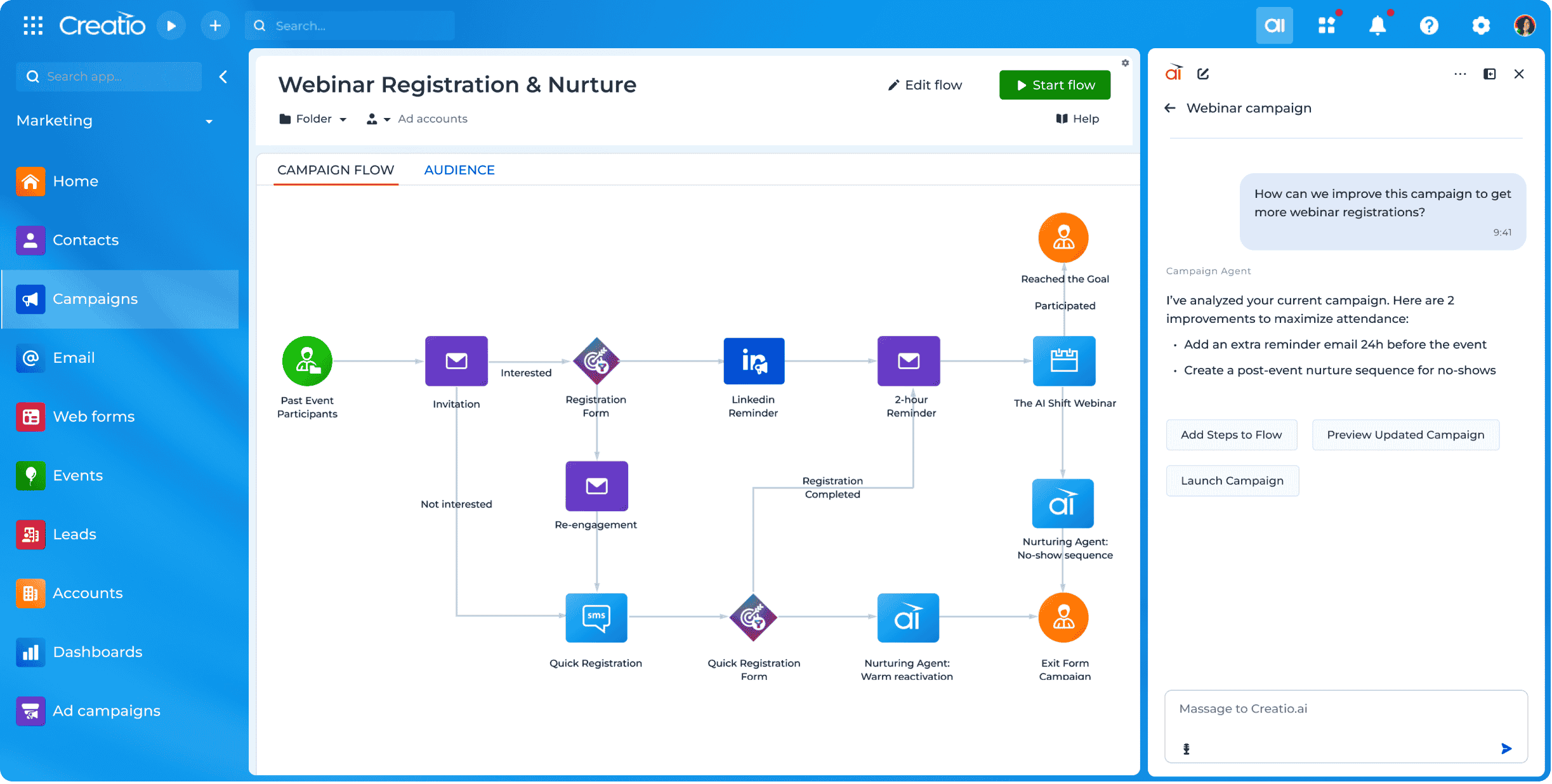
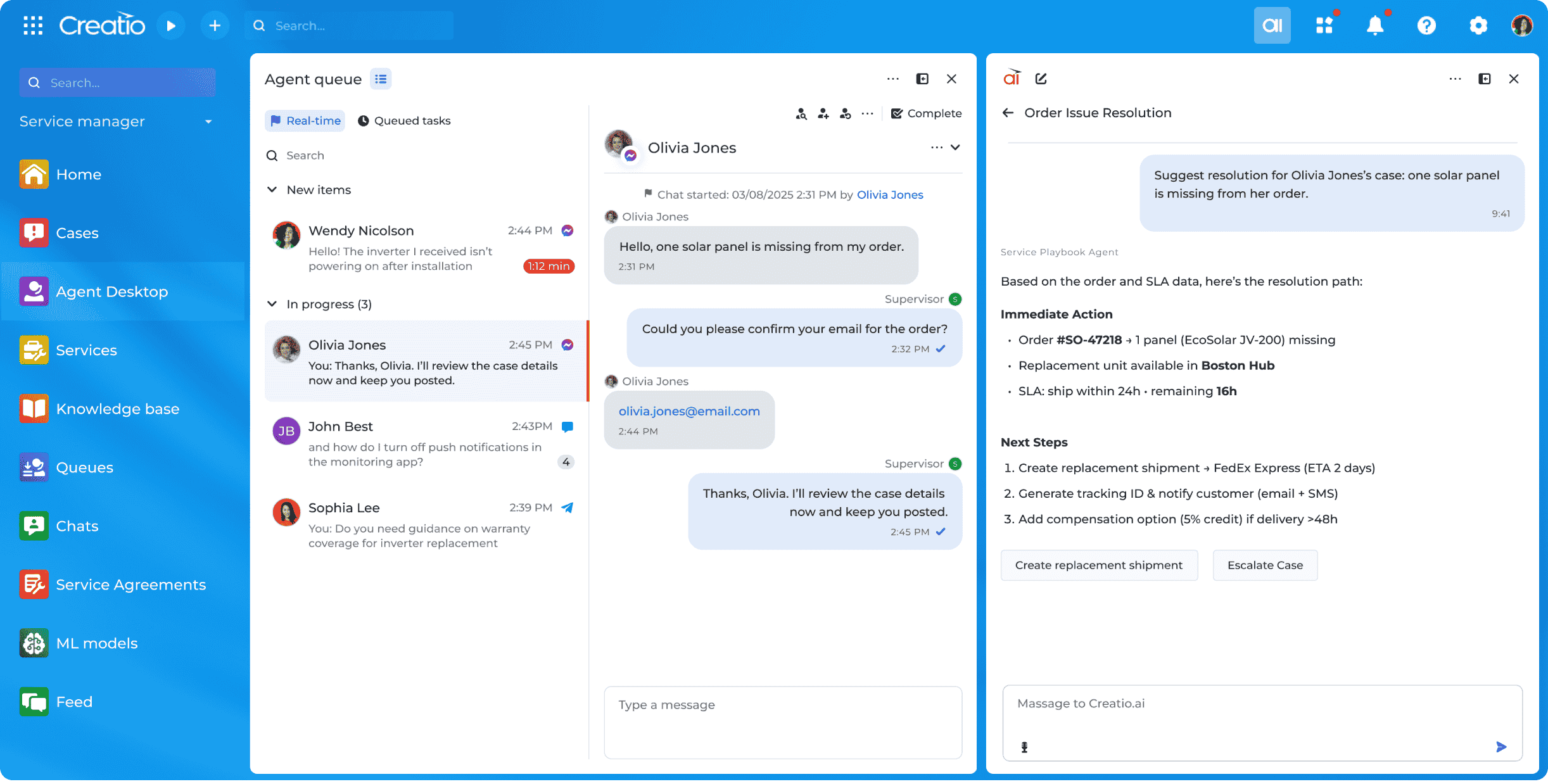
Creatio offers an agentic CRM and workflow platform. Its offerings include Creatio Studio, a no-code agentic platform to build applications and AI agents with natural language and visual designers, and a CRM suite with embedded AI agents across Creatio Marketing, Sales, and Service. The platform also includes industry workflows across 19 verticals and a range of marketplace add-ons. Creatio products can be purchased separately or as a unified CRM solution to…
$25
per month per user
Agentforce Sales
Score 8.8 out of 10
N/A
Salesforce' Agentforce Sales (formerly Salesforce Sales Cloud) is the company's flagship CRM platform. The AI CRM for Sales features data built right in.
$25
per month per user
Sitecore Digital Experience Platform
Score 8.9 out of 10
N/A
The Sitecore Experience Platform (Sitecore XP) is a digital experience platform used to build websites and create customer experiences online. The solution boasts fast content authoring, built-in personalization features, testing and other optimizations, as well as analytics and marketing features.
N/A
Pricing
Creatio
Salesforce Agentforce Sales
Sitecore Digital Experience Platform
Editions & Modules
Growth
$25
per month per user
Enterprise
$55
per month per user
Unlimited
$85
per month per user
Starter
$25.00
per month per user
Professional
$80.00
per month per user
Enterprise
$165.00
per month per user
Unlimited
$330.00
per month per user
Agentforce 1 Sales
$550
per month per user
No answers on this topic
Offerings
Pricing Offerings
Creatio
Agentforce Sales
Sitecore Digital Experience Platform
Free Trial
Yes
Yes
No
Free/Freemium Version
No
No
No
Premium Consulting/Integration Services
No
No
No
Entry-level Setup Fee
No setup fee
Optional
No setup fee
Additional Details
Creatio Sales, Creatio Marketing, and Creatio Service are available as add-ons for $15 per month, per user. Creatio AI is included in every tier of the Creatio platform (Growth, Enterprise, and Unlimited). Creatio AI starts at $5,000 per year
Creatio was both more affordable and easier to customize than Salesforce, if slightly less robust, and represented an easy decision when we made the switch.
We previously used Salesforce as our CRM. While it has great functionality, we found it to be cost prohibitive to always require consultants to configure and update as our business needs or processes changed. No other platform reviewed ticked as many boxes as we needed in its …
Creatio is miles ahead of Infor - now, looking back on Infor, it seems very dated and restricted. I love how you can work things out and change things yourself in Creatio. And if things are a bit more complicated, you have your dedicated team person to help you. We have …
Associate Director - Digital Technology and Consumer Markets
Chose Creatio
Although we haven't totally removed Oracle CX Sales, it's less effective due to its outdated sales marketing capabilities unlike Creatio, which offers robust tools at a lower cost.
Sure, the low code approach is eating the world and [is] a powerful feature in this CRM. But training time and time for implementation could be much [longer] than expected.
We selected Creatio because it's the most optimal system for our current business requirements and their further scale [development]. Also, we valued the support of the vendor and the big community of implement teams.
Creatio provides powerful features at an affordable cost. It is easy to customize and set up. The user interface is intuitive. It is possible to set up business rules with an easy interface without writing code. The basic setup can be performed by a business user, without …
Creatio is much faster and more configurable than Salesforce. The first thing that I noticed when migrating from Salesforce to Creatio was how few clicks it took to record activity or create a new task. Similarly, the page loading speed is so much faster which saves me hours …
For this customer, I've been choosing among AmoCRM, Insightly, Bitrix24, Zoho Bigin (and CRM) and many others. The choice of Creatio was predicted mostly by the fact, that the company was using Terrasoft CRM previously. So it was a safe decision and choice to have the same …
The system’s UI, rich functionality, and a great potential for scalability made the system stand out among other vendors. It is a fully-fledged solution that allowed us to work with customer data way more efficiently and improve our processes on a regular basis.
The user-friendliness of Creatio was a big selling point along with the low-code initiatives, both of which were important to our business. With Salesforce, unlimited wasn't really unlimited. You couldn't deploy an on-site instance and the overall cost of the system far …
Creatio stood out from other vendors in terms of both the system’s usability and robustness. We were impressed by the flexibility of customization that the system provides. On top of that, Creatio’s technical support is always very quick to respond and helpful.
Based on my experience, I’ve used Odoo — it’s an open-source ERP system. It’s not exactly the same as Salesforce or Sales Cloud, but it serves a similar purpose. And I feel that Sales Cloud is better. Personally, I find it easier to use and better than what Odoo offers, …
Over the years, I’ve helped many people move from different sales solutions — like Dynamics, HubSpot, and Act, which was one of the first ones. I’ve supported a lot of organizations in moving from those platforms to Salesforce.
So I've evaluated, implemented Microsoft Dynamics in the past. I've used Oracle CRM solutions. I've used Daylight, which is a very niche CRM system the last couple of years. And I've evaluated a variety from Legacy Microsoft Ones to Zoho and Sugar when making implementation …
Actually, we have not. By the time I joined my company, we already had Sales Cloud. It was already there and the decision was made. I'm sure that there were other small companies that the upper management team evaluated very quickly, but they came to a decision very quickly. I …
Raiser's Edge, CSING. Those are the primary ones. There's no competition at all. I mean, in terms of tracking duplicate contact, I mean contacts ability to be secure and provide the right access for different levels. Salesforce was able to do that. Oh yeah. Yes. Whereas the …
We have used HubSpot and we have used jojo CRM. So the customer who cannot afford the licensing model of Salesforce, jojo CRM is a very good platform and another for assembly level, hub Spot does the work as well.
Salesforce is magnificently more robust and functions much better when managing complex sales cycles with multiple individuals and products. With simple sales cycles and few products, Excel is a strong contender.
Salesforce CMS stacks up as a Customer management system because it has a more user friendly snd intuitive interface. The UX is better and more modern. It can be customised and extended. There are always learning opportunities and updates for the system so it keeps on …
Salesforce more so compliments these products, rather than stacks against them. We don't have any products similar to Salesforce CMS, so in lieu of that, these are the products we were using that mesh the easiest with Salesforce CMS in terms of proceeding through the …
In my opinion, Salesforce CMS is the most complex of these offerings, and probably the most complex platform of its kind. It was selected by another stakeholder - I would likely have chosen something less expensive and more intuitive to use. The robust feature set is amazing, …
We used the Catalyst product of Totango. It was not great as it was hard to navigate, and it did not offer any reporting capabilities at all, nor did it speed up our day-to-day tasks.
After evaluating OpenText, we found that Sitecore has stronger capabilities to utilize the content for personalization and contextual marketing. We also favored Sitecore's user permissions, roles, and content creation processes out of the box.
Adobe Marketo Engage is a fantastic product for managing campaigns and audience segmentations syncing with Adobe Audience Manager. It also has OOTB connectivity to very popular CRM platforms. Adobe Analytics and Adobe Target are pretty similar to Sitecore CDP/Personalize. Any …
Other tools lack one or the other and fail to provide a comprehensive best experience for everyone - content authors, marketers and developers. Sitecore comes with out of the box authoring host, best content authoring and WYSIWYG editing experience and much more.
Really the only comparable product to Sitecore DXP is Adobe Experience Manager. Both are very well established and robust content management platforms. Products like Contentful and Contentstack are very lightweight and do not have as many built-in features like DXP, so it is …
For one our client, we utilized Sitecore XM Cloud with Sitecore Search to build their websites. Sitecore search help to provide more ai based search experience with suggestions, textual relevance, facets. XM Cloud with Next JS help us to deliver the website for more modern …
Its is simply by far the most advanced system. Using other CMS you will soon be blocked with advanced customizations specially to their back office but Sitecore enables you to do whatever you want and hook into the pipelines and embed your own code/business logic.
I haven't used other DXPs in that great detail to provide a holistic comparison between it and Sitecore. Overall, I feel every product has its pros and cons. With Sitecore, I feel they are always innovating and coming up with new solutions to help the partners deliver the best …
We experienced issues with this CMS and thus switched from Sitecore Experience Platform to AEM and both of them have their own pro and cons. While Sitecore Experience Platform provides flexibility to copy properties from one page to other, AEM doesnot allow that.. we need to …
The main reason to use Sitecore Experience Manager is if you want to develop something completely custom. Sitecore is best suited for very robust, multi-page websites. If you need to build out a website that supports multiple product lines, Sitecore could be a good option.
All of these platforms have their pros and cons. Selecting the best fit is a matter aligning corporate need vs features provided. Have a .NET shop with an advanced marketing team looking to push UX forward and willing to pay a premium, then Sitecore may be the right fit. …
Sitecore was evaluated by our practice next to two other Content management systems 4 years ago. Sitecore scored the highest following a series of questions related to product stability, scalability, ease of use, and a host of other categories.
WordPress and Wix are great solutions for a small business or a solopreneur who's just looking to get a simple website up and running. For larger businesses with more robust content, I think Sitecore offers a bit more flexibility. Wix and Wordpress are both really simple to get …
Sitecore provides and enterprise grade CMS over Wordpress and allow us to do the customization we need for our unique environment. Optimizely might be better for AB testing.
Sitefinity is improving but at the time of decision making it had nothing that could compare with the A/B testing and personalisation features that Sitecore offers. This was a key differentiator and ultimately ensured Sitecore was purchased. Wordpress isn't really comparable …
The decision to select Sitecore was not ultimately mine, but the fact that we were able to leverage in-house Microsoft .Net (C#) experience on a platform that had a library of extensions, but also allowed us to customize and keep private our confidential IP has been a big help. …
Of all the competitors listed above, Sitecore owned, by far, the best combination of power, easy-of-use, and extensibility. It easily outperformed the other paid-for CMS systems. Its power is especially noticeable in its ability to handle very complex workflows, security …
I have used an in-house CMS and the Amaxus CMS. Sitecore is a great balance of these two. The in-house CMS was VERY user friendly, for the least technical client. It showed the actual page you were editing and allowed you to basically edit the text on the page, no HTML …
Every product has a cost window it fits in. Umbraco is perfect for small to mid-enterprise implementations. However Sitecore is more stable from a developement standpoint.
Creatio is well suited in following scenarios: Complex Business process modelling and automation, Low code No code development which is best for efficient timelines, customized reporting and dashboarding, seamless integration with other technologies. Scenarios where Creatio is less appropriate: Solutions which require high cutomizations on the frontend side as this can be done by javascript modifications but it increases the load on the page and slows it down.
In the end, I think we can always make it fit — and that’s one of the powers of Salesforce. Because of its flexibility and wide range of possibilities, you can really make it work for almost any need. The key, though, is to make thoughtful decisions upfront and plan carefully how you set it up. If you do that, you’ll end up with a truly flexible and effective system.
Having worked with other DXP platforms, I find Sitecore to be the most suitable for enterprise-level clients. The platform is highly flexible - both customizable and extendable - making it adaptable to any customer needs or requirements. The platform focuses on the success of both marketing and technical teams, which I don't see on other platforms.
Creatio's client success team is super. The team is collaborative, solution-oriented, and client-driven. We have weekly meetings with the team. They show up prepared with solutions/ideas to business requests and they are clearly engaged.
Creatio's infrastructure team has been critical to our ability to execute our cloud strategy. They have worked with us to set up our testing and production environments within Azure, assisted in testing, and are responsive and flexible to our unique requirements.
Creatio has been very flexible to requests for customization. We have taken their low-code out-of-the-box solution and "Ringlerized" it. The benefit for us is an application that meets our niche business needs.
Customer Profiles - the ability to identify key features on the site and flag those interactions to tie customer visits back to specific persona types.
Lead Scoring - the ability to establish a funnel for leads and use this funnel to assign a score or qualification within the sales funnel.
Personalization - the ability to tailor experiences to unique customer segments based on their needs, identifiying and optimizing the experience in real-time.
When we started using Creatio in 2022 the new user interface had just been released and did not include all the features we needed; however, we used a more classic user interface and were still satisfied with the results.
The ability to capture a digital signature directly within the application was missing in the base system; however, Creatio connected us with a partner that provided a solution for this specific situation.
I’d say the only thing that can be a bit tricky — and I know Tableau helps address this — is that sometimes we’re limited in how deep we can go with the data in terms of reporting. It would be great to have a bit more robustness within the app itself. However, we’ve figured out our workarounds, and overall, I think it’s a fantastic product — which is why I’ve been working with it for 23 years.
Sitecore is complicated. Software developers need (costly) training to get the most value out of it and business users do not find it intuitive to use. Concepts like the content tree can be difficult for the business users to grasp.
Despite everything being possible in Sitecore, virtually nothing comes out of the box - you need to develop every component and do so within a defined process and framework, which can be a fairly big development overhead.
We have always used a CRM and Creatio has proven to be much more effective in meeting our needs than our previous provider. Its customizability will allow us to adapt this product as our business may change in the future.
There are days when I wish we hadn't switched, but I know that if we put in the time, we will get to where we want to be with the software and that it has many more capabilities than anything else we looked at. However, the amount of time and onboarding we need to do is also far greater than we realized/were told when we originally bought the product. They told us we should hire onboarding support, but at the end, after we had already reached our budget maximum for this, so it's been slower than we had hoped.
Sitecore has proven that it can deliver on its promise of a robust, reliable enterprise CMS solution with plenty of features. Also, they keep updating it with more and better features. Now that we are highly trained on it we have started on getting the most out of it and we plan to keep doing more of that in the future.
It's very user friendly, at least to me ;-) No downtime, quick with updates, lot's op possibilities and options to explore and work with. I also realy like to use the Creatio Academy, it's a bit much but in this case less is more is the opposite: the more the better
All in all, it's a great product that use all day, every day. It's aesthetically pleasing overall and specifically provides information in a clean, concise way. It's easy to manipulate and seems to play well with the other products I use such as Pardot, Gmelius, and our company's proprietary data system. It increases my efficieny in my admin tasks so I have more time to focus on revenue-generation and account management. It's also easy to use from everywhere where it be on a university campus, in a hotel room, one of a million Starbucks, or at home
Once you learn how to use the platform and can put a solid strategy in place to manage it long-term, it becomes a lot easier to use. The tricky part is working with resources who are familiar with the platform to navigate some of the common implementation and configuration pitfalls. Although Sitecore has worked very hard to overcome some of these from their earlier product versions by creating wizards and improving their support documentation, at the end of the day it is still a very complex and powerful system that needs to be implemented carefully in order to foster the best possible user experience for authors. So it could be rated very usable or not usable at all based on how much planning took place and the quality of the implementation.
Other than the daily maintenance window where the server may be inaccessible for a few minutes, there have been no issues with accessing our Creatio site. The daily maintenance window is outside normal business hours so it does not affect our Users - just myself when I am looking to implement changes.
All Force.com apps run on world-class data centers with backup, failover, and disaster-recovery facilities. Force.com has had a proven 99.9 percent uptime record for years. Accordingly, I only recall our instance of Salesforce having one unscheduled, brief down time over 6 years. I can't remember for sure, but it may have been due to our Internet Service Provider (ISP) versus Salesforce itself. Also, Salesforce does it's best to keep customers in the loop:
Trust.salesforce.com is the salesforce.com community's home for real-time information on system performance and security. On this site you'll find:
Live and historical data on system performance Up-to-the minute information on planned maintenance Phishing, malicious software and social engineering threats Best security practices for your organization Information on how we safeguard your data
Some Users have reported slow responses from the server at times which seems to be localized. Users are based across four different time zones and the issue is intermittent.
For a SaaS provider, I'd rate their performance to be one of the best. At times, reporting tends to slow down if the data set is very large, which is the case in any system. But, that's a very rare phenomenon
Creatio support is generally very responsive and often responds much faster than the expected SLAs. We have very rarely had "blocking" problems when creating new applications or features, and in all cases, Creatio has been able to help us or direct us to a solution. Overall, we are very satisfied with their support.
The overall support has been good. More and more features are being released quite frequently. Very small features are also making big difference in how the tool can be adapted and used better. If there is anything we need or are stuck, the support team sets up a call and helps in resolving the issue/provides workarounds.
1. Customized software development & maintenance. 2. Technology Consulting - Consulting-based services for technology solutions data engineering or cloud solutions. 3. Used for tapping into multiple data sources such as CRM and marketing automation systems and, creating automated data extracts with a high-end visual representation of data. 4. Implemented for scheduling an existing report to automatically refresh and be delivered to specific users at a specific regular interval.
I attended two training sessions. I would rate them a 4 as an advanced user. It was very basic – great for someone new – would give 8+ for new person.
I had 3 years of experience at the time. I skipped basic and went onto advanced and still not helpful. A lot of it was best practices that didn’t feel relevant for our business
Most of the roadblocks to learning were not discovered until the users were actually in the system using it on a day to day basis. Our Customer Success Manager has offered to setup additional training sessions as needed to close the gaps in our learning. Some areas which required some additional training are setting up filters, dashboards, and generating reports.
I have gone through multiple. The content that’s delivered is quite basic – I wish they had more advanced training.
We are grandfathered into premium support plus training. We get unlimited access to instructor led and online training for free. We have taken advantage of this
Sitecore captures and remembers every single interaction your customers and prospects have in any part of the system, allowing you to build comprehensive, ever-learning profiles of each individual. From email marketing, to social media, to online shopping, Sitecore remembers where each interaction left off so you can automatically continue the conversation. Sitecore helps you manage your content for each and every experience your customers enjoy. Customize what content you want and the system will take care of how it's displayed.
The project manager for our implementation was great to work with and took the time to understand our business. We felt very comfortable going into the project with a reasonable scope of work to provide us with a functional version of Creatio to meet our needs. Unfortunately, we came across multiple challenges with this partner in their deliverables and timelines. Thankfully Creatio was able to provide support resources to ensure we were able to launch. We have since changed partners for our third-party support.
Just from an organizational standpoint - we standardized our data prior to moving to Salesforce. But we essentially standardized it wrong. That's created a big disgusting mess for us know that I'll have to deal with as the Admin. Be sure you think through use cases prior to doing something like that - seek outside opinions on how the data will work best, especially depending on what else you're going to integrate with Salesforce.
We implemented Sitecore on an Agile project team, which worked very well. We worked closely with the stakeholders for each feature and all features and user stories were prioritized outside of the development team. Anyone trying to implement a website of this magnitude should definitely attempt to do so in as much an Agile fashion as possible.
Creatio is miles ahead of Infor - now, looking back on Infor, it seems very dated and restricted. I love how you can work things out and change things yourself in Creatio. And if things are a bit more complicated, you have your dedicated team person to help you. We have Olga, who is amazing and really understands what we are trying to achieve.
Based on my experience, I’ve used Odoo — it’s an open-source ERP system. It’s not exactly the same as Salesforce or Sales Cloud, but it serves a similar purpose. And I feel that Sales Cloud is better. Personally, I find it easier to use and better than what Odoo offers, especially in terms of customization and achieving business objectives. That’s where Salesforce Sales Cloud really stands out in comparison to Odoo.
Adobe Marketo Engage is a fantastic product for managing campaigns and audience segmentations syncing with Adobe Audience Manager. It also has OOTB connectivity to very popular CRM platforms. Adobe Analytics and Adobe Target are pretty similar to Sitecore CDP/Personalize. Any custom/extension implementation required in the Adobe space has the same complexity as Sitecore.
It's very scalable as it has a ton of features (but you do need an admin who understands how to leverage these features). Because of the various features, we've also needed to host onboarding sessions with our users so that they can familiarize themselves with the platform, which isn't always super user-friendly or intuitive.
We went from manually processing Work Orders into Invoices once a day - representing significant impact to turn around speeds - to submitting automatically in real time, eliminating a great deal of human transcription errors and freeing up a great deal of operations time
Custom Implementation automation in Creatio has eliminated 4-6 hours of configuration work per sale in comparison to our old manual methods
It helps us achieve our objectives, especially now with Agentforce — we can get more insights to help our sellers sell more. It’s really nice because it’s almost like you can use the standard part of Salesforce to train your agents and teach your sellers how to improve their sales. So that’s really nice.