Overview
ProductRatingMost Used ByProduct SummaryStarting Price
Google Analytics
Score 8.2 out of 10
N/A
Google Analytics is perhaps the best-known web analytics product and, as a free product, it has massive adoption. Although it lacks some enterprise-level features compared to its competitors in the space, the launch of the paid Google Analytics Premium edition seems likely to close the gap.
$0
per month
Parse.ly
Score 7.8 out of 10
N/A
Parse.ly is a content optimization platform for online publishers. It provides in-depth analytics and helps maximize the performance of the digital content. It features a dashboard geared for editorial and business staff and an API that can be used by a product team to create personalized or contextual experiences on a website.
$499
per month
Webtrends Analytics
Score 4.4 out of 10
N/A
WebTrends provides an enterprise web analytics platform and, according to Forrester, has a strong focus on support for mobile and social channels and a very open platform. Webtrends competes directly with Adobe Site Catalyst, IBM Coremetrics. and comScore DigitalAnalytix.N/A
Pricing
Google AnalyticsParse.lyWebtrends Analytics
Editions & Modules
Google Analytics 360
150,000
per year
Google Analytics
Free
No answers on this topic
Offerings
Pricing Offerings
Google AnalyticsParse.lyWebtrends Analytics
Free Trial
NoYesNo
Free/Freemium Version
YesNoNo
Premium Consulting/Integration Services
NoYesNo
Entry-level Setup FeeNo setup feeRequiredNo setup fee
Additional Details
More Pricing Information
Community Pulse
Google AnalyticsParse.lyWebtrends Analytics
Considered Multiple Products
Google Analytics
Chose Google Analytics
Webtrends as a platform is older than Google Analytics and still quite good. If you have a company that is used to using Webtrends, it's likely still a good fit for you. Google Analytics has a lower entry cost and more accessible training to new Users, so that's why I would …
Chose Google Analytics
We have been using Google Analytics for over 10 years. Over that time we have periodically reviewed our analytics platforms a number of times. For us, it made more sense to stay with google analytics primarily because if we migrated to another platform we would lose the …
Chose Google Analytics
Certicom maybe is more accepted for some agencies but the reporting and monitoring tools are way more limited. The code client is not that straightforward.
Chose Google Analytics
We tested Webtrends and purchased Omniture (which we used for 2 years). Webtrends wasn't a good fit overall. Omniture was too cumbersome and expensive. The support was HORRIBLE and for a paid product it lacked some basic, no-brainer features.
Chose Google Analytics
We have used Omniture and WebTrends. WebTrends is an outdated analytics tool. Omniture, while robust is just not as customizable. Basically, if you have no intention or no need to do customization and you just want out-of-the-box reporting and not willing to spend the time in …
Chose Google Analytics
The cost-free aspect of GA is undeniably a key feature for organisations which don't require the level of customisation offered by the paid-for solutions.
An organisation which opts for GA won't need any paid solutions to fill in gaps.
Parse.ly
Chose Parse.ly
We tried Google Analytics and Google Data Studio before, and it was so complicated to set up we needed to hire experts to do it. Even then the performance was slow and the tools unintuitive to use. Many people have a blog they want to measure, we're not reinventing the wheel …
Chose Parse.ly
Google Analytics is a solid tool - however not all data is real-time, site performance is sometimes lacking and adding custom dimensions or parameters is challenging without bringing in development resources. Parse.ly's interface is far cleaner and focused compared to GA. …
Chose Parse.ly
Parse.ly is easier to track and to understand for me than the features that Google Analytics offers. Nonetheless, graphics seems to be more complex in Google's environment, which [I feel] can be a weakness for Parse.ly in the case of Data Analysts. Although, both are used in …
Chose Parse.ly
Parse.ly is easier to use and more self-explanatory than Google Analytics. The site essentially explains itself upon visiting it. Chartbeat was quite good but I believe Parse.ly provides more granular details on web traffic and gives the user more insights into how and why …
Chose Parse.ly
Parse.ly works better than Google Analytics. This is mainly due to its simplicity whereas Google Analytics can quickly become quite complicated with a lot of moving parts. Parse.ly, on the other hand, is quick to learn and understand while also providing a lot of information.
Chose Parse.ly
I use then in tandem; where Parse.ly lacks, I go over to Google Analytics and vice versa. Sometimes I need to look deeper at referral sources and that is where Parse.ly isn't as strong, especially if I am looking at a bigger set of content.
Chose Parse.ly
Adobe Analytics is our organization's "official" data source and provides a much more in-depth feature set and customizable reporting tool. It's much less user-friendly than Parse.ly but can provide more detailed reporting. Google Analytics is used by my organization as a …
Chose Parse.ly
Parse.ly gives a more detailed look into how content is performing, versus the overall site metrics provided by Google Analytics.
Chose Parse.ly
Faster feedback and quicker visualization than what Google provides. However, it obviously can't get as specific or in-depth as Google Analytics
Chose Parse.ly
Parse.ly is far more user-friendly than Google Analytics, which feels like a developer's tool by comparison. Parse.ly feels like it is designed for ease of access and use. While analyzing trends is more difficult in Google Analytics, it is straightforward in Parse.ly. Google …
Chose Parse.ly
I find Parse.ly much easier and intuitive to use, everything I need is served to me within a few clicks and the time it takes me to train someone on the system is much less than Google Analytics. I find the alerts I get when content is starting to spike very usefully too.
Chose Parse.ly
Parse.ly offers a more friendly user experience, with better ease in navigating the software.
Chose Parse.ly
Parse.ly excels in providing detailed insights into how users are interacting with specific pieces of content, allowing us to make data-driven decisions about content strategy and optimization. Its real-time reporting also provides us with immediate feedback on the …
Chose Parse.ly
Doesn't come with an integrated overlay like Chartbeat, but is more intuitive (just) than GA. Seems more accurate and detailed than Chartbeat but less than GA. It's my go-to for day-to-day traffic engagement but monthly I'm more likely to look at in-house GA-generated reports.
Chose Parse.ly
Parse.ly is way better because of how much more user-friendly and intuitive it is.
Chose Parse.ly
Parse.ly is the most comprehensive interface and system.
Chose Parse.ly
Have nothing similar to compare it with.
Chose Parse.ly
Firstly, I didn't make the business decision to use Parse.ly. I'm just an employee using it. However, the first thing you notice is the change in appearance. Parse.ly's dashboard looks far more complicated than Chartbeat's and the black, white, and green theme [are] not as …
Chose Parse.ly
Accuracy, reporting formats and the ability to benchmark, plus social media referrals built in as part of the dashboard. Also the information tags so that there is a consistent way to explain the reports to external recipients. Parse.ly's value for money and reliability is …
Chose Parse.ly
Parse.ly's data is as accurate as the competition's but is more accessible and digestible. That's what truly sets it apart.
Chose Parse.ly
Parse.ly does not have an equivalent of Chartbeat's Heads Up Display, which is very useful.

Parse.ly does not compare to GA in terms of historical data.
Webtrends Analytics
Chose Webtrends Analytics
I find Google Analytics to be very limiting. This may also be the way that the reports have been structured by our organization. It is viewed as an older way to obtain the metrics we are after and no new projects are implemented through Google Analytics.
Chose Webtrends Analytics
We currently use WebTrends, Google Analytics, Kissmetrics and ClickTale. I would like us to consolidate our activities to be focused on just Webtrends as it covers all of the requirements we have very well.
Chose Webtrends Analytics
Using Omniture at my current place of employment and using Google Analytics as a backup at both, Webtrends is the clear superior product. I go back to how easy the UI is to navigate and how simple it is to get user level data that isn't duplicated or doesn't try to pigeon hold …
Chose Webtrends Analytics

Compared to WebTrends, Google Analytics has a slicker interface, provides live site usage data, and is easier to jump into with basic usage. These days users expect to be able to create their own reports as needed, rather than have an "expert" do it for them. They are used to …

Chose Webtrends Analytics
Webtrends has its work cut out for itself considering you have the behemoth Google Analytics and Google Analytics Premium having a strong offering and brand recognition for the price of free. After reviewing the paid service I'd suggest you start off with GA as a cheaper …
Chose Webtrends Analytics
We've used Google Analytics - and Webtrends really wipes the floor with them. The data we get from Mixpanel can be mirrored in Webtrends - which is something we're working on at the moment with the Webtrends team. As for competitors to Webtrends, we did consider Adobe and …
Chose Webtrends Analytics
Webtrends was selected because of the price for Google Analytics Premium ($110k per year) and Adobe Omniture Analytics (twice the price). Clearly, it needed the Visitor Data Mart to get additional capability that you would expect as part of a Web Analytics suite. In our case, …
Chose Webtrends Analytics
I have only had significant experience with Google Analytics (GA) and WebTrends in this space. Overall - it is easier to learn and modify GA reports as a casual user - I always struggled with the fact that GA only offered partial data (sampling based).
Chose Webtrends Analytics
Have not use Webtrends competitors
Chose Webtrends Analytics
Omniture and Google Analytics - the client chose Webtrends over due to data privacy.

Chose Webtrends Analytics
Webtrends is just an option, depending on client budget. It's a simple analytics tool that does the job but we always recommend Omniture whenever possible.
Chose Webtrends Analytics
We evaluated Google Analytics, but we picked Webtrends as it offered better value for the price.
Chose Webtrends Analytics
Google Analytics
Omniture Site Catalyst
HitBox
Chose Webtrends Analytics
Google Analytics. We had a free trial to test out the system.
Features
Google AnalyticsParse.lyWebtrends Analytics
Web Analytics
Comparison of Web Analytics features of Product A and Product B
Google Analytics
8.4
11 Ratings
4% above category average
Parse.ly
7.6
7 Ratings
6% below category average
Webtrends Analytics
-
Ratings
Lead Conversion Tracking8.110 Ratings6.23 Ratings00 Ratings
Bounce Rate Measurement8.410 Ratings6.55 Ratings00 Ratings
Device and Browser Reporting9.211 Ratings8.36 Ratings00 Ratings
Pageview Tracking9.011 Ratings8.26 Ratings00 Ratings
Event Tracking8.311 Ratings7.85 Ratings00 Ratings
Reporting in real-time7.910 Ratings8.56 Ratings00 Ratings
Referral Source Tracking8.510 Ratings7.66 Ratings00 Ratings
Customizable Dashboards7.910 Ratings7.66 Ratings00 Ratings
Best Alternatives
Google AnalyticsParse.lyWebtrends Analytics
Small Businesses
StatCounter
StatCounter
Score 9.0 out of 10
StatCounter
StatCounter
Score 9.0 out of 10
StatCounter
StatCounter
Score 9.0 out of 10
Medium-sized Companies
Siteimprove
Siteimprove
Score 9.0 out of 10
Siteimprove
Siteimprove
Score 9.0 out of 10
Siteimprove
Siteimprove
Score 9.0 out of 10
Enterprises
Optimal
Optimal
Score 9.1 out of 10
Optimal
Optimal
Score 9.1 out of 10
Optimal
Optimal
Score 9.1 out of 10
All AlternativesView all alternativesView all alternativesView all alternatives
User Ratings
Google AnalyticsParse.lyWebtrends Analytics
Likelihood to Recommend
8.6
(193 ratings)
7.8
(82 ratings)
7.1
(30 ratings)
Likelihood to Renew
9.0
(51 ratings)
8.7
(32 ratings)
5.4
(25 ratings)
Usability
7.4
(19 ratings)
7.7
(35 ratings)
5.4
(7 ratings)
Availability
10.0
(4 ratings)
-
(0 ratings)
9.0
(4 ratings)
Performance
10.0
(2 ratings)
-
(0 ratings)
8.2
(3 ratings)
Support Rating
7.0
(42 ratings)
7.8
(35 ratings)
8.8
(8 ratings)
In-Person Training
-
(0 ratings)
-
(0 ratings)
9.7
(3 ratings)
Online Training
10.0
(2 ratings)
-
(0 ratings)
9.0
(4 ratings)
Implementation Rating
9.0
(7 ratings)
-
(0 ratings)
9.9
(5 ratings)
Configurability
6.0
(2 ratings)
-
(0 ratings)
7.1
(2 ratings)
Ease of integration
10.0
(1 ratings)
-
(0 ratings)
-
(0 ratings)
Product Scalability
10.0
(2 ratings)
-
(0 ratings)
-
(0 ratings)
Vendor post-sale
10.0
(1 ratings)
-
(0 ratings)
9.0
(1 ratings)
Vendor pre-sale
9.0
(1 ratings)
-
(0 ratings)
9.0
(1 ratings)
User Testimonials
Google AnalyticsParse.lyWebtrends Analytics
Likelihood to Recommend
Google
Google Analytics is particularly well suited for tracking and analyzing customer behavior on a grocery e-commerce platform. It provides a wealth of information about customer behavior, including what products are most popular, what pages are visited the most, and where customers are coming from. This information can help the platform optimize its website for better customer engagement and conversion rates. However, Google Analytics may not be the best tool for more advanced, granular analysis of customer behavior, such as tracking individual customer journeys or understanding customer motivations. In these cases, it may be more appropriate to use additional tools or solutions that provide deeper insights into customer behavior.
Read full review
Parse.ly
Parse.ly is a great tool for publishers who want to track engagement and audience behaviour across websites. With Parse.ly, we can easily track metrics like pageviews, time spent on page, and scroll depth to see which content is resonating with our audience and optimize our content strategy accordingly. Our marketers found Parse.ly to be an excellent tool for tracking the effectiveness of our campaigns. We can use Parse.ly to track metrics like referral sources, conversion rates, and engagement by audience segment to see which channels and tactics are driving the most engagement and conversions.
Read full review
Webtrends
Scenarios 1. If you want to use web server log files as input to your web analytics, then Webtrends will provides a good product, with great ease of implementation. Don't even think about being cheap on hardware, and make sure Webtrends runs on real servers, not in a VM environment. 2. If you want to use Data Tagging, similar to Google Analytics or Site Catalyst, Webtrends has a powerful product, just be prepared to pay. 3. If you are new to Web Analytics, but it is the strategic direction, start with Webtrends on Premises. Questions to Ask 1. What are you trying to accomplish? 2. Can you place a dollar value on the benefit that you expect/need from Webtrends? 3.Can you live with Webtrends running SaaS?
Read full review
Pros
Google
  • Multiple reports to see website use and behavior
  • Allows you to customize reports with days, weeks, months, and years
  • You can build out a dashboard to easily view stats from multiple websites in one place
  • You can share analytics reports via the dashboard, automatically emailed PDFs or in other formats
Read full review
Parse.ly
  • Firstly, the platform is super easy to use, it is user-friendly and easy to navigate through.
  • Secondly, the platform also provides you the option to use filters to your best fit and adjust the filters according to what data you want to look at.
  • Thirdly, it enables the user to have live feedback on their articles and see what can be improved going forward to address the need of the readers.
Read full review
Webtrends
  • Control privacy, data sharing and competitive industrial knowledge using Webtrends on premises
  • Great control over custom reports, custom dimensions and metrics
  • Flexible tool which allows multiple methods of data capture. To my knowledge it was the first tool with a Tag Builder / Tag Management function built in via a supporting website.
Read full review
Cons
Google
  • Data sampling is somewhat inaccurate on the free tier - this is addressed in premium but is expensive.
  • Some of the UI is very similar in naming when presenting different data, some in-situ information might be useful.
  • Gotchas around filtering and data validation.
  • Implementation can be tricky, it can take a lot of time and expertise to get a full, accurate picture of your metrics.
Read full review
Parse.ly
  • A more readily understandable visual guide to a visitor's pathway through your site would help understand what keeps a reader on-site.
  • The total page view number for the day should be more readily visible--on the overview page, not just by going to Posts>Historical.
  • Maintain the archive for longer than a year under all plans--it's a shame to lose year-on-year data quickly.
Read full review
Webtrends
  • The big downside, the elephant in the room, is that it does not (as of right now) have on-demand segmenting, drilldowns, etc. You have to think of what you want in advance and create those reports then analyze some data. This is huge. You can, of course, re-analyze old data after creating new reports but you still have to wait. (This deficiency may become obsolete with the release of Webtrends Explore later this month (May 2014).)
  • It has fewer mature integrations with other products and databases than competitors do, although I'm told it works with SharePoint better than anything else does.
  • Its attribution modeling capability is behind Google Analytics'. In my humble opinion, this could be changed quickly if Webtrends would make some tweaks to its standard visitor history files (i.e. preserve the order in which past visits were sourced beyond the single most recent one, rather than storing all those past sources as a randomized list).
  • It doesn't incorporate statistical tests, confidence intervals, or statistical associations. However, this same criticism can be applied to its competitors (other than A/B Testing products). It's a tabulation program, as they all are. In this respect, web analytics tools as a group are relatively primitive. Sorry to bring this up as a criticism of Webtrends but it's my pet peeve about the whole industry and I just have to say it. (p.s. take advantage of the heavy-duty Webtrends Scheduled Export functionality to get really granular data that you can feed to a stats program to get significances.)
  • Although the documentation, help screens, phone support and the knowledge base have improved tremendously in recent years, there is still a pretty steep learning curve because it is different from the tools that entry-level users may have already been exposed to. This can be a shock and many users are alienated at first because they just don't get some of the fundamentals at first. I'd like to see much better help screens that are thoroughly interlinked with the KB and documentation. Having superb online support would make a world of difference with the adoption of this basically powerful tool.
Read full review
Likelihood to Renew
Google
We will continue to use Google Analytics for several reasons. It is free, which is a huge selling point. It houses all of our ecommerce stores' data, and though it can't account for refunds or fraud orders, gives us and our clients directional, real time information on individual and group store performance.
Read full review
Parse.ly
As an employee, this is difficult for me to comment as I am not directly funding or making these business decisions. However, it is a tool many get on with for surface level data that is useful to editorial teams.
Read full review
Webtrends
I would be willing to try Webtrends again AFTER some research from other users. I would need to see that users mention better and faster customer support on questions and issues that arise while using the software. The software is capable of vast and incredible things, but if it isnt properly set up and supported during use, it is just a big hassel and waste of everyones time and money.
Read full review
Usability
Google
Google Analytics provides a wealth of data, down to minute levels. That is it's greatest detriment: find the right information when you need it can be a cumbersome task. You are able to create shortcuts, however, so it can mitigate some of this problem. Google is continually refining Analytics, so I do not doubt there will be improvements
Read full review
Parse.ly
The Parse.ly platform is very user-friendly and easy to use. User management is simple, and reporting setup only takes a few minutes. They provide very helpful documentation for implementing the scripts on your site and have great customer support to help with custom development such as implementing their content recommendation engine.
Read full review
Webtrends
If I could give it a 0, I would. Not having an intuitive user interface made it impossible to convince non-analytic business users to use the tool on their own. Even as a seasoned analyst, frequent calls were needed to get what should be simple tasks done. Account managers don't understand the tool either, and have to refer you to technical support
Read full review
Reliability and Availability
Google
We all know Google is at top when it comes to availability. We have never faced any such instances where I can suggest otherwise. All you need is a Google account, a device and internet connection to use this super powerful tool for reporting and visualising your site data, traffic, events, etc. that too in real time.
Read full review
Parse.ly
No answers on this topic
Webtrends
It is much better than average. Down time usually occurs because of a need to refresh the server on our end.
Read full review
Performance
Google
This has been a catalyst for improving our site's traffic handling capabilities. We were able to identify exit% from our sites through it and we used recommendations to handle and implement the same in our sites. We have been increasing the usage of Google Analytics in our sites and never had any performance related issues if we used Analytics
Read full review
Parse.ly
No answers on this topic
Webtrends
The v9 admin interface and v10 reporting interface work as well as expected, but have a tendency to be pokey, especially for bulky reports and whenever you're connected to wifi. I much prefer using the REST API for all reporting for this reason, which simply dumps out the data and doesn't bother with the user interface.
Read full review
Support Rating
Google
The Google reps respond very quickly. However, sometimes they can overly call you to set up an apportionment. I'm very proficient and sometimes when I talk to reps, they give beginner tutorials and insights that are a waste of time. I wish Google would understand my level of expertise and assign me to a rep (long-term) that doesn't have to walk me through the basics.
Read full review
Parse.ly
I rate this question this way solely because I haven't requested any support. I feel where I will eventually get support would be when we take Parse.ly up on some training that is being offered. We are looking to do that at some point after the first of the year and when our schedules support it.
Read full review
Webtrends
I once went on to Twitter to ask for help from my network of analytics people, and Webtrends themselves responded. They have been an excellent partner in making sure that their product is being used to the best of it's ability and I greatly appreciate that. Both Omniture and Google Analytics, do not have that level of support over social media
Read full review
In-Person Training
Google
No answers on this topic
Parse.ly
No answers on this topic
Webtrends
The in-person training was comprehensive enough to get you started, but I strongly recommend having a more experienced person when beginning with the tool.
Read full review
Online Training
Google
love the product and training they provide for businesses of all sizes. The following list of links will help you get started with Google Analytics from setup to understanding what data is being presented by Google Analytics.
  1. How to Use Google Analytics for Beginners – Mahalo’s how-to guide for beginners.
  2. A beginner’s guide to Google Analytics – A free eBook walking you through Google Analytics from setup to understanding what data is being presented.
  3. Getting to Know Your Google Analytics Dashboard – The title says it all! This is a brief post with one goal: to introduce you to the Google Analytics dashboard.
  4. Google Analytics for Beginners: How to Make the Most of Your Traffic Reports– This guide doesn’t cover setup, but it does a great job of helping you to better understand the data being presented.
  5. Google Analytics Video Tutorial 1: Setup – A video presentation that walks you through Google Analytics setup.
  6. Google Analytics Video Tutorial 2: Essential Stats – A video presentation that introduces you to some of the most important data being presented in Google Analytics.
Read full review
Parse.ly
No answers on this topic
Webtrends
Webtrends provides several free webinars over the course of the year, many of which I would expect to pay for. The people providing the webinars seem to have a good feel for real-world application of the product.
Read full review
Implementation Rating
Google
I think my biggest take away from the Google Analytics implementation was that there needs to be a clear understanding of what you want to achieve and how you want to achieve it before you start. Originally the analytics were added to track visitors, but as we became more savvy with the product, we began adding more and more functionality, and defining guidelines as we went along. While not detrimental to our success, this lack of an overarching goal resulted in some minor setbacks in implementation and the collection of some messy data that is unusable.
Read full review
Parse.ly
No answers on this topic
Webtrends
Careful planning and patience. Use a non-public test site to fine tune tags and reporting. Despite best laid plans, there will be surprises when you collect the data, run the analysis and begin generating reports using the tool. Perform a tag audit to ensure tags fire as desired.
Read full review
Alternatives Considered
Google
I have not used Adobe Analytics as much, but I know they offer something called customer journey analytics, which we are evaluating now. I have used Semrush, and I find them much better than Google Analytics. I feel a fairly nontechnical person could learn Semrush in about a month. They also offer features like competitive analysis (on content, keywords, traffic, etc.), which is very useful. If you have to choose one among Semrush and Google Analytics, I would say go for Semrush.
Read full review
Parse.ly
Parse.ly does pretty well compared to Chartbeat, particularly when it comes to historical information and analysis options that are easy for employees to use after some short training. The onboarding for Parse.ly is intuitive, and the scheduled reports take away basically all of the inconvenience associated with regular metrics reviewing. But Chartbeat wins in its social audience tracking because it can source traffic to a specific social post, which can show you exactly how your audience is coming to your content and where you need to put your content to be sure you get that audience.
Read full review
Webtrends
Webtrends has its work cut out for itself considering you have the behemoth Google Analytics and Google Analytics Premium having a strong offering and brand recognition for the price of free. After reviewing the paid service I'd suggest you start off with GA as a cheaper alternative that is just as robust, if not much more flexible in regards to the reporting and goal tracking needs for our company.
Read full review
Scalability
Google
Google Analytics is currently handling the reporting and tracking of near about 80 sites in our project. And I am not talking about the sites from different projects. They may have way more accounts than that. Never ever felt a performance issue from Google's end while generating or customising reports or tracking custom events or creating custom dimensions
Read full review
Parse.ly
No answers on this topic
Webtrends
No answers on this topic
Return on Investment
Google
  • It has helped us gain understanding of what is going on on our website.
  • It has helped us determine areas that need fixing (i.e. pages with extremely high bounce rates may need to be redone).
  • It has helped us understand our biggest avenues for bringing traffic to the website and business in general.
  • It has helped guide our website redesign.
Read full review
Parse.ly
  • Sometimes in meetings our editorial director will point out stories that didn't perform well. To us, that means readers don't really care about the topic, so we'll pivot away from writing about that in the future. That might not be "business objectives" though.
Read full review
Webtrends
  • Webtrends has had a positive impact on site visitation because it allowed us to understand the sources by domain for site traffic and find out ways to increase visits from those domains.
  • Webtrends has also allowed us to understand areas of optimization on the site, which has had a positive impact on the overall user journey on the site, likely leading to longer site duration and engagement.
Read full review
ScreenShots

Parse.ly Screenshots

Screenshot of Overview in full-screen mode: Many Parse.ly pages, like the Overview, are TV-ready. Keep your entire team up-to-date with live, full-screen dashboards on TVs in your office.Screenshot of Overview screen: See a snapshot of what your audience is paying attention to today so you can make fast decisions about what content to produce or distribute. Customize it to show only what your team cares about by filtering it to a particular author, section, or tag. You can pick what stats and listings are displayed.Screenshot of Real-time posts page: See what’s gathering steam so you can capitalize on attention to every post, campaign, or section.
Real-time data includes the last 24 hours and updates every five seconds. It can be seen, filtered, and sorted on most screens.Screenshot of Historical posts page: Explore historical trends by post, author, section, topic, referrer, or campaign. Compare today’s performance to last week, month, or year.Screenshot of Campaign tracking: Easily tie in your off-site promotion to engagement with your on-site content using UTM parameters.Screenshot of Multi-channel tracking: Track all your content in one place, no matter where it lives.
Compare how your content performances on various distributed channels including your website, AMP, Facebook Instant Articles, and Apple News.

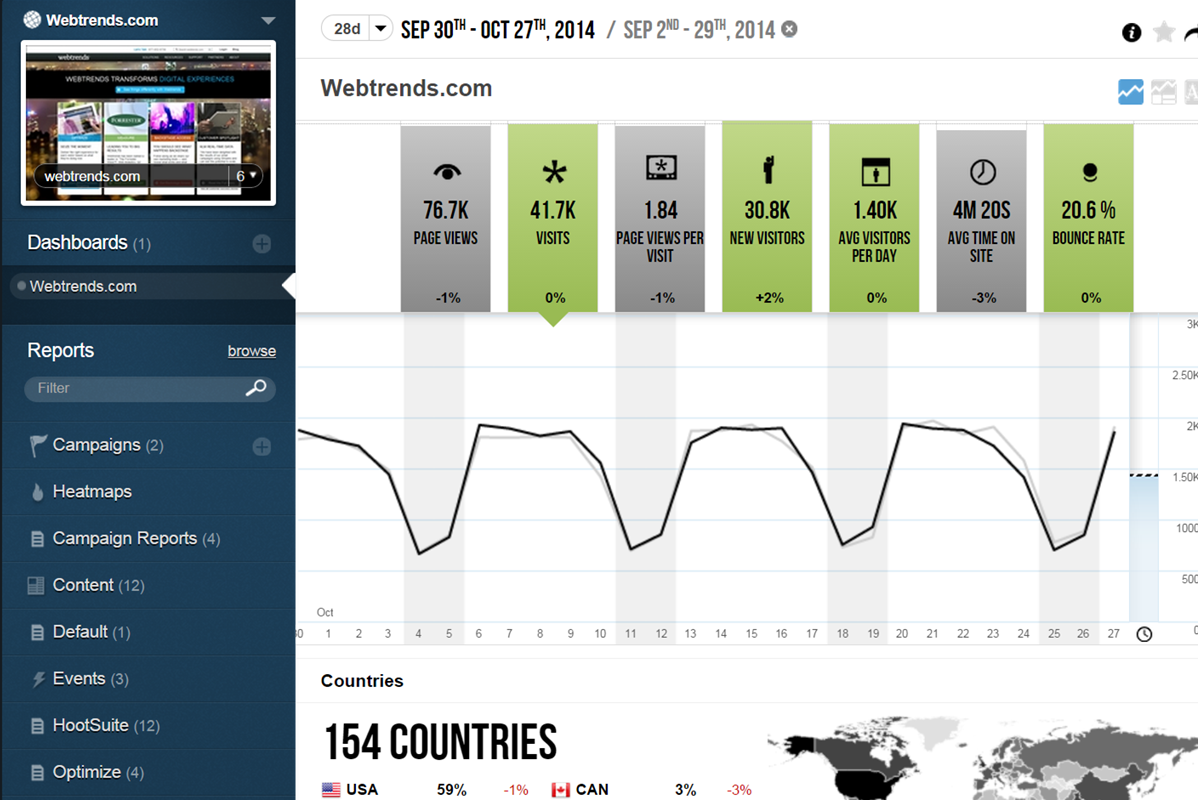
Webtrends Analytics Screenshots

Screenshot of 450+ out-of-box reports
Unlimited custom reports
Roll-up reports across domains
Out-of-box channel and market-specific reportsScreenshot of Unlimited dimensions
No processing time
Dynamic, on-the-fly segmentation
Create, save and share custom views, measures and segmentsScreenshot of Unlimited custom dashboards
Key metrics, trends, demographics, geo maps, word clouds and more
Drill-throughs to connected reports